
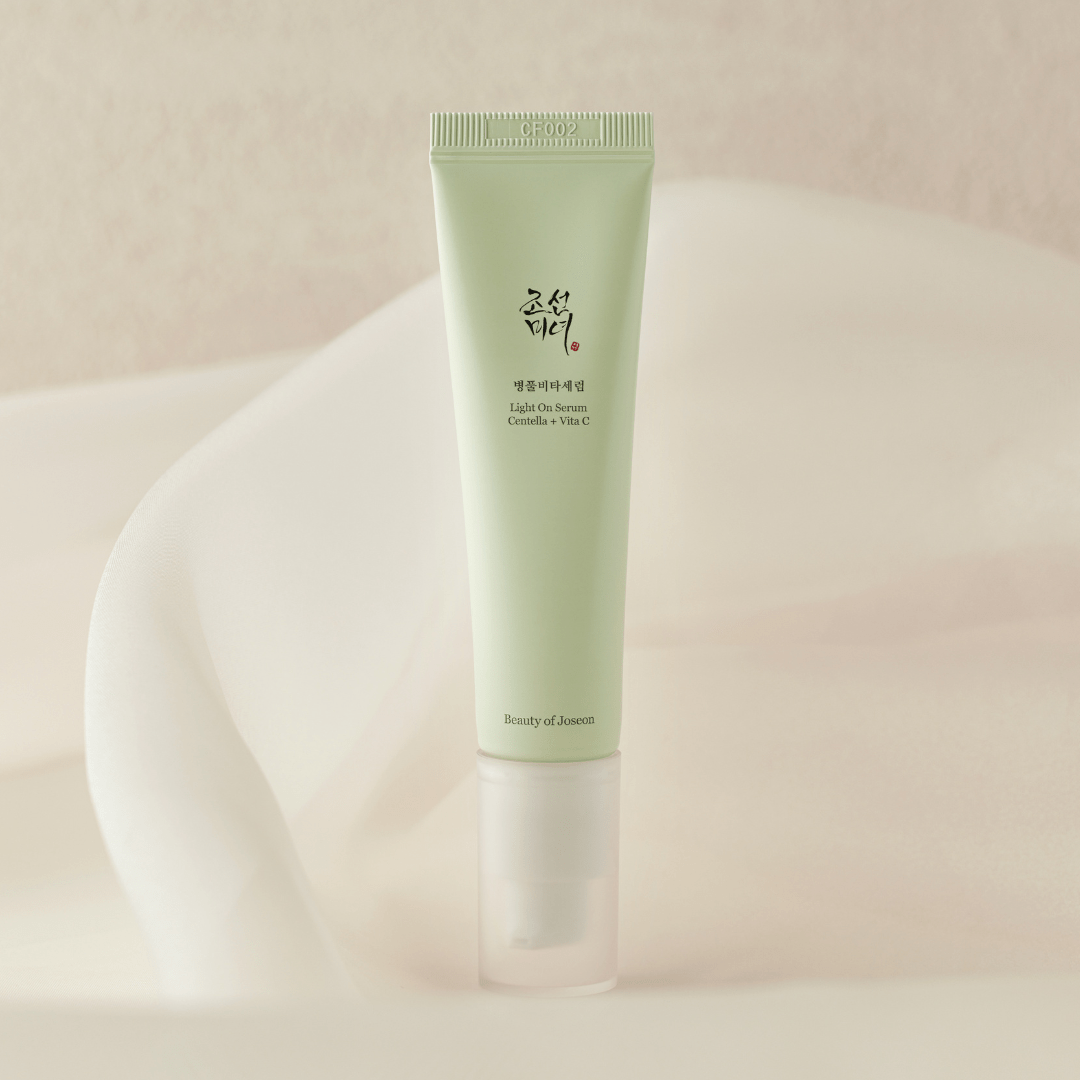

Beauty of Joseon
Light On Serum : Centella + Vita C

Light On Serum : Centella + Vita C
Beauty of Joseon
light-on-serum-centella-vita-c
Serum
9784826790181
Morning or Evening?
How often will you use this product?
Notes


Highlights
WHAT IS IT?
Brightening serum with Centella Asiatica and Vitamin C
FEATURES
Improved stability, reduced irritation, enhanced skin soothing and moisturization
BEST FOR
sensitive
CHECKS
Less sticky, less greasy, non-drying
Who Is It For?
All Ages All GendersWhat Does It Help With?
Brightening Skin Soothing Moisturization Skin Tone ImprovementBudget
Affordable (under $30)How To Use
Which routine should it be used in?
Instructions:
Key Information


What Beauty of Joseon Says
Product Description:
It is a brightening serum that contains Centella Asiatica extract and Vitamin C as main ingredients. Features improved formula addressing common issues with vitamin C products, reduced irritation, and enhanced skin soothing properties.
About the Brand:
Ingredients Overview
Ingredients List
CENTELLA ASIATICA EXTRACT, 3-O-ETHYL ASCORBIC ACID, GLYCERIN, PROPANEDIOL, BETAINE, DICAPRYLYL CARBONATE, METHYL TRIMETHICONE, CETYL ETHYLHEXANOATE, PANTHENOL, LAMINARIA JAPONICA EXTRACT, ECLIPTA PROSTRATA LEAF EXTRACT, PHELLODENDRON AMURENSE BARK EXTRACT, CITRUS UNSHIU PEEL EXTRACT, BRASSICA OLERACEA ACEPHALA LEAF EXTRACT, HYDROLYZED GARDENIA FLORIDA EXTRACT, HYDROGENATED LECITHIN, CETEARYL ALCOHOL, WATER, DIMETHICONE/VINYL DIMETHICONE CROSSPOLYMER, SILICA, BISABOLOL, POTASSIUM CETYL PHOSPHATE, HYDROLYZED JOJOBA ESTERS, CETEARYL OLIVATE, SORBITAN OLIVATE, HYDROXYETHYL ACRYLATE/SODIUM ACRYLOYLDIMETHYL TAURATE COPOLYMER, AMMONIUM ACRYLOYLDIMETHYLTAURATE/BEHENETH-25 METHACRYLATE CROSSPOLYMER, XANTHAN GUM, POLYGLYCERYL-10 MYRISTATE, ADENOSINE, FRUCTOOLIGOSACCHARIDES, BETA-GLUCAN, BUTYLENE GLYCOL, SORBITAN ISOSTEARATE, HYDROLYZED HYALURONIC ACID, MALTODEXTRIN, ARGININE, CARBOMER, ASCORBIC ACID POLYPEPTIDE, 1,2-HEXANEDIOL, HYDROXYACETOPHENONE, ETHYLHEXYLGLYCERIN
Key Ingredients
Centella Asiatica Extract 68%, 3-O-Ethyl Ascorbic Acid 10%
Ingredients Details
3-o Ethyl Ascorbic Acid
Common Name(s): Ethyl ascorbic acid,3-o-ea,vitamin c ether
DESCRIPTION
What It Does: Provides stable vitamin c activity combining formulation stability with good skin delivery.
Why It's Used: Best balance of stability and bioavailability among vitamin c derivatives — 3-o-ea provides stability superior to ascorbic acid with better bioavailability than large ester forms like ascorbyl tetraisopalmitate.
How It Works: C3 ether position protection prevents oxidation at the most vulnerable c2-c3 enediol. more lipophilic than ascorbic acid for improved skin penetration. ether bond resistant to hydrolysis in formulation but cleaved by skin esterases for active ascorbic acid release in viable epidermis.
Typically Found In: Stable brightening serums,anti-aging vitamin c products
TECHNICAL DETAILS
Primary Category: Active ingredient – ethyl ascorbic acid
Secondary Functions: Tyrosinase inhibitor,collagen cofactor
Application Areas:

Facial Skincare

Body Care
Hair Care
Beard Care
Color Cosmetics (Makeup)
Dietary/Oral Supplements
Typical Concentration Range: 1%–3%
SOURCING & ETHICS
Vegan Status: Yes – synthetic
Halal Status: Yes
Source Notes: Synthetically produced vitamin c derivative.
SKIN COMPATIBILITY
Irritancy Rating: 1/5 – very low
Comedogenicity Rating: 0/5 – non-comedogenic
Sensitivity Concerns: Non-irritating; suitable for all skin types.
Safe for Sensitive Skin: Yes
SAFETY & COMPATIBILITY
Safety Profile: Excellent safety profile. ewg score: 1.
Works Well With: Tocopherol,ferulic acid,niacinamide,spf
Avoid Combining With: No significant incompatibilities
SCIENTIFIC NOTE
3-o-ethyl ascorbic acid's ether bond at c3 provides fundamentally different stability vs ester-bonded vitamin c derivatives (ascorbyl palmitate, ascorbyl tetraisopalmitate). ether bonds are far more resistant to chemical hydrolysis than ester bonds — 3-o-ea is more hydrolysis-stable than c6 ester derivatives while still providing bioactive release via ether cleavage in skin.
Last Verified: 2026-03-12
Primary Sources: Cosing database,cir safety assessment
Betaine
Common Name(s): Trimethylglycine,tmg,natural betaine
CAS Number: 107-43-7
DESCRIPTION
What It Does: Provides osmoprotective humectant conditioning with anti-irritant and mild foam-boosting activity.
Why It's Used: Natural-origin multifunctional osmolyte from sugar beet providing hydration, anti-irritancy, and conditioning in virtually every cosmetic category.
How It Works: Quaternary ammonium betaine provides zwitterionic character for water binding via ionic hydration. osmoprotective function at 100–500mm as compatible solute protecting cells from osmotic stress. reduces surfactant irritation by competing with sls for protein binding sites. mild foam enhancement.
Typically Found In: Virtually all categories — moisturisers, shampoos, cleansers
TECHNICAL DETAILS
Primary Category: Functional ingredient – humectant
Secondary Functions: Tewl reduction,skin plumping
Application Areas:
Facial Skincare
Body Care
Hair Care
Beard Care
Color Cosmetics (Makeup)
Dietary/Oral Supplements
Typical Concentration Range: 0.5%–10%
SOURCING & ETHICS
Vegan Status: Conditional - feedstock declaration required
Halal Status: Unverified - feedstock declaration required (plant, animal and petrochemical routes all exist)
Source Notes: Synthetic or naturally derived. excellent aqueous solubility. [audit 2026-07-29 rev2: origin-dependent: the same inci exists in plant, animal and petrochemical versions and the name does not discriminate. determination requires shariah-panel sign-off.]
SKIN COMPATIBILITY
Irritancy Rating: 1/5 – very low
Comedogenicity Rating: 0/5 – non-comedogenic
Sensitivity Concerns: Non-irritating; suitable for all skin types.
Safe for Sensitive Skin: Yes
SAFETY & COMPATIBILITY
Safety Profile: Excellent safety profile. ewg score: 1.
Works Well With: Ceramides,emollients,occlusives,glycerin,hyaluronic acid
Avoid Combining With: No significant incompatibilities
SCIENTIFIC NOTE
Betaine's anti-irritant mechanism for surfactant systems involves competitive protein protection: betaine at high concentrations preferentially interacts with skin proteins, occupying binding sites that would otherwise be occupied by surfactant molecules causing protein denaturation. this competition reduces available protein binding for irritating surfactants, explaining betaine's well-documented ability to reduce sls irritation when co-formulated.
Last Verified: 2026-03-12
Primary Sources: Cosing database,craig betaine osmoprotective review,cir safety assessment
Centella Asiatica Extract
Common Name(s): Centella asiatica extract,botanical extract,phytochemical active
CAS Number: N/a
DESCRIPTION
What It Does: Provides antioxidant protection from reactive oxygen species, reduces inflammatory cytokine production in skin, and conditions skin surface through the plant's secondary metabolite complex.
Why It's Used: Chosen for its natural origin narrative, traditional use heritage, and multi-functional phytochemical profile that supports several concurrent skin care claims from one ingredient.
How It Works: Polyphenols, terpenoids, and alkaloids in the extract scavenge ros via hydrogen atom transfer, inhibit nf-kb or cox-2 inflammatory pathways, and interact with skin surface proteins for conditioning.
Typically Found In: Botanical skin care,natural products
TECHNICAL DETAILS
Primary Category: Active ingredient – antioxidant
Secondary Functions: Free radical scavenging,anti-aging
Application Areas:
Facial Skincare
Body Care
Hair Care
Beard Care
Color Cosmetics (Makeup)
Dietary/Oral Supplements
Typical Concentration Range: 0.1%–10%
SOURCING & ETHICS
Vegan Status: Yes
Halal Status: Yes
Source Notes: Plant-derived extract or synthetic.
SKIN COMPATIBILITY
Irritancy Rating: 1/5 – very low
Comedogenicity Rating: 0/5 – non-comedogenic
Sensitivity Concerns: Non-irritating; well-tolerated.
Safe for Sensitive Skin: Yes
SAFETY & COMPATIBILITY
Safety Profile: Excellent safety profile. ewg score: 1.
Works Well With: Vitamin c,vitamin e,ferulic acid,spf,other antioxidants
Avoid Combining With: No significant incompatibilities
SCIENTIFIC NOTE
Plant secondary metabolites evolved as uv photoprotectants and antimicrobial agents — mechanisms that directly translate to cosmetic antioxidant and anti-inflammatory activity in human skin.
Last Verified: 2026-03-12
Primary Sources: Cosing database,centella asiatica extract botanical review
Cetyl Ethylhexanoate
Common Name(s): Cetyl ethylhexanoate,cetyl ethylhexanoate,cosmetic functional ingredient,established active
CAS Number: N/a
DESCRIPTION
What It Does: Provides the characteristic cosmetic function of its ingredient class through molecular chemistry at recommended use concentration.
Why It's Used: Cetyl ethylhexanoate is selected for the specific functional properties of its molecular class — the chemical architecture of cetyl ethylhexanoate delivers the required cosmetic performance through documented interactions with skin biology and formulation matrix.
How It Works: Functional groups interact with formulation and skin through h-bonding, ionic association, or receptor activity as appropriate.
Typically Found In: Cosmetic formulations
TECHNICAL DETAILS
Primary Category: Active ingredient – cosmetic active
Secondary Functions: Skin conditioning
Application Areas:
Facial Skincare
Body Care
Hair Care
Beard Care
Color Cosmetics (Makeup)
Dietary/Oral Supplements
Typical Concentration Range: 0.1%–10%
SOURCING & ETHICS
Vegan Status: Conditional - supplier confirmation required
Halal Status: Unverified - supplier confirmation required
Source Notes: Commercially produced for cosmetic use. verify vegan/halal status with supplier. [audit 2026-07-29 rev2: the record's own source_notes does not assert a non-animal origin, or instructs the reader to verify with the supplier; "yes" asserts knowledge the record does not hold. determination requires shariah-panel sign-off.]
SKIN COMPATIBILITY
Irritancy Rating: 1/5 – very low
Comedogenicity Rating: 0/5 – non-comedogenic
Sensitivity Concerns: Well-tolerated by most skin types.
Safe for Sensitive Skin: Yes
SAFETY & COMPATIBILITY
Safety Profile: Good safety profile at recommended concentrations. ewg score: 1–2.
Works Well With: Standard skincare actives
Avoid Combining With: No known significant incompatibilities
SCIENTIFIC NOTE
Safety documented in cosing at standard formulation concentrations.
Last Verified: 2026-03-22
Primary Sources: Cosing database,cetyl ethylhexanoate technical review