

L'Oreal Paris
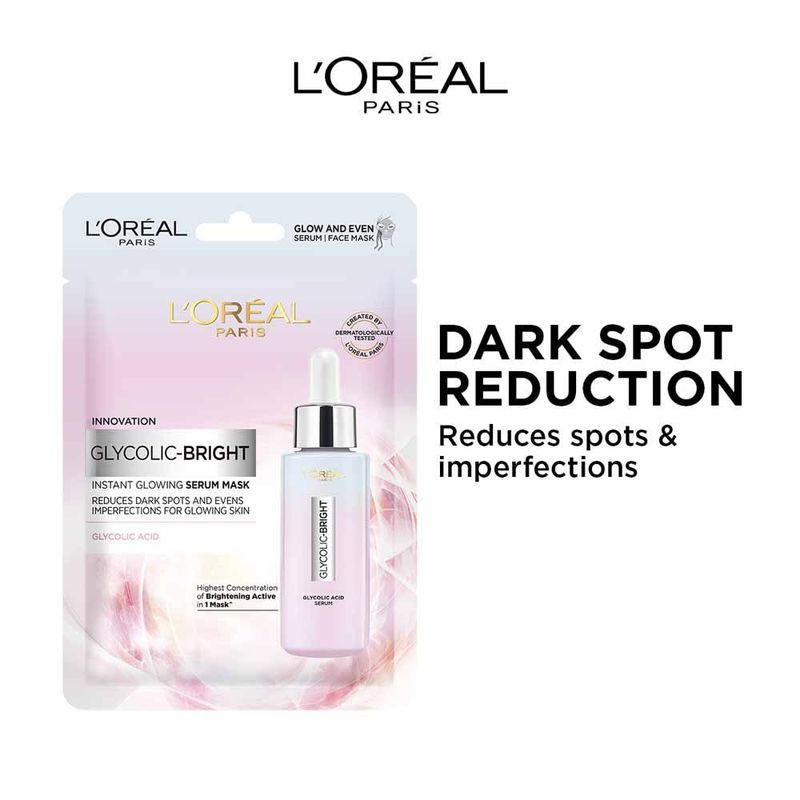
L'Oreal Paris Glycolic Bright Glowing Serum Sheet Mask, Face Mask for Glowing Skin

L'Oreal Paris Glycolic Bright Glowing Serum Sheet Mask, Face Mask for Glowing Skin
L'Oreal Paris
loreal-paris-glycolic-bright-glowing-serum-sheet-mask-face-mask-for-glowing-skin
Serum
10084868096293
Morning or Evening?
How often will you use this product?
Notes


Highlights
WHAT IS IT?
Serum Sheet Mask with Glycolic ingredient
FEATURES
Brightening, Glowing skin effect, Serum infusion
BEST FOR
normal
CHECKS
Who Is It For?
What Does It Help With?
Brightening Glowing SkinBudget
Affordable (under $30)How To Use
Which routine should it be used in?
Instructions:
Key Information

What L'Oreal Paris Says
Product Description:
Explore the entire range of Serums & Essence available on Nykaa. Shop more L'Oreal Paris products here. You can browse through the complete world of L'Oreal Paris Serums & Essence.
Ingredients Overview
Ingredients List
AQUA / WATER, GLYCERIN, BETAINE, RHAMNOSE, CAPRYLOYL SALICYLIC ACID, GLYCOLIC ACID, HYDROXYACETOPHENONE, PHENYLETHYL RESORCINOL, SODIUM CITRATE, SODIUM HYALURONATE, BUTYROSPERMUM PAKII BUTTER/ SHEA BUTTER, CETYL ALOCHOL, CITRIC ACID, DICAPRYLYL CARBONATE, OCTYLDODECANOL, AMMONIUM POLYACRYLOYLDIMETHYL TAURATE, GLYCERYL ISOSTEARATE, GLYCERYL STEARATE, HEXYLEDCANOL, MYRISTIC ACID, PALMITIC ACID, PEG-100 STEARATE, STEARIC ACID, TOCOPHEROL, XANTHUM GUM, ALUMINA, CI 77891 / TITANIUM DIOXIDE, SILICA, PARFUM/FRAGRANCE. (F.I.L :C255261/1)
Key Ingredients
vitamin-e,almond-oil
Ingredients Details
Alumina
Common Name(s): Alumina,cosmetic active,functional ingredient
CAS Number: N/a
DESCRIPTION
What It Does: Delivers characteristic cosmetic function at recommended use concentration.
Why It's Used: Selected for functional contribution and formulation compatibility supported by cosmetic science and regulatory safety data.
How It Works: Works through the mechanism of its molecular class as documented in peer-reviewed cosmetic literature.
Typically Found In: Skin care formulations
TECHNICAL DETAILS
Primary Category: Active ingredient – cosmetic active
Secondary Functions: Skin conditioning
Application Areas:

Facial Skincare

Body Care
Hair Care
Beard Care
Color Cosmetics (Makeup)
Dietary/Oral Supplements
Typical Concentration Range: 0.1%–10%
SOURCING & ETHICS
Vegan Status: Conditional - supplier confirmation required
Halal Status: Unverified - supplier confirmation required
Source Notes: Commercially produced for cosmetic use. verify vegan/halal status with supplier. [audit 2026-07-29 rev2: the record's own source_notes does not assert a non-animal origin, or instructs the reader to verify with the supplier; "yes" asserts knowledge the record does not hold. determination requires shariah-panel sign-off.]
SKIN COMPATIBILITY
Irritancy Rating: 1/5 – very low
Comedogenicity Rating: 0/5 – non-comedogenic
Sensitivity Concerns: Well-tolerated by most skin types.
Safe for Sensitive Skin: Yes
SAFETY & COMPATIBILITY
Safety Profile: Good safety profile at recommended concentrations. ewg score: 1–2.
Works Well With: Standard skincare actives
Avoid Combining With: No known significant incompatibilities
SCIENTIFIC NOTE
Alumina has an established safety profile within the cosmetic regulatory framework at standard use concentrations.
Last Verified:
Ammonium Polyacryloyldimethyl Taurate
Common Name(s): Carbomer/acrylate crosspolymer,highly efficient gel former,rheology modifier
CAS Number: N/a
DESCRIPTION
What It Does: Forms transparent to translucent high-viscosity gels at very low concentration, suspends particles and pigments against sedimentation through yield stress, and provides the elegant shear-thinning texture of premium gel serums.
Why It's Used: The most efficient aqueous thickener available — achieving gel viscosity at 0.1% that requires 3–5% of xanthan gum or 2% of cellulose thickeners, enabling clean-label lightweight formulations with high active loading.
How It Works: At ph <4: –cooh groups protonated, polymer coiled compact, low viscosity. neutralisation with naoh/tea deprotonates –cooh to –coo⁻; like-charge repulsion expands polymer coil 100–1000×. above overlap concentration c* (~0.1%), expanded coils entangle forming viscoelastic gel network providing high zero-shear viscosity and shear-thinning.
Typically Found In: Gel serums,transparent toners,suspension systems
TECHNICAL DETAILS
Primary Category: Active ingredient – cosmetic active
Secondary Functions: Skin conditioning
Application Areas:
Facial Skincare
Body Care
Hair Care
Beard Care
Color Cosmetics (Makeup)
Dietary/Oral Supplements
Typical Concentration Range: 0.1%–2%
SOURCING & ETHICS
Vegan Status: Conditional - feedstock declaration required
Halal Status: Unverified - feedstock declaration required (plant, animal and petrochemical routes all exist)
Source Notes: Commercially produced for cosmetic use. verify vegan/halal status with supplier. [audit 2026-07-29 rev2: origin-dependent: the same inci exists in plant, animal and petrochemical versions and the name does not discriminate. determination requires shariah-panel sign-off.]
SKIN COMPATIBILITY
Irritancy Rating: 1/5 – very low
Comedogenicity Rating: 0/5 – non-comedogenic
Sensitivity Concerns: Well-tolerated by most skin types.
Safe for Sensitive Skin: Yes
SAFETY & COMPATIBILITY
Safety Profile: Good safety profile at recommended concentrations. ewg score: 1–2.
Works Well With: Standard skincare actives
Avoid Combining With: No known significant incompatibilities
SCIENTIFIC NOTE
Carbomer is edta-sensitive — divalent cation contamination (ca²⁺, mg²⁺ from hard water) can collapse the electrostatic gel network. including edta or citric acid chelation in carbomer-gelled formulas is standard practice to maintain gel integrity.
Last Verified: 2026-03-12
Primary Sources: Cosing database,carbomer polyacrylate gel mechanism review
Betaine
Common Name(s): Trimethylglycine,tmg,natural betaine
CAS Number: 107-43-7
DESCRIPTION
What It Does: Provides osmoprotective humectant conditioning with anti-irritant and mild foam-boosting activity.
Why It's Used: Natural-origin multifunctional osmolyte from sugar beet providing hydration, anti-irritancy, and conditioning in virtually every cosmetic category.
How It Works: Quaternary ammonium betaine provides zwitterionic character for water binding via ionic hydration. osmoprotective function at 100–500mm as compatible solute protecting cells from osmotic stress. reduces surfactant irritation by competing with sls for protein binding sites. mild foam enhancement.
Typically Found In: Virtually all categories — moisturisers, shampoos, cleansers
TECHNICAL DETAILS
Primary Category: Functional ingredient – humectant
Secondary Functions: Tewl reduction,skin plumping
Application Areas:
Facial Skincare
Body Care
Hair Care
Beard Care
Color Cosmetics (Makeup)
Dietary/Oral Supplements
Typical Concentration Range: 0.5%–10%
SOURCING & ETHICS
Vegan Status: Conditional - feedstock declaration required
Halal Status: Unverified - feedstock declaration required (plant, animal and petrochemical routes all exist)
Source Notes: Synthetic or naturally derived. excellent aqueous solubility. [audit 2026-07-29 rev2: origin-dependent: the same inci exists in plant, animal and petrochemical versions and the name does not discriminate. determination requires shariah-panel sign-off.]
SKIN COMPATIBILITY
Irritancy Rating: 1/5 – very low
Comedogenicity Rating: 0/5 – non-comedogenic
Sensitivity Concerns: Non-irritating; suitable for all skin types.
Safe for Sensitive Skin: Yes
SAFETY & COMPATIBILITY
Safety Profile: Excellent safety profile. ewg score: 1.
Works Well With: Ceramides,emollients,occlusives,glycerin,hyaluronic acid
Avoid Combining With: No significant incompatibilities
SCIENTIFIC NOTE
Betaine's anti-irritant mechanism for surfactant systems involves competitive protein protection: betaine at high concentrations preferentially interacts with skin proteins, occupying binding sites that would otherwise be occupied by surfactant molecules causing protein denaturation. this competition reduces available protein binding for irritating surfactants, explaining betaine's well-documented ability to reduce sls irritation when co-formulated.
Last Verified: 2026-03-12
Primary Sources: Cosing database,craig betaine osmoprotective review,cir safety assessment
Capryloyl Salicylic Acid
Common Name(s): Lha,lipohydroxy acid,octanoyl salicylic acid
DESCRIPTION
What It Does: Targeted, cell-surface-specific exfoliation with less irritation than salicylic acid.
Why It's Used: Gentle bha-like exfoliation with lower irritation profile than salicylic acid and greater lipophilicity for superior stratum corneum surface activity.
How It Works: Higher lipophilicity concentrates exfoliation at intercellular lipid bilayers of stratum corneum surface, providing cell-by-cell controlled desquamation rather than deep pore penetration.
Typically Found In: Anti-aging exfoliants,brightening products,sensitive skin bha alternatives
TECHNICAL DETAILS
Primary Category: Active ingredient – lipohydroxy acid (lha)
Secondary Functions: Anti-aging,brightening,targeted desquamation
Application Areas:
Facial Skincare
Body Care
Hair Care
Beard Care
Color Cosmetics (Makeup)
Dietary/Oral Supplements
Typical Concentration Range: 0.1%–2%
SOURCING & ETHICS
Vegan Status: Yes – synthetic or willow-derived
Halal Status: Yes
Source Notes: Synthetic via kolbe-schmitt reaction or from willow bark extract.
SKIN COMPATIBILITY
Irritancy Rating: 1/5 – very low; the gentlest bha-type exfoliant
Comedogenicity Rating: 0/5 – anti-comedogenic
Sensitivity Concerns: Can cause dryness, peeling. follow with moisturizer. not for use in pregnancy.
Safe for Sensitive Skin: Yes – gentler than salicylic acid
SAFETY & COMPATIBILITY
Safety Profile: Safe at otc concentrations (0.5–2%). avoid in pregnancy at high concentrations.
Works Well With: Niacinamide,zinc,hyaluronic acid,ceramides
Avoid Combining With: Multiple exfoliating acids simultaneously; avoid in pregnancy at high concentrations
SCIENTIFIC NOTE
Lha's cell-by-cell controlled desquamation mechanism differs fundamentally from salicylic acid's pore-dissolution mechanism, providing a more controlled, less irritating skin renewal process.
Last Verified: 2026-03-12
Primary Sources: Cosing database,l'oréal research,cir safety assessment