

L'Oreal Paris
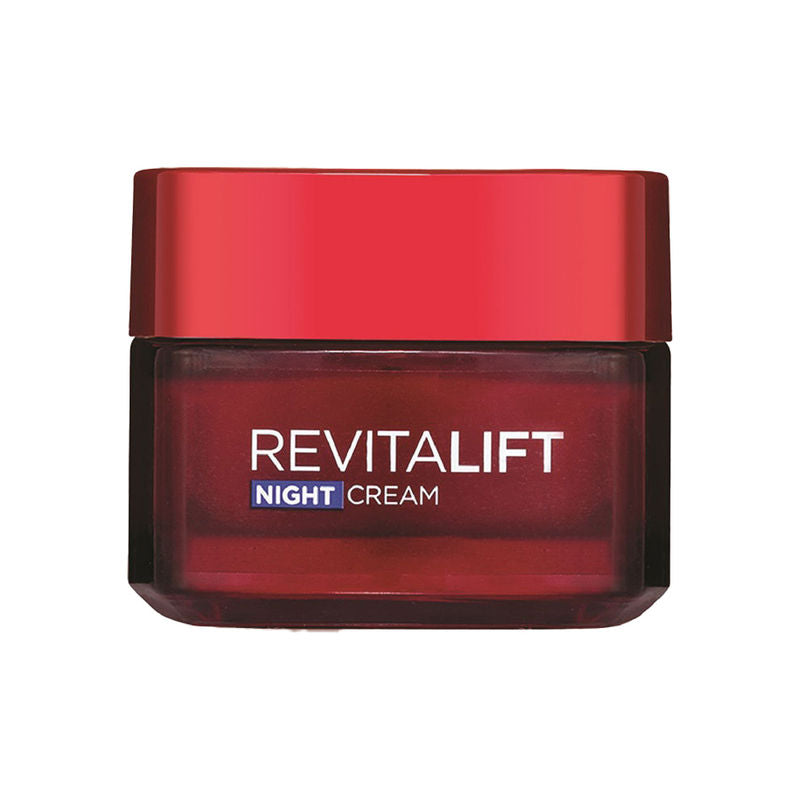
L'Oreal Paris Revitalift Anti-Wrinkle And Firming Night Cream

L'Oreal Paris Revitalift Anti-Wrinkle And Firming Night Cream
L'Oreal Paris
loreal-paris-revitalift-anti-wrinkle-and-firming-night-cream
Moisturize
10084768514341
Morning or Evening?
How often will you use this product?
Notes


Highlights
WHAT IS IT?
Night Cream; anti-ageing elements
FEATURES
Reduces fine lines & wrinkles, boosts skin firmness, youthfulness, radiance, enhances skin regeneration overnight
BEST FOR
CHECKS
Who Is It For?
What Does It Help With?
Anti-wrinkle Action Skin Firmness Skin RegenerationBudget
Affordable (under $30)How To Use
Which routine should it be used in?
Instructions:
Key Information

What L'Oreal Paris Says
Product Description:
Enriched with anti-ageing elements that reduce fine lines & wrinkles, boost skin firmness, youthfulness, radiance and enhance the skin regeneration process overnight.
Ingredients Overview
Ingredients List
AQUA / WATER, GLYCERIN, DIMETHICONE, HYDROGENATED POLYISOBUTENE, CETYL ALCOHOL, GLYCERYL STEARATE, ALUMINUM STARCH OCTENYLSUCCINATE, PEG-40 STEARATE, PRUNUS ARMENIACA KERNEL OIL / APRICOT KERNEL OIL, SHOREA ROBUSTA BUTTER / SHOREA ROBUSTA SEED BUTTER, PARAFFINUM LIQUIDUM / MINERAL OIL, PARAFFIN, ACETYL TRIFLUOROMETHYLPHENYL VALYLGLYCINE, ACRYLAMIDE/SODIUM ACRYLOYLDIMETHYLTAURATE COPOLYMER, ADENOSINE, ALPHA-ISOMETHYL IONONE, BENZYL ALCOHOL, BENZYL SALICYLATE, BUTYLPHENYL METHYLPROPIONAL, CAPRYLYL GLYCOL, CENTELLA ASIATICA EXTRACT, CERA MICROCRISTALLINA / MICROCRYSTALLINE WAX, CITRAL, CITRONELLOL, COUMARIN, FAEX EXTRACT / YEAST EXTRACT, GERANIOL, GLYCINE SOJA PROTEIN / SOYBEAN PROTEIN, HYDROLYZED SOY PROTEIN, HYDROXYISOHEXYL 3 CYCLOHEXENE CARBOXALDEHYDE, ISOHEXADECANE, LIMONENE, LINALOOL, MYRISTYL ALCOHOL, PALMITIC ACID, PARFUM / FRAGRANCE, PHENOXYETHANOL, PHENYL ETHYL ALCOHOL, POLYSORBATE 80, POTASSIUM SORBATE, RETINYL PALMITATE, SODIUM BENZOATE, SORBITAN TRISTEARATE, STEARIC ACID, STEARYL ALCOHOL, TRIETHANOLAMINE, ZEA MAYS EXTRACT / CORN KERNEL EXTRACT. (F.I.L. B159946/3)
Key Ingredients
Centella Asiatica, Pro-Retinol A, Dermalift Technology
Ingredients Details
Acetyl Trifluoromethylphenyl Valylglycine
Common Name(s): Acetyl trifluoromethylphenyl valylglycine,acetyl trifluoromethylphenyl valylglycine,lipid-conjugated or aromatic-modified peptide,advanced anti-aging signal peptide
CAS Number: N/a
DESCRIPTION
What It Does: Delivers signal peptide bioactivity to deeper sc layers through the lipid anchor's sc lipid-phase integration — providing receptor-mediated collagen synthesis stimulation at dermal targets accessible only to lipophilic peptide conjugates.
Why It's Used: Lipid conjugation is the essential enabling technology for peptide skin care — without sc penetration enhancement, most signal peptides remain on the surface and cannot reach their fibroblast receptor targets in the dermis.
How It Works: The fatty acid or aromatic anchor (logp contribution ~+3 per c16 chain) partitions the peptide into sc lipid bilayers. lateral diffusion through the sc lipid matrix carries the peptide toward the dermis where tissue enzymes cleave the lipid, releasing the active peptide sequence for receptor binding. spps synthesis provides >98% purity for reliable receptor pharmacology.
Typically Found In: Premium anti-aging serums,collagen products
TECHNICAL DETAILS
Primary Category: Active ingredient – peptide
Secondary Functions: Collagen synthesis,anti-aging
Application Areas:

Facial Skincare

Body Care
Hair Care
Beard Care
Color Cosmetics (Makeup)
Dietary/Oral Supplements
Typical Concentration Range: 1–5000 ppm
SOURCING & ETHICS
Vegan Status: Yes
Halal Status: Yes
Source Notes: Synthetically produced via solid-phase peptide synthesis (spps).
SKIN COMPATIBILITY
Irritancy Rating: 1/5 – very low
Comedogenicity Rating: 0/5 – non-comedogenic
Sensitivity Concerns: Non-irritating at recommended concentrations.
Safe for Sensitive Skin: Yes
SAFETY & COMPATIBILITY
Safety Profile: Excellent safety profile. ewg score: 1.
Works Well With: Retinoids,niacinamide,vitamin c,hyaluronic acid
Avoid Combining With: Strong acids below ph 3.5; oxidising agents
SCIENTIFIC NOTE
Lipid anchor selection impacts delivery profile: longer chain (c18) → higher logp, slower sc transit, deeper penetration; shorter chain (c12) → faster release, shallower delivery. formulator selects based on target receptor tissue depth.
Last Verified: Cosing database,acetyl trifluoromethylphenyl valylg lipid-conjugated peptide anti-aging review
Primary Sources: 2026-03-22
Acrylamide/sodium Acryloyldimethyltaurate Copolymer
Common Name(s): Acrylamide/sodium acryloyldimethyltaurate copolymer
DESCRIPTION
What It Does: Provides antioxidant protection, soothing anti-inflammatory effects, and skin-conditioning benefits through plant-derived polyphenols and phytochemicals.
Why It's Used: Plant extracts concentrate bioactive phytochemicals evolved for environmental protection — uv, microbial, and oxidative stressors — that translate to skin benefits.
How It Works: Polyphenols (flavonoids, phenolic acids) inhibit nf-κb-mediated inflammatory signaling, scavenge reactive oxygen species through electron donation, and chelate pro-oxidant metal ions to reduce oxidative skin damage.
Typically Found In: Lotions,creams,serums,masks
TECHNICAL DETAILS
Primary Category: Minerals
Secondary Functions: Skin-conditioning
Application Areas:
Facial Skincare
Body Care
Hair Care
Beard Care
Color Cosmetics (Makeup)
Dietary/Oral Supplements
Typical Concentration Range: 0.1–10%
SOURCING & ETHICS
Vegan Status: Yes
Halal Status: Yes
Source Notes: Mineral-derived ingredient; no biological origin.
SKIN COMPATIBILITY
Irritancy Rating: 1
Comedogenicity Rating: 0
Sensitivity Concerns: Low sensitization potential at recommended use concentrations.
Safe for Sensitive Skin: Yes
SAFETY & COMPATIBILITY
Safety Profile: Well-characterized cosmetic ingredient with established safety profile. generally non-irritating at typical use concentrations. suitable for leave-on and rinse-off cosmetics.
Works Well With: Plant extracts,peptides,vitamins
Avoid Combining With: Strong chelating agents (reduce mineral availability)
SCIENTIFIC NOTE
Plant secondary metabolites (flavonoids, terpenes, phenolic acids) are biosynthesized as defense compounds against uv, herbivores, and pathogens. their anti-inflammatory activity typically derives from competitive inhibition of cox-2 and 5-lox enzymes (ic50 1–50 µm), while antioxidant activity involves single electron transfer (set) and hydrogen atom transfer (hat) mechanisms with structure-dependent rate constants.
Last Verified: Cosing eu database; pcpc cosmetic ingredient safety reviews; ingredient-specific safety and efficacy literature
Primary Sources: 2025-01-15
Adenosine
Common Name(s): Adenine riboside,9-beta-d-ribofuranosyladenine
CAS Number: 58-61-7
DESCRIPTION
What It Does: Reduces fine lines, stimulates collagen, firms skin, and reduces inflammation.
Why It's Used: Fda-recognized anti-wrinkle active with multi-action collagen stimulation + wrinkle reduction + anti-inflammatory efficacy.
How It Works: Activates adenosine a2a receptors on fibroblasts stimulating collagen type i. also activates pka pathway promoting atp production and reducing inflammatory cytokines.
Typically Found In: Anti-aging serums,wrinkle treatments,korean skincare
TECHNICAL DETAILS
Primary Category: Active ingredient – purine nucleoside / anti-aging
Secondary Functions: Collagen stimulation,anti-inflammatory,cell energy
Application Areas:
Facial Skincare
Body Care
Hair Care
Beard Care
Color Cosmetics (Makeup)
Dietary/Oral Supplements
Typical Concentration Range: 0.04%–0.1%
SOURCING & ETHICS
Vegan Status: Yes – synthetically produced
Halal Status: Yes
Source Notes: Synthetically produced for cosmetic use.
SKIN COMPATIBILITY
Irritancy Rating: 1/5 – very low
Comedogenicity Rating: 0/5 – non-comedogenic
Sensitivity Concerns: Non-irritating; excellent tolerability.
Safe for Sensitive Skin: Yes
SAFETY & COMPATIBILITY
Safety Profile: Excellent safety profile. fda-recognized as safe and effective anti-wrinkle ingredient. ewg score: 1.
Works Well With: Other b vitamins,niacinamide,antioxidant complexes
Avoid Combining With: No significant incompatibilities
SCIENTIFIC NOTE
A 2002 clinical study demonstrated 0.04% adenosine cream significantly reduced wrinkle depth and increased skin elasticity after 4 weeks. fda recognition requires controlled clinical trial evidence.
Last Verified: Cosing database,adenosine anti-aging clinical data,fda otc anti-wrinkle monograph
Primary Sources: 2026-03-12
Alpha-isomethyl Ionone
Common Name(s): Alpha-isomethyl ionone
DESCRIPTION
What It Does: Delivers targeted skin-conditioning or bioactive benefits through a specific mechanism of action suited to the formulation's intended purpose.
Why It's Used: Specialty actives address specific skin concerns through targeted molecular mechanisms, providing efficacy beyond what base formulation ingredients alone can achieve.
How It Works: The bioactive compound interacts with specific molecular targets in skin cells or the extracellular matrix — enzymes, receptors, structural proteins, or signaling molecules — triggering beneficial biological responses.
Typically Found In: Serums,treatments,moisturizers,specialty products
TECHNICAL DETAILS
Primary Category: Specialty actives
Secondary Functions: Skin-conditioning,anti-aging
Application Areas:
Facial Skincare
Body Care
Hair Care
Beard Care
Color Cosmetics (Makeup)
Dietary/Oral Supplements
Typical Concentration Range: 0.01–5%
SOURCING & ETHICS
Vegan Status: Yes
Halal Status: Yes
Source Notes: Specialty active ingredient; check individual sourcing for vegan status.
SKIN COMPATIBILITY
Irritancy Rating: 1
Comedogenicity Rating: 0
Sensitivity Concerns: Low sensitization potential at recommended use concentrations.
Safe for Sensitive Skin: Yes
SAFETY & COMPATIBILITY
Safety Profile: Well-characterized cosmetic ingredient with established safety profile. generally non-irritating at typical use concentrations. suitable for leave-on and rinse-off cosmetics.
Works Well With: Niacinamide,hyaluronic acid,vitamin c,peptides
Avoid Combining With: Incompatible with oxidizing agents; check ph stability
SCIENTIFIC NOTE
Specialty actives typically work through enzyme inhibition (e.g., tyrosinase inhibition for brightening, mmp inhibition for anti-aging), receptor activation (e.g., retinoid receptors, ppar-γ for barrier genes), or transcription factor modulation (e.g., nrf2 for antioxidant gene upregulation). structure-activity relationships determine potency and selectivity.
Last Verified: Cosing eu database; pcpc cosmetic ingredient safety reviews; ingredient-specific safety and efficacy literature
Primary Sources: 2025-01-15
