

Guardian Malaysia
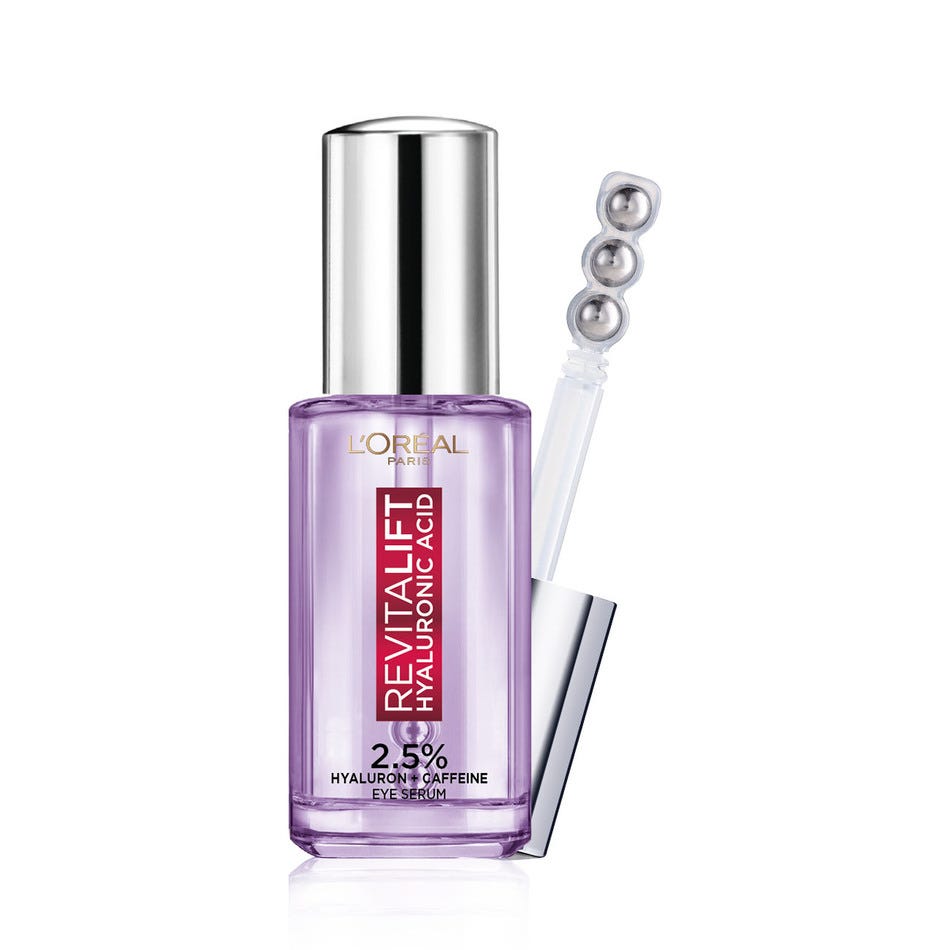
L'Oreal Revitalift Hyaluronic Eye Serum 20ml

L'Oreal Revitalift Hyaluronic Eye Serum 20ml
Guardian Malaysia
loreal-revitalift-hyaluronic-eye-serum-20ml
Eyecare
10084952670501
Morning or Evening?
How often will you use this product?
Notes


Highlights
WHAT IS IT?
Eye serum with hyaluronic acid
FEATURES
Triple action eye serum with pure hyaluronic acid for hydration and anti-aging benefits
BEST FOR
combination
CHECKS
Who Is It For?
Adult Women And MenWhat Does It Help With?
Fine Lines Wrinkles Eye Area HydrationBudget
Affordable (under $30)How To Use
Which routine should it be used in?
Instructions:
Key Information


What Guardian Malaysia Says
Product Description:
Concentrated eye serum with pure hyaluronic acid to reduce signs of aging around the eye area. Helps hydrate and plump skin while reducing fine lines and wrinkles.
About the Brand:
Ingredients Overview
Ingredients List
AQUA / WATER / EAU ,GLYCERIN ,HYDROXYETHYLPIPERAZINE ETHANE SULFONIC ACID ,NIACINAMIDE ,SODIUM HYALURONATE ,CAFFEINE ,CITRIC ACID ,HYDROXYACETOPHENONE ,TRISODIUM ETHYLENEDIAMINE DISUCCINATE ,ASCORBYL GLUCOSIDE ,CAPRYLYL GLYCOL ,CHLORPHENESIN
Key Ingredients
hyaluronic acid
Ingredients Details
Ascorbyl Glucoside
Common Name(s): Aa2g,2-o-alpha-d-glucopyranosyl-l-ascorbic acid
CAS Number: 129499-78-1
DESCRIPTION
What It Does: Provides stable gradual-release vitamin c activity for brightening and antioxidant protection.
Why It's Used: Most formulation-stable vitamin c derivative — ascorbyl glucoside remains stable in aqueous formulations where pure ascorbic acid oxidises within days, providing sustained vitamin c delivery over weeks of shelf life.
How It Works: Alpha-glucoside bond resists oxidation until cleaved by skin alpha-glucosidase enzymes. releases free l-ascorbic acid in viable epidermis. released ascorbic acid inhibits tyrosinase, stimulates collagen synthesis, and provides antioxidant activity. glucose group provides enhanced water solubility vs ascorbic acid.
Typically Found In: Stable vitamin c serums,brightening products,anti-aging
TECHNICAL DETAILS
Primary Category: Active ingredient – stable vitamin c glucoside
Secondary Functions: Tyrosinase inhibitor,collagen cofactor
Application Areas:

Facial Skincare

Body Care
Hair Care
Beard Care
Color Cosmetics (Makeup)
Dietary/Oral Supplements
Typical Concentration Range: 1%–5%
SOURCING & ETHICS
Vegan Status: Yes – enzymatic synthesis from ascorbic acid and glucose
Halal Status: Yes
Source Notes: Synthetically produced vitamin c derivative.
SKIN COMPATIBILITY
Irritancy Rating: 1/5 – very low
Comedogenicity Rating: 0/5 – non-comedogenic
Sensitivity Concerns: Non-irritating; suitable for all skin types.
Safe for Sensitive Skin: Yes
SAFETY & COMPATIBILITY
Safety Profile: Excellent safety profile. ewg score: 1.
Works Well With: Tocopherol,ferulic acid,niacinamide,spf
Avoid Combining With: No significant incompatibilities
SCIENTIFIC NOTE
Ascorbyl glucoside's stability advantage (18+ months in aqueous formulation vs days for ascorbic acid) arises from the glucose group's steric protection of ascorbic acid's c2 enediol that is the primary oxidation site. glucosidase cleavage in skin removes this protection in situ, releasing active ascorbic acid only where enzymatic activity exists — providing both formulation stability and bioactivation where needed.
Last Verified: Cosing database,yamamoto et al. ascorbyl glucoside stability study
Primary Sources: 2026-03-12
Caffeine
Common Name(s): Caffeine,methylxanthine anti-cellulite,antioxidant vasoactive
CAS Number: N/a
DESCRIPTION
What It Does: Stimulates lipolysis in adipocytes by inhibiting phosphodiesterase (preventing camp breakdown), reduces eye puffiness through vasoconstriction of periorbital capillaries, and provides antioxidant dna repair stimulation for photoprotective benefit.
Why It's Used: The only cosmetic active with a well-defined mechanism for anti-cellulite claims — phosphodiesterase inhibition elevating adipocyte camp is the documented biochemical pathway, providing mechanism-based efficacy substantiation superior to most slimming actives.
How It Works: Caffeine inhibits phosphodiesterase (pde3, pde4) preventing camp hydrolysis → elevated camp activates protein kinase a → phosphorylates hormone-sensitive lipase → lipolysis of triglycerides in adipocytes. for eye puffiness: caffeine's adenosine receptor antagonism reduces prostaglandin-mediated capillary dilation in periorbital tissue, reducing fluid accumulation.
Typically Found In: Anti-cellulite,eye creams,antioxidant products
TECHNICAL DETAILS
Primary Category: Active ingredient – antioxidant
Secondary Functions: Free radical scavenging,anti-aging
Application Areas:
Facial Skincare
Body Care
Hair Care
Beard Care
Color Cosmetics (Makeup)
Dietary/Oral Supplements
Typical Concentration Range: 0.1%–3%
SOURCING & ETHICS
Vegan Status: Yes
Halal Status: Yes
Source Notes: Plant-derived extract or synthetic.
SKIN COMPATIBILITY
Irritancy Rating: 1/5 – very low
Comedogenicity Rating: 0/5 – non-comedogenic
Sensitivity Concerns: Non-irritating; well-tolerated.
Safe for Sensitive Skin: Yes
SAFETY & COMPATIBILITY
Safety Profile: Excellent safety profile. ewg score: 1.
Works Well With: Vitamin c,vitamin e,ferulic acid,spf,other antioxidants
Avoid Combining With: No significant incompatibilities
SCIENTIFIC NOTE
Caffeine has one of the highest sc penetration rates of any cosmetic active (logp -0.07, mw 194 da) — the combination of small size and moderate logp providing excellent aqueous solubility with sufficient sc lipid partitioning for effective transdermal delivery to adipose tissue.
Last Verified: Cosing database,caffeine pde inhibitor anti-cellulite lipolysis review
Primary Sources: 2026-03-12
Caprylyl Glycol
Common Name(s): 1,2-octanediol,octanediol,sensiva sc 50
CAS Number: 1117-86-8
DESCRIPTION
What It Does: Provides the most potent antimicrobial diol activity alongside skin feel enhancement.
Why It's Used: Premium antimicrobial diol — caprylyl glycol's c8 chain provides the strongest membrane-disrupting antimicrobial activity of common diol preservative boosters with unique skin-feel enhancement.
How It Works: C8 1,2-diol: c8 chain length provides strongest bacterial and fungal membrane disruption of common diols. emollient skin feel improvement from c8 chain length interaction with skin surface. active at lower concentrations than shorter-chain diols. synergistic with ethylhexylglycerin.
Typically Found In: Natural preservation systems,skin feel enhancement
TECHNICAL DETAILS
Primary Category: Functional ingredient – antimicrobial humectant
Secondary Functions: Skin conditioning
Application Areas:
Facial Skincare
Body Care
Hair Care
Beard Care
Color Cosmetics (Makeup)
Dietary/Oral Supplements
Typical Concentration Range: 0.1%–1%
SOURCING & ETHICS
Vegan Status: Yes – synthetic
Halal Status: Yes
Source Notes: Commercially produced for cosmetic use. verify vegan/halal status with supplier.
SKIN COMPATIBILITY
Irritancy Rating: 1/5 – very low
Comedogenicity Rating: 0/5 – non-comedogenic
Sensitivity Concerns: Well-tolerated by most skin types.
Safe for Sensitive Skin: Yes
SAFETY & COMPATIBILITY
Safety Profile: Good safety profile at recommended concentrations. ewg score: 1–2.
Works Well With: Standard skincare actives
Avoid Combining With: No known significant incompatibilities
SCIENTIFIC NOTE
Caprylyl glycol's antimicrobial potency follows the chain-length dependent membrane activity of fatty acids: c8 is the optimal chain length for membrane disruption (same as caprylic acid's antimicrobial optimum), providing maximum membrane integration without the skin sensitisation associated with longer chain lengths. this chain-length pharmacophore relationship is why c8 > c6 > c5 in diol antimicrobial potency despite identical head group chemistry.
Last Verified: Cosing database,schülke sensiva sc 50 technical data,cir safety assessment
Primary Sources: 2026-03-12
Chlorphenesin
Common Name(s): 3-(4-chlorophenoxy)-1,2-propanediol,globacid
CAS Number: 104-29-0
DESCRIPTION
What It Does: Provides gram-negative focused preservation complementary to phenoxyethanol for comprehensive spectrum coverage.
Why It's Used: Phenoxyethanol complement — chlorphenesin's gram-negative and antifungal coverage complements phenoxyethanol's gram-positive activity for full-spectrum preservation at lower individual concentrations.
How It Works: 4-chlorophenol ether glycol disrupts bacterial and fungal membranes. strong gram-negative activity (pseudomonas, e. coli). good candida antifungal activity. used with phenoxyethanol for synergistic broad-spectrum coverage. ph stable 3-9.
Typically Found In: Comprehensive preservation systems,baby products (low concentration)
TECHNICAL DETAILS
Primary Category: Functional ingredient – glycerol ether preservative
Secondary Functions: Skin conditioning
Application Areas:
Facial Skincare
Body Care
Hair Care
Beard Care
Color Cosmetics (Makeup)
Dietary/Oral Supplements
Typical Concentration Range: 0.1%–0.3%
SOURCING & ETHICS
Vegan Status: Yes – synthetic
Halal Status: Yes
Source Notes: Commercially produced for cosmetic use. verify vegan/halal status with supplier.
SKIN COMPATIBILITY
Irritancy Rating: 1/5 – very low
Comedogenicity Rating: 0/5 – non-comedogenic
Sensitivity Concerns: Well-tolerated by most skin types.
Safe for Sensitive Skin: Yes
SAFETY & COMPATIBILITY
Safety Profile: Eu max 0.3% cosmetics. good safety profile. synergistic combination with phenoxyethanol (0.3% pe + 0.1% chlorphenesin often equivalent to 1% pe alone).
Works Well With: Standard skincare actives
Avoid Combining With: No known significant incompatibilities
SCIENTIFIC NOTE
Chlorphenesin + phenoxyethanol synergy operates through a classic spectrum-filling combination: phenoxyethanol provides strong gram-positive antimicrobial activity while chlorphenesin provides gram-negative and antifungal coverage. the combination's minimum inhibitory concentration sum is subadditive (provides equivalent preservation at combined concentrations below what either alone would require) — textbook pharmacological synergy enabling lower total preservative load.
Last Verified: Cosing database,eu preservative annex v,cir safety assessment
Primary Sources: 2026-03-12
