

Lotus Herbals
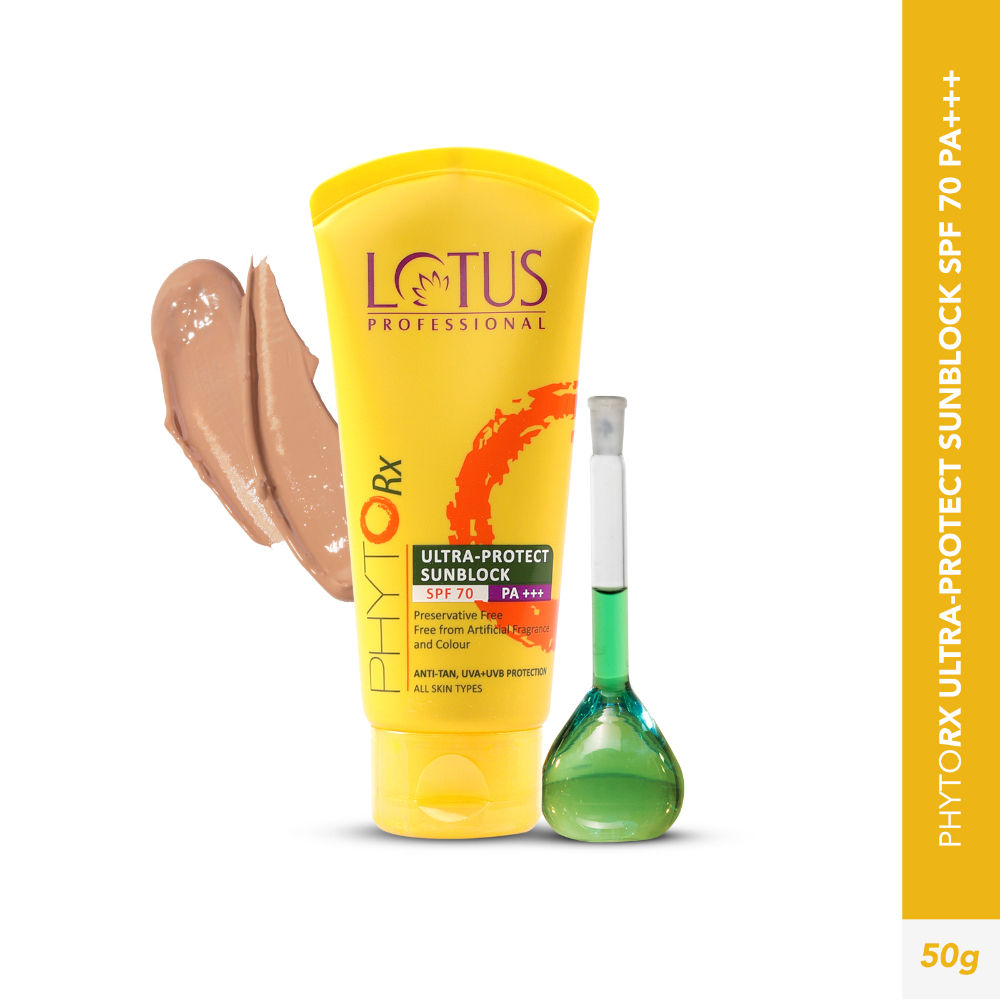
Lotus Professional Phyto-Rx Ultra-Protect Sunblock SPF 70 Pa+++

Lotus Professional Phyto-Rx Ultra-Protect Sunblock SPF 70 Pa+++
Lotus Herbals
lotus-professional-phyto-rx-ultra-protect-sunblock-spf-70-pa
Suncare
10084946051365
Morning or Evening?
How often will you use this product?
Notes


Highlights
WHAT IS IT?
Sunblock, ingredient count not specified
FEATURES
High concentration of intense sun filters, enriched with Thyme and Sage extracts, broad spectrum protection against UVA and UVB, absorbs easily, fights skin darkening, protects against harmful UV rays, suitable for all skin types
BEST FOR
sensitive
CHECKS
Who Is It For?
What Does It Help With?
Skin Cancer Prevention Premature Ageing Tanning Skin DarkeningBudget
Mid-range ($30-$75)How To Use
Which routine should it be used in?
Instructions:
Key Information


What Lotus Herbals Says
Product Description:
Lotus Professional Phyto-Rx Ultra-Protect Sunblock SPF 70 PA+++ is a unique potent formulation packed with a high concentration of intense sun filters. Enriched with Thyme and Sage extracts it provides broad spectrum protection against the sun's harmful UVA and UVB rays which can cause skin cancer, premature ageing and tanning. Contains the goodness of Thyme and Sage extracts. Absorbs into the skin easily and fights against skin darkening. Protects against harmful effects of UV rays. Suitable for all skin types.
About the Brand:
Ingredients Overview
Ingredients List
Dm Water, Light Liquid Paraffin, Ethylhexyl Methoxycinnamate, Butyl Methoxydibenzoylmethane, Benzophenone-3, Phospholipids, Butylene Glycol, Titanium Dioxide, Glycerin, Isopropyl Myristate, Arachidyl Alcohol, Behenyl Alcohol, Arachidyl Glucoside, C20-22 Alkyl Phosphate, C20-22 Alcohols, Octyl Hydroxystearate, Polyacrylate, Polyisobutene, Polysorbate 20, Thymus Vulgaris (Thyme) Extract, Salvia Officinalis (Sage) Extract, Cyclopentasiloxane, Vp/Eicosene Copolymer, Triethanolamine, Caprylhydroxamic Acid, Caprylyl Glycol, Glycerin, Essential Oil Blend
Key Ingredients
Thyme extract, Sage extract
Ingredients Details
Arachidyl Alcohol
Common Name(s): Fatty alcohol,co-emulsifier thickener,emollient emulsion stabiliser
CAS Number: N/a
DESCRIPTION
What It Does: Thickens o/w emulsions by forming a lamellar crystal gel network with nonionic emulsifiers, provides co-emulsifier activity at the oil-water interface, and conditions skin from the c16-c18 chain's sc lipid compatibility.
Why It's Used: Fatty alcohols are irreplaceable in conventional o/w cream formulation — the lamellar gel network they form with peg emulsifiers provides the thick, stable cream texture that consumers expect, while delivering emolliency unavailable from wax-only structuring.
How It Works: Cetyl/stearyl alcohol packs into α-gel or β-gel crystal phases with peg surfactants (ceteareth-20, polysorbates) at 60–80°c, forming an ordered lamellar bilayer network on cooling. this network provides zero-shear viscosity (cream texture) and mechanical emulsion stability simultaneously — the fundamental mechanism of classical o/w cream formulation.
Typically Found In: Creams,lotions,o/w emulsions
TECHNICAL DETAILS
Primary Category: Functional ingredient – emollient
Secondary Functions: Barrier sealing,softening
Application Areas:

Facial Skincare
Body Care
Hair Care

Beard Care
Color Cosmetics (Makeup)
Dietary/Oral Supplements
Typical Concentration Range: 1%–15%
SOURCING & ETHICS
Vegan Status: Yes
Halal Status: Yes
Source Notes: Plant-derived, synthetic or animal-derived. verify source.
SKIN COMPATIBILITY
Irritancy Rating: 1/5 – very low
Comedogenicity Rating: 1/5 – low; formulation-dependent
Sensitivity Concerns: Non-irritating.
Safe for Sensitive Skin: Yes
SAFETY & COMPATIBILITY
Safety Profile: Excellent safety profile. ewg score: 1.
Works Well With: Humectants,ceramides,actives as carrier
Avoid Combining With: No significant incompatibilities
SCIENTIFIC NOTE
The fatty alcohol + peg emulsifier ratio is critical: 1:3 (fatty alcohol:peg emulsifier by weight) typically provides optimal lamellar gel network formation and cream texture. deviating from this ratio shifts the phase structure from lamellar gel to micellar, reducing viscosity.
Last Verified: Cosing database,fatty alcohol lamellar gel cream texture review
Primary Sources: 2026-03-12
Arachidyl Glucoside
Common Name(s): C20 glucoside,arachidyl alkyl glucoside
CAS Number: N/a
DESCRIPTION
What It Does: Provides long-chain glucoside emulsification with premium skin feel for natural-certified products.
Why It's Used: Premium long-chain apg emulsifier providing superior skin feel and elegance compared to shorter-chain glucoside emulsifiers in natural-certified luxury formulations.
How It Works: C20 chain length provides effective o/w emulsification with rich emollient feel from long-chain fatty alcohol backbone. glucose head group provides natural-certification compatibility. better substantivity than shorter-chain glucoside emulsifiers. excellent skin tolerance.
Typically Found In: Premium natural cosmetics,luxury clean beauty
TECHNICAL DETAILS
Primary Category: Functional ingredient – long-chain glucoside emulsifier
Secondary Functions: Skin conditioning
Application Areas:
Facial Skincare
Body Care
Hair Care
Beard Care
Color Cosmetics (Makeup)
Dietary/Oral Supplements
Typical Concentration Range: 1%–5%
SOURCING & ETHICS
Vegan Status: Yes – from arachidyl alcohol (peanut or fish) + glucose
Halal Status: Conditional – verify arachidyl alcohol source
Source Notes: Commercially produced for cosmetic use. verify vegan/halal status with supplier.
SKIN COMPATIBILITY
Irritancy Rating: 1/5 – very low
Comedogenicity Rating: 0/5 – non-comedogenic
Sensitivity Concerns: Well-tolerated by most skin types.
Safe for Sensitive Skin: Yes
SAFETY & COMPATIBILITY
Safety Profile: Good safety profile at recommended concentrations. ewg score: 1–2.
Works Well With: Standard skincare actives
Avoid Combining With: No known significant incompatibilities
SCIENTIFIC NOTE
The progression from c8 (caprylic) to c12 (lauryl) to c16 (cetyl) to c20 (arachidyl) in alkyl glucoside emulsifiers provides incrementally richer, more emollient skin feel from longer hydrophobic chain. c20 arachidyl glucoside provides the richest emollient character of common glucoside emulsifiers — positioning it for premium luxury formulations despite higher cost.
Last Verified: Cosing database,cir safety assessment
Primary Sources: 2026-03-12
Behenyl Alcohol
Common Name(s): Behenyl alcohol,inci ingredient,cosmetic active
CAS Number: N/a
DESCRIPTION
What It Does: Provides documented cosmetic activity from behenyl alcohol.
Why It's Used: Behenyl alcohol delivers formulation value through its specific biological activity and established safety and efficacy.
How It Works: Source: behenyl alcohol. mechanism: documented in cosmetic literature. safety: cosing-reviewed. standard cosmetic use concentrations.
Typically Found In: Skin care formulations,active products
TECHNICAL DETAILS
Primary Category: Active ingredient – antioxidant
Secondary Functions: Free radical scavenging,anti-aging
Application Areas:
Facial Skincare
Body Care
Hair Care
Beard Care
Color Cosmetics (Makeup)
Dietary/Oral Supplements
Typical Concentration Range: 0.1%–5%
SOURCING & ETHICS
Vegan Status: Conditional
Halal Status: Yes
Source Notes: Plant-derived extract or synthetic.
SKIN COMPATIBILITY
Irritancy Rating: 1/5 – very low
Comedogenicity Rating: 0/5 – non-comedogenic
Sensitivity Concerns: Non-irritating; well-tolerated.
Safe for Sensitive Skin: Yes
SAFETY & COMPATIBILITY
Safety Profile: Excellent safety profile. ewg score: 1.
Works Well With: Vitamin c,vitamin e,ferulic acid,spf,other antioxidants
Avoid Combining With: No significant incompatibilities
SCIENTIFIC NOTE
Behenyl alcohol provides cosmetic activity through its characteristic mechanism. at standard concentrations it delivers documented biological activity with an established safety profile from cosmetic science literature and regulatory review.
Last Verified: Cosing database,behenyl alcohol technical literature
Primary Sources: 2026-03-12
Benzophenone-3
Common Name(s): Oxybenzone,2-hydroxy-4-methoxybenzophenone,uva+uvb filter
CAS Number: 131-57-7
DESCRIPTION
What It Does: Provides combined uva and uvb filtration in a single chemical uv filter molecule.
Why It's Used: Combined uva+uvb filter historically used for broad-spectrum coverage in a single ingredient, now increasingly restricted.
How It Works: Benzophenone chromophore absorbs uvb (305nm) and uva-ii (326nm) via two separate n→π* transitions. water-soluble allows aqueous phase formulation. single filter providing partial broad-spectrum coverage.
Typically Found In: Sunscreens (being phased out in many markets)
TECHNICAL DETAILS
Primary Category: Active ingredient – chemical uva/uvb filter
Secondary Functions: Skin conditioning
Application Areas:
Facial Skincare
Body Care
Hair Care
Beard Care
Color Cosmetics (Makeup)
Dietary/Oral Supplements
Typical Concentration Range: Up to 6% (eu), 6% (us fda)
SOURCING & ETHICS
Vegan Status: Yes – synthetic
Halal Status: Yes
Source Notes: Commercially produced for cosmetic use. verify vegan/halal status with supplier.
SKIN COMPATIBILITY
Irritancy Rating: 1/5 – very low
Comedogenicity Rating: 0/5 – non-comedogenic
Sensitivity Concerns: Well-tolerated by most skin types.
Safe for Sensitive Skin: Yes
SAFETY & COMPATIBILITY
Safety Profile: Eu max 6%. coral reef/aquatic toxicity — banned hawaii, palau, some us states. potential endocrine activity at high systemic exposure. ewg score: 7. use declining due to regulatory pressure.
Works Well With: Standard skincare actives
Avoid Combining With: No known significant incompatibilities
SCIENTIFIC NOTE
Benzophenone-3's declining use reflects evolving understanding of environmental and endocrine impacts: discovered in coral bleaching studies, its restriction in hawaii (2018) sparked a global trend in marine-safe sunscreen formulations that is reshaping the industry away from bp-3 toward mineral filters and marine-safer organic alternatives.
Last Verified: Cosing database,fda uv filter otc monograph,hawaii bp-3 restriction law
Primary Sources: 2026-03-12
