

Sunday Riley
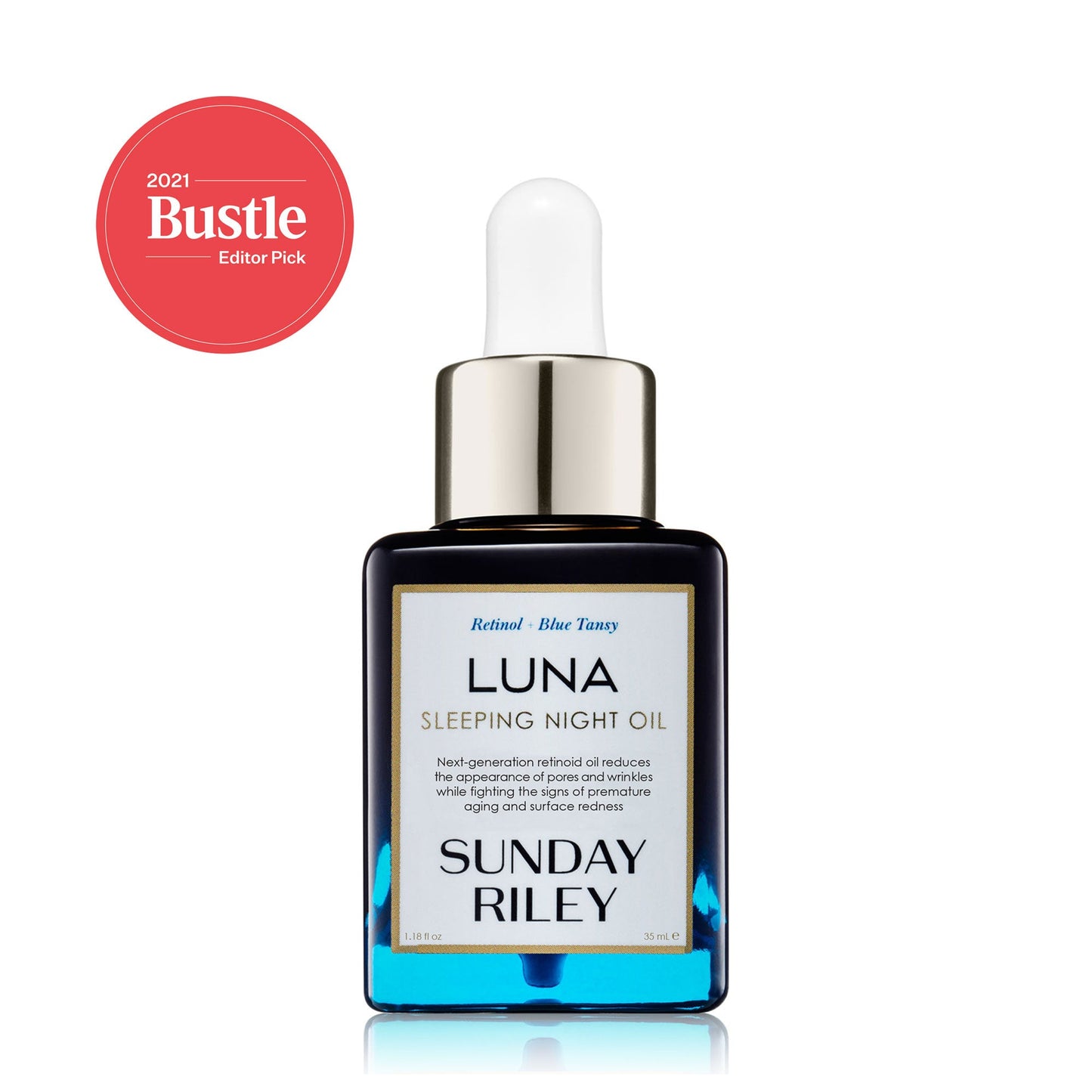
Luna Sleeping Night Oil

Luna Sleeping Night Oil
Sunday Riley
luna-sleeping-night-oil
Face Oil
9784780783909
Morning or Evening?
How often will you use this product?
Notes


Highlights
WHAT IS IT?
Retinol night oil
FEATURES
Reduces appearance of pores and wrinkles, improves signs of premature aging, neutralizes redness
BEST FOR
sensitive
CHECKS
Sulfate-free, Paraben-free, Gluten-free, Soy-free, Phthalate-free, Fragrance-free
Who Is It For?
Adults Concerned With Aging SkinWhat Does It Help With?
Wrinkles Fine Lines Uneven Texture Age Spots Dryness Dullness RednessBudget
Premium ($76-$150)How To Use
Which routine should it be used in?
Instructions:
Key Information


What Sunday Riley Says
Product Description:
A next-generation retinol oil that boosts the look and feel of skin plumpness, while improving the appearance of wrinkles, redness, and pores for visibly younger-looking skin.
About the Brand:
Ingredients Overview
Ingredients List
VITIS VINIFERA (GRAPE) SEED OIL, RUBUS LACINIATUS (BLACKBERRY) SEED OIL, SALVIA HISPANICA (CHIA) SEED OIL, PERSEA GRATISSIMA (AVOCADO) OIL, DIMETHYL ISOSORBIDE, HELIANTHUS ANNUUS (SUNFLOWER) SEED OIL, HYDROXYPINACOLONE RETINOATE, ROSMARINUS OFFICINALIS (ROSEMARY) LEAF EXTRACT, CITRUS AURANTIUM AMARA (BITTER ORANGE) FLOWER OIL, CITRUS AURANTIUM DULCIS (ORANGE) OIL, CHAMOMILLA RECUTITA (MATRICARIA) FLOWER OIL, CANANGA ODORATA (YLANG YLANG) FLOWER OIL, VETIVERIA ZIZANOIDES ROOT OIL, ANTHEMIS NOBILIS (CHAMOMILE) FLOWER OIL, TANACETUM ANNUUM (BLUE TANSY) FLOWER OIL, VANILLA PLANIFOLIA (VANILLA) FRUIT EXTRACT, ERIOCEPHALUS PUNCTULATUS (CAPE CHAMOMILE) FLOWER OIL, GREEN 6 (CI 61565), VIOLET 2 (CI 60725).
Key Ingredients
trans-retinoic acid ester complex, blue tansy, German chamomile
Ingredients Details
Citrus Aurantium Dulcis Orange Oil
Common Name(s): Citrus aurantium dulcis orange oil oil
DESCRIPTION
What It Does: Nourishes and softens skin through its balanced fatty acid profile, while antioxidant compounds protect against oxidative skin damage.
Why It's Used: Plant oils provide physiologically compatible lipid structures that integrate into the skin barrier and deliver fat-soluble antioxidants directly to skin cells.
How It Works: Fatty acids integrate into stratum corneum lipid lamellae, reinforcing the lipid barrier. antioxidants (tocopherols, carotenoids, polyphenols) neutralize ros through electron donation or singlet oxygen quenching.
Typically Found In: Face oils,serums,moisturizers,hair treatments,body oils
TECHNICAL DETAILS
Primary Category: Plant oils
Secondary Functions: Emollient,antioxidant
Application Areas:

Facial Skincare
Body Care
Hair Care

Beard Care
Color Cosmetics (Makeup)
Dietary/Oral Supplements
Typical Concentration Range: 0.5–30%
SOURCING & ETHICS
Vegan Status: Yes
Halal Status: Yes
Source Notes: Cold-pressed or solvent-extracted plant oil; no animal components.
SKIN COMPATIBILITY
Irritancy Rating: 1899-12-31 00:00:00 -0800
Comedogenicity Rating: 1900-01-01 00:00:00 -0800
Sensitivity Concerns: Low sensitization potential at recommended use concentrations.
Safe for Sensitive Skin: Yes
SAFETY & COMPATIBILITY
Safety Profile: Well-characterized cosmetic ingredient with established safety profile. generally non-irritating at typical use concentrations. suitable for leave-on and rinse-off cosmetics.
Works Well With: Vitamin e,ceramides,other plant oils,squalane
Avoid Combining With: Strong oxidizers (accelerate rancidity)
SCIENTIFIC NOTE
Vegetable oils are triglyceride matrices where the fatty acid composition determines skin compatibility, barrier function, and comedogenicity. oleic acid-rich oils (>60%) soften barrier lipids and enhance penetration; linoleic acid-rich oils reinforce ceramide-poor stratum corneum; saturated fatty acid-rich oils provide occlusion without skin penetration.
Last Verified: Cosing eu database; pcpc cosmetic ingredient safety reviews; aocs plant oil composition databases; fatty acid pharmacology reviews
Primary Sources: 2025-01-15
Dimethyl Isosorbide
Common Name(s): Dmi,isosorbide dimethyl ether,arlasolve dmi
CAS Number: 5306-85-4
DESCRIPTION
What It Does: Provides biocompatible penetration enhancement for improved active ingredient delivery.
Why It's Used: Biocompatible penetration enhancer from renewable sorbitol — dmi provides penetration enhancement without the toxicity of oleic acid or conventional chemical penetration enhancers.
How It Works: Cyclic ether from sorbitol is biocompatible and biodegradable. disrupts stratum corneum lipid packing via ether oxygen hydrogen bonding. solubilises challenging actives (retinoids, salicylic acid, ahas). enhances penetration 2–5× vs equivalent concentrations without dmi.
Typically Found In: Active delivery formulas,penetration-enhanced products,retinoid vehicles
TECHNICAL DETAILS
Primary Category: Functional ingredient – penetration-enhancing solvent
Secondary Functions: Skin conditioning
Application Areas:
Facial Skincare
Body Care
Hair Care
Beard Care
Color Cosmetics (Makeup)
Dietary/Oral Supplements
Typical Concentration Range: 1%–20%
SOURCING & ETHICS
Vegan Status: Yes – from sorbitol (corn or wheat derived)
Halal Status: Yes
Source Notes: Commercially produced for cosmetic use. verify vegan/halal status with supplier.
SKIN COMPATIBILITY
Irritancy Rating: 1/5 – very low
Comedogenicity Rating: 0/5 – non-comedogenic
Sensitivity Concerns: Well-tolerated by most skin types.
Safe for Sensitive Skin: Yes
SAFETY & COMPATIBILITY
Safety Profile: Good safety profile at recommended concentrations. ewg score: 1–2.
Works Well With: Standard skincare actives
Avoid Combining With: No known significant incompatibilities
SCIENTIFIC NOTE
Dmi's penetration enhancement mechanism differs from oleic acid's lipid disruption: dmi hydrogen bonds to stratum corneum proteins and lipids, temporarily creating more permeable protein-lipid domains without the membrane-fluidisation that causes oleic acid's irritation. this protein-hydrogen-bonding mechanism provides penetration enhancement from a different, gentler pathway.
Last Verified: Cosing database,croda arlasolve dmi technical data,cir safety assessment
Primary Sources: 2026-03-12
Helianthus Annuus (sunflower) Seed Oil
Common Name(s): Helianthus annuus (sunflower) seed oil,botanical oil,phytochemical active
CAS Number: N/a
DESCRIPTION
What It Does: Provides antioxidant protection from reactive oxygen species, reduces inflammatory cytokine production in skin, and conditions skin through the plant's phytochemical complex.
Why It's Used: Natural origin narrative, traditional use heritage, and multi-functional phytochemical profile supporting concurrent skin care claims from one ingredient.
How It Works: Polyphenols, terpenoids, and alkaloids scavenge ros via h• donation, inhibit nf-kb or cox-2 inflammatory pathways, and interact with skin surface proteins for conditioning.
Typically Found In: Botanical skin care,natural products
TECHNICAL DETAILS
Primary Category: Active ingredient – antioxidant
Secondary Functions: Free radical scavenging,anti-aging
Application Areas:
Facial Skincare
Body Care
Hair Care
Beard Care
Color Cosmetics (Makeup)
Dietary/Oral Supplements
Typical Concentration Range: 0.1%–10%
SOURCING & ETHICS
Vegan Status: Conditional
Halal Status: Yes
Source Notes: Plant-derived extract or synthetic.
SKIN COMPATIBILITY
Irritancy Rating: 1/5 – very low
Comedogenicity Rating: 0/5 – non-comedogenic
Sensitivity Concerns: Non-irritating; well-tolerated.
Safe for Sensitive Skin: Yes
SAFETY & COMPATIBILITY
Safety Profile: Excellent safety profile. ewg score: 1.
Works Well With: Vitamin c,vitamin e,ferulic acid,spf,other antioxidants
Avoid Combining With: No significant incompatibilities
SCIENTIFIC NOTE
Plant secondary metabolites evolved as photoprotectants and antimicrobials — mechanisms directly applicable to cosmetic antioxidant and anti-inflammatory activity in human skin.
Last Verified: Cosing database,helianthus annuus (sunflower) seed botanical review
Primary Sources: 2026-03-12
Hydroxypinacolone Retinoate
Common Name(s): Hpr,granactive retinoid,tretinoin-alternative
CAS Number: 893412-73-2
DESCRIPTION
What It Does: Provides direct retinoid receptor anti-aging activity without the irritation of tretinoin or conversion delays of retinol.
Why It's Used: The gentler tretinoin — hpr directly activates rar receptors without multi-step conversion from retinol, providing tretinoin-like anti-aging with significantly less irritation and uv stability.
How It Works: Ester of retinoic acid and pinacolone metabolite. directly binds rar alpha and gamma receptors for transcription factor-mediated gene expression. avoids retinol→retinaldehyde→retinoic acid conversion, eliminating lag time and reducing irritation from conversion intermediates.
Typically Found In: Anti-aging serums,sensitive skin retinoid products
TECHNICAL DETAILS
Primary Category: Active ingredient – gentle retinoid ester
Secondary Functions: Collagen booster,antioxidant
Application Areas:
Facial Skincare
Body Care
Hair Care
Beard Care
Color Cosmetics (Makeup)
Dietary/Oral Supplements
Typical Concentration Range: 0.01%–0.1%
SOURCING & ETHICS
Vegan Status: Yes – synthetic
Halal Status: Yes
Source Notes: Synthetic or plant-derived. requires opaque, airless packaging.
SKIN COMPATIBILITY
Irritancy Rating: 2/5 – low to moderate
Comedogenicity Rating: 0/5 – non-comedogenic
Sensitivity Concerns: Introduce slowly; retinization expected at higher potencies.
Safe for Sensitive Skin: Use with caution – avoid during pregnancy
SAFETY & COMPATIBILITY
Safety Profile: Safe at cosmetic concentrations. use spf. avoid during pregnancy. ewg score: 2.
Works Well With: Niacinamide,ceramides,hyaluronic acid,spf,tocopherol
Avoid Combining With: Pregnancy; extended uv without spf; benzoyl peroxide
SCIENTIFIC NOTE
Hpr's direct rar activation provides faster onset of anti-aging effects than retinol (no conversion lag) and more consistent individual response because effectiveness is not limited by individual variation in retinol-converting enzyme activity.
Last Verified: Cosing database,huxley research granactive retinoid studies
Primary Sources: 2026-03-12
