

SK-II
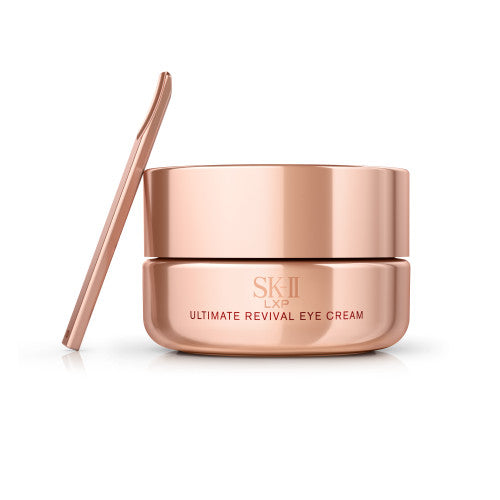
LXP Ultimate Revival Eye Cream

LXP Ultimate Revival Eye Cream
SK-II
lxp-ultimate-revival-eye-cream
Eyecare
9818419265829
Morning or Evening?
How often will you use this product?
Notes


Highlights
WHAT IS IT?
Ultra-rich eye cream with concentrated PITERA™
FEATURES
Contains highest concentrated PITERA™, 8X faster visible results, intense hydration, firms and brightens skin
BEST FOR
normal
CHECKS
Free of drying alcohols, sulfates, gluten, coconut,
Who Is It For?
Mature AdultsWhat Does It Help With?
Fine Lines & Wrinkles Firmness Skin Tone DrynessBudget
Professional (over $150)How To Use
Which routine should it be used in?
Instructions:
Key Information

What SK-II Says
Product Description:
Formulated with our Highest Concentrated PITERA™, SK-II's signature ingredient condensed to its purest form, for 8X faster visible results. The LXP Ultimate Revival Eye Cream nourishes the eye area with intense hydration to firm and brighten skin. For skin the looks and feels supple, plump, and radiant.
About the Brand:
Ingredients Overview
Ingredients List
Water, Galactomyces Ferment Filtrate*, Glycerin, Niacinamide, Isopropyl Isostearate, Isohexadecane, Butylene Glycol, Caprylic/Capric Triglyceride, Pentylene Glycol, Dimethicone, Stearyl Alcohol, Inositol, Petrolatum, Polyacrylamide, Cetyl Alcohol, Vinyl Dimethicone/Methicone Silsesquioxane Crosspolymer, Behenyl Alcohol, C13-14 Isoparaffin, Panthenol, Tocopheryl Acetate, Titanium Dioxide, Benzyl Alcohol, Polymethylsilsesquioxane, Dimethiconol, Methylparaben, Cetearyl Alcohol, Cetearyl Glucoside, Laureth-7, PEG-100 Stearate, Stearic Acid, Xanthan Gum, Disodium EDTA, Crithmum Maritimum Extract, Propylparaben, Ethylparaben, Palmaria Palmata Extract, Oryza Sativa (Rice) Bran Extract, PEG-7 Glyceryl Cocoate, Sodium Hydroxide, Fragrance, Polyquaternium-7, Litchi Chinensis Pericarp Extract, Saccharomyces Cerevisiae Extract, Palmitoyl Dipeptide-7, Methylsilanol Tri-PEG-8 Glyceryl Cocoate, Methicone, Hexapeptide-3, CI 77492
Key Ingredients
PITERA™, Niacinamide, Lychee Extract
Ingredients Details
Butylene Glycol
Common Name(s): 1,3-butanediol,bg,1,3-butylene glycol
CAS Number: 107-88-0
DESCRIPTION
What It Does: Provides humectant hydration and active ingredient solubilization with excellent skin feel.
Why It's Used: Preferred glycol humectant in premium and k-beauty formulations for superior skin feel vs propylene glycol with equivalent functionality.
How It Works: Two hydroxyl groups at 1,3-positions provide water binding and solvent activity. better tolerated than propylene glycol with minimal sensitization risk. 4-carbon backbone provides slightly greater hydrophobic character enabling dissolution of less polar actives vs pg.
Typically Found In: Toners,essences,serums,k-beauty formulas
TECHNICAL DETAILS
Primary Category: Functional ingredient – glycol humectant
Secondary Functions: Tewl reduction,skin plumping
Application Areas:

Facial Skincare
Body Care
Hair Care

Beard Care
Color Cosmetics (Makeup)
Dietary/Oral Supplements
Typical Concentration Range: 1%–10%
SOURCING & ETHICS
Vegan Status: Yes – synthetic
Halal Status: Yes
Source Notes: Synthetic or naturally derived. excellent aqueous solubility.
SKIN COMPATIBILITY
Irritancy Rating: 1/5 – very low
Comedogenicity Rating: 0/5 – non-comedogenic
Sensitivity Concerns: Non-irritating; suitable for all skin types.
Safe for Sensitive Skin: Yes
SAFETY & COMPATIBILITY
Safety Profile: Excellent safety profile. ewg score: 1.
Works Well With: Ceramides,emollients,occlusives,glycerin,hyaluronic acid
Avoid Combining With: No significant incompatibilities
SCIENTIFIC NOTE
K-beauty's preference for butylene glycol over propylene glycol is driven by two factors: bg's superior skin feel (less tacky than pg's higher viscosity) and its lower sensitization potential (1,3-bg has better spatial distribution of hydroxyl groups that reduces protein interaction vs pg's 1,2-position oh groups).
Last Verified: 2026-03-12
Primary Sources: Cosing database,cir safety assessment
Caprylic/capric Triglyceride
Common Name(s): Mct oil,fractionated coconut oil,c8/c10 triglyceride
CAS Number: 73398-61-5
DESCRIPTION
What It Does: Lightweight, stable emollient that solubilizes oil-soluble actives for excellent delivery without greasy feel.
Why It's Used: Universal lightweight emollient base and solubilizer for oil-soluble actives in serums and low-viscosity formulations where mineral oil or petrolatum would be too heavy.
How It Works: Medium-chain length provides ideal balance of spreading coefficient, penetration rate, and barrier-sealing properties. excellent solubilizer for vitamin e, retinoids, and other lipophilic actives.
Typically Found In: Serums,facial oils,sunscreens,anti-aging products,hair products
TECHNICAL DETAILS
Primary Category: Active ingredient – medium-chain triglyceride emollient
Secondary Functions: Active solubilizer,spreading agent
Application Areas:
Facial Skincare
Body Care
Hair Care
Beard Care
Color Cosmetics (Makeup)
Dietary/Oral Supplements
Typical Concentration Range: 1%–50%
SOURCING & ETHICS
Vegan Status: Conditional - feedstock declaration required
Halal Status: Unverified - feedstock declaration required (plant, animal and petrochemical routes all exist)
Source Notes: Fractionated by hydrolysis and re-esterification of coconut oil. only c8 and c10 fatty acids retained. [audit 2026-07-29 rev2: origin-dependent: the same inci exists in plant, animal and petrochemical versions and the name does not discriminate. determination requires shariah-panel sign-off.]
SKIN COMPATIBILITY
Irritancy Rating: 1/5 – very low
Comedogenicity Rating: 1/5 – very low; medium-chain length generally non-comedogenic
Sensitivity Concerns: Non-irritating.
Safe for Sensitive Skin: Yes
SAFETY & COMPATIBILITY
Safety Profile: Excellent safety profile. ewg score: 1.
Works Well With: Humectants,ceramides,actives as carrier
Avoid Combining With: No significant incompatibilities
SCIENTIFIC NOTE
Mct oil's medium-chain length (c8/c10) provides superior oxidative stability vs longer polyunsaturated chains and better skin aesthetics (lighter, less greasy) vs longer chain emollients (c16/c18). excellent solubilizer for retinoic acid, tocopheryl esters, and other lipophilic actives.
Last Verified: 2026-03-12
Primary Sources: Cosing database,cir safety assessment,ewg skin deep
Dimethicone
Common Name(s): Pdms,polydimethylsiloxane,silicone fluid
CAS Number: 9006-65-9
DESCRIPTION
What It Does: Provides silicone-characteristic silky feel and skin protection with adjustable viscosity.
Why It's Used: The benchmark cosmetic silicone – sets the gold standard for silky application feel, spreadability, and skin protection in virtually all skin care categories.
How It Works: Polydimethylsiloxane chain flexibility provides extremely low surface tension and high spreadability. inert si-o backbone provides chemical stability and excellent skin tolerance. occlusive film formation reduces tewl. higher viscosity grades provide more intense conditioning.
Typically Found In: Moisturizers,foundations,primers,sunscreens – nearly universal
TECHNICAL DETAILS
Primary Category: Functional ingredient – polydimethylsiloxane
Secondary Functions: Barrier sealing,softening
Application Areas:
Facial Skincare
Body Care
Hair Care
Beard Care
Color Cosmetics (Makeup)
Dietary/Oral Supplements
Typical Concentration Range: 0.1%–30%
SOURCING & ETHICS
Vegan Status: Conditional - supplier confirmation required
Halal Status: Unverified - supplier confirmation required
Source Notes: Plant-derived, synthetic or animal-derived. verify source. [audit 2026-07-29 rev2: the record's own source_notes does not assert a non-animal origin, or instructs the reader to verify with the supplier; "yes" asserts knowledge the record does not hold. determination requires shariah-panel sign-off.]
SKIN COMPATIBILITY
Irritancy Rating: 1/5 – very low
Comedogenicity Rating: 1/5 – low; formulation-dependent
Sensitivity Concerns: Non-irritating.
Safe for Sensitive Skin: Yes
SAFETY & COMPATIBILITY
Safety Profile: Excellent safety profile. ewg score: 1.
Works Well With: Humectants,ceramides,actives as carrier
Avoid Combining With: No significant incompatibilities
SCIENTIFIC NOTE
Dimethicone's exceptional silky feel arises from its very low intermolecular attractive forces (weak van der waals forces due to non-polar methyl groups) that allow silicone chains to slide freely over skin. the coefficient of kinetic friction for pdms against skin (~0.04) is among the lowest of any cosmetic material – explaining why even small amounts transform product feel.
Last Verified: 2026-03-12
Primary Sources: Cosing database,cir safety assessment
Galactomyces Ferment Filtrate
Common Name(s): Galactomyces ferment filtrate,sake yeast postbiotic,multi-function brightening active
CAS Number: N/a
DESCRIPTION
What It Does: Brightens skin tone by inhibiting melanin transfer from melanocytes to keratinocytes (not tyrosinase inhibition), strengthens the skin barrier by upregulating involucrin and filaggrin expression, minimises pore appearance, and provides antioxidant protection from the ferment's organic acid and flavonoid complex.
Why It's Used: Gff's brightening mechanism differs from all tyrosinase inhibitors — it blocks melanosome transfer rather than melanin synthesis, providing additive brightening when combined with tyrosinase inhibitors and targeting the previously unaddressed transfer step.
How It Works: Gff contains niacinamide (inhibits melanosome par-2 transfer), arbutin-related compounds (tyrosinase inhibition), vitamin b complex, alpha-arbutin, and organic acids. the combined transfer inhibition + tyrosinase inhibition + antioxidant activity explains multi-step brightening. barrier upregulation occurs through fatty acid ceramide precursor provision.
Typically Found In: Brightening,k-beauty,barrier repair
TECHNICAL DETAILS
Primary Category: Active ingredient – skin microbiome support
Secondary Functions: Microbiome balance,prebiotic effect
Application Areas:
Facial Skincare
Body Care
Hair Care
Beard Care
Color Cosmetics (Makeup)
Dietary/Oral Supplements
Typical Concentration Range: 1%–95%
SOURCING & ETHICS
Vegan Status: Yes
Halal Status: Yes
Source Notes: Fermentation-derived or plant-extracted.
SKIN COMPATIBILITY
Irritancy Rating: 1/5 – very low
Comedogenicity Rating: 0/5 – non-comedogenic
Sensitivity Concerns: Non-irritating; beneficial for sensitive skin.
Safe for Sensitive Skin: Yes
SAFETY & COMPATIBILITY
Safety Profile: Excellent safety profile. ewg score: 1.
Works Well With: Ceramides,niacinamide,soothing actives
Avoid Combining With: No significant incompatibilities
SCIENTIFIC NOTE
The legendary sake brewery discovery: morihei uehara observed fermentation workers had unusually smooth, bright skin on their hands despite sun exposure and chemical contact — investigation identified galactomyces as the responsible fermentation organism, leading to the commercial gff cosmetic ingredient.
Last Verified: 2026-03-12
Primary Sources: Cosing database,galactomyces ferment filtrate brightening mechanism review