
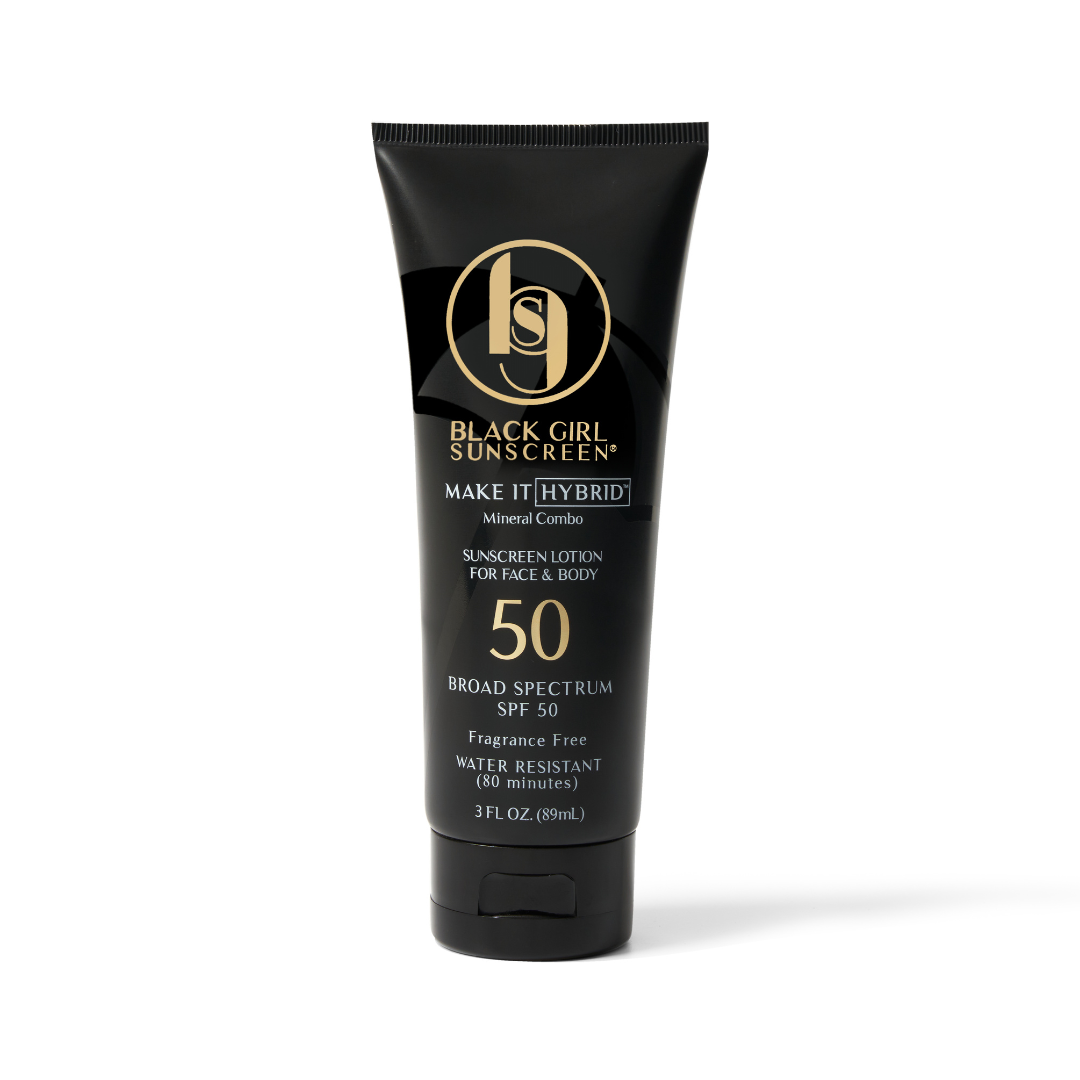

Black Girl Sunscreen
Make It Hybrid_x0099_ SPF 50 Sunscreen

Make It Hybrid_x0099_ SPF 50 Sunscreen
Black Girl Sunscreen
make-it-hybrid-spf-50-sunscreen
Suncare
9873690657061
Morning or Evening?
How often will you use this product?
Notes


Highlights
WHAT IS IT?
Hybrid sunscreen with SPF 50
FEATURES
Leaves no white residue, dewy finish, broad-spectrum protection
BEST FOR
normal
CHECKS
No white residue
Who Is It For?
WomenWhat Does It Help With?
Sun Protection Moisturizing Soothing HealingBudget
Affordable (under $30)How To Use
Which routine should it be used in?
Instructions:
Key Information


What Black Girl Sunscreen Says
Product Description:
A lightweight mineral and synthetic formula with zinc-oxide designed to protect against sun damage leaving no white residue and a dewy finish. Broad-spectrum SPF 50 specifically crafted for women, infused with ingredients such as aloe, lavender, and shea butter that help moisturize, soothe and heal your skin.
About the Brand:
Ingredients Overview
Ingredients List
Homosalate,Octisalate,Octocrylene,Zinc-Oxide,Acrylic-Acid/VP-Crosspolymer,Aloe-Barbadensis-Leaf-Juice,Butyrospermum-Parkii-Butter,Caprylic/Capric-Triglyceride,Daucus-Carota-Sativa-Seed-Oil,Glycerin,Glyceryl-Caprylate,Glyceryl-Undecylenate,Helianthus-Annuus-Seed-Oil,Lavandula-Angustifolia-Oil,Persea-Gratissima-Oil,Simmondsia-Chinensis-Seed-Oil,Sodium-Hydroxide,Tetrasodium-Glutamate-Diacetate,Tocopheryl-Acetate,VP/Acrylates/Lauryl-Methacrylate-Copolymer,Water
Key Ingredients
Aloe, Shea Butter, Carrot Seed Oil, Sunflower Oil, Avocado Oil, Jojoba Oil, Lavender Oil
Ingredients Details
Acrylic Acid/vp Crosspolymer
Common Name(s): Acrylic acid/vp crosspolymer,acrylates/vp crosspolymer,acrylic-vinylpyrrolidone polymer
DESCRIPTION
What It Does: Thickens water-based products and creates a film on skin or hair to improve hold and texture.
Why It's Used: Used as a thickener and binder in hair styling products and skin care where both film-forming and viscosity control are required in clear or translucent formulas.
How It Works: Crosslinked acrylic acid backbone (anionic polyelectrolyte) swells in water upon neutralization; vp units increase surface affinity to hair/skin and improve film flexibility.
Typically Found In: Hair gels,styling products,clear serums,setting sprays,skin primers
TECHNICAL DETAILS
Primary Category: Functional ingredient – viscosity controlling
Secondary Functions: Film forming,binding,skin conditioning
Application Areas:

Facial Skincare

Body Care
Hair Care
Beard Care
Color Cosmetics (Makeup)
Dietary/Oral Supplements
Typical Concentration Range: 0.1%–5%
SOURCING & ETHICS
Vegan Status: Yes
Halal Status: Yes
Source Notes: Synthetic polymer; acrylate/vinylpyrrolidone copolymer.
SKIN COMPATIBILITY
Irritancy Rating: 1/5 – very low
Comedogenicity Rating: 0/5 – non-comedogenic
Sensitivity Concerns: Generally non-irritating; rare contact sensitization possible at high concentrations. acrylic acid residual monomer levels regulated in eu (max 0.1%).
Safe for Sensitive Skin: Yes
SAFETY & COMPATIBILITY
Safety Profile: Good safety profile. ewg score: 1–2.
Works Well With: Neutralizing agents (naoh/tea),humectants,styling polymers,preservatives
Avoid Combining With: Do not use without neutralization (acidic ph causes poor swelling)
SCIENTIFIC NOTE
Acrylic acid/vp crosspolymers combine the anionic charge of polyacrylic acid with the hydrophilic, substantive properties of pvp; crosslinking creates a gel-network without dissolution; hlb and ph of system affects swelling efficiency.
Last Verified: 2026-03-27
Primary Sources: Cosing database,inci dictionary,supplier technical data sheets
Aloe Barbadensis Leaf Juice
Common Name(s): Aloe barbadensis leaf juice,cosmetic active,functional ingredient
CAS Number: N/a
DESCRIPTION
What It Does: Delivers characteristic cosmetic function — skin conditioning, protection, preservation, or active biological benefit — at recommended use concentration.
Why It's Used: Selected for its functional contribution and formulation compatibility — supported by cosmetic science literature and regulatory safety assessment.
How It Works: Works through the mechanism of its molecular class — physicochemical interaction with the formulation or biological interaction with skin proteins, lipids, or receptors as documented in peer-reviewed literature.
Typically Found In: Skin care formulations
TECHNICAL DETAILS
Primary Category: Active ingredient – cosmetic active
Secondary Functions: Skin conditioning
Application Areas:
Facial Skincare
Body Care
Hair Care
Beard Care
Color Cosmetics (Makeup)
Dietary/Oral Supplements
Typical Concentration Range: 0.1%–10%
SOURCING & ETHICS
Vegan Status: Conditional - supplier confirmation required
Halal Status: Unverified - supplier confirmation required
Source Notes: Commercially produced for cosmetic use. verify vegan/halal status with supplier. [audit 2026-07-29 rev2: the record's own source_notes does not assert a non-animal origin, or instructs the reader to verify with the supplier; "yes" asserts knowledge the record does not hold. determination requires shariah-panel sign-off.]
SKIN COMPATIBILITY
Irritancy Rating: 1/5 – very low
Comedogenicity Rating: 0/5 – non-comedogenic
Sensitivity Concerns: Well-tolerated by most skin types.
Safe for Sensitive Skin: Yes
SAFETY & COMPATIBILITY
Safety Profile: Good safety profile at recommended concentrations. ewg score: 1–2.
Works Well With: Standard skincare actives
Avoid Combining With: No known significant incompatibilities
SCIENTIFIC NOTE
Aloe barbadensis leaf juice delivers documented functional benefit with an established safety profile within the cosmetic regulatory framework (cosing eu, cir usa).
Last Verified: 2026-03-12
Primary Sources: Cosing database,aloe barbadensis leaf juice technical literature
Butyrospermum Parkii Butter
Common Name(s): Butyrospermum parkii butter,botanical carrier oil,emollient fatty acid delivery
CAS Number: N/a
DESCRIPTION
What It Does: Softens and conditions skin by integrating into sc lipid bilayers, delivers essential fatty acids (oleic, linoleic, linolenic) for barrier lipid synthesis, and provides rich, non-stripping moisturisation.
Why It's Used: Natural carrier oils provide the closest compositional match to endogenous sc lipids, delivering emolliency through genuine barrier integration rather than simple surface occlusion.
How It Works: Fatty acid triglycerides partition into sc lipid bilayers — oleic acid (c18:1) provides fluid, emollient integration; linoleic acid (c18:2) acts as essential ceramide precursor; saturated fatty acids provide more occlusive barrier reinforcement.
Typically Found In: Moisturisers,facial oils,natural skin care
TECHNICAL DETAILS
Primary Category: Functional ingredient – emollient
Secondary Functions: Barrier sealing,softening
Application Areas:
Facial Skincare
Body Care
Hair Care
Beard Care
Color Cosmetics (Makeup)
Dietary/Oral Supplements
Typical Concentration Range: 1%–100%
SOURCING & ETHICS
Vegan Status: Conditional - supplier confirmation required
Halal Status: Unverified - supplier confirmation required
Source Notes: Plant-derived, synthetic or animal-derived. verify source. [audit 2026-07-29 rev2: the record's own source_notes does not assert a non-animal origin, or instructs the reader to verify with the supplier; "yes" asserts knowledge the record does not hold. determination requires shariah-panel sign-off.]
SKIN COMPATIBILITY
Irritancy Rating: 1/5 – very low
Comedogenicity Rating: 1/5 – low; formulation-dependent
Sensitivity Concerns: Non-irritating.
Safe for Sensitive Skin: Yes
SAFETY & COMPATIBILITY
Safety Profile: Excellent safety profile. ewg score: 1.
Works Well With: Humectants,ceramides,actives as carrier
Avoid Combining With: No significant incompatibilities
SCIENTIFIC NOTE
Essential fatty acids — linoleic (c18:2, n-6) and α-linolenic (c18:3, n-3) acids — cannot be synthesised by the body; topical delivery through carrier oils provides direct substrate for ceramide and eicosanoid biosynthesis in the epidermis.
Last Verified: 2026-03-12
Primary Sources: Cosing database,butyrospermum parkii butter carrier oil botanical review
Caprylic/capric Triglyceride
Common Name(s): Mct oil,fractionated coconut oil,c8/c10 triglyceride
CAS Number: 73398-61-5
DESCRIPTION
What It Does: Lightweight, stable emollient that solubilizes oil-soluble actives for excellent delivery without greasy feel.
Why It's Used: Universal lightweight emollient base and solubilizer for oil-soluble actives in serums and low-viscosity formulations where mineral oil or petrolatum would be too heavy.
How It Works: Medium-chain length provides ideal balance of spreading coefficient, penetration rate, and barrier-sealing properties. excellent solubilizer for vitamin e, retinoids, and other lipophilic actives.
Typically Found In: Serums,facial oils,sunscreens,anti-aging products,hair products
TECHNICAL DETAILS
Primary Category: Active ingredient – medium-chain triglyceride emollient
Secondary Functions: Active solubilizer,spreading agent
Application Areas:
Facial Skincare
Body Care
Hair Care
Beard Care
Color Cosmetics (Makeup)
Dietary/Oral Supplements
Typical Concentration Range: 1%–50%
SOURCING & ETHICS
Vegan Status: Conditional - feedstock declaration required
Halal Status: Unverified - feedstock declaration required (plant, animal and petrochemical routes all exist)
Source Notes: Fractionated by hydrolysis and re-esterification of coconut oil. only c8 and c10 fatty acids retained. [audit 2026-07-29 rev2: origin-dependent: the same inci exists in plant, animal and petrochemical versions and the name does not discriminate. determination requires shariah-panel sign-off.]
SKIN COMPATIBILITY
Irritancy Rating: 1/5 – very low
Comedogenicity Rating: 1/5 – very low; medium-chain length generally non-comedogenic
Sensitivity Concerns: Non-irritating.
Safe for Sensitive Skin: Yes
SAFETY & COMPATIBILITY
Safety Profile: Excellent safety profile. ewg score: 1.
Works Well With: Humectants,ceramides,actives as carrier
Avoid Combining With: No significant incompatibilities
SCIENTIFIC NOTE
Mct oil's medium-chain length (c8/c10) provides superior oxidative stability vs longer polyunsaturated chains and better skin aesthetics (lighter, less greasy) vs longer chain emollients (c16/c18). excellent solubilizer for retinoic acid, tocopheryl esters, and other lipophilic actives.
Last Verified: 2026-03-12
Primary Sources: Cosing database,cir safety assessment,ewg skin deep