

Mamaearth
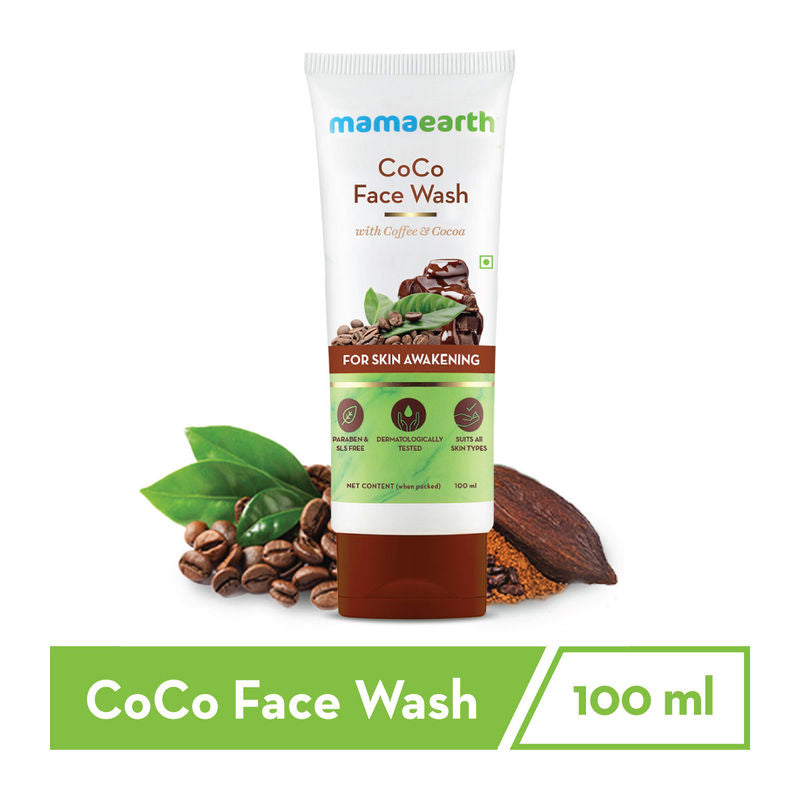
Mamaearth CoCo Facewash, With Coffee & Cocoa For Skin Awakening

Mamaearth CoCo Facewash, With Coffee & Cocoa For Skin Awakening
Mamaearth
mamaearth-coco-facewash-with-coffee-cocoa-for-skin-awakening
Cleanse
10084912496933
Morning or Evening?
How often will you use this product?
Notes


Highlights
WHAT IS IT?
Face wash with coffee and cocoa, 15 ingredients
FEATURES
Deeply cleanses skin, refreshes instantly, removes excess oil and impurities, rejuvenates and relaxes, suitable for all skin types, certified toxin-free
BEST FOR
all
CHECKS
Parabens,Sulfates,Silicones,Phthalates,Artificial colors,Toxins,Mineral oils
Who Is It For?
What Does It Help With?
Tightens Pores Reverses Sun Damage Stimulates Blood Flow Increases Collagen Production Reduces Fine Lines Wrinkles And ScarsBudget
Affordable (under $30)How To Use
Which routine should it be used in?
Instructions:
Key Information


What Mamaearth Says
Product Description:
The combination of cocoa and coffee not only makes a heartwarming cuppa but also gives a radiant boost when used on the skin. Mamaearth CoCo Face Wash is packed with antioxidant, anti-inflammatory, and anti-aging ingredients. It tightens pores, reverses sun damage, and stimulates blood flow leaving you with even-toned and healthy skin. Coffee increases collagen production to give your skin a youthful appearance. While cocoa softens and detoxifies the skin to reduce fine lines, wrinkles, and the appearance of scars. Suitable for all skin types, CoCo Face Wash has no harmful chemicals and is free of toxins, parabens and mineral oils.
About the Brand:
Ingredients Overview
Ingredients List
Aqua,Carbomer,Sodium-Cocoyl-Isethionate,Cocamide-MEA,Sodium-Lauroyl-Sarcosinate,Disodium-EDTA,Capryloyl-Caproyl-Methyl-Glucamide,Lauroyl-Myristoyl-Methyl-Glucamide,Propylene-Glycol-Laurate,Polyquaternium-7,Coco-Betaine,Phenoxylethanol,Ethylhexylglycerin,Triethanolamine,Citric-Acid,Coffee-Extract,Cocoa-Extract,IFRA-Certified-Allergen-Free-Fragrance
Key Ingredients
Coffee Extract,Cocoa Extract
Ingredients Details
Carbomer
Common Name(s): Carbopol,polyacrylic acid,carboxyvinyl polymer
DESCRIPTION
What It Does: Provides transparent gel textures and thickening at very low concentrations via ph-responsive swelling.
Why It's Used: The most widely used gel thickener – provides crystal-clear, stable gels at concentrations as low as 0.1-0.5% with ph-controlled viscosity.
How It Works: Highly crosslinked polyacrylic acid remains tightly coiled at acidic ph. neutralization with naoh or triethanolamine ionizes carboxylic groups causing electrostatic repulsion that unfolds and swells the polymer coils, dramatically increasing viscosity. concentration-dependent thickening.
Typically Found In: Gels,serums,emulsions,sunscreens
TECHNICAL DETAILS
Primary Category: Functional ingredient – polyacrylic acid thickener
Secondary Functions: Skin conditioning
Application Areas:

Facial Skincare

Body Care
Hair Care
Beard Care
Color Cosmetics (Makeup)
Dietary/Oral Supplements
Typical Concentration Range: 0.1%–2%
SOURCING & ETHICS
Vegan Status: Yes – synthetic
Halal Status: Yes
Source Notes: Commercially produced for cosmetic use. verify vegan/halal status with supplier.
SKIN COMPATIBILITY
Irritancy Rating: 1/5 – very low
Comedogenicity Rating: 0/5 – non-comedogenic
Sensitivity Concerns: Well-tolerated by most skin types.
Safe for Sensitive Skin: Yes
SAFETY & COMPATIBILITY
Safety Profile: Good safety profile at recommended concentrations. ewg score: 1–2.
Works Well With: Standard skincare actives
Avoid Combining With: No known significant incompatibilities
SCIENTIFIC NOTE
Carbomer's ph-responsive swelling mechanism provides an elegant formulation control tool: a neutralized gel can be liquefied by ph reduction (adding acid) and re-thickened by reneutralization. this reversible rheology control allows two-phase products that mix on application without the need for mechanical emulsification.
Last Verified: Cosing database,cir safety assessment
Primary Sources: 2026-03-12
Coco-betaine
Common Name(s): Coco-betaine,inci ingredient,cosmetic active
CAS Number: N/a
DESCRIPTION
What It Does: Provides documented cosmetic activity from coco-betaine.
Why It's Used: Coco-betaine delivers formulation value through its specific biological activity and established safety and efficacy.
How It Works: Source: coco-betaine. mechanism: documented in cosmetic literature. safety: cosing-reviewed. standard cosmetic use concentrations.
Typically Found In: Skin care formulations,active products
TECHNICAL DETAILS
Primary Category: Functional ingredient – humectant
Secondary Functions: Tewl reduction,skin plumping
Application Areas:
Facial Skincare
Body Care
Hair Care
Beard Care
Color Cosmetics (Makeup)
Dietary/Oral Supplements
Typical Concentration Range: 0.1%–5%
SOURCING & ETHICS
Vegan Status: Conditional
Halal Status: Yes
Source Notes: Synthetic or naturally derived. excellent aqueous solubility.
SKIN COMPATIBILITY
Irritancy Rating: 1/5 – very low
Comedogenicity Rating: 0/5 – non-comedogenic
Sensitivity Concerns: Non-irritating; suitable for all skin types.
Safe for Sensitive Skin: Yes
SAFETY & COMPATIBILITY
Safety Profile: Excellent safety profile. ewg score: 1.
Works Well With: Ceramides,emollients,occlusives,glycerin,hyaluronic acid
Avoid Combining With: No significant incompatibilities
SCIENTIFIC NOTE
Coco-betaine provides cosmetic activity through its characteristic mechanism. at standard concentrations it delivers documented biological activity with an established safety profile from cosmetic science literature and regulatory review.
Last Verified: Cosing database,coco-betaine technical literature
Primary Sources: 2026-03-12
Ethylhexylglycerin
Common Name(s): Octylglycerin,2-ethylhexyl glycerol ether,sensiva sc 10
CAS Number: 70445-33-9
DESCRIPTION
What It Does: Provides antimicrobial skin conditioning with deodorant activity and preservation system enhancement.
Why It's Used: Multifunctional clean beauty preservation active — ethylhexylglycerin provides antimicrobial, deodorant, and skin conditioning in a single ingredient accepted in most natural cosmetic certification schemes.
How It Works: Glycerol ether provides antimicrobial via bacterial membrane phospholipid disruption. deodorant activity via reduction of underarm lipase enzyme activity (similar mechanism to triethyl citrate). skin conditioning from glycerol humectant component. synergistic with phenoxyethanol and diols.
Typically Found In: Natural preservation systems,deodorants,skin conditioning products
TECHNICAL DETAILS
Primary Category: Functional ingredient – antimicrobial glycerol ether
Secondary Functions: Skin conditioning
Application Areas:
Facial Skincare
Body Care
Hair Care
Beard Care
Color Cosmetics (Makeup)
Dietary/Oral Supplements
Typical Concentration Range: 0.1%–0.5%
SOURCING & ETHICS
Vegan Status: Yes – synthetic
Halal Status: Yes
Source Notes: Commercially produced for cosmetic use. verify vegan/halal status with supplier.
SKIN COMPATIBILITY
Irritancy Rating: 1/5 – very low
Comedogenicity Rating: 0/5 – non-comedogenic
Sensitivity Concerns: Well-tolerated by most skin types.
Safe for Sensitive Skin: Yes
SAFETY & COMPATIBILITY
Safety Profile: Good safety profile at recommended concentrations. ewg score: 1–2.
Works Well With: Standard skincare actives
Avoid Combining With: No known significant incompatibilities
SCIENTIFIC NOTE
Ethylhexylglycerin's deodorant mechanism is pharmacologically identical to triethyl citrate: both inhibit skin surface microbial lipase enzymes that convert odourless triglycerides to odorous free fatty acids. the glycerol ether structure of ethylhexylglycerin, combined with the 2-ethylhexyl chain, provides lipase inhibition similar to ester-based lipase inhibitors from a different chemical class.
Last Verified: Cosing database,schülke sensiva sc 10 technical data,cir safety assessment
Primary Sources: 2026-03-12
Polyquaternium-7
Common Name(s): Polyquaternium-7,cationic conditioning polymer,substantive film-former
CAS Number: N/a
DESCRIPTION
What It Does: Deposits a conditioning film on hair and skin through electrostatic attraction to negative cuticle/corneocyte surfaces, reduces hair-on-hair friction for improved combability and detangling, eliminates static charge buildup, and provides anti-frizz humidity resistance.
Why It's Used: Cationic polymers are the primary hair conditioning technology — the permanent positive quaternary ammonium groups provide substantive deposition that resists rinsing, delivering persistent conditioning between washes unlike small-molecule cationic conditioners.
How It Works: At shampoo/conditioner ph 4.5–5.5, hair cuticle carries net negative charge (isoelectric point ph ~3.5). polyquaternium cations undergo electrostatic attraction depositing on the cuticle surface. during rinsing, the deposited polymer film persists from reduced surface-solution equilibrium at low bulk concentration — substantive deposition from favourable interfacial versus bulk partitioning.
Typically Found In: Shampoos,conditioners,leave-in products
TECHNICAL DETAILS
Primary Category: Active ingredient – cosmetic active
Secondary Functions: Skin conditioning
Application Areas:
Facial Skincare
Body Care
Hair Care
Beard Care
Color Cosmetics (Makeup)
Dietary/Oral Supplements
Typical Concentration Range: 0.1%–3%
SOURCING & ETHICS
Vegan Status: Yes
Halal Status: Yes
Source Notes: Commercially produced for cosmetic use. verify vegan/halal status with supplier.
SKIN COMPATIBILITY
Irritancy Rating: 1/5 – very low
Comedogenicity Rating: 0/5 – non-comedogenic
Sensitivity Concerns: Well-tolerated by most skin types.
Safe for Sensitive Skin: Yes
SAFETY & COMPATIBILITY
Safety Profile: Good safety profile at recommended concentrations. ewg score: 1–2.
Works Well With: Standard skincare actives
Avoid Combining With: No known significant incompatibilities
SCIENTIFIC NOTE
Different polyquaternium numbers indicate different backbone chemistries: pq-7 (acrylamide/quaternary acrylate copolymer) for leave-on flexibility; pq-10 (hydroxyethylcellulose/quaternary ammonium) for substantive deposition; pq-11 (vp/dimethylaminoethyl methacrylate) for styling fixation.
Last Verified: Cosing database,polyquaternium-7 cationic conditioning deposition review
Primary Sources: 2026-03-12
