

Nykaa E retail limited
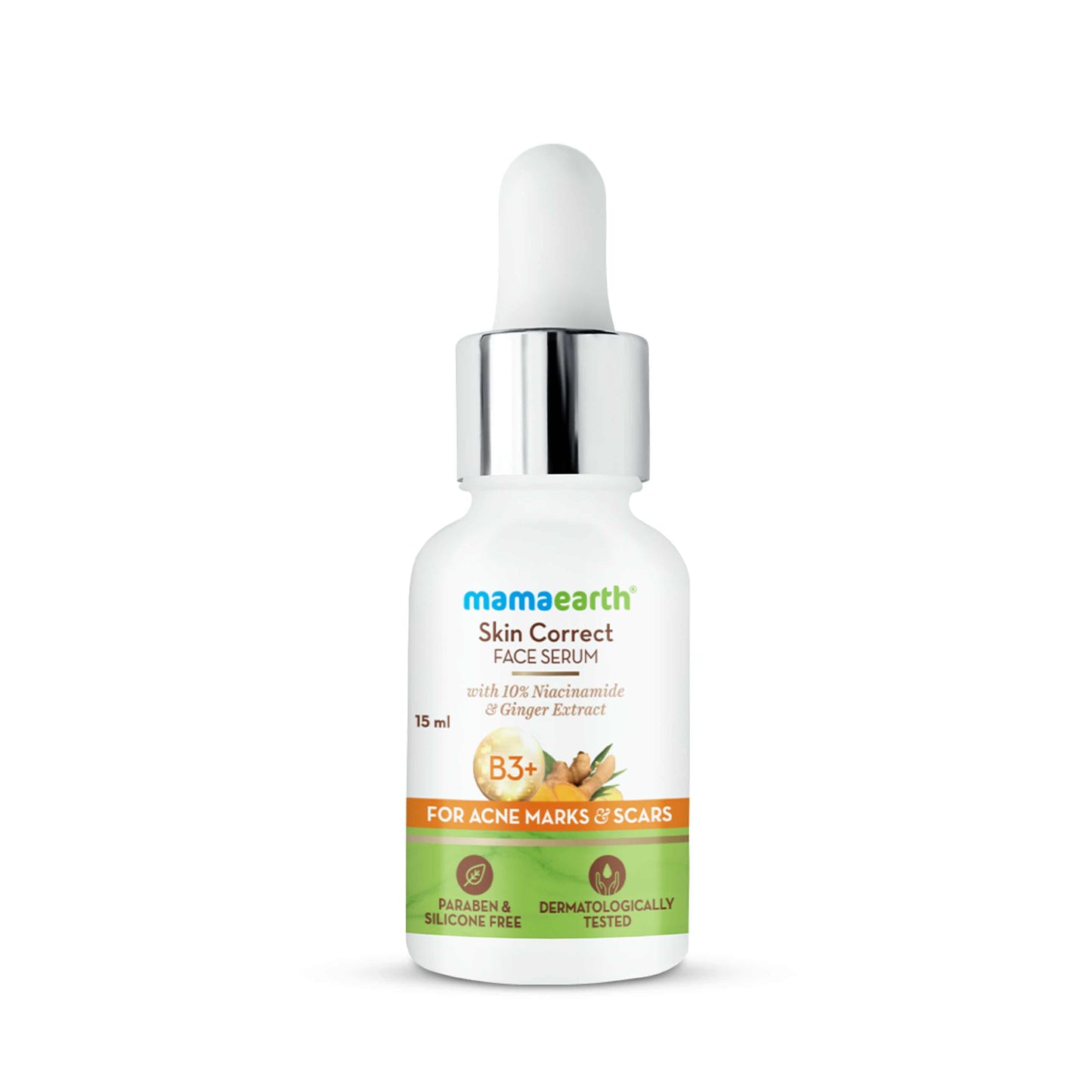
Mamaearth Skin Correct Face Serum with Niacinamide and Ginger Extract for Acne Marks & Scars

Mamaearth Skin Correct Face Serum with Niacinamide and Ginger Extract for Acne Marks & Scars
Nykaa E retail limited
mamaearth-skin-correct-face-serum-with-niacinamide-and-ginger-extract-for-acne-marks-scars
Serum
10084913447205
Morning or Evening?
How often will you use this product?
Notes


Highlights
WHAT IS IT?
Face serum with Niacinamide and Ginger Extract
FEATURES
Targets acne marks and scars
BEST FOR
combination
CHECKS
Who Is It For?
Adults With Acne Marks And ScarsWhat Does It Help With?
Acne Marks And Scar ReductionBudget
Affordable (under $30)How To Use
Which routine should it be used in?
Instructions:
Key Information


What Nykaa E retail limited Says
Product Description:
A face serum designed to target acne marks and scars
About the Brand:
Ingredients Overview
Ingredients List
Aqua, Niacinamide, Propylene Glycol, Glycerin, Zinc PCA, Diethylene glycol monoethyl ether, Phenoxyethanol, Hydroxyethyl cellulose, Xanthan Gum, Citric Acid, Perfume, Ethylhexylglycerin, Sodium Gluconate, Zingiber Officinale (Ginger) Extract, Sodium Benzoate, Benzyl Alcohol, Dehydroacetic Acid
Key Ingredients
niacinamide,ginger-extract
Ingredients Details
Benzyl Alcohol
Common Name(s): Phenylcarbinol,benzenemethanol,alpha-hydroxytoluene
CAS Number: 100-51-6
DESCRIPTION
What It Does: Provides dual fragrance and preservative activity as an aromatic alcohol.
Why It's Used: Multi-function ingredient serving as both fragrance component and preservative – reduces formulation complexity by providing both functions in one ingredient.
How It Works: Phenylcarbinol provides antimicrobial activity via membrane disruption (effective vs gram-positive bacteria and moulds). solvent for fragrances and difficult-to-dissolve actives. mild oxidative conversion to benzaldehyde provides sweet almond-like fragrance.
Typically Found In: Fragrances,preserved cosmetics,solvent systems
TECHNICAL DETAILS
Primary Category: Fragrance component / preservative
Secondary Functions: Skin conditioning
Application Areas:

Facial Skincare

Body Care
Hair Care
Beard Care
Color Cosmetics (Makeup)
Dietary/Oral Supplements
Typical Concentration Range: 0.001%–1% (fragrance); up to 1% as preservative
SOURCING & ETHICS
Vegan Status: Yes - standard ethanol routes are non-animal; confirm denaturant origin
Halal Status: Conditional - ethanol production route and residual concentration; jurisdiction-dependent, refer to certifier stance
Source Notes: Commercially produced for cosmetic use. verify vegan/halal status with supplier. [audit 2026-07-29 rev2: ethanol pathway; determination depends on route, on whether the plant also produces beverage alcohol, and on residual concentration. determination requires shariah-panel sign-off.]
SKIN COMPATIBILITY
Irritancy Rating: 1/5 – very low
Comedogenicity Rating: 0/5 – non-comedogenic
Sensitivity Concerns: Well-tolerated by most skin types.
Safe for Sensitive Skin: Yes
SAFETY & COMPATIBILITY
Safety Profile: Eu cosmetics regulation: declared fragrance allergen. also listed as approved preservative (annex v, max 1%). dual regulatory status (fragrance + preservative) depending on function and concentration.
Works Well With: Standard skincare actives
Avoid Combining With: No known significant incompatibilities
SCIENTIFIC NOTE
Benzyl alcohol's dual regulatory status (fragrance allergen and approved preservative) creates a formulation paradox: it must be listed as a fragrance allergen if present >0.001% (leave-on) regardless of whether it was added for fragrance or preservation. this regulatory dual identity means a preservative added for antimicrobial function triggers the same allergen declaration requirement as a fragrance added for scent.
Last Verified: 2026-03-12
Primary Sources: Cosing database,ifra standards,eu preservative annex v
Citric Acid
Common Name(s): Lemon acid,2-hydroxypropane-1,2,3-tricarboxylic acid
CAS Number: 77-92-9
DESCRIPTION
What It Does: Adjusts ph to optimal ranges, chelates destabilizing metal ions, provides mild exfoliation at higher concentrations.
Why It's Used: Universal cosmetic ph adjuster and chelating agent. aha exfoliant activity is secondary.
How It Works: As ph adjuster, donates protons. as chelating agent, three carboxylic groups bind divalent metals (ca²⁺, mg²⁺, fe²⁺) preventing oxidative degradation.
Typically Found In: Nearly all cosmetic formulations,brightening products,exfoliants
TECHNICAL DETAILS
Primary Category: Active ingredient – alpha hydroxy acid (aha)
Secondary Functions: Chelating agent,ph adjustment,preservation enhancement
Application Areas:
Facial Skincare
Body Care
Hair Care
Beard Care
Color Cosmetics (Makeup)
Dietary/Oral Supplements
Typical Concentration Range: 0.1%–10%
SOURCING & ETHICS
Vegan Status: Yes – synthetic or fermentation-derived
Halal Status: Yes
Source Notes: Produced by fermentation of sugars by aspergillus niger. gras (e330). most abundant organic acid in citrus.
SKIN COMPATIBILITY
Irritancy Rating: 1/5 – very low at low concentrations; 2/5 at exfoliant concentrations
Comedogenicity Rating: 0/5 – non-comedogenic
Sensitivity Concerns: Photosensitizing – mandatory spf use. start at low frequency.
Safe for Sensitive Skin: Use with caution – spf required
SAFETY & COMPATIBILITY
Safety Profile: Safe at otc concentrations. eu: ≤10% leave-on at ph ≥3.5. mandatory spf advisory.
Works Well With: Niacinamide,ceramides,hyaluronic acid,spf
Avoid Combining With: Retinol in same step; multiple exfoliants simultaneously
SCIENTIFIC NOTE
Three carboxylic acid groups provide multiple proton donation sites and stronger chelation than monocarboxylic ahas. this makes citric acid the preferred cosmetic chelating agent alongside edta.
Last Verified: 2026-03-12
Primary Sources: Cosing database,cir safety assessment,ewg skin deep
Dehydroacetic Acid
Common Name(s): Dha preservative,3-acetyl-6-methyl-2h-pyran-2,4(3h)-dione
CAS Number: 520-45-6
DESCRIPTION
What It Does: Provides broad-spectrum preservation effective at higher ph than benzoate or sorbate.
Why It's Used: Ph-flexible preservative for formulations at ph 5-7 where sodium benzoate and potassium sorbate lose efficacy.
How It Works: Cyclic dicarbonyl pyranone structure provides ph-independent antimicrobial activity (active form is the neutral molecule, not ph-dependent ionisation). effective ph 4-8 (much broader than benzoate/sorbate). good antifungal vs aspergillus and candida. often used as sodium salt (sodium dehydroacetate) for water solubility.
Typically Found In: Higher ph cosmetics,anti-fungal preservation systems
TECHNICAL DETAILS
Primary Category: Functional ingredient – pyranone preservative
Secondary Functions: Skin conditioning
Application Areas:
Facial Skincare
Body Care
Hair Care
Beard Care
Color Cosmetics (Makeup)
Dietary/Oral Supplements
Typical Concentration Range: 0.1%–0.6%
SOURCING & ETHICS
Vegan Status: Conditional - supplier confirmation required
Halal Status: Unverified - supplier confirmation required
Source Notes: Commercially produced for cosmetic use. verify vegan/halal status with supplier. [audit 2026-07-29 rev2: the record's own source_notes does not assert a non-animal origin, or instructs the reader to verify with the supplier; "yes" asserts knowledge the record does not hold. determination requires shariah-panel sign-off.]
SKIN COMPATIBILITY
Irritancy Rating: 1/5 – very low
Comedogenicity Rating: 0/5 – non-comedogenic
Sensitivity Concerns: Well-tolerated by most skin types.
Safe for Sensitive Skin: Yes
SAFETY & COMPATIBILITY
Safety Profile: Eu max 0.6% as dehydroacetic acid. less commonly used than benzoate/sorbate due to higher cost.
Works Well With: Standard skincare actives
Avoid Combining With: No known significant incompatibilities
SCIENTIFIC NOTE
Dehydroacetic acid's ph-independent antimicrobial activity arises from a fundamentally different mechanism vs benzoate/sorbate: rather than requiring the acidic free acid form (ph-dependent ionisation), dha's cyclic diketone structure is itself the active antimicrobial form. this means dha provides equivalent antimicrobial activity at ph 5 and ph 7 — completely unlike the ph-sensitive preservatives that lose activity above ph 5.
Last Verified: 2026-03-12
Primary Sources: Cosing database,eu preservative annex v,cir safety assessment
Ethylhexylglycerin
Common Name(s): Octylglycerin,2-ethylhexyl glycerol ether,sensiva sc 10
CAS Number: 70445-33-9
DESCRIPTION
What It Does: Provides antimicrobial skin conditioning with deodorant activity and preservation system enhancement.
Why It's Used: Multifunctional clean beauty preservation active — ethylhexylglycerin provides antimicrobial, deodorant, and skin conditioning in a single ingredient accepted in most natural cosmetic certification schemes.
How It Works: Glycerol ether provides antimicrobial via bacterial membrane phospholipid disruption. deodorant activity via reduction of underarm lipase enzyme activity (similar mechanism to triethyl citrate). skin conditioning from glycerol humectant component. synergistic with phenoxyethanol and diols.
Typically Found In: Natural preservation systems,deodorants,skin conditioning products
TECHNICAL DETAILS
Primary Category: Functional ingredient – antimicrobial glycerol ether
Secondary Functions: Skin conditioning
Application Areas:
Facial Skincare
Body Care
Hair Care
Beard Care
Color Cosmetics (Makeup)
Dietary/Oral Supplements
Typical Concentration Range: 0.1%–0.5%
SOURCING & ETHICS
Vegan Status: Conditional - supplier confirmation required
Halal Status: Unverified - supplier confirmation required
Source Notes: Commercially produced for cosmetic use. verify vegan/halal status with supplier. [audit 2026-07-29 rev2: the record's own source_notes does not assert a non-animal origin, or instructs the reader to verify with the supplier; "yes" asserts knowledge the record does not hold. determination requires shariah-panel sign-off.]
SKIN COMPATIBILITY
Irritancy Rating: 1/5 – very low
Comedogenicity Rating: 0/5 – non-comedogenic
Sensitivity Concerns: Well-tolerated by most skin types.
Safe for Sensitive Skin: Yes
SAFETY & COMPATIBILITY
Safety Profile: Good safety profile at recommended concentrations. ewg score: 1–2.
Works Well With: Standard skincare actives
Avoid Combining With: No known significant incompatibilities
SCIENTIFIC NOTE
Ethylhexylglycerin's deodorant mechanism is pharmacologically identical to triethyl citrate: both inhibit skin surface microbial lipase enzymes that convert odourless triglycerides to odorous free fatty acids. the glycerol ether structure of ethylhexylglycerin, combined with the 2-ethylhexyl chain, provides lipase inhibition similar to ester-based lipase inhibitors from a different chemical class.
Last Verified: 2026-03-12
Primary Sources: Cosing database,schülke sensiva sc 10 technical data,cir safety assessment