
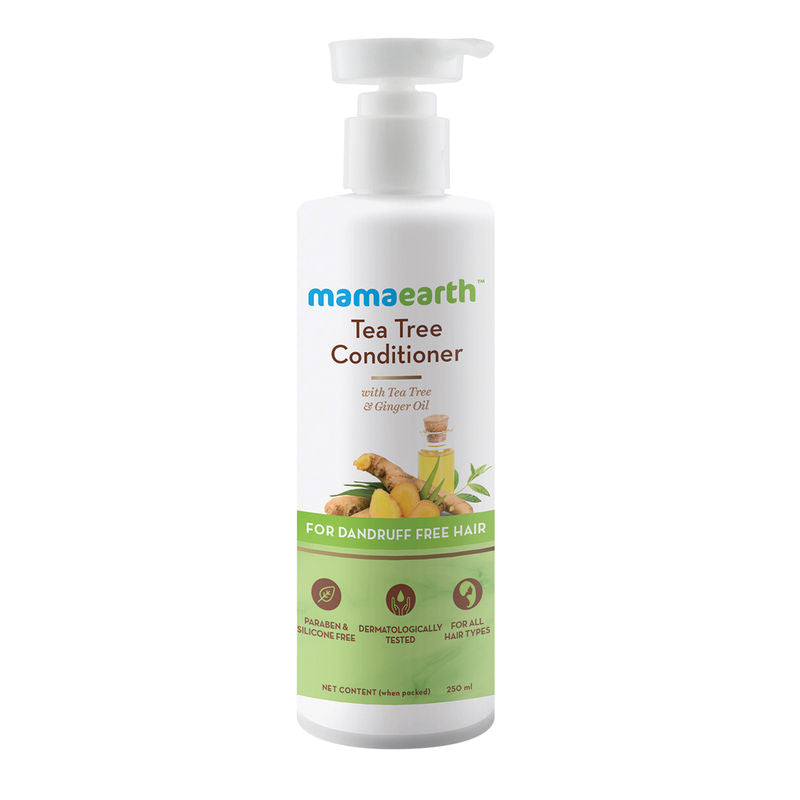

Mamaearth
Mamaearth Tea Tree Anti Dandruff Conditioner With Ginger Oil
Stimulate and renew your hair with an outlandish mix of tea tree and ginger oil that helps in reducing itch and irritation while contributing to the shine and smoothness of the hair and soothing dryness and itchiness. Made using natural ingredients to gently work on and remove dandruff and excess oil, enriched with coconut oil for soft and smooth hair, almond oil for nourishment and shine, and ginger oil to soothe dryness. Safe for colored and chemically treated hair, free from harmful chemicals and toxins like silicones, parabens, mineral oil, and dyes.
Sulfate-free
Paraben-free
Color-safe
Silicone-free
Natural
Oily Scalp
Optimized for Your Environment & Lifestyle
Nykaa
In stock
Recommended

Mamaearth Tea Tree Anti Dandruff Conditioner With Ginger Oil
Mamaearth
mamaearth-tea-tree-anti-dandruff-conditioner-with-ginger-oil
Conditioner
10202939523365
Morning or Evening?
How often will you use this product?
Notes


Secure payment protection
Your Biodata Compatibility Analysis
Based on your 6 hair health indices and environmental factors
Poor Match
Significant incompatibilities
Growth Cycle Health Index
Hair Match
Hair Health Index Alignment
Optimal for OSI, SSI, DI, HSI
Ingredient Efficacy
Matching Ingredient Score
Environment Compatibility
Current UV, Air Quality & Humidity
Why This Works for Your Specific Profile
Damage Index:
Damage levels outside specified range may not benefit optimally from product formulation
Water Quality:
Fine hair becomes weighed down and greasy from heavy formulation
Hair:
Closed cuticles resist product penetration causing surface buildup without internal benefits
Active Lifestyle:
High activity and frequent washing rapidly strip product benefits requiring excessive reapplication
Your Hair Profile Integration
Your Hair Archetype

Density Level

Washing Frequency

Shedding Level

Oil Level
Your Hair Health Indices
Oil Secretion (OSI)
Very low oil production
Scalp Sensitivity (SSI)
Very low sensitivity
Growth Rate (CMR)
Poor metabolism rate
Damage Index (DI)
Minimal damage
Hair Strength (HSI)
Very weak strength
Softness Index (SI)
Significant improvement needed
Water & Environmental Integration

Water:


Expected Results & Timeline
Key Highlights

What is it?
Conditioner with natural active ingredients including tea tree and ginger oil

Who Is It For
All Ages, Suitable for all genders

Budget
Rs. 353.29 - Rs. 706.58

Timeline
3-4 weeks
Why You’ll Love It

What Does It Help With?
Dandruff, Scalp itchiness, Dry scalp, Oily scalp, Hair dullness

Best for
Scalp Issues

Features
Reduces dandruff and controls oil, reduces itching and dryness, nourishes and strengthens hair, suitable for all hair types including colored and chemically treated, free from sulfates, parabens, silicones and artificial preservatives

Checks
MadeSafe certified, dermatologically tested, hypoallergenic
Ingredients Overview
Ingredients List
Aqua, Cetearyl-Alcohol, Caprylic/Capric-Triglyceride, Emulsifying-Wax, Coconut-Oil, Sweet-Almond-Oil, Tea-Tree-Oil, Ginger-Oil, Cetrimonium-Chloride, Polyquaternium-73, Coco-Caprylate/Caprate, Polyquaternium-10, Potassium-Sorbate, Disodium-EDTA, IFRA-Certified-Allergen-Free-Fragrance
Key Ingredients
Tea Tree Oil, Ginger Oil, Coconut Oil, Sweet Almond Oil
Ingredients Details
Coco-caprylate/caprate
Common Name(s): Coco-caprylate/caprate
DESCRIPTION
What It Does: Smooths and softens skin by filling intercorneocyte spaces, reducing friction, and providing a pleasant aesthetic skin feel in formulations.
Why It's Used: Synthetic esters provide tailored aesthetic properties — spreadability, skin feel, volatility, refractive index — that natural oils alone cannot consistently deliver.
How It Works: The ester molecule fills microscopic surface irregularities between corneocytes, reducing coefficient of friction, reflecting light uniformly, and providing a lubrication layer that protects the skin surface.
Typically Found In: Moisturizers,sunscreens,color cosmetics,body lotions,lip products
TECHNICAL DETAILS
Primary Category: Synthetic emollients
Secondary Functions: Emollient
Application Areas:

Facial Skincare

Body Care
Hair Care
Beard Care
Color Cosmetics (Makeup)
Dietary/Oral Supplements
Typical Concentration Range: 1–20%
SOURCING & ETHICS
Vegan Status: Conditional - feedstock declaration required
Halal Status: Unverified - feedstock declaration required (plant, animal and petrochemical routes all exist)
Source Notes: Synthetically produced ester emollient; no animal components. [audit 2026-07-29 rev2: origin-dependent: the same inci exists in plant, animal and petrochemical versions and the name does not discriminate. determination requires shariah-panel sign-off.]
SKIN COMPATIBILITY
Irritancy Rating: 1
Comedogenicity Rating: 1
Sensitivity Concerns: Low sensitization potential at recommended use concentrations.
Safe for Sensitive Skin: Yes
SAFETY & COMPATIBILITY
Safety Profile: Well-characterized cosmetic ingredient with established safety profile. generally non-irritating at typical use concentrations. suitable for leave-on and rinse-off cosmetics.
Works Well With: Silicones,uv filters,other emollients
Avoid Combining With: Strongly alkaline conditions (risk of saponification of ester-type emollients)
SCIENTIFIC NOTE
The spreading coefficient of an emollient is governed by its surface tension, viscosity, and polarity. esters with branched alkyl chains (e.g., isopropyl, isostearyl) spread rapidly and leave a non-tacky film; linear long-chain esters provide more substantive moisturization. hlb value determines the preferred formulation system (w/o vs o/w emulsions).
Last Verified: 2025-01-15
Primary Sources: Cosing eu database; pcpc cosmetic ingredient safety reviews; ingredient-specific safety and efficacy literature
Coconut Oil
Common Name(s): Coconut oil,botanical oil,phytochemical active
CAS Number: N/a
DESCRIPTION
What It Does: Provides antioxidant protection from reactive oxygen species, reduces inflammatory cytokine production in skin, and conditions skin through the plant's phytochemical complex.
Why It's Used: Natural origin narrative, traditional use heritage, and multi-functional phytochemical profile supporting concurrent skin care claims from one ingredient.
How It Works: Polyphenols, terpenoids, and alkaloids scavenge ros via h• donation, inhibit nf-kb or cox-2 inflammatory pathways, and interact with skin surface proteins for conditioning.
Typically Found In: Botanical skin care,natural products
TECHNICAL DETAILS
Primary Category: Active ingredient – antioxidant
Secondary Functions: Free radical scavenging,anti-aging
Application Areas:
Facial Skincare
Body Care
Hair Care
Beard Care
Color Cosmetics (Makeup)
Dietary/Oral Supplements
Typical Concentration Range: 0.1%–10%
SOURCING & ETHICS
Vegan Status: Conditional - supplier confirmation required
Halal Status: Yes
Source Notes: Plant-derived extract or synthetic. [audit 2026-07-29 rev2: status downgraded on audit. determination requires shariah-panel sign-off.]
SKIN COMPATIBILITY
Irritancy Rating: 1/5 – very low
Comedogenicity Rating: 0/5 – non-comedogenic
Sensitivity Concerns: Non-irritating; well-tolerated.
Safe for Sensitive Skin: Yes
SAFETY & COMPATIBILITY
Safety Profile: Excellent safety profile. ewg score: 1.
Works Well With: Vitamin c,vitamin e,ferulic acid,spf,other antioxidants
Avoid Combining With: No significant incompatibilities
SCIENTIFIC NOTE
Plant secondary metabolites evolved as photoprotectants and antimicrobials — mechanisms directly applicable to cosmetic antioxidant and anti-inflammatory activity in human skin.
Last Verified: 2026-03-12
Primary Sources: Cosing database,coconut oil botanical review
Ginger Oil
Common Name(s): Ginger root oil,ginger essential oil
DESCRIPTION
What It Does: Provides warm spicy ginger fragrance with anti-inflammatory and circulation-enhancing warming properties.
Why It's Used: Warming anti-inflammatory spice oil for circulation-enhancing body care and anti-cellulite formulations with authentic warming ginger note.
How It Works: Zingiberene (30-35%) and beta-sesquiphellandrene provide characteristic ginger aroma. 6-gingerol (non-volatile) provides warming trpv1 activation and anti-inflammatory cox inhibition in whole ginger extract. trpv1 activation provides warming sensation for massage products.
Typically Found In: Warming body products,anti-cellulite,spice fragrances,men's grooming
TECHNICAL DETAILS
Primary Category: Active ingredient – antioxidant
Secondary Functions: Free radical scavenging,anti-aging
Application Areas:
Facial Skincare
Body Care
Hair Care
Beard Care
Color Cosmetics (Makeup)
Dietary/Oral Supplements
Typical Concentration Range: 0.001%–2%
SOURCING & ETHICS
Vegan Status: Yes – from zingiber officinale rhizome
Halal Status: Yes
Source Notes: Plant-derived extract or synthetic.
SKIN COMPATIBILITY
Irritancy Rating: 1/5 – very low
Comedogenicity Rating: 0/5 – non-comedogenic
Sensitivity Concerns: Non-irritating; well-tolerated.
Safe for Sensitive Skin: Yes
SAFETY & COMPATIBILITY
Safety Profile: Sensitiser at high concentrations. eu declared allergens: limonene. ifra guidelines.
Works Well With: Vitamin c,vitamin e,ferulic acid,spf,other antioxidants
Avoid Combining With: No significant incompatibilities
SCIENTIFIC NOTE
Ginger oil's volatile compounds (zingiberene, primarily) provide the characteristic ginger aroma but minimal warming effect, while the non-volatile gingerols/shogaols in ginger extract (not in essential oil) provide warming trpv1 activation. this separation means ginger essential oil provides scent without heat, while ginger co2 extract or whole ginger extract provides warming with scent. formulation intent determines which ginger ingredient is appropriate.
Last Verified: 2026-03-12
Primary Sources: Cosing database,ifra standards
Polyquaternium-10
Common Name(s): Pq-10,hydroxyethylcellulose ethyl trimethylammonium chloride,jr-400
CAS Number: 54351-50-7
DESCRIPTION
What It Does: Provides film-forming conditioning and detangling with heat protection in a polymer that adsorbs substantively to hair.
Why It's Used: The most widely used cationic polymer conditioner – provides excellent conditioning and detangling while adsorbing strongly to damaged hair areas that need conditioning most.
How It Works: Cationic quaternary ammonium groups along the polymer backbone adsorb to anionic sites on hair keratin. higher charge density on damaged hair (more negative sites) leads to preferential adsorption where conditioning is needed. polymer film formation provides heat protection and volume.
Typically Found In: Shampoos,2-in-1 products,conditioners,styling products
TECHNICAL DETAILS
Primary Category: Functional ingredient – cationic polymer conditioner
Secondary Functions: Skin conditioning
Application Areas:
Facial Skincare
Body Care
Hair Care
Beard Care
Color Cosmetics (Makeup)
Dietary/Oral Supplements
Typical Concentration Range: 0.1%–2%
SOURCING & ETHICS
Vegan Status: Conditional - supplier confirmation required
Halal Status: Unverified - supplier confirmation required
Source Notes: Commercially produced for cosmetic use. verify vegan/halal status with supplier. [audit 2026-07-29 rev2: the record's own source_notes does not assert a non-animal origin, or instructs the reader to verify with the supplier; "yes" asserts knowledge the record does not hold. determination requires shariah-panel sign-off.]
SKIN COMPATIBILITY
Irritancy Rating: 1/5 – very low
Comedogenicity Rating: 0/5 – non-comedogenic
Sensitivity Concerns: Well-tolerated by most skin types.
Safe for Sensitive Skin: Yes
SAFETY & COMPATIBILITY
Safety Profile: Good safety profile at recommended concentrations. ewg score: 1–2.
Works Well With: Standard skincare actives
Avoid Combining With: No known significant incompatibilities
SCIENTIFIC NOTE
Polyquaternium-10's 'self-targeting' to damaged hair sites is a unique smart conditioning mechanism. as hair damage increases negative charge density by exposing keratin's aspartate and glutamate carboxylate groups, pq-10's cationic polymer backbone adsorbs preferentially to these high-charge damage sites – automatically delivering more conditioning where the hair needs it most.
Last Verified: 2026-03-12
Primary Sources: Cosing database,robbins hair science,cir safety assessment
Personalized Usage Instructions
How to Use
Step 1
After shampooing with Mamaearth Tea Tree Shampoo, take an adequate amount of conditioner in your palm
Step 2
Apply on damp hair from mid-length to tips
Step 3
Leave on for 2-3 minutes
Step 4
Rinse thoroughly
Medical Chemicals

Protein/Moisture
- Moisture
pH Level
- Acidic

Porosity Taget
- Normal Porosity
Customized for Your Profile
Scalp Condtions
Anti-Dandruff, Sensitive Scalp, pH Balanced, Oil Control, Dry Scalp
Climate Suitability
Humid, Dry, Hard Water, Soft Water
Clinical Claims
Dermatologically tested and hypoallergenic, certified MadeSafe brand
Frequency
After shampooing with Mamaearth Tea Tree Shampoo, take an adequate amount of conditioner in your palm. Apply on damp hair from mid-length to tips. Leave on for 2-3 minutes. Rinse thoroughly.
Product Information

MadeSafe certified
dermatologically tested
hypoallergenic