

Mamaearth
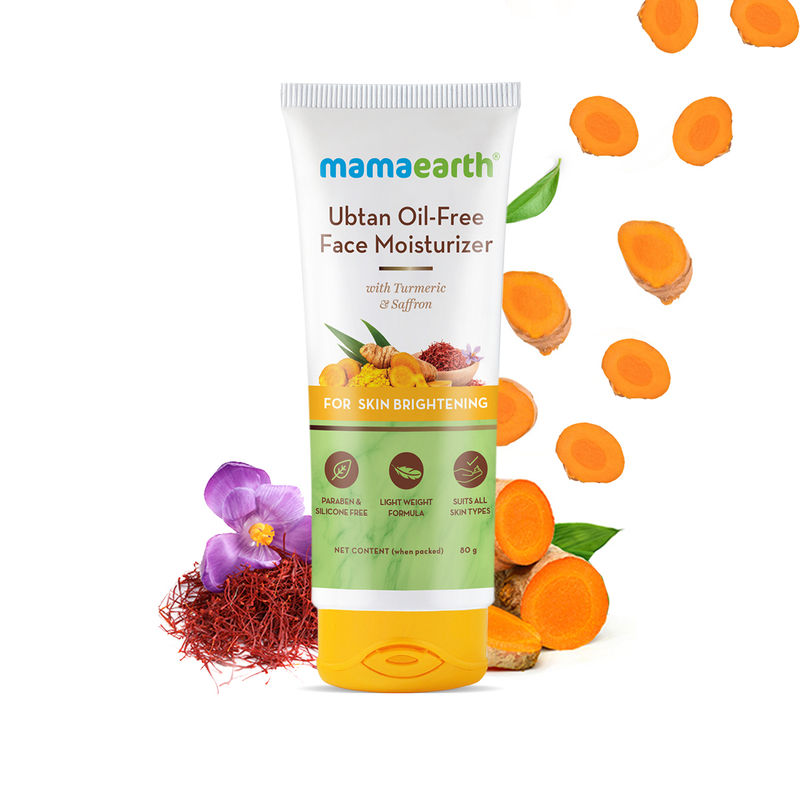
Mamaearth Ubtan Oil-Free Face Moisturizer With Turmeric & Saffron For Skin Brightening

Mamaearth Ubtan Oil-Free Face Moisturizer With Turmeric & Saffron For Skin Brightening
Mamaearth
mamaearth-ubtan-oil-free-face-moisturizer-with-turmeric-saffron-for-skin-brightening
Moisturize
10084914037029
Morning or Evening?
How often will you use this product?
Notes


Highlights
WHAT IS IT?
Oil-Free Face Moisturizer with 4 key ingredients
FEATURES
Non-Sticky Moisturization, Keeps Skin Soft and Supple, Brightens and Makes Skin Glow
BEST FOR
normal
CHECKS
Silicones, Parabens, Mineral oils, Dyes
Who Is It For?
All Genders Suitable For All Skin TypesWhat Does It Help With?
Skin Brightening Hydration Sun Protection Anti-agingBudget
Affordable (under $30)How To Use
Which routine should it be used in?
Instructions:
Key Information


What Mamaearth Says
Product Description:
Glow without the grease! Treat your skin to the traditional goodness of turmeric and saffron with Mamaearth's Ubtan Oil-Free Face Moisturizer that brightens without being sticky. The hydrating formula keeps the skin soft and plump all day long while the traditional goodness of ubtan naturally protects you. Crafted especially for Indian weather, this face moisturizer is extremely lightweight and gets absorbed into the skin in no time, leaving behind a non-greasy matte finish. With a philosophy aimed at making products free of toxins and harmful chemicals, you won't find any silicones, parabens, mineral oils and dyes in Mamaearth's products.
About the Brand:
Ingredients Overview
Ingredients List
Aqua, Cetearyl-Ethylhexanoate, Diethylhexyl-Carbonate, Coco-Caprylate/Caprate, Pentaerythrityl-Distearate, Polyglyceryl-3-Dicitrate/Stearate, Glyceryl-Stearate-Citrate, Betaine, Methyl-Methacrylate-Crosspolymer, Trilaurin, Behenyl-Alcohol, Caesalpinia-Spinosa-Gum, Tetrahydrocurcumin-(Turmeric), Saffron-Flower-Extract, Soyabean-Oil, Carrot-Root-Extract, Beta-Carotene, Tocopherol, Ethylhexylglycerin, Phenoxyethanol, Sodium-Hydroxide, Acrylates/C10-30 Alkyl-Acrylate-Crosspolymer, Disodium-EDTA, IFRA-Certified-Allergen-Free-Fragrance
Key Ingredients
Turmeric, Saffron, Soybean Oil, Carrot Root
Ingredients Details
Beta-carotene
Common Name(s): Provitamin a,all-trans-beta-carotene
CAS Number: 7235-40-7
DESCRIPTION
What It Does: Neutralizes free radicals, provides photoprotection support, conditions skin, and imparts healthy skin tone.
Why It's Used: Natural antioxidant, skin conditioning, and natural colorant with additional provitamin a activity.
How It Works: Quenches singlet oxygen and free radicals. enzymatic cleavage yields retinal. accumulates in stratum corneum for photoprotective antioxidant defense.
Typically Found In: Self-tanners,sunscreens,natural colorants,anti-aging formulations
TECHNICAL DETAILS
Primary Category: Active ingredient – vitamin a derivative
Secondary Functions: Uv protection support,natural colorant,vitamin a precursor
Application Areas:

Facial Skincare
Body Care

Hair Care
Beard Care
Color Cosmetics (Makeup)
Dietary/Oral Supplements
Typical Concentration Range: 0.01%–1%
SOURCING & ETHICS
Vegan Status: Yes – plant-derived or fermentation
Halal Status: Yes
Source Notes: Derived from dunaliella salina algae, carrot oil, or synthesized. algae-derived most sustainable.
SKIN COMPATIBILITY
Irritancy Rating: 1/5 – very low
Comedogenicity Rating: 0/5 – non-comedogenic
Sensitivity Concerns: Very well-tolerated; high concentrations may impart orange tint.
Safe for Sensitive Skin: Yes
SAFETY & COMPATIBILITY
Safety Profile: Safe at cosmetic concentrations. use spf. avoid during pregnancy. ewg score: 2.
Works Well With: Niacinamide,ceramides,hyaluronic acid,spf,tocopherol
Avoid Combining With: No significant incompatibilities
SCIENTIFIC NOTE
Beta-carotene accumulates in the stratum corneum and provides measurable photoprotection against uv-induced oxidative stress when applied topically. not a replacement for uv filters.
Last Verified: Cosing database,cir safety assessment,stahl & sies carotenoid review
Primary Sources: 2026-03-12
Betaine
Common Name(s): Trimethylglycine,tmg,natural betaine
CAS Number: 107-43-7
DESCRIPTION
What It Does: Provides osmoprotective humectant conditioning with anti-irritant and mild foam-boosting activity.
Why It's Used: Natural-origin multifunctional osmolyte from sugar beet providing hydration, anti-irritancy, and conditioning in virtually every cosmetic category.
How It Works: Quaternary ammonium betaine provides zwitterionic character for water binding via ionic hydration. osmoprotective function at 100–500mm as compatible solute protecting cells from osmotic stress. reduces surfactant irritation by competing with sls for protein binding sites. mild foam enhancement.
Typically Found In: Virtually all categories — moisturisers, shampoos, cleansers
TECHNICAL DETAILS
Primary Category: Functional ingredient – humectant
Secondary Functions: Tewl reduction,skin plumping
Application Areas:
Facial Skincare
Body Care
Hair Care
Beard Care
Color Cosmetics (Makeup)
Dietary/Oral Supplements
Typical Concentration Range: 0.5%–10%
SOURCING & ETHICS
Vegan Status: Yes – from beta vulgaris (sugar beet) molasses
Halal Status: Yes
Source Notes: Synthetic or naturally derived. excellent aqueous solubility.
SKIN COMPATIBILITY
Irritancy Rating: 1/5 – very low
Comedogenicity Rating: 0/5 – non-comedogenic
Sensitivity Concerns: Non-irritating; suitable for all skin types.
Safe for Sensitive Skin: Yes
SAFETY & COMPATIBILITY
Safety Profile: Excellent safety profile. ewg score: 1.
Works Well With: Ceramides,emollients,occlusives,glycerin,hyaluronic acid
Avoid Combining With: No significant incompatibilities
SCIENTIFIC NOTE
Betaine's anti-irritant mechanism for surfactant systems involves competitive protein protection: betaine at high concentrations preferentially interacts with skin proteins, occupying binding sites that would otherwise be occupied by surfactant molecules causing protein denaturation. this competition reduces available protein binding for irritating surfactants, explaining betaine's well-documented ability to reduce sls irritation when co-formulated.
Last Verified: Cosing database,craig betaine osmoprotective review,cir safety assessment
Primary Sources: 2026-03-12
Coco-caprylate/caprate
Common Name(s): Coco-caprylate/caprate
DESCRIPTION
What It Does: Smooths and softens skin by filling intercorneocyte spaces, reducing friction, and providing a pleasant aesthetic skin feel in formulations.
Why It's Used: Synthetic esters provide tailored aesthetic properties — spreadability, skin feel, volatility, refractive index — that natural oils alone cannot consistently deliver.
How It Works: The ester molecule fills microscopic surface irregularities between corneocytes, reducing coefficient of friction, reflecting light uniformly, and providing a lubrication layer that protects the skin surface.
Typically Found In: Moisturizers,sunscreens,color cosmetics,body lotions,lip products
TECHNICAL DETAILS
Primary Category: Synthetic emollients
Secondary Functions: Emollient
Application Areas:
Facial Skincare
Body Care
Hair Care
Beard Care
Color Cosmetics (Makeup)
Dietary/Oral Supplements
Typical Concentration Range: 1–20%
SOURCING & ETHICS
Vegan Status: Yes
Halal Status: Yes
Source Notes: Synthetically produced ester emollient; no animal components.
SKIN COMPATIBILITY
Irritancy Rating: 1
Comedogenicity Rating: 1
Sensitivity Concerns: Low sensitization potential at recommended use concentrations.
Safe for Sensitive Skin: Yes
SAFETY & COMPATIBILITY
Safety Profile: Well-characterized cosmetic ingredient with established safety profile. generally non-irritating at typical use concentrations. suitable for leave-on and rinse-off cosmetics.
Works Well With: Silicones,uv filters,other emollients
Avoid Combining With: Strongly alkaline conditions (risk of saponification of ester-type emollients)
SCIENTIFIC NOTE
The spreading coefficient of an emollient is governed by its surface tension, viscosity, and polarity. esters with branched alkyl chains (e.g., isopropyl, isostearyl) spread rapidly and leave a non-tacky film; linear long-chain esters provide more substantive moisturization. hlb value determines the preferred formulation system (w/o vs o/w emulsions).
Last Verified: Cosing eu database; pcpc cosmetic ingredient safety reviews; ingredient-specific safety and efficacy literature
Primary Sources: 2025-01-15
Ethylhexylglycerin
Common Name(s): Octylglycerin,2-ethylhexyl glycerol ether,sensiva sc 10
CAS Number: 70445-33-9
DESCRIPTION
What It Does: Provides antimicrobial skin conditioning with deodorant activity and preservation system enhancement.
Why It's Used: Multifunctional clean beauty preservation active — ethylhexylglycerin provides antimicrobial, deodorant, and skin conditioning in a single ingredient accepted in most natural cosmetic certification schemes.
How It Works: Glycerol ether provides antimicrobial via bacterial membrane phospholipid disruption. deodorant activity via reduction of underarm lipase enzyme activity (similar mechanism to triethyl citrate). skin conditioning from glycerol humectant component. synergistic with phenoxyethanol and diols.
Typically Found In: Natural preservation systems,deodorants,skin conditioning products
TECHNICAL DETAILS
Primary Category: Functional ingredient – antimicrobial glycerol ether
Secondary Functions: Skin conditioning
Application Areas:
Facial Skincare
Body Care
Hair Care
Beard Care
Color Cosmetics (Makeup)
Dietary/Oral Supplements
Typical Concentration Range: 0.1%–0.5%
SOURCING & ETHICS
Vegan Status: Yes – synthetic
Halal Status: Yes
Source Notes: Commercially produced for cosmetic use. verify vegan/halal status with supplier.
SKIN COMPATIBILITY
Irritancy Rating: 1/5 – very low
Comedogenicity Rating: 0/5 – non-comedogenic
Sensitivity Concerns: Well-tolerated by most skin types.
Safe for Sensitive Skin: Yes
SAFETY & COMPATIBILITY
Safety Profile: Good safety profile at recommended concentrations. ewg score: 1–2.
Works Well With: Standard skincare actives
Avoid Combining With: No known significant incompatibilities
SCIENTIFIC NOTE
Ethylhexylglycerin's deodorant mechanism is pharmacologically identical to triethyl citrate: both inhibit skin surface microbial lipase enzymes that convert odourless triglycerides to odorous free fatty acids. the glycerol ether structure of ethylhexylglycerin, combined with the 2-ethylhexyl chain, provides lipase inhibition similar to ester-based lipase inhibitors from a different chemical class.
Last Verified: Cosing database,schülke sensiva sc 10 technical data,cir safety assessment
Primary Sources: 2026-03-12
