

Mamaearth
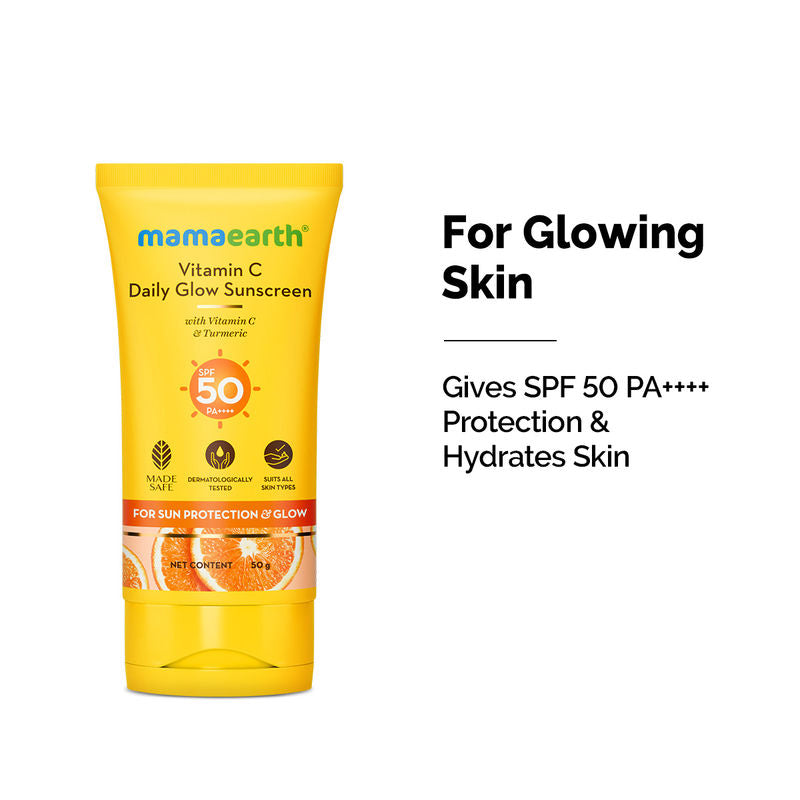
Mamaearth Vitamin C Daily Glow Sunscreen with Vit C & Turmeric for Tan Protection & Glow SPF50 PA+

Mamaearth Vitamin C Daily Glow Sunscreen with Vit C & Turmeric for Tan Protection & Glow SPF50 PA+
Mamaearth
mamaearth-vitamin-c-daily-glow-sunscreen-with-vit-c-turmeric-for-tan-protection-glow-spf50-pa
Suncare
10084914200869
Morning or Evening?
How often will you use this product?
Notes


Highlights
WHAT IS IT?
Face Sunscreen with 20 ingredients
FEATURES
Protects against tan, Contains Vitamin C and Turmeric, SPF50 PA+ rating, Absorbs without white cast, Mild fragrance
BEST FOR
normal
CHECKS
No white cast, IFRA Certified Allergen Free Fragrance, Paraben-Free, Sulfate-free
Who Is It For?
All Adults Both GendersWhat Does It Help With?
Tan Protection Skin Glow Sun ProtectionBudget
Affordable (under $30)How To Use
Which routine should it be used in?
Instructions:
Key Information


What Mamaearth Says
Product Description:
Mamaearth Vitamin C Daily Glow Sunscreen with Vit C & Turmeric for Tan Protection & Glow SPF50 PA+ offers protection against tan and helps to give glow. It contains Vitamin C and Turmeric and is designed for face sun care.
About the Brand:
Ingredients Overview
Ingredients List
Aqua,Octisalate,C12-15-Alkyl-Benzoate,Octocrylene,Sorbitan-Stearate,Sucrose-Cocoate,Homosalate,Butyl-Methoxydibenzoylmethane,Zinc-Oxide,Cetearyl-Ethylhexanoate,Propylene-Glycol,Cetearyl-Alcohol,Glyceryl-Stearate,Glycerin,Hydroxyethyl-Acrylate-Sodium-Acryloyldimethyl-Taurate-Copolymer,Phenoxyethanol,Ethylhexyl-Triazone,Tinosorb-M,Turmeric-Root-Extract,Orange-Peel-Extract,Lemon-Fruit-Extract,Butylated-Hydroxy-Toluene,Disodium-EDTA,Citric-Acid,IFRA-Certified-Allergen-Free-Fragrance
Key Ingredients
Vitamin C, Turmeric Root Extract, Zinc Oxide
Ingredients Details
Glycerin
Common Name(s): Glycerol,glycerine,1,2,3-propanetriol
CAS Number: 56-81-5
DESCRIPTION
What It Does: Glycerin pulls water from the environment and deeper skin layers into the outer skin layer (epidermis), boosting moisture levels and keeping skin soft, smooth, and plump.
Why It's Used: It is used in virtually every moisturizer, serum, and cleanser because it is highly effective at hydrating skin, is well-tolerated by all skin types, and enhances the texture and spreadability of formulations.
How It Works: As a humectant, glycerin forms hydrogen bonds with water molecules, trapping them in the skin. it also reinforces the skin barrier by integrating into lipid structures between skin cells.
Typically Found In: Moisturizers,serums,cleansers,toners,sheet masks,sunscreens,body lotions,shampoos,conditioners
TECHNICAL DETAILS
Primary Category: Humectant
Secondary Functions: Skin barrier support,emollient,solvent
Application Areas:

Facial Skincare
Body Care
Hair Care
Beard Care

Color Cosmetics (Makeup)
Dietary/Oral Supplements
Typical Concentration Range: 1%–30% (typical: 3–10%)
SOURCING & ETHICS
Vegan Status: Conditional - feedstock declaration required
Halal Status: Unverified - feedstock declaration required (plant, animal and petrochemical routes all exist)
Source Notes: Derived from plant oils via hydrolysis or saponification; synthetic versions also available. palm-derived glycerin carries sustainability concerns. [audit 2026-07-29 rev2: origin-dependent: the same inci exists in plant, animal and petrochemical versions and the name does not discriminate. determination requires shariah-panel sign-off.]
SKIN COMPATIBILITY
Irritancy Rating: 1/5 – very low; non-irritating at all standard concentrations
Comedogenicity Rating: 0/5 – non-comedogenic
Sensitivity Concerns: Extremely rare allergic reactions; generally safe for all skin types including sensitive and baby skin
Safe for Sensitive Skin: Yes
SAFETY & COMPATIBILITY
Safety Profile: Widely recognized as safe. ewg hazard score: 1. no significant concerns for irritation, sensitization, or toxicity at typical concentrations (up to 50%).
Works Well With: Hyaluronic acid,ceramides,niacinamide,panthenol,urea,peptides,retinol,ahas/bhas
Avoid Combining With: No known incompatibilities at standard concentrations
SCIENTIFIC NOTE
Glycerin is an endogenous skin component found naturally in the stratum corneum. aquaporin-3 channels in keratinocytes facilitate glycerin transport, making it integral to natural skin hydration pathways.
Last Verified: 2026-03-12
Primary Sources: Cosing database,cir safety assessment,ewg skin deep,inci decoder
Homosalate
Common Name(s): Hms,3,3,5-trimethylcyclohexyl salicylate
CAS Number: 118-56-9
DESCRIPTION
What It Does: Provides uvb filtration and co-solvent function enabling higher uv filter concentrations in high-spf formulas.
Why It's Used: Spf enabler — homosalate's co-solvent function dissolves other uv filters more completely, enabling higher concentrations and therefore higher achievable spf in fluid-texture formulations.
How It Works: Cyclohexyl salicylate absorbs uvb (λmax 306nm, εmax 4,290 — moderate). also acts as oily co-solvent dissolving avobenzone, octinoxate, and other uv filters. photostable cyclohexyl structure.
Typically Found In: High-spf combination sunscreens
TECHNICAL DETAILS
Primary Category: Active ingredient – cyclohexyl salicylate uvb filter
Secondary Functions: Skin conditioning
Application Areas:
Facial Skincare
Body Care
Hair Care
Beard Care
Color Cosmetics (Makeup)
Dietary/Oral Supplements
Typical Concentration Range: Up to 15% (eu), 10% (us fda)
SOURCING & ETHICS
Vegan Status: Conditional - supplier confirmation required
Halal Status: Unverified - supplier confirmation required
Source Notes: Commercially produced for cosmetic use. verify vegan/halal status with supplier. [audit 2026-07-29 rev2: the record's own source_notes does not assert a non-animal origin, or instructs the reader to verify with the supplier; "yes" asserts knowledge the record does not hold. determination requires shariah-panel sign-off.]
SKIN COMPATIBILITY
Irritancy Rating: 1/5 – very low
Comedogenicity Rating: 0/5 – non-comedogenic
Sensitivity Concerns: Well-tolerated by most skin types.
Safe for Sensitive Skin: Yes
SAFETY & COMPATIBILITY
Safety Profile: Eu max 15% (sccs 2019 reduced limit). fda: 10%. potential endocrine activity at high concentrations. ewg score: 4.
Works Well With: Standard skincare actives
Avoid Combining With: No known significant incompatibilities
SCIENTIFIC NOTE
Homosalate's maximum concentration in eu was reduced from 10% to 15% in sccs opinion 2019 (counter-intuitively raised, not reduced) specifically to enable effective uv filter dissolution — demonstrating that homosalate's primary value is as a co-solvent enabling other uv filters to function, not solely as a uv filter itself.
Last Verified: 2026-03-12
Primary Sources: Cosing database,fda uv filter otc monograph,sccs homosalate opinion
Octisalate
Common Name(s): Organic uv filter,uv absorbing sunscreen active,photoprotection
CAS Number: N/a
DESCRIPTION
What It Does: Absorbs uva (320–400 nm) and/or uvb (290–320 nm) photons with a high molar extinction coefficient, dissipates absorbed energy as vibrational heat, and contributes to the formulation's spf and critical wavelength.
Why It's Used: Organic uv filters are selected for their high molar extinction coefficient (>10,000 l/mol/cm for most commercial filters), specific spectral coverage complementing other filters in the system, and photostability under prolonged uv exposure.
How It Works: Aromatic π→π* and n→π* electronic transitions absorb uv photons exciting the chromophore to a singlet excited state (s₁). ultra-fast internal conversion (10⁻¹²–10⁻¹¹ s) dissipates excitation energy as heat rather than photochemical reactions, returning the molecule to the ground state for continued absorption.
Typically Found In: Sunscreens,spf formulas
TECHNICAL DETAILS
Primary Category: Active ingredient – cosmetic active
Secondary Functions: Skin conditioning
Application Areas:
Facial Skincare
Body Care
Hair Care
Beard Care
Color Cosmetics (Makeup)
Dietary/Oral Supplements
Typical Concentration Range: Check local sunscreen limits
SOURCING & ETHICS
Vegan Status: Conditional - supplier confirmation required
Halal Status: Unverified - supplier confirmation required
Source Notes: Commercially produced for cosmetic use. verify vegan/halal status with supplier. [audit 2026-07-29 rev2: the record's own source_notes does not assert a non-animal origin, or instructs the reader to verify with the supplier; "yes" asserts knowledge the record does not hold. determination requires shariah-panel sign-off.]
SKIN COMPATIBILITY
Irritancy Rating: 1/5 – very low
Comedogenicity Rating: 0/5 – non-comedogenic
Sensitivity Concerns: Well-tolerated by most skin types.
Safe for Sensitive Skin: Yes
SAFETY & COMPATIBILITY
Safety Profile: Good safety profile at recommended concentrations. ewg score: 1–2.
Works Well With: Standard skincare actives
Avoid Combining With: No known significant incompatibilities
SCIENTIFIC NOTE
Organic uv filter photostability varies significantly — avobenzone degrades rapidly alone but is stabilised by octocrylene (energy quenching) or triazine-class filters (direct stabilisation). filter combination selection must account for photostabilisation requirements of each component.
Last Verified: 2026-03-12
Primary Sources: Cosing database,organic uv filter photostability combination review
Octocrylene
Common Name(s): 2-ethylhexyl 2-cyano-3,3-diphenylacrylate
CAS Number: 6197-30-4
DESCRIPTION
What It Does: Provides uvb-uva-ii uv protection and essential avobenzone photostabilisation.
Why It's Used: The essential combination partner — octocrylene's dual uv filter + avobenzone photostabilisation function makes it virtually irreplaceable for durable broad-spectrum chemical sunscreens requiring uva-i coverage.
How It Works: Cyanocinnamate chromophore absorbs uvb-uva-ii (λmax 303nm). triplet energy transfer from excited avobenzone to octocrylene photostabilises avobenzone (>90% efficiency at 3:1 avobenzone:octocrylene ratio). hydrophobic character enhances water resistance.
Typically Found In: Broad-spectrum sunscreens,avobenzone-containing formulas
TECHNICAL DETAILS
Primary Category: Active ingredient – uv filter and photostabiliser
Secondary Functions: Skin conditioning
Application Areas:
Facial Skincare
Body Care
Hair Care
Beard Care
Color Cosmetics (Makeup)
Dietary/Oral Supplements
Typical Concentration Range: Up to 10% (eu), 10% (us fda)
SOURCING & ETHICS
Vegan Status: Conditional - supplier confirmation required
Halal Status: Unverified - supplier confirmation required
Source Notes: Commercially produced for cosmetic use. verify vegan/halal status with supplier. [audit 2026-07-29 rev2: the record's own source_notes does not assert a non-animal origin, or instructs the reader to verify with the supplier; "yes" asserts knowledge the record does not hold. determination requires shariah-panel sign-off.]
SKIN COMPATIBILITY
Irritancy Rating: 1/5 – very low
Comedogenicity Rating: 0/5 – non-comedogenic
Sensitivity Concerns: Well-tolerated by most skin types.
Safe for Sensitive Skin: Yes
SAFETY & COMPATIBILITY
Safety Profile: Eu max 10%. fda: 10%. ewg score: 3. recent benzophenone impurity concerns from aged product hydrolysis under study.
Works Well With: Standard skincare actives
Avoid Combining With: No known significant incompatibilities
SCIENTIFIC NOTE
Octocrylene's triplet energy transfer photostabilisation of avobenzone operates via a dexter electron exchange mechanism: excited-state avobenzone (triplet) transfers excitation energy to octocrylene via orbital overlap, allowing avobenzone to return to its ground state uv-absorbing form without photodegradation. this energy transfer is only efficient at close molecular proximity — requiring intimate mixing of the two compounds in the formulation oil phase.
Last Verified: 2026-03-12
Primary Sources: Cosing database,fda uv filter otc monograph,sccs octocrylene opinion