
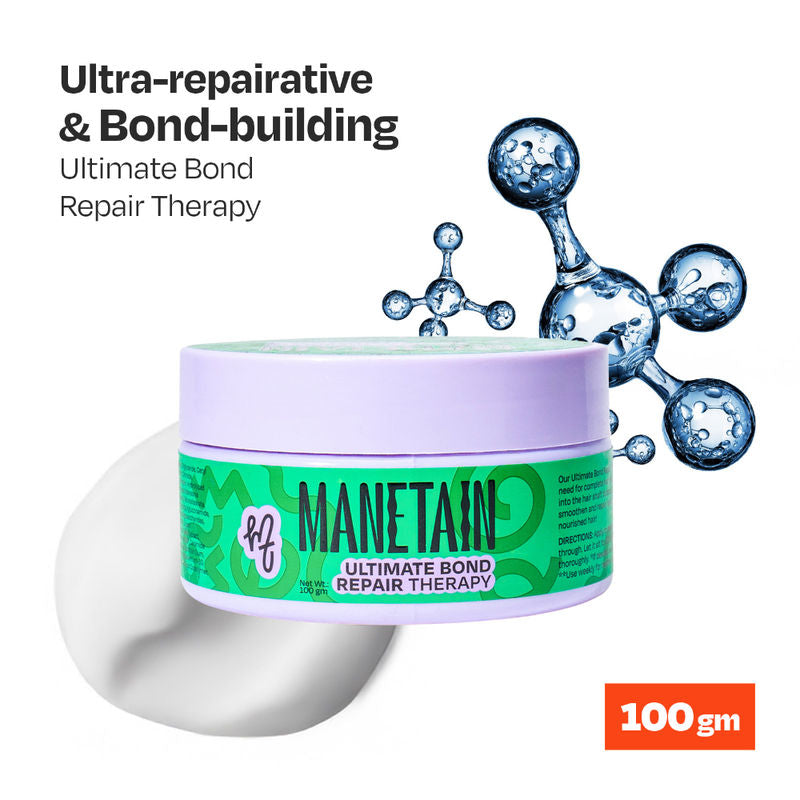

Manetain
Manetain Ultimate Bond Repair Therapy - Hydrates, Strengthens & Restores Damaged Hair
A bond repair therapy that hydrates, strengthens, and restores damaged hair with plant-based proteins, ceramides, and Fiberhance™ technology for repairing internal keratin structure and improving hair health.
Protein-free
Bond Building
Damage Repair
Dryness
Breakage
All Types
Optimized for Your Environment & Lifestyle
Nykaa
In stock
Recommended

Manetain Ultimate Bond Repair Therapy - Hydrates, Strengthens & Restores Damaged Hair
Manetain
manetain-ultimate-bond-repair-therapy-hydrates-strengthens-restores-damaged-hair
Hair Mask
10202939687205
Morning or Evening?
How often will you use this product?
Notes


Secure payment protection
Your Biodata Compatibility Analysis
Based on your 6 hair health indices and environmental factors
Poor Match
Significant incompatibilities
Growth Cycle Health Index
Hair Match
Hair Health Index Alignment
Optimal for OSI, SSI, DI, HSI
Ingredient Efficacy
Matching Ingredient Score
Environment Compatibility
Current UV, Air Quality & Humidity
Why This Works for Your Specific Profile
Damage Index:
Damage levels outside specified range may not benefit optimally from product formulation
Water Quality:
Dry or dull hair experiences increased brittleness from protein concentration without moisture balance
Hair:
Closed cuticles resist product penetration causing surface buildup without internal benefits
Active Lifestyle:
Activity levels outside optimal range affect product performance and maintenance requirements
Your Hair Profile Integration
Your Hair Archetype

Density Level

Washing Frequency

Shedding Level

Oil Level
Your Hair Health Indices
Oil Secretion (OSI)
Very low oil production
Scalp Sensitivity (SSI)
Very low sensitivity
Growth Rate (CMR)
Poor metabolism rate
Damage Index (DI)
Minimal damage
Hair Strength (HSI)
Very weak strength
Softness Index (SI)
Significant improvement needed
Water & Environmental Integration

Water:


Expected Results & Timeline
Key Highlights

What is it?
Hair Cream/Mask with key proteins and ceramides

Who Is It For
Adults, All Genders

Budget
Rs. 799.33 - Rs. 1,598.66

Timeline
Noticeable effect after one use
Why You’ll Love It

What Does It Help With?
Damage Repair, Dryness, Breakage

Best for
Damage Repair

Features
Hydrates damaged hair, strengthens hair bonds with plant proteins and ceramides, restores internal keratin structure, smooths and adds shine

Checks
100% Authentic
Ingredients Overview
Ingredients List
Purified-Water,Caprylic-Capric-Triglyceride,Cetyl-Alcohol,Cetostearyl-Alcohol,Behentrimonium-Chloride,Hydrolyzed-Wheat-Protein,Hydrolyzed-Soy-Protein,Hydrolyzed-Corn-Protein,Cetrimonium-Chloride,Hydrolyzed-Adansonia-Digitata-Seed-Extract,Glyceryl-Monostearate,Quaternium-87,Polyquaternium-39,Hydroxypropylgluconamide,Hydroxypropylammonium-Gluconate,Fructooligosaccharides,Beta-Vulgaris-Root-Extract,Soy-Lecithin,Linum-Usitatissimum-Seed-Extract,Salvia-Hispanica-Seed-Extract,Carbomer,Cholesterol,Ceramide-Ap,Ceramide-Eop,Ceramide-Np,Phytospingosine,Sodium-Lauroyl-Lactylate,Xanthan-Gum,Guarhydroxytriammonium-Chloride,Polyquaternium-10,Diheptyl-Succinate,Capryloyl-Glycerin-Sebacic-Acid-Copolymer,Phenoxyethanol,Natural-Essential-Oil
Key Ingredients
Plant-Based Proteins,Ceramides,Fiberhance™
Ingredients Details
Carbomer
Common Name(s): Carbopol,polyacrylic acid,carboxyvinyl polymer
DESCRIPTION
What It Does: Provides transparent gel textures and thickening at very low concentrations via ph-responsive swelling.
Why It's Used: The most widely used gel thickener – provides crystal-clear, stable gels at concentrations as low as 0.1-0.5% with ph-controlled viscosity.
How It Works: Highly crosslinked polyacrylic acid remains tightly coiled at acidic ph. neutralization with naoh or triethanolamine ionizes carboxylic groups causing electrostatic repulsion that unfolds and swells the polymer coils, dramatically increasing viscosity. concentration-dependent thickening.
Typically Found In: Gels,serums,emulsions,sunscreens
TECHNICAL DETAILS
Primary Category: Functional ingredient – polyacrylic acid thickener
Secondary Functions: Skin conditioning
Application Areas:

Facial Skincare

Body Care
Hair Care
Beard Care
Color Cosmetics (Makeup)
Dietary/Oral Supplements
Typical Concentration Range: 0.1%–2%
SOURCING & ETHICS
Vegan Status: Yes – synthetic
Halal Status: Yes
Source Notes: Commercially produced for cosmetic use. verify vegan/halal status with supplier.
SKIN COMPATIBILITY
Irritancy Rating: 1/5 – very low
Comedogenicity Rating: 0/5 – non-comedogenic
Sensitivity Concerns: Well-tolerated by most skin types.
Safe for Sensitive Skin: Yes
SAFETY & COMPATIBILITY
Safety Profile: Good safety profile at recommended concentrations. ewg score: 1–2.
Works Well With: Standard skincare actives
Avoid Combining With: No known significant incompatibilities
SCIENTIFIC NOTE
Carbomer's ph-responsive swelling mechanism provides an elegant formulation control tool: a neutralized gel can be liquefied by ph reduction (adding acid) and re-thickened by reneutralization. this reversible rheology control allows two-phase products that mix on application without the need for mechanical emulsification.
Last Verified: Cosing database,cir safety assessment
Primary Sources: 2026-03-12
Ceramides
Common Name(s): Ceramides,ceramide sphingolipid,sc barrier lipid
CAS Number: N/a
DESCRIPTION
What It Does: Restores sc lamellar lipid bilayers, reduces trans-epidermal water loss, repairs barrier dysfunction in dry and eczematous skin, and strengthens the physical barrier against environmental irritants.
Why It's Used: Provides direct structural barrier lipid replacement — unlike humectants that attract water, ceramides physically rebuild the lipid bilayer architecture required to retain moisture within the skin.
How It Works: Ceramides integrate into the sc intercellular lamellar bilayer, restoring the ordered orthorhombic packing disrupted in barrier-compromised skin. the sphingosine backbone's amide bond and hydroxyl groups form the h-bonding network that stabilises the lamellar structure.
Typically Found In: Barrier repair,dry skin,eczema-prone
TECHNICAL DETAILS
Primary Category: Functional ingredient – emollient
Secondary Functions: Barrier sealing,softening
Application Areas:
Facial Skincare
Body Care
Hair Care
Beard Care
Color Cosmetics (Makeup)
Dietary/Oral Supplements
Typical Concentration Range: 0.01%–5%
SOURCING & ETHICS
Vegan Status: Conditional
Halal Status: Yes
Source Notes: Plant-derived, synthetic or animal-derived. verify source.
SKIN COMPATIBILITY
Irritancy Rating: 1/5 – very low
Comedogenicity Rating: 1/5 – low; formulation-dependent
Sensitivity Concerns: Non-irritating.
Safe for Sensitive Skin: Yes
SAFETY & COMPATIBILITY
Safety Profile: Excellent safety profile. ewg score: 1.
Works Well With: Humectants,ceramides,actives as carrier
Avoid Combining With: No significant incompatibilities
SCIENTIFIC NOTE
Sc ceramides comprise ~50% of the sc lipid mass (by weight) and are essential for barrier function; ceramide depletion in atopic dermatitis and aged skin is a primary driver of barrier dysfunction and tewl elevation.
Last Verified: Cosing database,ceramides ceramide barrier review
Primary Sources: 2026-03-12
Cholesterol
Common Name(s): 5-cholesten-3-ol,cholesterin
CAS Number: 57-88-5
DESCRIPTION
What It Does: Provides essential barrier sterol function as one of three critical stratum corneum lipid components.
Why It's Used: Essential component of complete barrier repair formulations – the stratum corneum barrier requires ceramides:cholesterol:fatty acids in approximately 1:1:1 molar ratio for complete barrier restoration.
How It Works: Integrates between ceramide headgroups in lamellar body structures, providing fluidity and flexibility to the otherwise rigid ceramide-dominated lipid matrix. controls lamellar body phase behavior for functional barrier.
Typically Found In: Barrier repair moisturizers,eczema treatments,dry skin formulations
TECHNICAL DETAILS
Primary Category: Active ingredient – barrier sterol
Secondary Functions: Lamellar body structure,barrier sterol
Application Areas:
Facial Skincare
Body Care
Hair Care
Beard Care
Color Cosmetics (Makeup)
Dietary/Oral Supplements
Typical Concentration Range: 0.01%–1%
SOURCING & ETHICS
Vegan Status: Conditional – animal-derived (lanolin) or plant-derived phytosterol analogs; verify
Halal Status: Conditional – verify source
Source Notes: Traditionally from lanolin (wool grease). plant-derived cholesterol alternatives include phytosterols, though these show slightly different barrier integration. verify for vegan/halal.
SKIN COMPATIBILITY
Irritancy Rating: 1/5 – very low
Comedogenicity Rating: 0/5 – non-comedogenic
Sensitivity Concerns: Endogenous molecule; excellent tolerability.
Safe for Sensitive Skin: Yes
SAFETY & COMPATIBILITY
Safety Profile: Exceptional safety profile. natural skin component. ewg score: 1.
Works Well With: Other ceramides,cholesterol,free fatty acids,hyaluronic acid,niacinamide
Avoid Combining With: No significant incompatibilities
SCIENTIFIC NOTE
Elias demonstrated that barrier repair requires all three lipid classes (ceramides, cholesterol, fatty acids) in approximately equimolar ratios. formulations providing only ceramides without cholesterol and fatty acids show significantly inferior barrier restoration vs complete triple-lipid combinations.
Last Verified: Cosing database,elias et al. barrier lipid ratio study,loden barrier repair review
Primary Sources: 2026-03-12
Fructooligosaccharides
Common Name(s): Fos,oligofructose,short-chain inulin
CAS Number: 308066-66-2
DESCRIPTION
What It Does: Provides rapid-acting prebiotic microbiome support with humectant conditioning from short-chain fructan oligomers.
Why It's Used: Fast-acting prebiotic for rapid microbiome support — fos's shorter chain length provides faster fermentation by beneficial bacteria vs long-chain inulin, enabling quicker microbiome compositional shifts.
How It Works: Dp 2-10 fructooligomers (vs inulin's dp 10-60) provide more rapid access to bacterial fermentation enzymes. higher water solubility and humectant activity than long-chain inulin. more bioavailable to skin surface bacteria vs longer-chain inulin that penetrates deeper before fermentation.
Typically Found In: Prebiotic skin care,rapid microbiome support products
TECHNICAL DETAILS
Primary Category: Active ingredient – short-chain prebiotic
Secondary Functions: Tewl reduction,skin plumping
Application Areas:
Facial Skincare
Body Care
Hair Care
Beard Care
Color Cosmetics (Makeup)
Dietary/Oral Supplements
Typical Concentration Range: 0.5%–5%
SOURCING & ETHICS
Vegan Status: Yes – from sucrose enzymatic synthesis or inulin hydrolysis
Halal Status: Yes
Source Notes: Synthetic or naturally derived. excellent aqueous solubility.
SKIN COMPATIBILITY
Irritancy Rating: 1/5 – very low
Comedogenicity Rating: 0/5 – non-comedogenic
Sensitivity Concerns: Non-irritating; suitable for all skin types.
Safe for Sensitive Skin: Yes
SAFETY & COMPATIBILITY
Safety Profile: Excellent safety profile. ewg score: 1.
Works Well With: Ceramides,emollients,occlusives,glycerin,hyaluronic acid
Avoid Combining With: No significant incompatibilities
SCIENTIFIC NOTE
Fos's shorter chain length provides different prebiotic kinetics vs long-chain inulin: short-chain fos (dp 2-5) is fermented within 12-24 hours by surface bacteria, while long-chain inulin (dp 10-60) ferments over 48-72 hours. this temporal difference enables formulation of 'fast-acting' (fos) vs 'sustained-release' (inulin) prebiotic products with different microbiome support kinetics.
Last Verified: Cosing database,roberfroid fos prebiotic review
Primary Sources: 2026-03-12
Personalized Usage Instructions
How to Use
Step 1
After cleansing, apply evenly to wet hair, detangle and comb through for even distribution, leave on for 20-30 minutes, rinse thoroughly
Step 2
May use Heat Cap
Step 3
Use weekly
Medical Chemicals

Protein/Moisture
- Protein/Moisture balance type
pH Level
-

Porosity Taget
- High Porosity
Customized for Your Profile
Scalp Condtions
Climate Suitability
Humid, Dry, Hard Water, Soft Water
Clinical Claims
Frequency
After cleansing, apply evenly to wet hair, detangle and comb through for even distribution, leave on for 20-30 minutes, rinse thoroughly. May use Heat Cap. Use weekly.
Product Information

100% Authentic
