

mCaffeine
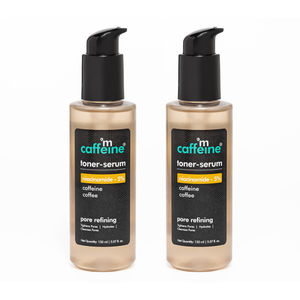
mCaffeine Toner Serum- Niacinamide Pack of 2

mCaffeine Toner Serum- Niacinamide Pack of 2
mCaffeine
mcaffeine-toner-serum-niacinamide-pack-of-2
Serum
10084766581029
Morning or Evening?
How often will you use this product?
Notes


Highlights
WHAT IS IT?
Face Serum with Niacinamide
FEATURES
Suitable for all skin types including acne prone, dull and oily skin; Contains active ingredient Niacinamide
BEST FOR
combination
CHECKS
Who Is It For?
What Does It Help With?
Acne Dullness Oily SkinBudget
Affordable (under $30)How To Use
Which routine should it be used in?
Instructions:
Key Information


What mCaffeine Says
Product Description:
mCaffeine Toner Serum Niacinamide Pack of 2
About the Brand:
Ingredients Overview
Ingredients List
Aqua (water), Niacinamide, Butylene Glycol, Coffee Extract, Caffeine, Phenoxyethanol (and) Triethylene Glycol, Acetamidoethoxyethanol, Aqua (and) Lens Esculenta (Lentil) Seed Extract, PEG-40 Hydrogenated Castor Oil, Polyacrylate Crosspolymer-6, Xanthan gum, Sodium Gluconate, Fragrance, CI 15985, CI 42090, CI 17200, CI 19140, CI 16035
Key Ingredients
Niacinamide
Ingredients Details
Acetamidoethoxyethanol
Common Name(s): Acetamidoethoxyethanol,acetamidoethoxyethanol,cosmetic functional ingredient,established cosmetic active
CAS Number: N/a
DESCRIPTION
What It Does: Provides the characteristic cosmetic function of its ingredient class through its molecular chemistry at recommended use concentration.
Why It's Used: Acetamidoethoxyethanol is selected for the specific functional properties of its molecular class — the chemical architecture of acetamidoethoxyethanol delivers the required cosmetic performance through documented interactions with skin biology and formulation matrix.
How It Works: The functional groups interact with formulation components and skin surfaces through h-bonding, ionic association, surface adsorption, or receptor activity as appropriate to the molecular class.
Typically Found In: Cosmetic formulations
TECHNICAL DETAILS
Primary Category: Active ingredient – cosmetic active
Secondary Functions: Skin conditioning
Application Areas:

Facial Skincare

Body Care
Hair Care
Beard Care
Color Cosmetics (Makeup)
Dietary/Oral Supplements
Typical Concentration Range: 0.1%–10%
SOURCING & ETHICS
Vegan Status: Conditional - supplier confirmation required
Halal Status: Unverified - supplier confirmation required
Source Notes: Commercially produced for cosmetic use. verify vegan/halal status with supplier. [audit 2026-07-29 rev2: the record's own source_notes does not assert a non-animal origin, or instructs the reader to verify with the supplier; "yes" asserts knowledge the record does not hold. determination requires shariah-panel sign-off.]
SKIN COMPATIBILITY
Irritancy Rating: 1/5 – very low
Comedogenicity Rating: 0/5 – non-comedogenic
Sensitivity Concerns: Well-tolerated by most skin types.
Safe for Sensitive Skin: Yes
SAFETY & COMPATIBILITY
Safety Profile: Good safety profile at recommended concentrations. ewg score: 1–2.
Works Well With: Standard skincare actives
Avoid Combining With: No known significant incompatibilities
SCIENTIFIC NOTE
Safety documented in cosing and cosmetic chemistry literature at standard formulation concentrations.
Last Verified: 2026-03-22
Primary Sources: Cosing database,acetamidoethoxyethanol technical review
Butylene Glycol
Common Name(s): 1,3-butanediol,bg,1,3-butylene glycol
CAS Number: 107-88-0
DESCRIPTION
What It Does: Provides humectant hydration and active ingredient solubilization with excellent skin feel.
Why It's Used: Preferred glycol humectant in premium and k-beauty formulations for superior skin feel vs propylene glycol with equivalent functionality.
How It Works: Two hydroxyl groups at 1,3-positions provide water binding and solvent activity. better tolerated than propylene glycol with minimal sensitization risk. 4-carbon backbone provides slightly greater hydrophobic character enabling dissolution of less polar actives vs pg.
Typically Found In: Toners,essences,serums,k-beauty formulas
TECHNICAL DETAILS
Primary Category: Functional ingredient – glycol humectant
Secondary Functions: Tewl reduction,skin plumping
Application Areas:
Facial Skincare
Body Care
Hair Care
Beard Care
Color Cosmetics (Makeup)
Dietary/Oral Supplements
Typical Concentration Range: 1%–10%
SOURCING & ETHICS
Vegan Status: Yes – synthetic
Halal Status: Yes
Source Notes: Synthetic or naturally derived. excellent aqueous solubility.
SKIN COMPATIBILITY
Irritancy Rating: 1/5 – very low
Comedogenicity Rating: 0/5 – non-comedogenic
Sensitivity Concerns: Non-irritating; suitable for all skin types.
Safe for Sensitive Skin: Yes
SAFETY & COMPATIBILITY
Safety Profile: Excellent safety profile. ewg score: 1.
Works Well With: Ceramides,emollients,occlusives,glycerin,hyaluronic acid
Avoid Combining With: No significant incompatibilities
SCIENTIFIC NOTE
K-beauty's preference for butylene glycol over propylene glycol is driven by two factors: bg's superior skin feel (less tacky than pg's higher viscosity) and its lower sensitization potential (1,3-bg has better spatial distribution of hydroxyl groups that reduces protein interaction vs pg's 1,2-position oh groups).
Last Verified: 2026-03-12
Primary Sources: Cosing database,cir safety assessment
Caffeine
Common Name(s): Caffeine,methylxanthine anti-cellulite,antioxidant vasoactive
CAS Number: N/a
DESCRIPTION
What It Does: Stimulates lipolysis in adipocytes by inhibiting phosphodiesterase (preventing camp breakdown), reduces eye puffiness through vasoconstriction of periorbital capillaries, and provides antioxidant dna repair stimulation for photoprotective benefit.
Why It's Used: The only cosmetic active with a well-defined mechanism for anti-cellulite claims — phosphodiesterase inhibition elevating adipocyte camp is the documented biochemical pathway, providing mechanism-based efficacy substantiation superior to most slimming actives.
How It Works: Caffeine inhibits phosphodiesterase (pde3, pde4) preventing camp hydrolysis → elevated camp activates protein kinase a → phosphorylates hormone-sensitive lipase → lipolysis of triglycerides in adipocytes. for eye puffiness: caffeine's adenosine receptor antagonism reduces prostaglandin-mediated capillary dilation in periorbital tissue, reducing fluid accumulation.
Typically Found In: Anti-cellulite,eye creams,antioxidant products
TECHNICAL DETAILS
Primary Category: Active ingredient – antioxidant
Secondary Functions: Free radical scavenging,anti-aging
Application Areas:
Facial Skincare
Body Care
Hair Care
Beard Care
Color Cosmetics (Makeup)
Dietary/Oral Supplements
Typical Concentration Range: 0.1%–3%
SOURCING & ETHICS
Vegan Status: Conditional - supplier confirmation required
Halal Status: Unverified - supplier confirmation required
Source Notes: Plant-derived extract or synthetic. [audit 2026-07-29 rev2: status downgraded on audit. determination requires shariah-panel sign-off.]
SKIN COMPATIBILITY
Irritancy Rating: 1/5 – very low
Comedogenicity Rating: 0/5 – non-comedogenic
Sensitivity Concerns: Non-irritating; well-tolerated.
Safe for Sensitive Skin: Yes
SAFETY & COMPATIBILITY
Safety Profile: Excellent safety profile. ewg score: 1.
Works Well With: Vitamin c,vitamin e,ferulic acid,spf,other antioxidants
Avoid Combining With: No significant incompatibilities
SCIENTIFIC NOTE
Caffeine has one of the highest sc penetration rates of any cosmetic active (logp -0.07, mw 194 da) — the combination of small size and moderate logp providing excellent aqueous solubility with sufficient sc lipid partitioning for effective transdermal delivery to adipose tissue.
Last Verified: 2026-03-12
Primary Sources: Cosing database,caffeine pde inhibitor anti-cellulite lipolysis review
Ci 15985
Common Name(s): Ci 15985,approved cosmetic colorant,colour cosmetics pigment
CAS Number: N/a
DESCRIPTION
What It Does: Provides colour in cosmetic formulations within the permitted application areas and concentrations specified by fda 21 cfr 73/74 and eu cosmetics regulation annex iv.
Why It's Used: Regulatory compliance requires verifying both the permitted use category (fd&c, d&c, ext. d&c) and the specific application area approval for each colorant in each target market.
How It Works: Colour arises from selective wavelength absorption by the chromophore structure — electronic transitions (d-orbital for transition metal pigments; π→π* for organic chromophores) absorb specific visible wavelengths providing the perceived complementary colour.
Typically Found In: Colour cosmetics
TECHNICAL DETAILS
Primary Category: Active ingredient – mineral / metal active
Secondary Functions: Antimicrobial,sebum regulation,antioxidant enzyme cofactor
Application Areas:
Facial Skincare
Body Care
Hair Care
Beard Care
Color Cosmetics (Makeup)
Dietary/Oral Supplements
Typical Concentration Range: Per product type — check fda/eu permitted list
SOURCING & ETHICS
Vegan Status: Conditional - supplier confirmation required
Halal Status: Conditional - basis not stated in source record; supplier origin confirmation required to determine what evidence applies
Source Notes: Mineral/inorganic compound. cosmetic or pharmaceutical grade. [audit 2026-07-29 rev2: status downgraded on audit. determination requires shariah-panel sign-off.]
SKIN COMPATIBILITY
Irritancy Rating: 1/5 – very low
Comedogenicity Rating: 0/5 – non-comedogenic
Sensitivity Concerns: Non-irritating at recommended concentrations.
Safe for Sensitive Skin: Yes at recommended concentrations
SAFETY & COMPATIBILITY
Safety Profile: Excellent safety profile at cosmetic concentrations. ewg score: 1–2.
Works Well With: Niacinamide,salicylic acid,other actives
Avoid Combining With: No significant incompatibilities at standard concentrations
SCIENTIFIC NOTE
All cosmetic colorants in the us require fda batch certification confirming identity and purity per lot — uncertified batches cannot legally appear in finished us cosmetics. eu annex iv lists permitted colorants with specific maximum concentrations and use restrictions by product category.
Last Verified: 2026-03-12
Primary Sources: Fda 21 cfr 73/74,eu cosmetics regulation annex iv,colorant regulatory review