

BABOR
Mimical Control

Mimical Control
BABOR
mimical-control
Moisturize
9580431376677
Morning or Evening?
How often will you use this product?
Notes


Highlights
WHAT IS IT?
24-hour moisturizing cream with multiple ingredients
FEATURES
Softens expression lines, strengthens skin from inside out, releases micro-tensions, prevents light- and environment-induced skin aging
BEST FOR
Mature Skin, Dry Skin
CHECKS
Does not contain formaldehyde, dioxins, DEET, toluene, SLS, SLES, triclosan, talc
Who Is It For?
Adults Women And MenWhat Does It Help With?
Anti-aging HydrationBudget
Mid-rangeHow To Use
Which routine should it be used in?
Instructions:
Key Information


What BABOR Says
Product Description:
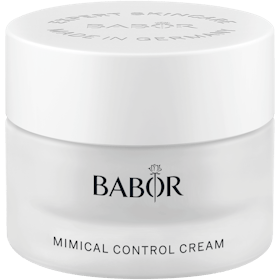
24-hour cream to soften expression lines. The facial skin is not only exposed to different environment influences, but is also heavily strained by its daily tasks. Facial expressions and micro-tensions in the skin appear on the skin over time in the form of expression lines. The Mimical Control Cream specifically counteracts the appearance of expression lines and makes the complexion appear smoother and fresh.
About the Brand:
Ingredients Overview
Ingredients List
AQUA, GLYCERIN, MACADAMIA INTEGRIFOLIA SEED OIL, SQUALANE, ETHYLHEXYL ISONONANOATE, SESAMUM INDICUM SEED OIL, PERSEA GRATISSIMA OIL, CETEARYL ALCOHOL, HYDROGENATED VEGETABLE GLYCERIDES, POTASSIUM CETYL PHOSPHATE, TOCOPHERYL ACETATE, ERYTHRITOL, BRASSICA CAMPESTRIS STEROLS, PHENOXYETHANOL, HYDROGENATED PALM GLYCERIDES, PANTHENOL, DIMETHICONE, ISOMALT, PARFUM, CARBOMER, XANTHAN GUM, ETHYLHEXYLGLYCERIN, HELIANTHUS ANNUUS SEED OIL, TOCOPHEROL, DISODIUM EDTA, SODIUM HYDROXIDE, CAPRYLYL GLYCOL, SODIUM BENZOATE, POTASSIUM SORBATE, HOMARINE HCL, PANTOLACTONE, LECITHIN, RHODODENDRON FERRUGINEUM LEAF CELL CULTURE EXTRACT, ACETYL HEXAPEPTIDE-8, CITRIC ACID, LACTIC ACID
Key Ingredients
Alpine stem cells, Squalane, Mimical Control Peptide, OsmoTec, Vitamin E, Avocado oil, Sesame oil, Macadamia oil, Panthenol
Ingredients Details
Cetearyl Alcohol
Common Name(s): Cetostearyl alcohol,c16-18 fatty alcohol
CAS Number: 8005-44-5
DESCRIPTION
What It Does: Provides fatty alcohol emulsification and thickening for stable, well-textured emulsions.
Why It's Used: The most widely used fatty alcohol in cosmetics – provides emulsification, thickening, and emolliency simultaneously from a single ingredient with excellent safety profile.
How It Works: Forms bilayer lamellar structures in water with emulsifiers creating a viscous structured network that thickens and stabilizes emulsions. fatty alcohol emolliency provides direct skin conditioning. bilayer formation reduces inter-droplet coalescence in emulsions.
Typically Found In: Creams,lotions,conditioners – virtually all emulsion products
TECHNICAL DETAILS
Primary Category: Functional ingredient – fatty alcohol emulsifier/thickener
Secondary Functions: Barrier sealing,softening
Application Areas:

Facial Skincare
Body Care
Hair Care

Beard Care
Color Cosmetics (Makeup)
Dietary/Oral Supplements
Typical Concentration Range: 1%–25%
SOURCING & ETHICS
Vegan Status: Yes – from vegetable or coconut/palm fatty acids
Halal Status: Yes
Source Notes: Plant-derived, synthetic or animal-derived. verify source.
SKIN COMPATIBILITY
Irritancy Rating: 1/5 – very low
Comedogenicity Rating: 1/5 – low; formulation-dependent
Sensitivity Concerns: Non-irritating.
Safe for Sensitive Skin: Yes
SAFETY & COMPATIBILITY
Safety Profile: Excellent safety profile. ewg score: 1.
Works Well With: Humectants,ceramides,actives as carrier
Avoid Combining With: No significant incompatibilities
SCIENTIFIC NOTE
Cetearyl alcohol's ability to form lamellar liquid crystal structures ('krafft phases') with water and co-emulsifiers provides not only emulsion stability but also enhanced skin penetration via the lamellar skin barrier pathway. these crystalline structures can act as a reservoir for active ingredients, slowly releasing them as the lamellar structure melts on skin contact.
Last Verified: Cosing database,cir safety assessment
Primary Sources: 2026-03-12
Ethylhexyl Isononanoate
Common Name(s): Ethylhexyl isononanoate,2-ethylhexyl isononanoate,cetiol eh
CAS Number: 71566-49-9
DESCRIPTION
What It Does: Provides silky ester emolliency with excellent spreading and uv filter compatibility.
Why It's Used: Standard lightweight ester emollient for sunscreens and colour cosmetics — isononanoate's spreading and uv filter compatibility makes it the preferred lightweight ester for sunscreen vehicles.
How It Works: Branched ester provides low surface tension for excellent spreading. isononanoic acid's branching prevents close molecular packing for liquid state at room temperature. excellent uv filter (avobenzone, octinoxate) solubilisation. low comedogenicity from short-chain ester.
Typically Found In: Sunscreens,colour cosmetics,lightweight moisturisers
TECHNICAL DETAILS
Primary Category: Functional ingredient – emollient
Secondary Functions: Barrier sealing,softening
Application Areas:
Facial Skincare
Body Care
Hair Care
Beard Care
Color Cosmetics (Makeup)
Dietary/Oral Supplements
Typical Concentration Range: 1%–20%
SOURCING & ETHICS
Vegan Status: Yes – from isononanoic acid and 2-ethylhexanol
Halal Status: Yes
Source Notes: Plant-derived, synthetic or animal-derived. verify source.
SKIN COMPATIBILITY
Irritancy Rating: 1/5 – very low
Comedogenicity Rating: 1/5 – very low
Sensitivity Concerns: Non-irritating.
Safe for Sensitive Skin: Yes
SAFETY & COMPATIBILITY
Safety Profile: Excellent safety profile. ewg score: 1.
Works Well With: Humectants,ceramides,actives as carrier
Avoid Combining With: No significant incompatibilities
SCIENTIFIC NOTE
Ethylhexyl isononanoate's uv filter solubilisation capacity is particularly important for avobenzone: avobenzone requires an oil vehicle for stable dissolution and eihn provides excellent avobenzone solubilisation while contributing a light, dry-touch aesthetic — critical for consumer acceptance of sunscreens containing high avobenzone concentrations.
Last Verified: Cosing database,cir safety assessment
Primary Sources: 2026-03-12
Glycerin
Common Name(s): Glycerol,glycerine,1,2,3-propanetriol
CAS Number: 56-81-5
DESCRIPTION
What It Does: Glycerin pulls water from the environment and deeper skin layers into the outer skin layer (epidermis), boosting moisture levels and keeping skin soft, smooth, and plump.
Why It's Used: It is used in virtually every moisturizer, serum, and cleanser because it is highly effective at hydrating skin, is well-tolerated by all skin types, and enhances the texture and spreadability of formulations.
How It Works: As a humectant, glycerin forms hydrogen bonds with water molecules, trapping them in the skin. it also reinforces the skin barrier by integrating into lipid structures between skin cells.
Typically Found In: Moisturizers,serums,cleansers,toners,sheet masks,sunscreens,body lotions,shampoos,conditioners
TECHNICAL DETAILS
Primary Category: Humectant
Secondary Functions: Skin barrier support,emollient,solvent
Application Areas:
Facial Skincare
Body Care
Hair Care
Beard Care
Color Cosmetics (Makeup)
Dietary/Oral Supplements
Typical Concentration Range: 1%–30% (typical: 3–10%)
SOURCING & ETHICS
Vegan Status: Yes – plant-derived (coconut, soy, palm) or synthetic
Halal Status: Yes – when plant-derived or synthetic; verify source with supplier
Source Notes: Derived from plant oils via hydrolysis or saponification; synthetic versions also available. palm-derived glycerin carries sustainability concerns.
SKIN COMPATIBILITY
Irritancy Rating: 1/5 – very low; non-irritating at all standard concentrations
Comedogenicity Rating: 0/5 – non-comedogenic
Sensitivity Concerns: Extremely rare allergic reactions; generally safe for all skin types including sensitive and baby skin
Safe for Sensitive Skin: Yes
SAFETY & COMPATIBILITY
Safety Profile: Widely recognized as safe. ewg hazard score: 1. no significant concerns for irritation, sensitization, or toxicity at typical concentrations (up to 50%).
Works Well With: Hyaluronic acid,ceramides,niacinamide,panthenol,urea,peptides,retinol,ahas/bhas
Avoid Combining With: No known incompatibilities at standard concentrations
SCIENTIFIC NOTE
Glycerin is an endogenous skin component found naturally in the stratum corneum. aquaporin-3 channels in keratinocytes facilitate glycerin transport, making it integral to natural skin hydration pathways.
Last Verified: Cosing database,cir safety assessment,ewg skin deep,inci decoder
Primary Sources: 2026-03-12
Hydrogenated Vegetable Glycerides
Common Name(s): Hydrogenated vegetable glycerides
DESCRIPTION
What It Does: Delivers targeted skin-conditioning or bioactive benefits through a specific mechanism of action suited to the formulation's intended purpose.
Why It's Used: Specialty actives address specific skin concerns through targeted molecular mechanisms, providing efficacy beyond what base formulation ingredients alone can achieve.
How It Works: The bioactive compound interacts with specific molecular targets in skin cells or the extracellular matrix — enzymes, receptors, structural proteins, or signaling molecules — triggering beneficial biological responses.
Typically Found In: Serums,treatments,moisturizers,specialty products
TECHNICAL DETAILS
Primary Category: Specialty actives
Secondary Functions: Skin-conditioning,anti-aging
Application Areas:
Facial Skincare
Body Care
Hair Care
Beard Care
Color Cosmetics (Makeup)
Dietary/Oral Supplements
Typical Concentration Range: 0.01–5%
SOURCING & ETHICS
Vegan Status: Yes
Halal Status: Yes
Source Notes: Specialty active ingredient; check individual sourcing for vegan status.
SKIN COMPATIBILITY
Irritancy Rating: 1
Comedogenicity Rating: 0
Sensitivity Concerns: Low sensitization potential at recommended use concentrations.
Safe for Sensitive Skin: Yes
SAFETY & COMPATIBILITY
Safety Profile: Well-characterized cosmetic ingredient with established safety profile. generally non-irritating at typical use concentrations. suitable for leave-on and rinse-off cosmetics.
Works Well With: Niacinamide,hyaluronic acid,vitamin c,peptides
Avoid Combining With: Incompatible with oxidizing agents; check ph stability
SCIENTIFIC NOTE
Specialty actives typically work through enzyme inhibition (e.g., tyrosinase inhibition for brightening, mmp inhibition for anti-aging), receptor activation (e.g., retinoid receptors, ppar-γ for barrier genes), or transcription factor modulation (e.g., nrf2 for antioxidant gene upregulation). structure-activity relationships determine potency and selectivity.
Last Verified: Cosing eu database; pcpc cosmetic ingredient safety reviews; ingredient-specific safety and efficacy literature
Primary Sources: 2025-01-15
