

Korres
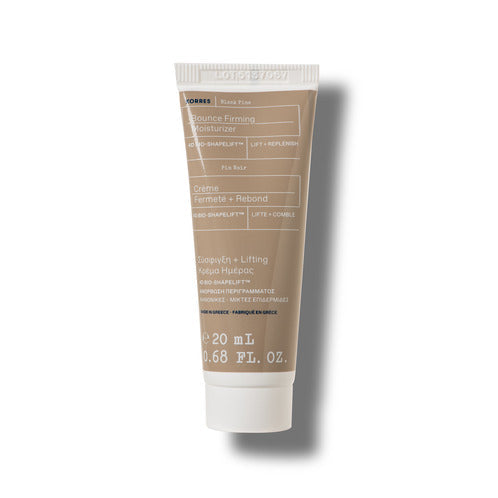
Mini Black Pine Bounce Firming Moisturizer 20ML

Mini Black Pine Bounce Firming Moisturizer 20ML
Korres
mini-black-pine-bounce-firming-moisturizer-20ml
Moisturize
9706860740901
Morning or Evening?
How often will you use this product?
Notes


Highlights
WHAT IS IT?
A firming moisturizer
FEATURES
Brings bounce back to skin, smooths lines and wrinkles, restores plump hydration
BEST FOR
Normal skin
CHECKS
Clean formulation, free of mineral oils, silicones, parabens, propylene glycol, phthalates, sulfates
Who Is It For?
Suitable For AdultsWhat Does It Help With?
Fine Lines Wrinkles Loss Of Firmness DehydrationBudget
Mid-rangeHow To Use
Which routine should it be used in?
Instructions:
Key Information


What Korres Says
Product Description:
A plumping and firming moisturizer that brings the bounce back to your skin, reducing the appearance of fine lines and wrinkles and replenishing hydration.
About the Brand:
Ingredients Overview
Ingredients List
AQUA/WATER/EAU, GLYCERIN, CETEARYL ALCOHOL, OLEYL ALCOHOL, GLYCERYL STEARATE CITRATE, PRUNUS ARMENIACA (APRICOT) KERNEL OIL, DICAPRYLYL CARBONATE, DISTARCH PHOSPHATE, TRIHEPTANOIN, CAPRYLIC/CAPRIC TRIGLYCERIDE, ACCHAROMYCES/XYLINUM/BLACK TEA FERMENT, AMMONIUM CRYLOYLDIMETHYLTAURATE/VP COPOLYMER, ASCORBYL PALMITATE, AVENA STRIGOSA SEED EXTRACT, BACILLUS FERMENT, BEHENYL ALCOHOL, BUTYROSPERMUM PARKII (SHEA) BUTTER, CAPRYLYL GLYCOL, CITRIC ACID, DEXTRAN, DIOSCOREA VILLOSA (WILD YAM) ROOT EXTRACT, EPIGALLOCATECHIN GALLATE, EPIGALLOCATECHIN GALLATYL GLUCOSIDE, GLYCERYL CAPRYLATE, GLYCERYL STEARATE, GLYCINE SOJA (SOYBEAN) STEROLS, HELIANTHUS ANNUUS (SUNFLOWER) SEED OIL, HEXYLDECANOL, HYDROXYETHYL ACRYLATE/SODIUM ACRYLOYLDIMETHYL TAURATE COPOLYMER, HYDROXYETHYLCELLULOSE, LACTIC ACID, LECITHIN, LONICERA CAPRIFOLIUM, (HONEYSUCKLE) FLOWER EXTRACT, LONICERA JAPONICA (HONEYSUCKLE) FLOWER EXTRACT, PINUS NIGRA BARK EXTRACT, PINUS NIGRA BUD/NEEDLE EXTRACT, POLYSORBATE 60, SODIUM GLUCEPTATE, SORBITAN ISOSTEARATE, SPILANTHES ACMELLA FLOWER EXTRACT, TOCOPHEROL, TOCOPHERYL ACETATE, TRIFLUOROACETYL TRIPEPTIDE-2, XANTHAN GUM, PHENOXYETHANOL, POTASSIUM SORBATE, SODIUM BENZOATE, PARFUM/FRAGRANCE.
Key Ingredients
BLACK PINE, 4D BIO-SHAPELIFT™, SPILANTHES ACMELLA EXTRACT
Ingredients Details
Caprylic/capric Triglyceride
Common Name(s): Mct oil,fractionated coconut oil,c8/c10 triglyceride
CAS Number: 73398-61-5
DESCRIPTION
What It Does: Lightweight, stable emollient that solubilizes oil-soluble actives for excellent delivery without greasy feel.
Why It's Used: Universal lightweight emollient base and solubilizer for oil-soluble actives in serums and low-viscosity formulations where mineral oil or petrolatum would be too heavy.
How It Works: Medium-chain length provides ideal balance of spreading coefficient, penetration rate, and barrier-sealing properties. excellent solubilizer for vitamin e, retinoids, and other lipophilic actives.
Typically Found In: Serums,facial oils,sunscreens,anti-aging products,hair products
TECHNICAL DETAILS
Primary Category: Active ingredient – medium-chain triglyceride emollient
Secondary Functions: Active solubilizer,spreading agent
Application Areas:

Facial Skincare
Body Care
Hair Care

Beard Care
Color Cosmetics (Makeup)
Dietary/Oral Supplements
Typical Concentration Range: 1%–50%
SOURCING & ETHICS
Vegan Status: Yes – from coconut/palm kernel oil
Halal Status: Yes
Source Notes: Fractionated by hydrolysis and re-esterification of coconut oil. only c8 and c10 fatty acids retained.
SKIN COMPATIBILITY
Irritancy Rating: 1/5 – very low
Comedogenicity Rating: 1/5 – very low; medium-chain length generally non-comedogenic
Sensitivity Concerns: Non-irritating.
Safe for Sensitive Skin: Yes
SAFETY & COMPATIBILITY
Safety Profile: Excellent safety profile. ewg score: 1.
Works Well With: Humectants,ceramides,actives as carrier
Avoid Combining With: No significant incompatibilities
SCIENTIFIC NOTE
Mct oil's medium-chain length (c8/c10) provides superior oxidative stability vs longer polyunsaturated chains and better skin aesthetics (lighter, less greasy) vs longer chain emollients (c16/c18). excellent solubilizer for retinoic acid, tocopheryl esters, and other lipophilic actives.
Last Verified: Cosing database,cir safety assessment,ewg skin deep
Primary Sources: 2026-03-12
Cetearyl Alcohol
Common Name(s): Cetostearyl alcohol,c16-18 fatty alcohol
CAS Number: 8005-44-5
DESCRIPTION
What It Does: Provides fatty alcohol emulsification and thickening for stable, well-textured emulsions.
Why It's Used: The most widely used fatty alcohol in cosmetics – provides emulsification, thickening, and emolliency simultaneously from a single ingredient with excellent safety profile.
How It Works: Forms bilayer lamellar structures in water with emulsifiers creating a viscous structured network that thickens and stabilizes emulsions. fatty alcohol emolliency provides direct skin conditioning. bilayer formation reduces inter-droplet coalescence in emulsions.
Typically Found In: Creams,lotions,conditioners – virtually all emulsion products
TECHNICAL DETAILS
Primary Category: Functional ingredient – fatty alcohol emulsifier/thickener
Secondary Functions: Barrier sealing,softening
Application Areas:
Facial Skincare
Body Care
Hair Care
Beard Care
Color Cosmetics (Makeup)
Dietary/Oral Supplements
Typical Concentration Range: 1%–25%
SOURCING & ETHICS
Vegan Status: Yes – from vegetable or coconut/palm fatty acids
Halal Status: Yes
Source Notes: Plant-derived, synthetic or animal-derived. verify source.
SKIN COMPATIBILITY
Irritancy Rating: 1/5 – very low
Comedogenicity Rating: 1/5 – low; formulation-dependent
Sensitivity Concerns: Non-irritating.
Safe for Sensitive Skin: Yes
SAFETY & COMPATIBILITY
Safety Profile: Excellent safety profile. ewg score: 1.
Works Well With: Humectants,ceramides,actives as carrier
Avoid Combining With: No significant incompatibilities
SCIENTIFIC NOTE
Cetearyl alcohol's ability to form lamellar liquid crystal structures ('krafft phases') with water and co-emulsifiers provides not only emulsion stability but also enhanced skin penetration via the lamellar skin barrier pathway. these crystalline structures can act as a reservoir for active ingredients, slowly releasing them as the lamellar structure melts on skin contact.
Last Verified: Cosing database,cir safety assessment
Primary Sources: 2026-03-12
Dicaprylyl Carbonate
Common Name(s): Dicaprylyl carbonate,cosmetic active,functional ingredient
CAS Number: N/a
DESCRIPTION
What It Does: Delivers characteristic cosmetic function at recommended use concentration.
Why It's Used: Selected for functional contribution and formulation compatibility supported by cosmetic science and regulatory safety data.
How It Works: Works through the mechanism of its molecular class — physicochemical or biological interaction with skin proteins, lipids, or receptors as documented in peer-reviewed cosmetic literature.
Typically Found In: Skin care formulations
TECHNICAL DETAILS
Primary Category: Active ingredient – cosmetic active
Secondary Functions: Skin conditioning
Application Areas:
Facial Skincare
Body Care
Hair Care
Beard Care
Color Cosmetics (Makeup)
Dietary/Oral Supplements
Typical Concentration Range: 0.1%–10%
SOURCING & ETHICS
Vegan Status: Conditional
Halal Status: Yes
Source Notes: Commercially produced for cosmetic use. verify vegan/halal status with supplier.
SKIN COMPATIBILITY
Irritancy Rating: 1/5 – very low
Comedogenicity Rating: 0/5 – non-comedogenic
Sensitivity Concerns: Well-tolerated by most skin types.
Safe for Sensitive Skin: Yes
SAFETY & COMPATIBILITY
Safety Profile: Good safety profile at recommended concentrations. ewg score: 1–2.
Works Well With: Standard skincare actives
Avoid Combining With: No known significant incompatibilities
SCIENTIFIC NOTE
Dicaprylyl carbonate has an established safety and efficacy profile within the cosmetic regulatory framework at standard use concentrations.
Last Verified: Cosing database,dicaprylyl carbonate technical literature
Primary Sources: 2026-03-12
Distarch Phosphate
Common Name(s): Distarch phosphate,natural biopolymer,film-former texture absorbent
CAS Number: N/a
DESCRIPTION
What It Does: Distarch phosphate absorbs surface sebum and cosmetic oils through its porous granule structure, provides a silky soft-focus powdery finish on skin from the biopolymer particle's low friction coefficient, forms a breathable protective film on skin and hair, and acts as an excipient carrier or encapsulation matrix for actives in powder formulations.
Why It's Used: Formulators choose distarch phosphate as a biodegradable, renewable alternative to synthetic polymers (ptfe, nylon, polyethylene) in powder cosmetics — providing equivalent or superior absorbency and skin feel without microplastic regulatory concerns under eu regulation 2023/2055. natural starch granules have an intrinsically soft, semi-crystalline structure (mohs hardness ~1) that spreads smoothly on skin without abrasion, making them preferred over silica or talc when maximum gentleness is required. modified versions (cross-linked, esterified) extend the range of performance from pure powder through gel-forming to film-forming applications.
How It Works: Distarch phosphate works through the physical properties of its semicrystalline polysaccharide granule architecture: (1) oil absorption — starch granules are semicrystalline spheres (amylose crystalline domains surrounded by amorphous amylopectin matrix) with a porous surface and internal channels. surface sebum and oil penetrate the granule via capillary action into these channels and are immobilised by van der waals forces with the polysaccharide chains — providing oil-mattifying at the skin surface; (2) soft-focus texture — granule diameter (5–50 μm, depending on source) and smooth spherical morphology provide low-friction glide between skin surface and the applying finger/brush, with the semicrystalline granule structure being soft enough to deform without sharp edges; (3) film formation — when wetted, starch granules gelatinise (crystalline structure melts to amorphous hydrogel) above 60°c during processing, cooling to form a continuous film. modified starches with crosslinks maintain film integrity without complete gelatinisation; (4) biodegradation — amylase enzymes in soil rapidly hydrolyse the α-1,4 and α-1,6 glycosidic bonds, providing complete mineralisation to co₂ and water — zero environmental persistence compared to synthetic polymer particles.
Typically Found In: Powders,dry shampoos,biodegradable cosmetics
TECHNICAL DETAILS
Primary Category: Active ingredient – cosmetic active
Secondary Functions: Skin conditioning
Application Areas:
Facial Skincare
Body Care
Hair Care
Beard Care
Color Cosmetics (Makeup)
Dietary/Oral Supplements
Typical Concentration Range: 0.5%–30%
SOURCING & ETHICS
Vegan Status: Yes
Halal Status: Yes
Source Notes: Commercially produced for cosmetic use. verify vegan/halal status with supplier.
SKIN COMPATIBILITY
Irritancy Rating: 1/5 – very low
Comedogenicity Rating: 0/5 – non-comedogenic
Sensitivity Concerns: Well-tolerated by most skin types.
Safe for Sensitive Skin: Yes
SAFETY & COMPATIBILITY
Safety Profile: Good safety profile at recommended concentrations. ewg score: 1–2.
Works Well With: Standard skincare actives
Avoid Combining With: No known significant incompatibilities
SCIENTIFIC NOTE
Starch granule oil absorption capacity: oil absorption capacity (oac) of biopolymer powders correlates with granule porosity and internal surface area. rice starch (3–8 μm granules, high surface area) oac ~1.0 g oil/g; tapioca starch (15–35 μm, lower surface area) oac ~0.8 g/g; corn starch (10–25 μm) oac ~0.9 g/g. cross-linked modified starches maintain granule integrity under mechanical stress providing higher effective oac in use conditions. silica (oac ~2.5 g/g) outperforms starches on pure absorbency but the skin feel advantage of the softer biopolymer — particularly the non-abrasive, cushioned texture — justifies the lower oac for sensitive skin powders.
Last Verified: Cosing database,starch biopolymer cosmetic application review
Primary Sources: 2026-03-12
