

Minimalist
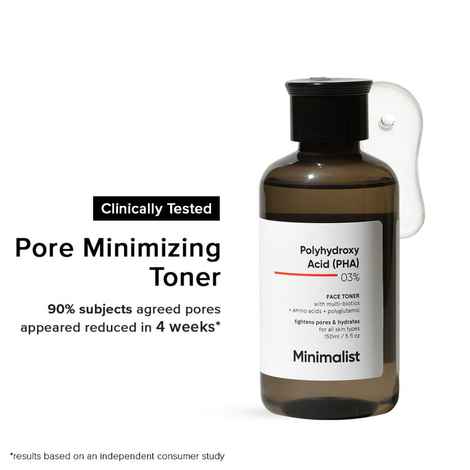
Minimalist 3% PHA Face Toner For Pore Tightening , Mild Expfoliation & Hydration with Biotics, 150 ml

Minimalist 3% PHA Face Toner For Pore Tightening , Mild Expfoliation & Hydration with Biotics, 150 ml
Minimalist
minimalist-3-pha-face-toner-for-pore-tightening-mild-expfoliation-hydration-with-biotics-150-ml
Tone
10085498224933
Morning or Evening?
How often will you use this product?
Notes


Highlights
WHAT IS IT?
PHA 3% Face toner with Biotics
FEATURES
Reduces pores, mild exfoliation, hydration with biotics, balanced skin microbiome, alcohol-free, pH 3.8-4.8, fragrance-free, silicone-free, sulfate-free, paraben-free, suitable for normal to oily, acne prone & sensitive skin
BEST FOR
combination
CHECKS
Does not contain alcohol, fragrance, silicones, sulfates, parabens, essential oils, dyes
Who Is It For?
All Genders Suitable For Normal Oily Combination Acne Prone And Sensitive SkinWhat Does It Help With?
Reduces Pore Size Mild Exfoliation Hydration Balances Skin Microbiome Tightens Pores Smooth SkinBudget
Affordable (under $30)How To Use
Which routine should it be used in?
Instructions:
Key Information

What Minimalist Says
Product Description:
Key Features of Minimalist PHA 3% + Biotic Toner: REDUCES PORES & PROVIDES MILD EXFOLIATION: Contains active ingredient Niacinamide that removes pore congestion resulting in visibly less pores and tightened skin. PHAs are next generation AHAs. Because of its larger molecule size compared to Glycolic acid (molecular weight 178 vs. 76 for Glycolic acid), it penetrates the skin slowly, hence offering gentle exfoliation without causing any skin irritation. HYDRATES & RENEW SKIN: Formulated with an optimum blend of several hydrating ingredients to give your skin a boost of much needed hydration. It contains super hydrators like Polyglutamic Acid, Panthenol (Vitamin B5), Hyaluronic Acid, Xylitylglucoside, Anhydroxylitol, Xylitol, Saccharide Isomerate and Amino acids like Lysine, Histidine and Arginine. Combined, these ingredients restore the water skin loses during cleansing. BALANCE SKIN MICROBIOME: Formulated with Prebiotics and Probiotics to balance skin microbiome and enhance natural defence barriers of the skin. Ecosystem of our skin is a complex environment and it has a diverse microbiota community. Prebiotics has been shown to selectively increase the activity and growth of beneficial skin microbiota. On the other hand, topical applications of probiotics directly effects the skin by enhancing its natural defence barriers. This product uses both forms of biotic to restore skin’s natural health and beauty ALCOHOL-FREE, HIGH PERFORMANCE, CLEAN TONER: This toner is (i) Fragrance-free (ii) Silicones-free (iii) Sulphates-free (iv) Parabens-free (v) Essential Oils-free and (vi) Dyes-free. Also, it is non-comedogenic and alcohol free. Formulated at pH 3.8 - 4.8 with high quality ingredients including Gluconolactone sourced from Jungbunzlauer, Switzerland and Prorenew Complex CLR from CLR Chemisches, Germany. A TONER FOR NORMAL, OILY, COMBINATION, ACNE PRONE & SENSITIVE SKIN: This pore tightening, mild exfoliating toner with biotics (pre and pro) suits normal to oily skin. It is also suitable for acne prone and sensitive skin.
About the Brand:
Ingredients Overview
Ingredients List
Aqua (Water); Gluconolactone (3%); Niacinamide; Butylene Glycol; Methylpropanediol; Inulin; Lactococcus Ferment Lysate; Saccharide Isomerate; Cucumis Sativus (Cucumber) Fruit Extract; Xylitylglucoside; Anhydroxylitol; Xylitol; Salicylic Acid; Allantoin; Trehalose; Glycerin; Sodium Polyglutamate; Sodium Hyaluronate; Panthenol (Vitamin B5); Lysine; Histidine; Arginine; Aspartic Acid; Threonine; Serine; Glutamic Acid; Proline; Glycine; Alanine; Valine; Methionine; Isoleucine; Leucine; Tyrosine; Phenylalanine; Cysteine; Ethoxydiglycol; Trisodium Ethylenediamine Disuccinate; Phenoxyethanol; Ethylhexylglycerin; 1,2-Hexanediol; Citric Acid; Sodium Citrate
Key Ingredients
Niacinamide, Polyglutamic Acid, Panthenol (Vitamin B5), Hyaluronic Acid, Xylitylglucoside, Anhydroxylitol, Xylitol, Saccharide Isomerate, Lysine, Histidine, Arginine, Gluconolactone
Ingredients Details
Anhydroxylitol
Common Name(s): Anhydroxylitol,cosmetic active,functional ingredient
CAS Number: N/a
DESCRIPTION
What It Does: Delivers characteristic cosmetic function at recommended use concentration.
Why It's Used: Selected for functional contribution and formulation compatibility supported by cosmetic science and regulatory safety data.
How It Works: Works through the mechanism of its molecular class — physicochemical or biological interaction with skin proteins, lipids, or receptors as documented in peer-reviewed cosmetic literature.
Typically Found In: Skin care formulations
TECHNICAL DETAILS
Primary Category: Active ingredient – cosmetic active
Secondary Functions: Skin conditioning
Application Areas:

Facial Skincare

Body Care
Hair Care
Beard Care
Color Cosmetics (Makeup)
Dietary/Oral Supplements
Typical Concentration Range: 0.1%–10%
SOURCING & ETHICS
Vegan Status: Conditional
Halal Status: Yes
Source Notes: Commercially produced for cosmetic use. verify vegan/halal status with supplier.
SKIN COMPATIBILITY
Irritancy Rating: 1/5 – very low
Comedogenicity Rating: 0/5 – non-comedogenic
Sensitivity Concerns: Well-tolerated by most skin types.
Safe for Sensitive Skin: Yes
SAFETY & COMPATIBILITY
Safety Profile: Good safety profile at recommended concentrations. ewg score: 1–2.
Works Well With: Standard skincare actives
Avoid Combining With: No known significant incompatibilities
SCIENTIFIC NOTE
Anhydroxylitol has an established safety and efficacy profile within the cosmetic regulatory framework at standard use concentrations.
Last Verified: Cosing database,anhydroxylitol technical literature
Primary Sources: 2026-03-12
Arginine
Common Name(s): L-arginine,2-amino-5-guanidinopentanoic acid
CAS Number: 74-79-3
DESCRIPTION
What It Does: Conditions skin, attracts moisture, supports wound healing, and improves microcirculation via no synthesis.
Why It's Used: Multi-functional amino acid for skin hydration, conditioning, and wound healing in peptide and nmf formulations.
How It Works: Guanidinium group binds water (humectant). substrate for nitric oxide synthase (enos) producing nitric oxide that vasodilates capillaries improving skin nutrition. stimulates fibroblast proliferation for wound healing.
Typically Found In: Anti-aging serums,wound healing products,nmf moisturizers,scalp treatments
TECHNICAL DETAILS
Primary Category: Active ingredient – amino acid
Secondary Functions: Wound healing,microcirculation,nmf component
Application Areas:
Facial Skincare
Body Care
Hair Care
Beard Care
Color Cosmetics (Makeup)
Dietary/Oral Supplements
Typical Concentration Range: 0.5%–5%
SOURCING & ETHICS
Vegan Status: Yes – plant-derived or synthetic
Halal Status: Yes
Source Notes: Fermentation-derived or synthetic. natural skin component.
SKIN COMPATIBILITY
Irritancy Rating: 1/5 – very low
Comedogenicity Rating: 0/5 – non-comedogenic
Sensitivity Concerns: Non-irritating; endogenous skin molecule.
Safe for Sensitive Skin: Yes
SAFETY & COMPATIBILITY
Safety Profile: Excellent safety profile. natural skin nmf component. ewg score: 1.
Works Well With: Hyaluronic acid,ceramides,peptides,other amino acids
Avoid Combining With: No significant incompatibilities
SCIENTIFIC NOTE
Arginine is a conditionally essential amino acid in wound healing where local demand exceeds synthesis capacity. topical arginine provides the nos substrate locally for no-mediated vasodilation and immune cell function in healing tissue.
Last Verified: Cosing database,cir safety assessment,witte & barbul arginine wound healing review
Primary Sources: 2026-03-12
Gluconolactone
Common Name(s): D-gluconolactone,delta-gluconolactone
CAS Number: 90-80-2
DESCRIPTION
What It Does: Provides the gentlest chemical exfoliation with simultaneous antioxidant, moisture retention, and barrier support.
Why It's Used: Preferred exfoliant for rosacea, eczema, sensitive skin, and post-procedure recovery where standard ahas cause unacceptable irritation.
How It Works: Hydrolyzes slowly on skin surface to gluconic acid providing gentle exfoliation. multiple hydroxyl groups enable water binding (humectant) and metal chelation (antioxidant).
Typically Found In: Sensitive skin exfoliants,rosacea treatments,eczema care,post-procedure recovery
TECHNICAL DETAILS
Primary Category: Active ingredient – polyhydroxy acid (pha)
Secondary Functions: Gentle exfoliation,antioxidant,humectant
Application Areas:
Facial Skincare
Body Care
Hair Care
Beard Care
Color Cosmetics (Makeup)
Dietary/Oral Supplements
Typical Concentration Range: 5%–15%
SOURCING & ETHICS
Vegan Status: Yes – fermentation or synthetic
Halal Status: Yes
Source Notes: Fermentation-derived from glucose or synthetic. among the safest chemical exfoliants available.
SKIN COMPATIBILITY
Irritancy Rating: 1/5 – very low
Comedogenicity Rating: 0/5 – non-comedogenic
Sensitivity Concerns: No photosensitization; no stinging; suitable for very sensitive skin.
Safe for Sensitive Skin: Yes – ideal for sensitive, reactive, rosacea, and eczema-prone skin; no photosensitization
SAFETY & COMPATIBILITY
Safety Profile: Exceptional safety profile. no photosensitization. ewg score: 1.
Works Well With: Ceramides,niacinamide,hyaluronic acid,soothing actives
Avoid Combining With: No significant incompatibilities
SCIENTIFIC NOTE
Phas have molecular weights 2–3× larger than ahas, limiting penetration to superficial layers. combined humectant and antioxidant properties make them uniquely well-tolerated while providing meaningful exfoliation.
Last Verified: Cosing database,green & yu (2003) pha review,cir safety assessment
Primary Sources: 2026-03-12
Histidine
Common Name(s): 2-amino-3-(1h-imidazol-4-yl)propanoic acid,l-his
CAS Number: 71-00-1
DESCRIPTION
What It Does: Provides nmf conditioning with copper-chelating antioxidant and uv-absorbing activity from imidazole ring.
Why It's Used: Antioxidant nmf amino acid — histidine's imidazole ring provides unique copper-chelating antioxidant activity alongside nmf hydration and uv absorption not available from other nmf amino acids.
How It Works: Imidazole ring chelates cu²⁺ and fe²⁺ for antioxidant metal chelation (inhibiting fenton reaction). uv absorption at 211nm provides partial photoprotection. precursor for carnosine (with beta-alanine) for anti-glycation. nmf component via imidazole + carboxylate water binding.
Typically Found In: Antioxidant skincare,anti-aging products,nmf moisturisers
TECHNICAL DETAILS
Primary Category: Active ingredient – imidazole amino acid
Secondary Functions: Skin conditioning
Application Areas:
Facial Skincare
Body Care
Hair Care
Beard Care
Color Cosmetics (Makeup)
Dietary/Oral Supplements
Typical Concentration Range: 0.5%–5%
SOURCING & ETHICS
Vegan Status: Yes – fermentation
Halal Status: Yes
Source Notes: Commercially produced for cosmetic use. verify vegan/halal status with supplier.
SKIN COMPATIBILITY
Irritancy Rating: 1/5 – very low
Comedogenicity Rating: 0/5 – non-comedogenic
Sensitivity Concerns: Well-tolerated by most skin types.
Safe for Sensitive Skin: Yes
SAFETY & COMPATIBILITY
Safety Profile: Good safety profile at recommended concentrations. ewg score: 1–2.
Works Well With: Standard skincare actives
Avoid Combining With: No known significant incompatibilities
SCIENTIFIC NOTE
Histidine's imidazole ring's copper chelation provides the same chemical mechanism as the pharmaceutical cuprimine (d-penicillamine) used for copper chelation therapy in wilson's disease — just with significantly lower affinity. the imidazole copper chelation prevents fenton-type radical generation from free copper ions that would otherwise catalyse hydroxyl radical production from hydrogen peroxide.
Last Verified: Cosing database,cir safety assessment
Primary Sources: 2026-03-12
