

Nykaa E retail limited
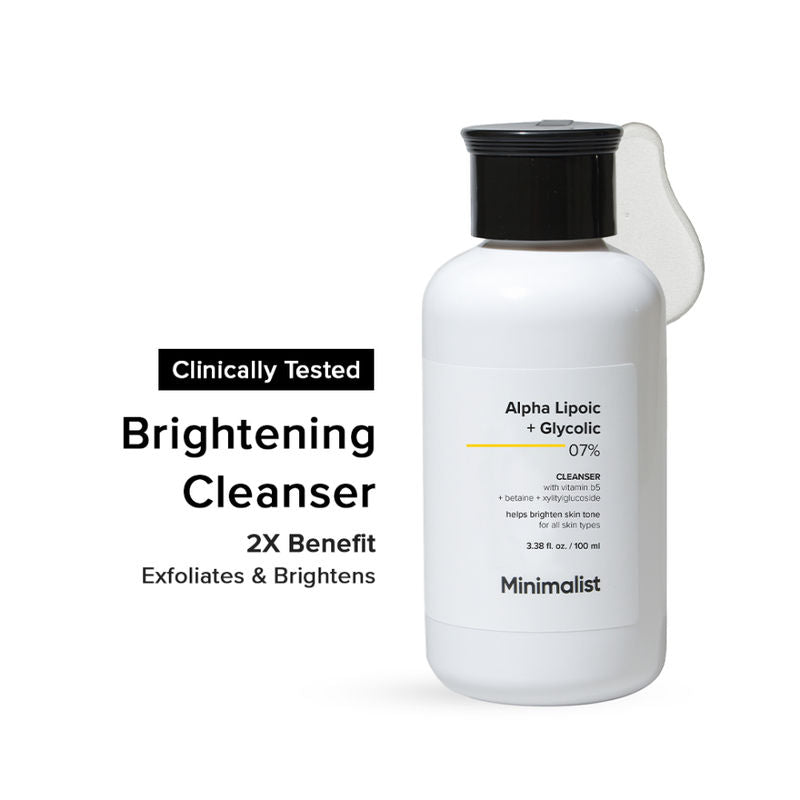
Minimalist 7% ALA & AHA Brightening Face Wash With Vitamin B5 & Glycolic acid For Glowing Skin

Minimalist 7% ALA & AHA Brightening Face Wash With Vitamin B5 & Glycolic acid For Glowing Skin
Nykaa E retail limited
minimalist-7-ala-aha-brightening-face-wash-with-vitamin-b5-glycolic-acid-for-glowing-skin
Cleanse
10085498388773
Morning or Evening?
How often will you use this product?
Notes


Highlights
WHAT IS IT?
Face Wash with 3 key ingredients
FEATURES
Contains Alpha Lipoic Acid, Glycolic Acid, Vitamin B5 for brightening and glowing skin
BEST FOR
sensitive
CHECKS
No parabens, no sulfates, no alcohol explicitly mentioned
Who Is It For?
All Genders No Specific Age Range MentionedWhat Does It Help With?
Brightening Glowing SkinBudget
Affordable (under $30)How To Use
Which routine should it be used in?
Instructions:
Key Information


What Nykaa E retail limited Says
Product Description:
Explore the entire range of Face Wash available on Nykaa. Shop more Minimalist products here.You can browse through the complete world of Minimalist Face Wash.
About the Brand:
Ingredients Overview
Ingredients List
Alpha-Lipoic-Acid,Glycolic-Acid,Vitamin-B5
Key Ingredients
Alpha Lipoic Acid, Glycolic Acid, Vitamin B5
Ingredients Details
Alpha Lipoic Acid
Common Name(s): Thioctic acid,ala,1,2-dithiolane-3-pentanoic acid
CAS Number: 1077-28-7
DESCRIPTION
What It Does: Provides universal antioxidant protection in both water and oil phases with vitamin c and e regeneration capacity.
Why It's Used: The universal antioxidant — ala's ability to function in both aqueous and lipid environments while regenerating both vitamin c and vitamin e makes it a uniquely comprehensive antioxidant not provided by any individual vitamins alone.
How It Works: Dithiolane ring provides both free radical scavenging and metal chelation. regenerates ascorbyl radical back to ascorbic acid (vitamin c recycling). regenerates tocopheroxyl radical back to tocopherol (vitamin e recycling). anti-glycation via reactive carbonyl quenching by thiol groups.
Typically Found In: Premium anti-aging serums,universal antioxidant products
TECHNICAL DETAILS
Primary Category: Active ingredient – antioxidant
Secondary Functions: Free radical scavenging,anti-aging
Application Areas:

Facial Skincare
Body Care

Hair Care
Beard Care
Color Cosmetics (Makeup)
Dietary/Oral Supplements
Typical Concentration Range: 0.1%–2%
SOURCING & ETHICS
Vegan Status: Yes – synthetic
Halal Status: Yes
Source Notes: Plant-derived extract or synthetic.
SKIN COMPATIBILITY
Irritancy Rating: 1/5 – very low
Comedogenicity Rating: 0/5 – non-comedogenic
Sensitivity Concerns: Non-irritating; well-tolerated.
Safe for Sensitive Skin: Yes
SAFETY & COMPATIBILITY
Safety Profile: Potential photosensitisation at high concentrations. use with adequate packaging protection — oxidises in air.
Works Well With: Vitamin c,vitamin e,ferulic acid,spf,other antioxidants
Avoid Combining With: No significant incompatibilities
SCIENTIFIC NOTE
Ala's ability to regenerate both vitamin c (water-soluble) and vitamin e (lipid-soluble) from their oxidised radicals creates a remarkable antioxidant recycling network: ala is oxidised during the process, but reduced glutathione regenerates ala from its oxidised form (dihydrolipoic acid). this creates a chain: gsh→ala→vit e→vit c→radical scavenging, with each reduced antioxidant regenerating the next, extending the effective antioxidant capacity far beyond stoichiometric concentration.
Last Verified: 2026-03-12
Primary Sources: Cosing database,packer et al. alpha lipoic acid antioxidant review
Glycolic Acid
Common Name(s): Hydroxyacetic acid,2-hydroxyacetic acid
CAS Number: 79-14-1
DESCRIPTION
What It Does: Provides maximum aha efficacy from the smallest most penetrating alpha-hydroxy acid.
Why It's Used: The most potent aha — glycolic acid's smallest molecular size provides the deepest penetration and highest efficacy of any alpha-hydroxy acid for exfoliation and anti-aging.
How It Works: Smallest aha (mw 76) provides deepest stratum corneum penetration. disrupts corneodesmosomes reducing cohesion. stimulates fibroblast collagen i and iii synthesis. efficacy is ph-dependent — free acid fraction determines activity.
Typically Found In: Chemical peels,body lotions,anti-aging serums,exfoliating toners
TECHNICAL DETAILS
Primary Category: Active ingredient – primary aha
Secondary Functions: Brightening,collagen stimulation
Application Areas:
Facial Skincare
Body Care
Hair Care
Beard Care
Color Cosmetics (Makeup)
Dietary/Oral Supplements
Typical Concentration Range: 1%–10% cosmetic; higher professional
SOURCING & ETHICS
Vegan Status: Yes – synthetic or fermentation-derived
Halal Status: Yes
Source Notes: Fermentation-derived or synthetic. ph must be ≤4.0 for aha activity.
SKIN COMPATIBILITY
Irritancy Rating: 2/5 – low to moderate
Comedogenicity Rating: 0/5 – non-comedogenic
Sensitivity Concerns: Photosensitizing – mandatory spf use. start at low frequency.
Safe for Sensitive Skin: Use with caution – spf required
SAFETY & COMPATIBILITY
Safety Profile: Eu cosmetics: max 10% leave-on, ph ≥3.5, mandatory sun protection advisory. professional peel concentrations regulated separately.
Works Well With: Niacinamide,ceramides,hyaluronic acid,spf
Avoid Combining With: Retinol in same step; multiple exfoliants simultaneously
SCIENTIFIC NOTE
Glycolic acid's ph-dependent efficacy is critical: at ph 3.0 ~100% is in the free acid (membrane-permeable) form; at ph 3.5 ~70%; at ph 4.0 ~50%. the eu ph ≥3.5 requirement reduces free acid proportion, lowering efficacy but also reducing irritation — why professional peel concentrations at lower ph are far more active than equivalent cosmetic concentrations.
Last Verified: 2026-03-12
Primary Sources: Cosing database,eu aha guidelines,cir safety assessment
Vitamin B5
Common Name(s): Panthenol / vitamin b5,pro-vitamin humectant conditioner,wound healing active
CAS Number: N/a
DESCRIPTION
What It Does: Deeply hydrates by binding water in the viable epidermis (not just the sc surface), stimulates keratinocyte proliferation for wound healing and barrier repair, and coats hair strands for conditioning and shine.
Why It's Used: Panthenol penetrates far deeper than glycerin due to its smaller size — reaching the viable epidermis where it converts to pantothenic acid (coa precursor) for direct metabolic support of skin cell function.
How It Works: D-panthenol is oxidised to pantothenic acid by skin alcoholic dehydrogenase after sc penetration → incorporated into coenzyme a (coa) → acetyl-coa for fatty acid synthesis supporting ceramide production. the polyol oh groups provide direct humectant water binding during transit.
Typically Found In: Healing skin care,conditioning,hair products
TECHNICAL DETAILS
Primary Category: Functional ingredient – humectant
Secondary Functions: Tewl reduction,skin plumping
Application Areas:
Facial Skincare
Body Care
Hair Care
Beard Care
Color Cosmetics (Makeup)
Dietary/Oral Supplements
Typical Concentration Range: 0.5%–5%
SOURCING & ETHICS
Vegan Status: Yes
Halal Status: Yes
Source Notes: Synthetic or naturally derived. excellent aqueous solubility.
SKIN COMPATIBILITY
Irritancy Rating: 1/5 – very low
Comedogenicity Rating: 0/5 – non-comedogenic
Sensitivity Concerns: Non-irritating; suitable for all skin types.
Safe for Sensitive Skin: Yes
SAFETY & COMPATIBILITY
Safety Profile: Excellent safety profile. ewg score: 1.
Works Well With: Ceramides,emollients,occlusives,glycerin,hyaluronic acid
Avoid Combining With: No significant incompatibilities
SCIENTIFIC NOTE
Panthenol's unique dual mechanism — provitamin metabolic activity (via coa) and direct humectant function (via oh groups) — provides both immediate surface moisture and deeper metabolic skin support from a single vitamin ingredient.
Last Verified: 2026-03-12
Primary Sources: Cosing database,d-panthenol vitamin b5 humectant wound healing review