
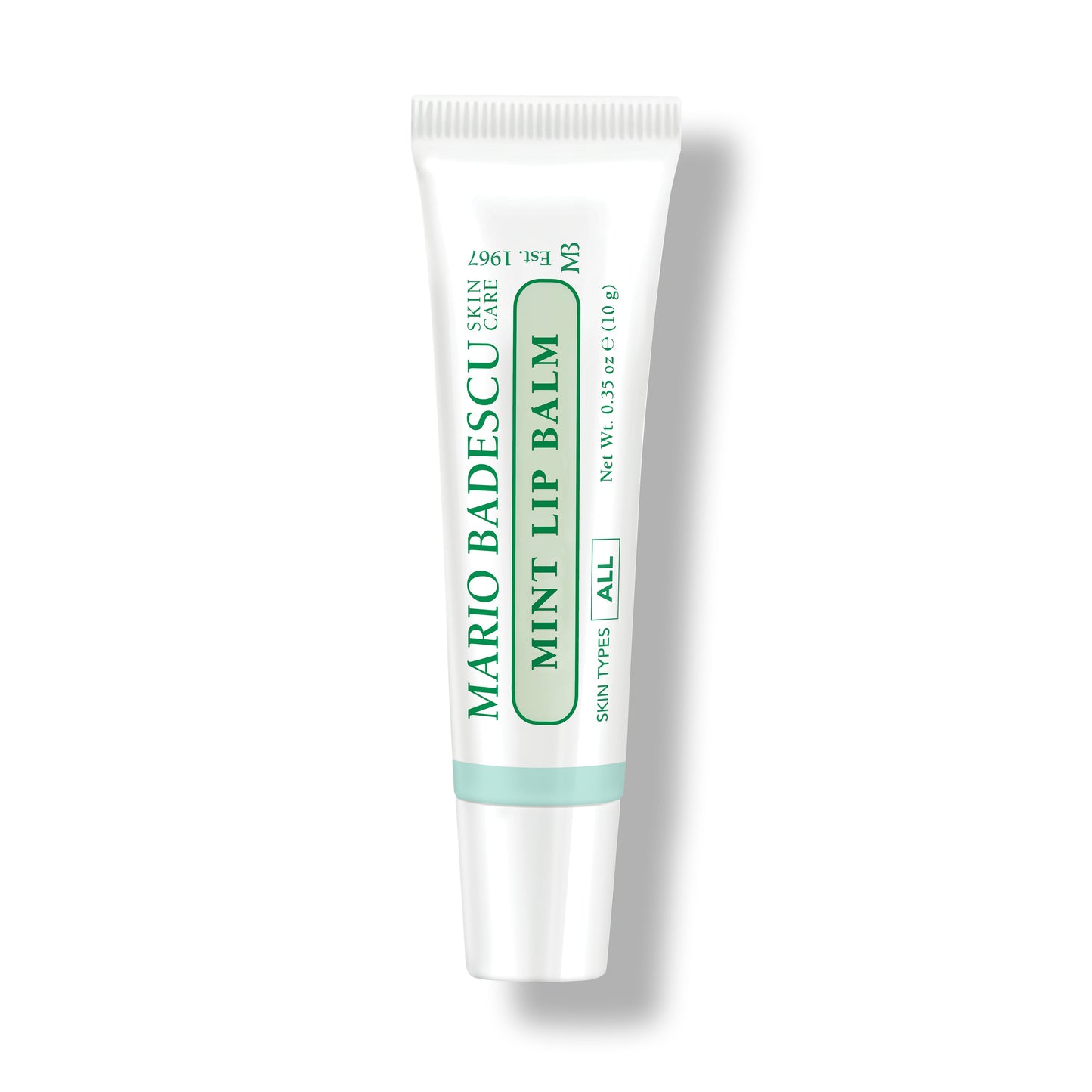

Mario Badescu
Mint Lip Balm (Squeeze Tube)

Mint Lip Balm (Squeeze Tube)
Mario Badescu
mint-lip-balm-squeeze-tube
Lip care
9818359300389
Morning or Evening?
How often will you use this product?
Notes


Highlights
WHAT IS IT?
Lip balm with 6 key ingredients
FEATURES
Ultra-nourishing, moisture-intensive, provides lasting hydration, fresh minty feel
BEST FOR
all skin types
CHECKS
Free of alcohol, paraben, sulfates
Who Is It For?
All Ages And GendersWhat Does It Help With?
Dry Lips Moisture RetentionBudget
Affordable (under $30)How To Use
Which routine should it be used in?
Instructions:
Key Information


What Mario Badescu Says
Product Description:
Ultra-nourishing, moisture-intensive. Seals in moisture for lasting hydration. Fresh, minty, and slightly tingly
About the Brand:
Ingredients Overview
Ingredients List
Hydrogenated Polydecene, Cocoglycerides, Ethylene/Propylene/Styrene Copolymer, Dimethicone, Brassica Glycerides, Persea Gratissima (Avocado) Oil, Glyceryl Behenate, Microcrystalline Cellulose, Polyhydroxystearic Acid, Parfum (Fragrance), Jojoba Esters, Helianthus Annuus (Sunflower) Seed Wax, Theobroma Cacao (Cocoa) Seed Butter, Prunus Amygdalus Dulcis (Sweet Almond) Oil, Butyrospermum Parkii (Shea) Butter, Silica Silylate, Silica, Cera Alba (Beeswax, Cire d'abeille), Chamomilla Recutita (Matricaria) Flower Extract, Raspberry Seed Oil/Tocopheryl Succinate Aminopropanediol Esters, Dimethicone Crosspolymer, Dimethicone/Vinyl Dimethicone Crosspolymer, Aloe Barbadensis Leaf Extract, Cocos Nucifera (Coconut) Oil, Glyceryl Rosinate, Hydrogenated Vegetable Oil, Olea Europaea (Olive) Oil Unsaponifiables, Acacia Decurrens Flower Cera, Tocopherol, Butylene/Ethylene/Styrene Copolymer, Polyglycerin-3, Linoleic Acid, Linolenic Acid, Pentaerythrityl Tetra-di-t-butyl Hydroxyhydrocinnamate, Limonene, Linalool
Key Ingredients
Beeswax,Cocoa-Butter,Coconut-Oil,Olive-Oil,Peppermint,Sweet-Almond-Oil,Vitamin-E
Ingredients Details
Beeswax
Common Name(s): Cera alba (white),cera flava (yellow),apis mellifera wax
CAS Number: 8012-89-3
DESCRIPTION
What It Does: Provides natural wax structure and emolliency for cosmetic texture and lip balm applications.
Why It's Used: The original cosmetic wax – provides natural, hard-texture structure for lip balms, sticks, and creams with emollient skin conditioning.
How It Works: Complex mixture of esters (wax esters), hydrocarbons (hentriacontane), and fatty acids provides semi-crystalline structure. melting point 62-65°c enables stable solid products. emulsifying capacity from free cerotic acid content.
Typically Found In: Lip balms,cosmetic sticks,creams,natural cosmetics
TECHNICAL DETAILS
Primary Category: Functional ingredient – natural wax
Secondary Functions: Natural wax structure,occlusive conditioning
Application Areas:

Facial Skincare

Body Care
Hair Care
Beard Care
Color Cosmetics (Makeup)
Dietary/Oral Supplements
Typical Concentration Range: 2%–30%
SOURCING & ETHICS
Vegan Status: No – honeybee-derived
Halal Status: Conditional – animal-derived; verify halal certification
Source Notes: Plant-derived, synthetic or animal-derived. verify source.
SKIN COMPATIBILITY
Irritancy Rating: 1/5 – very low
Comedogenicity Rating: 1/5 – low; formulation-dependent
Sensitivity Concerns: Non-irritating.
Safe for Sensitive Skin: Yes
SAFETY & COMPATIBILITY
Safety Profile: Excellent safety profile. ewg score: 1.
Works Well With: Humectants,ceramides,actives as carrier
Avoid Combining With: No significant incompatibilities
SCIENTIFIC NOTE
Beeswax's multi-component wax ester composition (myricyl palmitate as primary component) provides a unique crystalline structure that gives lip balms and cosmetic sticks their characteristic 'dragée' glide – different from synthetic wax esters that lack this crystalline lattice diversity.
Last Verified: Cosing database,cir safety assessment
Primary Sources: 2026-03-12
Cocoa Butter
Common Name(s): Cocoa butter,cacao butter
CAS Number: 8002-31-1
DESCRIPTION
What It Does: Provides hard-setting occlusive emolliency for body butters and lip balms with skin conditioning stearic acid.
Why It's Used: Classic body care and lip balm solid butter providing strong occlusive moisture retention with the iconic cocoa scent and stable solid-at-room-temperature consistency.
How It Works: High stearic (32-36%) and palmitic (25-30%) acid content provides hard, brittle texture with high melting point (34-38°c). solid at room temperature, melts at body contact for on-skin application. occlusive barrier film reduces tewl. natural polyphenols provide antioxidant activity.
Typically Found In: Body butters,lip balms,hard lotions,soap,cosmetics
TECHNICAL DETAILS
Primary Category: Functional ingredient – emollient
Secondary Functions: Occlusive barrier,hard butter texture,natural aroma
Application Areas:
Facial Skincare
Body Care
Hair Care
Beard Care
Color Cosmetics (Makeup)
Dietary/Oral Supplements
Typical Concentration Range: 1%–100%
SOURCING & ETHICS
Vegan Status: Yes – from theobroma cacao seeds
Halal Status: Yes
Source Notes: Expeller or cold-pressed from roasted cacao beans. natural cocoa butter retains aroma; deodorized available for unscented formulas. very shelf stable (shelf life 3-5 years).
SKIN COMPATIBILITY
Irritancy Rating: 1/5 – very low
Comedogenicity Rating: 4/5 – comedogenic; avoid on acne-prone face
Sensitivity Concerns: Non-irritating.
Safe for Sensitive Skin: Yes
SAFETY & COMPATIBILITY
Safety Profile: Excellent safety profile. ewg score: 1.
Works Well With: Humectants,ceramides,actives as carrier
Avoid Combining With: No significant incompatibilities
SCIENTIFIC NOTE
Cocoa butter is one of the few naturally occurring fats with a sharp melting point transition (34-38°c) just below body temperature, providing solid-at-room-temperature stability while melting completely and uniformly on skin contact. this unique thermal transition gives body butters and lip balms their characteristic texture and application.
Last Verified: Cosing database,cir safety assessment
Primary Sources: 2026-03-12
Coconut Oil
Common Name(s): Coconut oil,botanical oil,phytochemical active
CAS Number: N/a
DESCRIPTION
What It Does: Provides antioxidant protection from reactive oxygen species, reduces inflammatory cytokine production in skin, and conditions skin through the plant's phytochemical complex.
Why It's Used: Natural origin narrative, traditional use heritage, and multi-functional phytochemical profile supporting concurrent skin care claims from one ingredient.
How It Works: Polyphenols, terpenoids, and alkaloids scavenge ros via h• donation, inhibit nf-kb or cox-2 inflammatory pathways, and interact with skin surface proteins for conditioning.
Typically Found In: Botanical skin care,natural products
TECHNICAL DETAILS
Primary Category: Active ingredient – antioxidant
Secondary Functions: Free radical scavenging,anti-aging
Application Areas:
Facial Skincare
Body Care
Hair Care
Beard Care
Color Cosmetics (Makeup)
Dietary/Oral Supplements
Typical Concentration Range: 0.1%–10%
SOURCING & ETHICS
Vegan Status: Conditional
Halal Status: Yes
Source Notes: Plant-derived extract or synthetic.
SKIN COMPATIBILITY
Irritancy Rating: 1/5 – very low
Comedogenicity Rating: 0/5 – non-comedogenic
Sensitivity Concerns: Non-irritating; well-tolerated.
Safe for Sensitive Skin: Yes
SAFETY & COMPATIBILITY
Safety Profile: Excellent safety profile. ewg score: 1.
Works Well With: Vitamin c,vitamin e,ferulic acid,spf,other antioxidants
Avoid Combining With: No significant incompatibilities
SCIENTIFIC NOTE
Plant secondary metabolites evolved as photoprotectants and antimicrobials — mechanisms directly applicable to cosmetic antioxidant and anti-inflammatory activity in human skin.
Last Verified: Cosing database,coconut oil botanical review
Primary Sources: 2026-03-12
Olive Oil
Common Name(s): Olive oil oil
DESCRIPTION
What It Does: Nourishes and softens skin through its balanced fatty acid profile, while antioxidant compounds protect against oxidative skin damage.
Why It's Used: Plant oils provide physiologically compatible lipid structures that integrate into the skin barrier and deliver fat-soluble antioxidants directly to skin cells.
How It Works: Fatty acids integrate into stratum corneum lipid lamellae, reinforcing the lipid barrier. antioxidants (tocopherols, carotenoids, polyphenols) neutralize ros through electron donation or singlet oxygen quenching.
Typically Found In: Face oils,serums,moisturizers,hair treatments,body oils
TECHNICAL DETAILS
Primary Category: Plant oils
Secondary Functions: Emollient,antioxidant
Application Areas:
Facial Skincare
Body Care
Hair Care
Beard Care
Color Cosmetics (Makeup)
Dietary/Oral Supplements
Typical Concentration Range: 0.5–30%
SOURCING & ETHICS
Vegan Status: Yes
Halal Status: Yes
Source Notes: Cold-pressed or solvent-extracted plant oil; no animal components.
SKIN COMPATIBILITY
Irritancy Rating: 1899-12-31 00:00:00 -0800
Comedogenicity Rating: 1900-01-01 00:00:00 -0800
Sensitivity Concerns: Low sensitization potential at recommended use concentrations.
Safe for Sensitive Skin: Yes
SAFETY & COMPATIBILITY
Safety Profile: Well-characterized cosmetic ingredient with established safety profile. generally non-irritating at typical use concentrations. suitable for leave-on and rinse-off cosmetics.
Works Well With: Vitamin e,ceramides,other plant oils,squalane
Avoid Combining With: Strong oxidizers (accelerate rancidity)
SCIENTIFIC NOTE
Vegetable oils are triglyceride matrices where the fatty acid composition determines skin compatibility, barrier function, and comedogenicity. oleic acid-rich oils (>60%) soften barrier lipids and enhance penetration; linoleic acid-rich oils reinforce ceramide-poor stratum corneum; saturated fatty acid-rich oils provide occlusion without skin penetration.
Last Verified: Cosing eu database; pcpc cosmetic ingredient safety reviews; aocs plant oil composition databases; fatty acid pharmacology reviews
Primary Sources: 2025-01-15
