
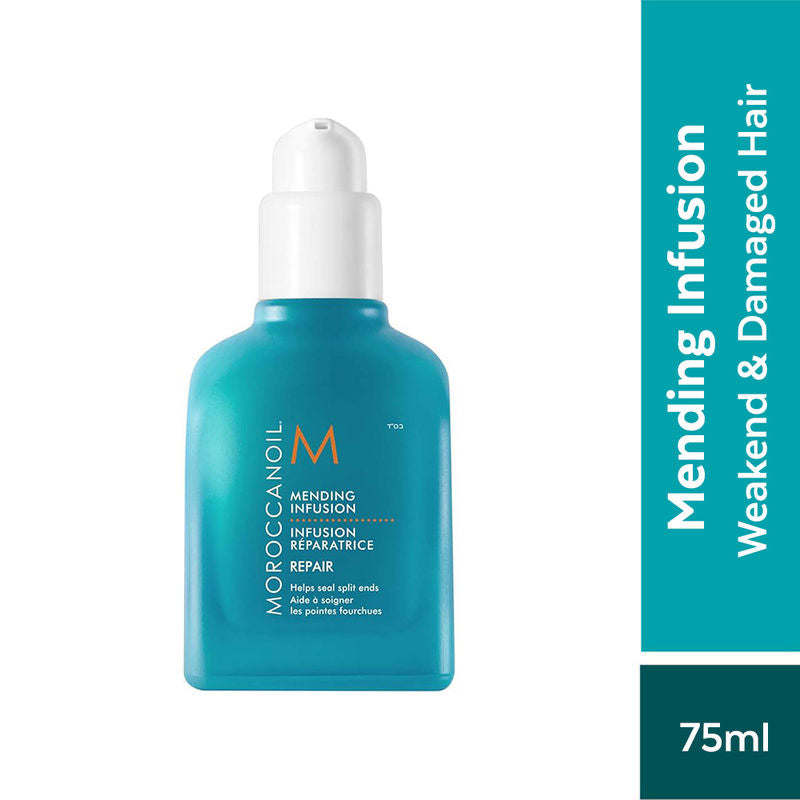

Moroccanoil
Moroccanoil Mending Infusion with Argan Oil Leave-in Finishing Serum to Help Seal Split Ends
A leave-in finishing serum formulated with argan oil and other nourishing ingredients that help seal split ends, increase hair elasticity and strength, and provide damage recovery for softer and smoother hair.
Sulfate-free
Paraben-free
Color-safe
Damage Repair
Split Ends
Breakage
Optimized for Your Environment & Lifestyle
Nykaa
In stock
Recommended

Moroccanoil Mending Infusion with Argan Oil Leave-in Finishing Serum to Help Seal Split Ends
Moroccanoil
moroccanoil-mending-infusion-with-argan-oil-leave-in-finishing-serum-to-help-seal-split-ends
Hair Serum
10202944438565
Morning or Evening?
How often will you use this product?
Notes


Secure payment protection
Your Biodata Compatibility Analysis
Based on your 6 hair health indices and environmental factors
Poor Match
Significant incompatibilities
Growth Cycle Health Index
Hair Match
Hair Health Index Alignment
Optimal for OSI, SSI, DI, HSI
Ingredient Efficacy
Matching Ingredient Score
Environment Compatibility
Current UV, Air Quality & Humidity
Why This Works for Your Specific Profile
Damage Index:
Damage levels outside specified range may not benefit optimally from product formulation
Water Quality:
Fine hair becomes weighed down and greasy from heavy formulation
Hair:
Closed cuticles resist product penetration causing surface buildup without internal benefits
Active Lifestyle:
Activity levels outside optimal range affect product performance and maintenance requirements
Your Hair Profile Integration
Your Hair Archetype

Density Level

Washing Frequency

Shedding Level

Oil Level
Your Hair Health Indices
Oil Secretion (OSI)
Very low oil production
Scalp Sensitivity (SSI)
Very low sensitivity
Growth Rate (CMR)
Poor metabolism rate
Damage Index (DI)
Minimal damage
Hair Strength (HSI)
Very weak strength
Softness Index (SI)
Significant improvement needed
Water & Environmental Integration

Water:


Expected Results & Timeline
Key Highlights

What is it?
Leave-in finishing serum with key nourishing ingredients including argan oil and hydrolyzed quinoa

Who Is It For
All Ages

Budget
Rs. 3,700.80 - Rs. 7,401.60

Timeline
Why You’ll Love It

What Does It Help With?
Split Ends, Damage Repair, Breakage

Best for
Split Ends

Features
Helps seal split ends, nourishes hair, increases elasticity and strength, provides smoothness and softness

Checks
100% Authentic, directly purchased from Moroccanoil
Ingredients Overview
Ingredients List
aqua-water-eau, dimethicone, glycerin, cyclohexasiloxane, hydroxyethyl-acrylate-sodium-acryloyldimethyl-taurate-copolymer, squalane, argania-spinosa-argan-kernel-oil, hydrolyzed-quinoa, hydrolyzed-adansonia-digitata-seed-extract, camellia-sinensis-green-tea-leaf-extract, chamomilla-recutita-matricaria-flower-extract, lavandula-angustifolia-lavender-flower-extract, parfum-fragrance, coconut-alkanes, peg-40-castor-oil, galactoarabinan, polysorbate-60, dilinoleic-acid-propanediol-copolymer, sorbitan-isostearate, benzophenone-4, panthenol, coco-caprylate-caprate, xylitol, ethyl-macadamiate, citric-acid, benzophenone-3, tocopherol, malic-acid, sulfuric-acid, potassium-sorbate, sodium-benzoate, benzyl-alcohol, phenoxyethanol
Key Ingredients
Argan Oil, Galactoarabinan, Baobab Extract, Hydrolyzed Quinoa
Ingredients Details
Argan Oil
Common Name(s): Argan oil,moroccan oil
CAS Number: 223747-87-3
DESCRIPTION
What It Does: Conditions and nourishes skin and hair with exceptional fatty acid, squalene, and tocopherol content.
Why It's Used: Premium multi-nutrient facial and hair oil – its unique phytosterol and squalene composition provides anti-aging benefits beyond simple emolliency.
How It Works: Balanced oleic/linoleic acid ratio provides both emolliency and barrier repair. high squalene content (6-7%) provides antioxidant and sebum-compatible emolliency. tocopherols provide antioxidant stability and skin benefit. phytosterols inhibit 5-alpha-reductase and reduce inflammation.
Typically Found In: Premium facial oils,hair oils,anti-aging products
TECHNICAL DETAILS
Primary Category: Functional ingredient – emollient
Secondary Functions: Squalene content,phytosterol activity,anti-aging
Application Areas:

Facial Skincare
Body Care
Hair Care
Beard Care

Color Cosmetics (Makeup)
Dietary/Oral Supplements
Typical Concentration Range: 1%–100%
SOURCING & ETHICS
Vegan Status: Yes – from argania spinosa kernels
Halal Status: Yes
Source Notes: Cold-pressed from roasted (food) or unroasted (cosmetic) argan kernels. unesco world heritage traditional production. fair trade certified sources available.
SKIN COMPATIBILITY
Irritancy Rating: 1/5 – very low
Comedogenicity Rating: 0/5 – non-comedogenic
Sensitivity Concerns: Non-irritating.
Safe for Sensitive Skin: Yes
SAFETY & COMPATIBILITY
Safety Profile: Excellent safety profile. ewg score: 1.
Works Well With: Humectants,ceramides,actives as carrier
Avoid Combining With: No significant incompatibilities
SCIENTIFIC NOTE
Argan oil's squalene content (6-7%) is among the highest of all plant oils, second only to olive oil. squalene is an endogenous skin lipid that declines with age, making argan oil's high squalene level particularly relevant for anti-aging facial use – replenishing both essential fatty acids and age-depleting skin lipids simultaneously.
Last Verified: Cosing database,boucetta et al. argan oil review,cir safety assessment
Primary Sources: 2026-03-12
Benzophenone-3
Common Name(s): Oxybenzone,2-hydroxy-4-methoxybenzophenone,uva+uvb filter
CAS Number: 131-57-7
DESCRIPTION
What It Does: Provides combined uva and uvb filtration in a single chemical uv filter molecule.
Why It's Used: Combined uva+uvb filter historically used for broad-spectrum coverage in a single ingredient, now increasingly restricted.
How It Works: Benzophenone chromophore absorbs uvb (305nm) and uva-ii (326nm) via two separate n→π* transitions. water-soluble allows aqueous phase formulation. single filter providing partial broad-spectrum coverage.
Typically Found In: Sunscreens (being phased out in many markets)
TECHNICAL DETAILS
Primary Category: Active ingredient – chemical uva/uvb filter
Secondary Functions: Skin conditioning
Application Areas:
Facial Skincare
Body Care
Hair Care
Beard Care
Color Cosmetics (Makeup)
Dietary/Oral Supplements
Typical Concentration Range: Up to 6% (eu), 6% (us fda)
SOURCING & ETHICS
Vegan Status: Yes – synthetic
Halal Status: Yes
Source Notes: Commercially produced for cosmetic use. verify vegan/halal status with supplier.
SKIN COMPATIBILITY
Irritancy Rating: 1/5 – very low
Comedogenicity Rating: 0/5 – non-comedogenic
Sensitivity Concerns: Well-tolerated by most skin types.
Safe for Sensitive Skin: Yes
SAFETY & COMPATIBILITY
Safety Profile: Eu max 6%. coral reef/aquatic toxicity — banned hawaii, palau, some us states. potential endocrine activity at high systemic exposure. ewg score: 7. use declining due to regulatory pressure.
Works Well With: Standard skincare actives
Avoid Combining With: No known significant incompatibilities
SCIENTIFIC NOTE
Benzophenone-3's declining use reflects evolving understanding of environmental and endocrine impacts: discovered in coral bleaching studies, its restriction in hawaii (2018) sparked a global trend in marine-safe sunscreen formulations that is reshaping the industry away from bp-3 toward mineral filters and marine-safer organic alternatives.
Last Verified: Cosing database,fda uv filter otc monograph,hawaii bp-3 restriction law
Primary Sources: 2026-03-12
Benzophenone-4
Common Name(s): Benzophenone-4
DESCRIPTION
What It Does: Absorbs or reflects uv radiation, preventing uv-induced dna damage, photo-oxidative stress, and premature skin aging.
Why It's Used: Uv filters are the active ingredients in sun protection — without them, formulations cannot make spf claims or prevent solar-induced skin damage.
How It Works: The uv-absorbing chromophore undergoes photoexcitation by uv photons, then dissipates the absorbed energy through thermal relaxation (chemical filters) or photon scattering/reflection (physical filters), preventing photon penetration to skin cells.
Typically Found In: Sunscreens,moisturizers with spf,foundations with spf
TECHNICAL DETAILS
Primary Category: Uv filters
Secondary Functions: Skin-protecting
Application Areas:
Facial Skincare
Body Care
Hair Care
Beard Care
Color Cosmetics (Makeup)
Dietary/Oral Supplements
Typical Concentration Range: 0.5–25% (within regulatory limits)
SOURCING & ETHICS
Vegan Status: Yes
Halal Status: Yes
Source Notes: Synthetic uv filter; no animal components.
SKIN COMPATIBILITY
Irritancy Rating: 1
Comedogenicity Rating: 0
Sensitivity Concerns: Contact allergy to uv filters occurs in approximately 1–3% of the general population; patch testing recommended for those with known photosensitivity.
Safe for Sensitive Skin: Yes
SAFETY & COMPATIBILITY
Safety Profile: Regulatory approval required per market (eu annex vi, fda otc monograph, etc.). generally non-irritating at approved concentrations.
Works Well With: Other uv filters,antioxidants,emollients
Avoid Combining With: Incompatible filter combinations (photodegradation); check regulatory approvals per region
SCIENTIFIC NOTE
Uv filters operate through two mechanisms: organic/chemical filters absorb uv photons through electronic excitation (π→π* transitions in conjugated systems), then dissipate energy via thermal relaxation; inorganic/physical filters (tio2, zno) scatter and reflect photons through mie scattering (particle size 50–300 nm) and band gap absorption. spf is measured in vivo (iso 24444) as the ratio of minimal erythema doses with and without sunscreen.
Last Verified: Cosing eu database; pcpc cosmetic ingredient safety reviews; eu cosmetics regulation annex vi; iso 24444 (in vivo spf testing)
Primary Sources: 2025-01-15
Cyclohexasiloxane
Common Name(s): D6,cyclomethicone d6,hexamethylcyclotrisiloxane
CAS Number: 540-97-6
DESCRIPTION
What It Does: Provides volatile silicone delivery with longer contact time than d5 for extended active delivery.
Why It's Used: Longer-evaporation volatile silicone for formulations requiring extended delivery contact time vs d5's rapid evaporation.
How It Works: Larger ring (6 silicone units) provides lower vapor pressure than d5 (5 units). slower evaporation rate (2-3× longer than d5) provides extended delivery window. same dry-touch after complete evaporation.
Typically Found In: Longer-duration volatile vehicles,serum formulations
TECHNICAL DETAILS
Primary Category: Functional ingredient – volatile cyclic silicone
Secondary Functions: Skin conditioning
Application Areas:
Facial Skincare
Body Care
Hair Care
Beard Care
Color Cosmetics (Makeup)
Dietary/Oral Supplements
Typical Concentration Range: 1%–30%
SOURCING & ETHICS
Vegan Status: Yes – synthetic
Halal Status: Yes
Source Notes: Commercially produced for cosmetic use. verify vegan/halal status with supplier.
SKIN COMPATIBILITY
Irritancy Rating: 1/5 – very low
Comedogenicity Rating: 0/5 – non-comedogenic
Sensitivity Concerns: Well-tolerated by most skin types.
Safe for Sensitive Skin: Yes
SAFETY & COMPATIBILITY
Safety Profile: Eu restrictions on d5 do not apply to d6 – d6 may be used in rinse-off products without restriction.
Works Well With: Standard skincare actives
Avoid Combining With: No known significant incompatibilities
SCIENTIFIC NOTE
The different evaporation rates of d4 (methylcyclosiloxane), d5, and d6 provide formulators with a toolkit of volatile silicone delivery windows: d4 evaporates in ~1 minute, d5 in ~5 minutes, d6 in ~15 minutes. blending these provides precisely tunable evaporation kinetics for specific delivery timing requirements.
Last Verified: Cosing database,dow silicone technical data,cir safety assessment
Primary Sources: 2026-03-12
Personalized Usage Instructions
How to Use
Step 1
Apply a dime-sized amount between palms and work through dry hair, focusing on the ends after styling
Step 2
Reapply as needed
Step 3
Stylist Tip: Workout throughout ends while blow drying your hair
Medical Chemicals

Protein/Moisture
- Protein/Moisture balance type
pH Level
-

Porosity Taget
- High Porosity
Customized for Your Profile
Scalp Condtions
Climate Suitability
Humid, Dry, UV Protection, Pollution Shield, Winter, Summer
Clinical Claims
Frequency
Apply a dime-sized amount between palms and work through dry hair, focusing on the ends after styling. Reapply as needed. Stylist Tip: Workout throughout ends while blow drying your hair.
Product Information

100% Authentic
directly purchased from Moroccanoil
