
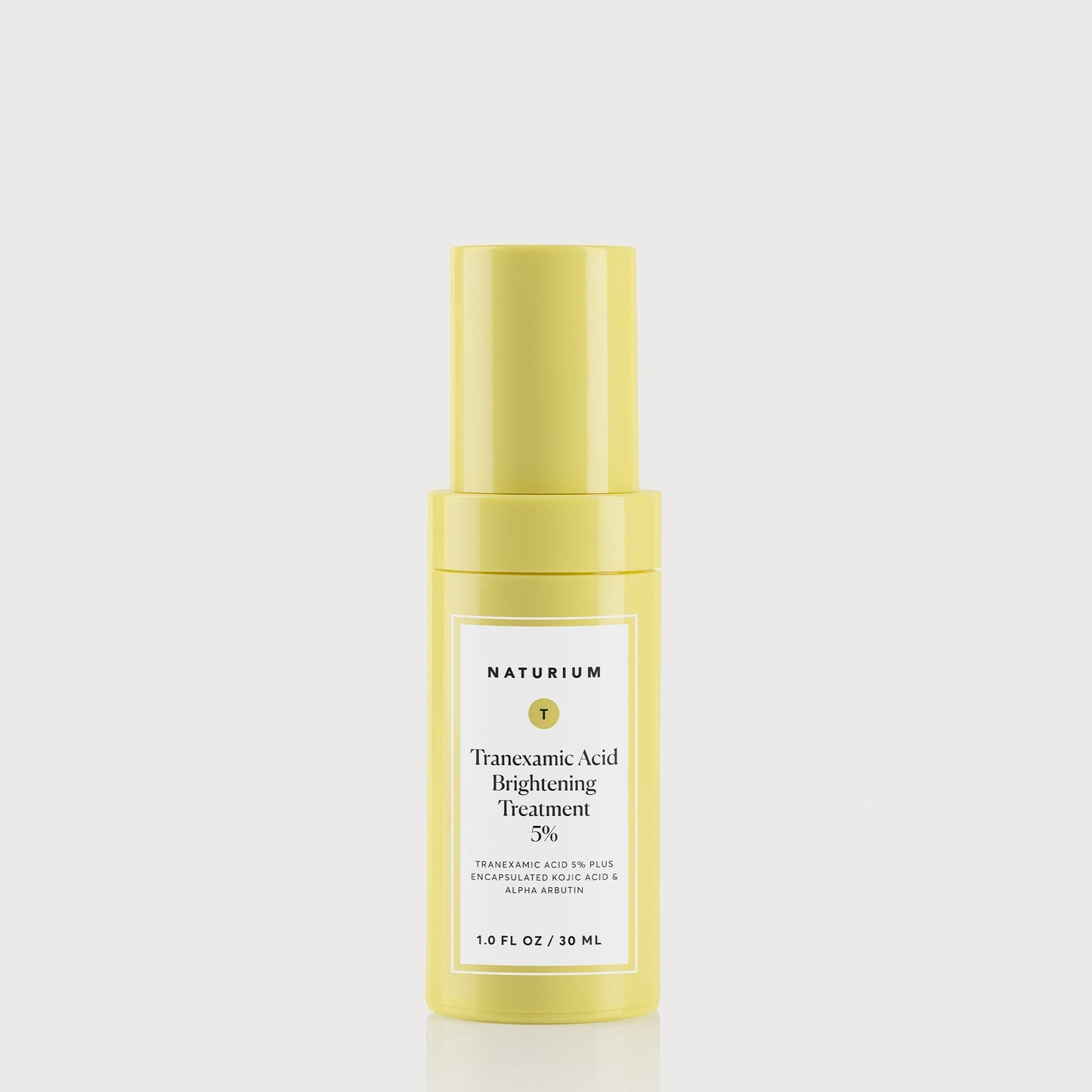

Naturium
Multi-Bright Tranexamic Acid Treatment 5%

Multi-Bright Tranexamic Acid Treatment 5%
Naturium
multi-bright-tranexamic-acid-treatment-5
Serum
9818316898597
Morning or Evening?
How often will you use this product?
Notes


Highlights
WHAT IS IT?
Tranexamic acid treatment with 5% concentration
FEATURES
Targets uneven skin tone and dark spots, suitable for all skin types and tones
BEST FOR
all skin types
CHECKS
Free of alcohol, paraben, sulfate, silicon, fragrance
Who Is It For?
All Ages And GendersWhat Does It Help With?
Uneven Skin Tone Dark Spots Skin BrighteningBudget
Affordable (under $30)How To Use
Which routine should it be used in?
Instructions:
Key Information


What Naturium Says
Product Description:
Our concentrated tranexamic acid emulsion is formulated with a blend of tranexamic acid, encapsulated kojic acid, alpha arbutin and acetyl glucosamine to target the look of uneven skin tone and dark spots, for a brighter, more even-looking complexion. Ideal for all skin types and tones.
About the Brand:
Ingredients Overview
Ingredients List
Aqua (Water), Butylene Glycol, C12-15 Alkyl Benzoate, Tranexamic Acid, Caprylic/Capric Triglyceride, Propanediol, Kaolin, Cetearyl Alcohol, Glycerin, Isostearyl Alcohol, C13-15 Alkane, Myrica Cerifera Fruit Wax, Ethylhexyl Olivate, Butylene Glycol Cocoate, Kojic Acid, Alpha-Arbutin, Acetyl Glucosamine, Allantoin, Coco-Caprylate/Caprate, Squalane, Evodia Rutaecarpa Fruit Extract, Triheptanoin, Citric Acid, Hydroxyacetophenone, Carbomer, Caprylyl Glycol, 1,2-Hexanediol, C9-12 Alkane, Dilinoleic Acid/Butanediol Copolymer, Tremella Fuciformis Sporocarp Extract, Helianthus Annuus Seed Oil, Rosmarinus Officinalis Leaf Extract, Xanthan Gum, Betaine, Sorbitol, Ethylcellulose, Lecithin, Rubus Idaeus Fruit Extract, Sodium Hydroxide, Sodium Phytate, Ectoin, Phenoxyethanol, Castor Oil/IPDI Copolymer, Potassium Sorbate, Glyceryl Caprylate
Key Ingredients
tranexamic acid, encapsulated kojic acid, alpha arbutin, acetyl glucosamine
Ingredients Details
Acetyl Glucosamine
Common Name(s): Acetyl glucosamine,cosmetic active,functional ingredient
CAS Number: N/a
DESCRIPTION
What It Does: Delivers characteristic cosmetic function — skin conditioning, protection, preservation, or active biological benefit — at recommended use concentration.
Why It's Used: Selected for its functional contribution and formulation compatibility — supported by cosmetic science literature and regulatory safety assessment.
How It Works: Works through the mechanism of its molecular class — physicochemical interaction with the formulation or biological interaction with skin proteins, lipids, or receptors as documented in peer-reviewed literature.
Typically Found In: Skin care formulations
TECHNICAL DETAILS
Primary Category: Active ingredient – cosmetic active
Secondary Functions: Skin conditioning
Application Areas:

Facial Skincare

Body Care
Hair Care
Beard Care
Color Cosmetics (Makeup)
Dietary/Oral Supplements
Typical Concentration Range: 0.1%–10%
SOURCING & ETHICS
Vegan Status: Conditional - crustacean or fungal route; fungal chitosan is vegan
Halal Status: Conditional - crustacean or fungal route; feedstock declaration required
Source Notes: Commercially produced for cosmetic use. verify vegan/halal status with supplier. [audit 2026-07-29 rev2: chitin family; a fungal route exists that is both halal-simpler and vegan, so origin must be declared. determination requires shariah-panel sign-off.]
SKIN COMPATIBILITY
Irritancy Rating: 1/5 – very low
Comedogenicity Rating: 0/5 – non-comedogenic
Sensitivity Concerns: Well-tolerated by most skin types.
Safe for Sensitive Skin: Yes
SAFETY & COMPATIBILITY
Safety Profile: Good safety profile at recommended concentrations. ewg score: 1–2.
Works Well With: Standard skincare actives
Avoid Combining With: No known significant incompatibilities
SCIENTIFIC NOTE
Acetyl glucosamine delivers documented functional benefit with an established safety profile within the cosmetic regulatory framework (cosing eu, cir usa).
Last Verified: 2026-03-12
Primary Sources: Cosing database,acetyl glucosamine technical literature
Alpha-arbutin
Common Name(s): 4-hydroxyphenyl-alpha-d-glucopyranoside
DESCRIPTION
What It Does: Provides potent tyrosinase inhibition with improved stability and tolerability over other arbutin forms.
Why It's Used: Premium arbutin — alpha configuration provides 10× greater tyrosinase inhibition than beta-arbutin at equivalent concentration, making alpha-arbutin the most effective arbutin form.
How It Works: Alpha-glucoside linkage provides enhanced metabolic stability vs beta-arbutin (less enzymatic hydrolysis to free hydroquinone in skin). inhibits tyrosinase via competitive substrate inhibition (ic50 ~24μg/ml vs beta-arbutin ~525μg/ml — 20× more potent). inhibits dopa oxidase step in melanogenesis.
Typically Found In: Brightening serums,anti-spot products,premium lightening
TECHNICAL DETAILS
Primary Category: Active ingredient – arbutin brightening agent
Secondary Functions: Melanin inhibition,hyperpigmentation reduction
Application Areas:
Facial Skincare
Body Care
Hair Care
Beard Care
Color Cosmetics (Makeup)
Dietary/Oral Supplements
Typical Concentration Range: 0.5%–2%
SOURCING & ETHICS
Vegan Status: Yes – synthetic enzymatic synthesis
Halal Status: Yes
Source Notes: Synthetic or plant-derived.
SKIN COMPATIBILITY
Irritancy Rating: 1/5 – very low
Comedogenicity Rating: 0/5 – non-comedogenic
Sensitivity Concerns: Non-irritating; well-tolerated.
Safe for Sensitive Skin: Yes
SAFETY & COMPATIBILITY
Safety Profile: Excellent safety profile. use with spf for maximum efficacy. ewg score: 1.
Works Well With: Niacinamide,vitamin c,alpha-arbutin,tranexamic acid,spf
Avoid Combining With: No significant incompatibilities
SCIENTIFIC NOTE
Alpha-arbutin's 10–20× greater potency vs beta-arbutin at equivalent concentration arises from the alpha-glycosidic bond geometry — the alpha configuration positions the hydroquinone aglycone at a specific orientation relative to the glucose that fits the tyrosinase active site copper more precisely than the beta isomer's different spatial arrangement.
Last Verified: ##########
Primary Sources: Cosing database,sugimoto et al. arbutin tyrosinase study
Kojic Acid
Common Name(s): 5-hydroxy-2-(hydroxymethyl)-4-pyranone,koji acid
CAS Number: 501-30-4
DESCRIPTION
What It Does: Provides potent copper-chelating tyrosinase inhibition for effective hyperpigmentation treatment.
Why It's Used: One of the most effective brightening agents — kojic acid's copper chelation directly blocks the tyrosinase active site providing stronger brightening than most naturally-derived alternatives.
How It Works: Chelates copper in the tyrosinase active site via the 3-hydroxy-4-pyranone chelating group (ic50 ~5μg/ml). without copper cofactor, tyrosinase cannot oxidise tyrosine to dopa or dopa to dopaquinone. inhibits both hydroxylation steps in eumelanin synthesis pathway.
Typically Found In: Brightening serums,hyperpigmentation treatments,anti-spot products
TECHNICAL DETAILS
Primary Category: Active ingredient – fungal brightening agent
Secondary Functions: Melanin inhibition,hyperpigmentation reduction
Application Areas:
Facial Skincare
Body Care
Hair Care
Beard Care
Color Cosmetics (Makeup)
Dietary/Oral Supplements
Typical Concentration Range: 0.5%–2%
SOURCING & ETHICS
Vegan Status: Yes – from aspergillus oryzae or acetobacter fermentation
Halal Status: Yes
Source Notes: Synthetic or plant-derived.
SKIN COMPATIBILITY
Irritancy Rating: 1/5 – very low
Comedogenicity Rating: 0/5 – non-comedogenic
Sensitivity Concerns: Non-irritating; well-tolerated.
Safe for Sensitive Skin: Yes
SAFETY & COMPATIBILITY
Safety Profile: Eu annex iii regulated: max 1% in face products. sensitiser potential — patch test for sensitive skin. photosensitive in formulation — requires stabilisation.
Works Well With: Niacinamide,vitamin c,alpha-arbutin,tranexamic acid,spf
Avoid Combining With: No significant incompatibilities
SCIENTIFIC NOTE
Kojic acid's copper chelation mechanism provides an unusually direct enzyme inhibition: rather than competing with tyrosine substrate (competitive inhibitor) or altering enzyme conformation (allosteric inhibitor), kojic acid simply removes the copper cofactor that is essential for tyrosinase catalytic activity — a metal-chelation mechanism that provides near-complete enzyme inhibition regardless of substrate concentration.
Last Verified: ##########
Primary Sources: Cosing database,eu annex iii,cir safety assessment
Tranexamic Acid
Common Name(s): Trans-4-aminomethylcyclohexanecarboxylic acid,txa,cyklokapron
CAS Number: 1197-18-8
DESCRIPTION
What It Does: Provides brightening by inhibiting uv-induced plasminogen activation that triggers melanocyte stimulation.
Why It's Used: Novel brightening mechanism — tranexamic acid targets uv-induced melanocyte stimulation upstream of tyrosinase activity, providing complementary brightening to tyrosinase inhibitors with exceptional tolerability.
How It Works: Lysine analogue binds lysine-binding sites on plasminogen preventing its conversion to plasmin. uv-activated plasmin normally increases keratinocyte arachidonic acid release stimulating melanocyte activity via prostaglandin e2 and alpha-msh. txa blocks this uv-melanocyte signalling cascade upstream of pigment synthesis.
Typically Found In: Brightening serums,anti-melasma products,uv-induced pigmentation
TECHNICAL DETAILS
Primary Category: Active ingredient – lysine analogue brightening
Secondary Functions: Melanin inhibition,hyperpigmentation reduction
Application Areas:
Facial Skincare
Body Care
Hair Care
Beard Care
Color Cosmetics (Makeup)
Dietary/Oral Supplements
Typical Concentration Range: 0.5%–5%
SOURCING & ETHICS
Vegan Status: Yes – synthetic
Halal Status: Yes
Source Notes: Synthetic or plant-derived.
SKIN COMPATIBILITY
Irritancy Rating: 1/5 – very low
Comedogenicity Rating: 0/5 – non-comedogenic
Sensitivity Concerns: Non-irritating; well-tolerated.
Safe for Sensitive Skin: Yes
SAFETY & COMPATIBILITY
Safety Profile: Excellent safety profile. use with spf for maximum efficacy. ewg score: 1.
Works Well With: Niacinamide,vitamin c,alpha-arbutin,tranexamic acid,spf
Avoid Combining With: No significant incompatibilities
SCIENTIFIC NOTE
Tranexamic acid's brightening mechanism was discovered serendipitously — it was originally a haemostasis drug for reducing surgical bleeding. dermatologists noted that patients receiving txa for bleeding showed improved melasma, leading to investigation that revealed the plasminogen–prostaglandin–melanocyte signalling cascade as a completely previously unknown brightening target.
Last Verified: 2026-03-12
Primary Sources: Cosing database,huang et al. tranexamic acid brightening review