
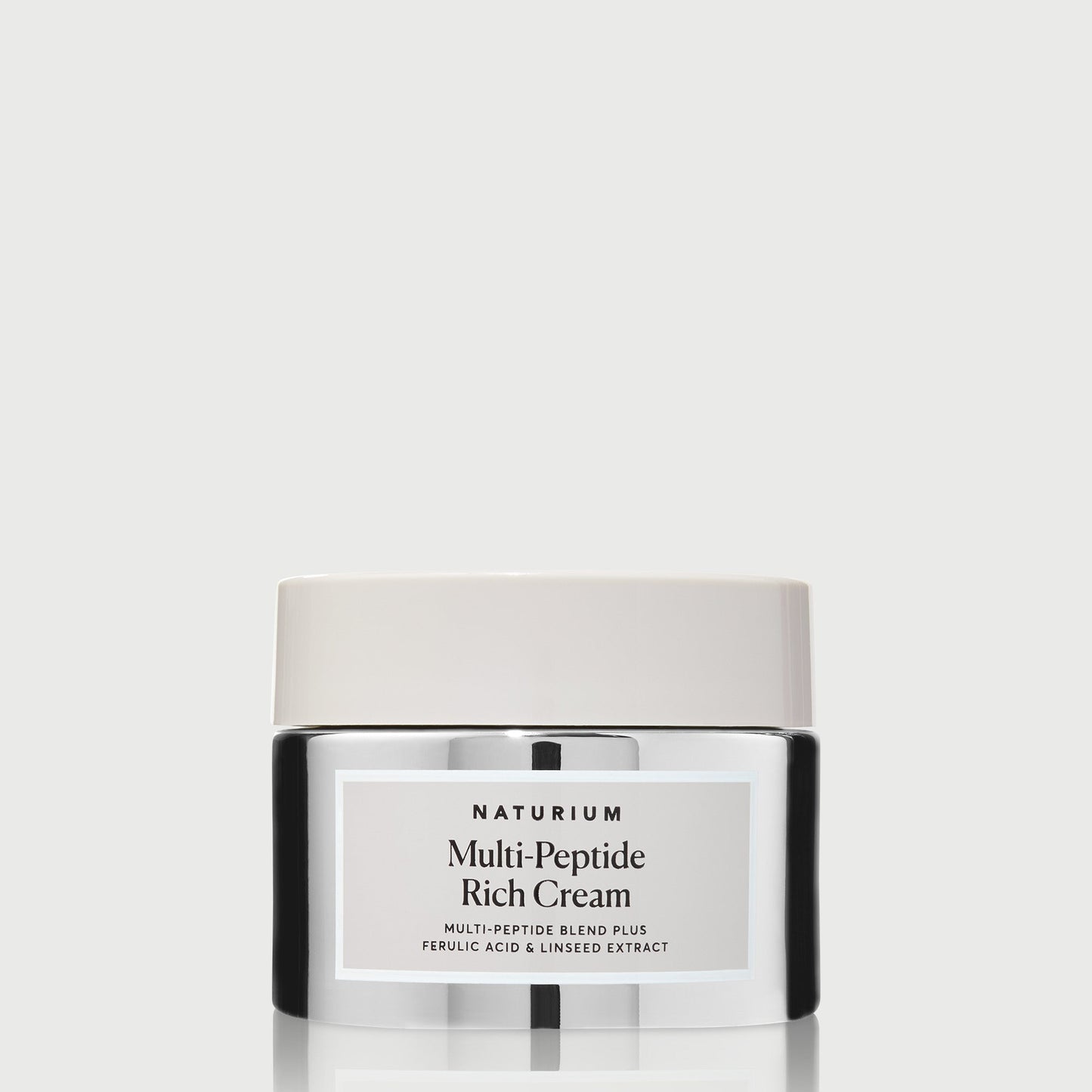

Naturium
Multi-Peptide Rich Cream

Multi-Peptide Rich Cream
Naturium
multi-peptide-rich-cream
Moisturize
9818312704293
Morning or Evening?
How often will you use this product?
Notes


Highlights
WHAT IS IT?
Multi-peptide rich moisturizing cream
FEATURES
Advanced multi-peptide blend, intensely nourishing, smoothing, firming, targets fine lines and wrinkles, plumps and locks in moisture
BEST FOR
all skin types
CHECKS
Free of alcohol, paraben, oil, silicon
Who Is It For?
Adults Seeking Anti-aging BenefitsWhat Does It Help With?
Fine Lines Wrinkles Firmness Hydration Skin PlumpingBudget
Affordable (under $30)How To Use
Which routine should it be used in?
Instructions:
Key Information


What Naturium Says
Product Description:
Our ultra-rich cream is formulated with an advanced multi-peptide blend to intensely nourish, smooth and firm skin's appearance. An innovative combination of palmitoyl pentapeptide-4, copper tripeptide-1 and encapsulated ferulic acid help target fine lines and wrinkles for a more youthful-looking complexion. Plus, linseed extract to help plump and lock in moisture for hydrated, healthy-looking skin.
About the Brand:
Ingredients Overview
Ingredients List
Aqua/Water/Eau, Caprylic/Capric Triglyceride, Glycerin, Octyldodecanol, Butylene Glycol, Polyglyceryl-3 Polyricinoleate, Cera Microcristallina/Microcrystalline Wax/Cire Microcristalline, Magnesium Stearate, Polyglyceryl-3 Oleate, Undecane, 1,2-Hexanediol, Polyglyceryl-20 Octadecabehenate/Hydroxystearate, Sorbitan Olivate, Stearalkonium Bentonite, Magnesium Sulfate, Linum Usitatissimum (Linseed) Seed Extract, Sodium Hyaluronate, Mannitol, Phosphatidylcholine, Palmitoyl Pentapeptide-4, Copper Tripeptide-1, Ferulic Acid, Gold, Tocopherol, Tridecane, Asiaticoside, Propylene Carbonate, Glyceryl Caprylate, Cetyl Alcohol, Decyl Glucoside, P-anisic Acid, Xanthan Gum, Tocopheryl Acetate, Sodium Chloride, Sodium Benzoate, Potassium Sorbate, Phenoxyethanol
Key Ingredients
palmitoyl pentapeptide-4, copper tripeptide-1, ferulic acid, linseed extract
Ingredients Details
Copper Tripeptide-1
Common Name(s): Ghk-cu,copper peptide,gly-his-lys:copper complex
CAS Number: 49557-75-7
DESCRIPTION
What It Does: Stimulates collagen and elastin, accelerates wound healing, activates antioxidant enzymes, and reduces inflammation with an exceptional evidence base.
Why It's Used: Most extensively studied carrier peptide with proven wound healing, anti-aging, and even hair growth efficacy from 50+ years of peer-reviewed research.
How It Works: Copper delivery to enzyme cofactor sites activates sod (antioxidant), lysyl oxidase (collagen crosslinking), and cytochrome c oxidase (cellular energy). ghk moiety signals tgf-beta1 for fibroblast proliferation and collagen synthesis.
Typically Found In: Anti-aging serums,wound healing products,hair growth treatments
TECHNICAL DETAILS
Primary Category: Active ingredient – ghk-cu copper carrier peptide
Secondary Functions: Copper delivery,antioxidant enzyme activation,wound healing
Application Areas:

Facial Skincare

Body Care
Hair Care
Beard Care
Color Cosmetics (Makeup)
Dietary/Oral Supplements
Typical Concentration Range: 0.1%–2%
SOURCING & ETHICS
Vegan Status: Yes – synthetic
Halal Status: Yes
Source Notes: Synthetically produced; copper-peptide complex requires careful formulation.
SKIN COMPATIBILITY
Irritancy Rating: 1/5 – very low
Comedogenicity Rating: 0/5 – non-comedogenic
Sensitivity Concerns: Non-irritating; suitable for sensitive skin.
Safe for Sensitive Skin: Yes
SAFETY & COMPATIBILITY
Safety Profile: Excellent safety profile. ewg score: 1.
Works Well With: Hyaluronic acid,ceramides,antioxidants
Avoid Combining With: Avoid mixing with high-concentration ahas (copper chelation concern); high-dose vitamin c (ascorbate competes for copper binding)
SCIENTIFIC NOTE
Ghk-cu has been shown to activate over 4,000 human genes involved in tissue remodeling and wound healing. pickart's seminal work documented the peptide's ability to restore aging skin by activating the same gene expression programs active in wound healing.
Last Verified: Cosing database,pickart et al. ghk-cu 50-year review,hostynek et al. clinical study
Primary Sources: 2026-03-12
Ferulic Acid
Common Name(s): 4-hydroxy-3-methoxycinnamic acid,coniferic acid
CAS Number: 1135-24-6
DESCRIPTION
What It Does: Doubles vitamin c and e efficacy through synergistic stabilization, providing superior photoprotection.
Why It's Used: Essential in vitamin c serums as the c+e+ferulic acid synergistic antioxidant trio that provides exceptional photoprotection – a clinically proven combination.
How It Works: Phenolic structure provides direct free radical scavenging. also stabilizes l-ascorbic acid and tocopherol by donating hydrogen atoms to regenerate oxidized antioxidants. absorbs uv (290–330nm) providing additional photoprotection.
Typically Found In: Vitamin c serums,antioxidant complexes,sunscreens,anti-aging products
TECHNICAL DETAILS
Primary Category: Active ingredient – hydroxycinnamic acid antioxidant
Secondary Functions: Vitamin c synergist,uv absorber,antioxidant stabilizer
Application Areas:
Facial Skincare
Body Care
Hair Care
Beard Care
Color Cosmetics (Makeup)
Dietary/Oral Supplements
Typical Concentration Range: 0.5%–1%
SOURCING & ETHICS
Vegan Status: Yes – plant-derived (wheat, rice bran, oats)
Halal Status: Yes
Source Notes: Extracted from ferulic acid-rich plant sources (wheat bran, rice bran, sweet corn) or synthetically produced.
SKIN COMPATIBILITY
Irritancy Rating: 1/5 – very low
Comedogenicity Rating: 0/5 – non-comedogenic
Sensitivity Concerns: Non-irritating; well-tolerated.
Safe for Sensitive Skin: Yes
SAFETY & COMPATIBILITY
Safety Profile: Excellent safety profile. ewg score: 1.
Works Well With: Vitamin c,vitamin e,ferulic acid,spf,other antioxidants
Avoid Combining With: No significant incompatibilities
SCIENTIFIC NOTE
Pinnell et al. demonstrated that the combination of 15% vitamin c + 1% vitamin e + 0.5% ferulic acid provides 8× superior photoprotection to vitamin c alone. ferulic acid stabilizes ascorbic acid by donating electrons, preventing oxidative degradation.
Last Verified: Cosing database,pinnell et al. (2005) ce ferulic study,murray et al. antioxidant synergy
Primary Sources: 2026-03-12
Palmitoyl Pentapeptide-4
Common Name(s): Matrixyl,pal-kttks,lys-thr-thr-lys-ser palmitoyl
CAS Number: 214047-00-4
DESCRIPTION
What It Does: Stimulates collagen types i, iii, and iv synthesis in fibroblasts, reducing wrinkles and firming skin.
Why It's Used: Clinically proven signal peptide and the original matrixyl with the strongest evidence base for wrinkle reduction via collagen stimulation. cornerstone of peptide anti-aging formulations.
How It Works: Palmitoyl moiety enables stratum corneum penetration. pal-kttks peptide sequence mimics collagen type i procollagen fragment activating tgf-beta receptor-mediated collagen synthesis in fibroblasts. also stimulates fibronectin and hyaluronan production.
Typically Found In: Anti-aging serums,anti-wrinkle creams,eye treatments,neck creams
TECHNICAL DETAILS
Primary Category: Active ingredient – matrikine signal peptide
Secondary Functions: Collagen type i stimulation,wrinkle reduction,skin firming
Application Areas:
Facial Skincare
Body Care
Hair Care
Beard Care
Color Cosmetics (Makeup)
Dietary/Oral Supplements
Typical Concentration Range: 1–1000 ppm (typically 3–200 ppm)
SOURCING & ETHICS
Vegan Status: Yes – synthetically produced
Halal Status: Yes
Source Notes: Synthesized by solid-phase peptide synthesis (spps) followed by palmitoylation. commercially supplied in aqueous solution (matrixyl by sederma).
SKIN COMPATIBILITY
Irritancy Rating: 1/5 – very low
Comedogenicity Rating: 0/5 – non-comedogenic
Sensitivity Concerns: Non-irritating; suitable for all skin types.
Safe for Sensitive Skin: Yes
SAFETY & COMPATIBILITY
Safety Profile: Exceptional safety profile. ewg score: 1.
Works Well With: Hyaluronic acid,ceramides,retinol,vitamin c,niacinamide
Avoid Combining With: Avoid mixing with high-concentration ahas at same ph (may hydrolyze peptide bonds)
SCIENTIFIC NOTE
Lintner & mas-chamberlin (2002) demonstrated pal-kttks upregulates collagen i, iii, and iv as well as fibronectin in fibroblast cultures. a 2.0 ppm clinical trial showed statistically significant wrinkle depth reduction after 4 weeks.
Last Verified: Cosing database,lintner & mas-chamberlin (2002) matrixyl study,gorouhi & maibach peptide review
Primary Sources: 2026-03-12
