
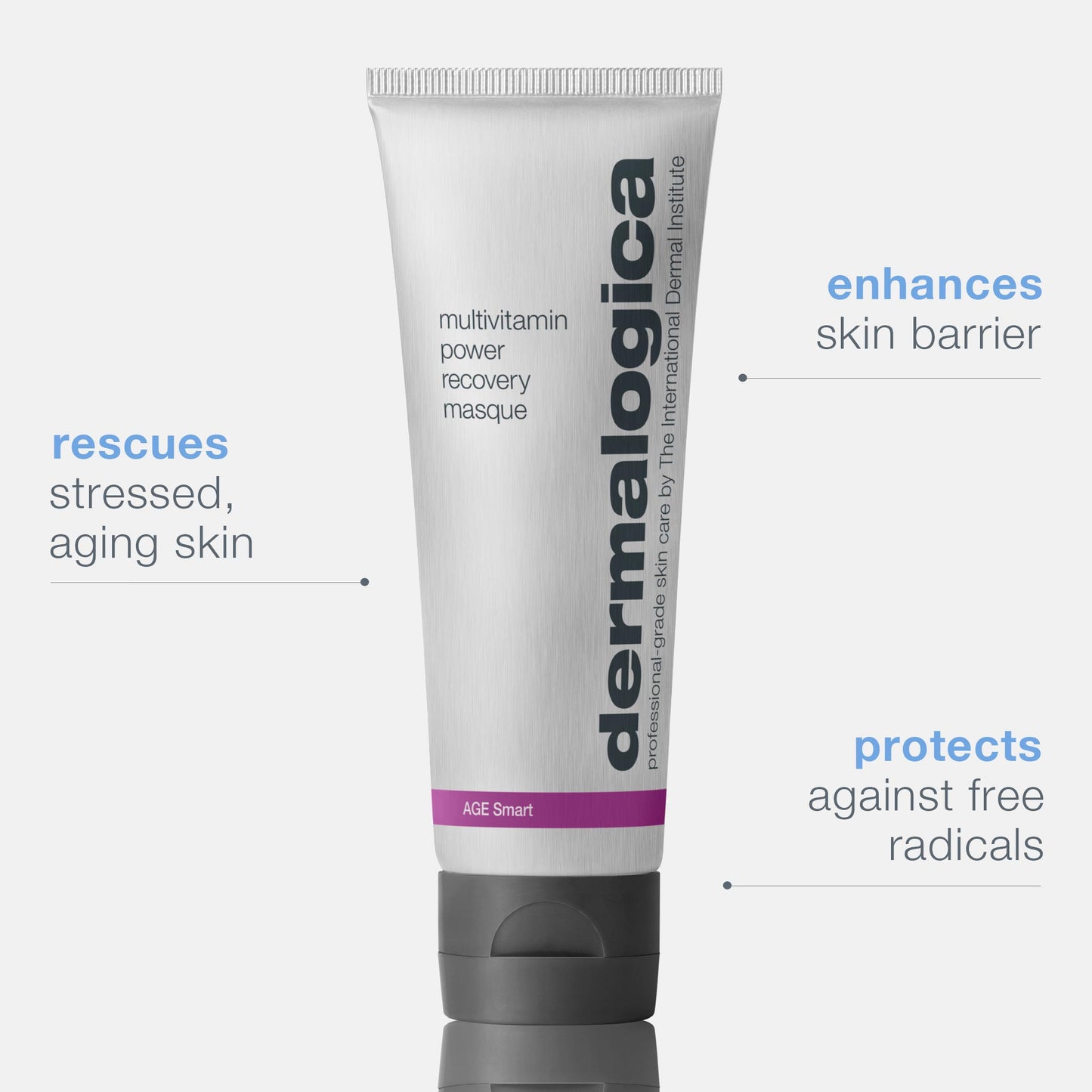

dermalogica
Multivitamin Power Recovery Masque

Multivitamin Power Recovery Masque
dermalogica
multivitamin-power-recovery-masque
Face Mask
9784810012965
Morning or Evening?
How often will you use this product?
Notes


Highlights
WHAT IS IT?
Ultra-replenishing face masque with vitamins A, C, and E
FEATURES
Restores damaged skin, enhances barrier properties, shields from free radicals, moisturizes and softens skin
BEST FOR
all
CHECKS
Paraben-free, artificial colors-free, fragrances-free, gluten-free
Who Is It For?
Adults With Aging Skin ConcernsWhat Does It Help With?
Dryness Dehydration Dullness Uneven Skin Tone Texture PhotodamageBudget
Mid-range ($30-$75)How To Use
Which routine should it be used in?
Instructions:
Key Information


What dermalogica Says
Product Description:
Ultra-replenishing masque helps rescue stressed, aging skin. Powerful, concentrated vitamins A, C and E, and Linoleic Acid help restore skin showing signs of damage and aging while enhancing barrier properties. Helps shield skin from free radicals and moisturize with nutrient-rich Algae Extract.
About the Brand:
Ingredients Overview
Ingredients List
Water/Aqua/Eau, Butylene Glycol, C12-15 Alkyl Benzoate, Glycerin, Di-C12-15 Alkyl Fumarate, Glycereth-7 Triacetate, Panthenol, Tocopheryl Acetate, Glyceryl Stearate, PEG-100 Stearate, Orbignya Oleifera Seed Oil, Dipropylene Glycol Dibenzoate, Stearyl Alcohol, Sorbitan Stearate, Palmitoyl Tripeptide-1, Palmitoyl Tetrapeptide-7, Lactic Acid, Retinyl Palmitate, Olea Europaea (Olive) Fruit Oil, Chondrus Crispus, Glycyrrhiza Glabra (Licorice) Root Extract, Anthemis Nobilis Flower Oil, Glycine Soja (Soybean) Oil, Camellia Sinensis Leaf Extract, Citrus Limon (Lemon) Peel Extract, Vitis Vinifera (Grape) Seed Extract, Chamomilla Recutita (Matricaria) Flower Extract, Arctium Majus Root Extract, Symphytum Officinale Root Extract, Hydrogenated Vegetable Oil, Hydrolyzed Soy Protein, Zea Mays (Corn) Oil, Leuconostoc/Radish Root Ferment Filtrate, Vegetable Oil, Sodium PCA, Dimethicone, Linoleic Acid, Beta-Glucan, Arginine/Lysine Polypeptide, Caprylyl Glycol, Phospholipids, Beta-Carotene, Ascorbyl Palmitate, Tocopherol, Sodium Polyacrylate, Sclerotium Gum, Decylene Glycol, Propylene Glycol, Sodium Lactate, Allantoin, Ammonium Glycyrrhizate, PPG-15 Stearyl Ether Benzoate, 1,2-Hexanediol, Potassium Cetyl Phosphate, Polysorbate 20, Sorbic Acid, Aminomethyl Propanol, Potassium Hydroxide, Carbomer, Menthoxypropanediol, Disodium EDTA, Citric Acid, Propanediol, Phenoxyethanol, Sodium Benzoate, Chlorphenesin, Sodium Dehydroacetate, BHT, Potassium Sorbate, Annatto (CI 75120).
Key Ingredients
Vitamin A, Vitamin C, Vitamin E, Linoleic Acid, Algae Extract
Ingredients Details
Butylene Glycol
Common Name(s): 1,3-butanediol,bg,1,3-butylene glycol
CAS Number: 107-88-0
DESCRIPTION
What It Does: Provides humectant hydration and active ingredient solubilization with excellent skin feel.
Why It's Used: Preferred glycol humectant in premium and k-beauty formulations for superior skin feel vs propylene glycol with equivalent functionality.
How It Works: Two hydroxyl groups at 1,3-positions provide water binding and solvent activity. better tolerated than propylene glycol with minimal sensitization risk. 4-carbon backbone provides slightly greater hydrophobic character enabling dissolution of less polar actives vs pg.
Typically Found In: Toners,essences,serums,k-beauty formulas
TECHNICAL DETAILS
Primary Category: Functional ingredient – glycol humectant
Secondary Functions: Tewl reduction,skin plumping
Application Areas:

Facial Skincare
Body Care
Hair Care

Beard Care
Color Cosmetics (Makeup)
Dietary/Oral Supplements
Typical Concentration Range: 1%–10%
SOURCING & ETHICS
Vegan Status: Yes – synthetic
Halal Status: Yes
Source Notes: Synthetic or naturally derived. excellent aqueous solubility.
SKIN COMPATIBILITY
Irritancy Rating: 1/5 – very low
Comedogenicity Rating: 0/5 – non-comedogenic
Sensitivity Concerns: Non-irritating; suitable for all skin types.
Safe for Sensitive Skin: Yes
SAFETY & COMPATIBILITY
Safety Profile: Excellent safety profile. ewg score: 1.
Works Well With: Ceramides,emollients,occlusives,glycerin,hyaluronic acid
Avoid Combining With: No significant incompatibilities
SCIENTIFIC NOTE
K-beauty's preference for butylene glycol over propylene glycol is driven by two factors: bg's superior skin feel (less tacky than pg's higher viscosity) and its lower sensitization potential (1,3-bg has better spatial distribution of hydroxyl groups that reduces protein interaction vs pg's 1,2-position oh groups).
Last Verified: 2026-03-12
Primary Sources: Cosing database,cir safety assessment
C12-15 Alkyl Benzoate
Common Name(s): C12-15 alkyl benzoate,cosmetic active,functional ingredient
CAS Number: N/a
DESCRIPTION
What It Does: Delivers characteristic cosmetic function at recommended use concentration.
Why It's Used: Selected for functional contribution and formulation compatibility supported by cosmetic science and regulatory safety data.
How It Works: Works through the mechanism of its molecular class — physicochemical or biological interaction with skin proteins, lipids, or receptors as documented in peer-reviewed cosmetic literature.
Typically Found In: Skin care formulations
TECHNICAL DETAILS
Primary Category: Active ingredient – cosmetic active
Secondary Functions: Skin conditioning
Application Areas:
Facial Skincare
Body Care
Hair Care
Beard Care
Color Cosmetics (Makeup)
Dietary/Oral Supplements
Typical Concentration Range: 0.1%–10%
SOURCING & ETHICS
Vegan Status: Conditional - supplier confirmation required
Halal Status: Unverified - supplier confirmation required
Source Notes: Commercially produced for cosmetic use. verify vegan/halal status with supplier. [audit 2026-07-29 rev2: the record's own source_notes does not assert a non-animal origin, or instructs the reader to verify with the supplier; "yes" asserts knowledge the record does not hold. determination requires shariah-panel sign-off.]
SKIN COMPATIBILITY
Irritancy Rating: 1/5 – very low
Comedogenicity Rating: 0/5 – non-comedogenic
Sensitivity Concerns: Well-tolerated by most skin types.
Safe for Sensitive Skin: Yes
SAFETY & COMPATIBILITY
Safety Profile: Good safety profile at recommended concentrations. ewg score: 1–2.
Works Well With: Standard skincare actives
Avoid Combining With: No known significant incompatibilities
SCIENTIFIC NOTE
C12-15 alkyl benzoate has an established safety and efficacy profile within the cosmetic regulatory framework at standard use concentrations.
Last Verified:
Di-c12-15 Alkyl Fumarate
Common Name(s): Emollient wm,c12-15 alkyl fumarate
CAS Number: N/a
DESCRIPTION
What It Does: Provides silky non-tacky emolliency with excellent silicone and uv filter compatibility.
Why It's Used: Silicone-compatible ester emollient for premium gel and anhydrous formulations where silicone-like aesthetics are desired from a non-silicone ingredient.
How It Works: Fumarate diester provides silicone-like skin feel from low surface tension. excellent compatibility with cyclomethicone, dimethicone, and cyclopentasiloxane for hybrid silicone-ester formulations. non-tacky from low molecular weight. compatible with uv filters reducing white cast.
Typically Found In: Gel formulations,silicone-ester hybrid products,sunscreens
TECHNICAL DETAILS
Primary Category: Functional ingredient – fumarate ester emollient
Secondary Functions: Barrier sealing,softening
Application Areas:
Facial Skincare
Body Care
Hair Care
Beard Care
Color Cosmetics (Makeup)
Dietary/Oral Supplements
Typical Concentration Range: 1%–20%
SOURCING & ETHICS
Vegan Status: Conditional - supplier confirmation required
Halal Status: Unverified - supplier confirmation required
Source Notes: Plant-derived, synthetic or animal-derived. verify source. [audit 2026-07-29 rev2: the record's own source_notes does not assert a non-animal origin, or instructs the reader to verify with the supplier; "yes" asserts knowledge the record does not hold. determination requires shariah-panel sign-off.]
SKIN COMPATIBILITY
Irritancy Rating: 1/5 – very low
Comedogenicity Rating: 1/5 – low; formulation-dependent
Sensitivity Concerns: Non-irritating.
Safe for Sensitive Skin: Yes
SAFETY & COMPATIBILITY
Safety Profile: Excellent safety profile. ewg score: 1.
Works Well With: Humectants,ceramides,actives as carrier
Avoid Combining With: No significant incompatibilities
SCIENTIFIC NOTE
Di-c12-15 alkyl fumarate's silicone-like skin feel despite being a hydrocarbon ester arises from the trans-fumarate geometry: the rigid trans double bond in the fumarate backbone provides a specific molecular shape that interacts with skin surface proteins and lipids to reduce friction in a way similar to pdms's siloxane chain flexibility, providing the characteristic silky application feel without silicone chemistry.
Last Verified: 2026-03-12
Primary Sources: Cosing database,cir safety assessment
Glycereth-7 Triacetate
Common Name(s): Glycereth-7 triacetate,glycereth-7 triacetate,glyceryl ester,natural glycerol-derived emollient
CAS Number: N/a
DESCRIPTION
What It Does: Provides fatty acid fatty acid emolliency from the glycerol ester with one glycerol position esterified providing hlb ~3–4 for o/w emulsification, plus gentle glycerol humectancy from the backbone after sc esterase hydrolysis.
Why It's Used: Glycereth-7 triacetate is selected for fatty acid glyceryl ester emolliency — the glycerol carrier provides natural origin, biodegradability, and mild glycerol humectancy co-delivery alongside characteristic emolliency for the target formulation from the fatty acid fatty acid chain.
How It Works: Glyceryl monoester: glycerol backbone → mild humectancy + natural origin; fatty acid chain → characteristic emolliency for the target formulation; sc esterase hydrolysis → free glycerol + fatty acid metabolites.
Typically Found In: Emollient skin care,barrier repair
TECHNICAL DETAILS
Primary Category: Functional ingredient – emollient
Secondary Functions: Barrier sealing,softening
Application Areas:
Facial Skincare
Body Care
Hair Care
Beard Care
Color Cosmetics (Makeup)
Dietary/Oral Supplements
Typical Concentration Range: 0.5%–30%
SOURCING & ETHICS
Vegan Status: Conditional - feedstock declaration required
Halal Status: Unverified - feedstock declaration required (plant, animal and petrochemical routes all exist)
Source Notes: Plant-derived, synthetic or animal-derived. verify source. [audit 2026-07-29 rev2: origin-dependent: the same inci exists in plant, animal and petrochemical versions and the name does not discriminate. determination requires shariah-panel sign-off.]
SKIN COMPATIBILITY
Irritancy Rating: 1/5 – very low
Comedogenicity Rating: 1/5 – low; formulation-dependent
Sensitivity Concerns: Non-irritating.
Safe for Sensitive Skin: Yes
SAFETY & COMPATIBILITY
Safety Profile: Excellent safety profile. ewg score: 1.
Works Well With: Humectants,ceramides,actives as carrier
Avoid Combining With: No significant incompatibilities
SCIENTIFIC NOTE
Glyceryl mono/diesters are biodegradable alternatives to petro-derived esters — the glycerol backbone ensures ecocert and cosmos certification compatibility.
Last Verified: 2026-03-22
Primary Sources: Cosing database,glycereth-7 triacetate glyceryl ester emollient review