

NANOWHITE
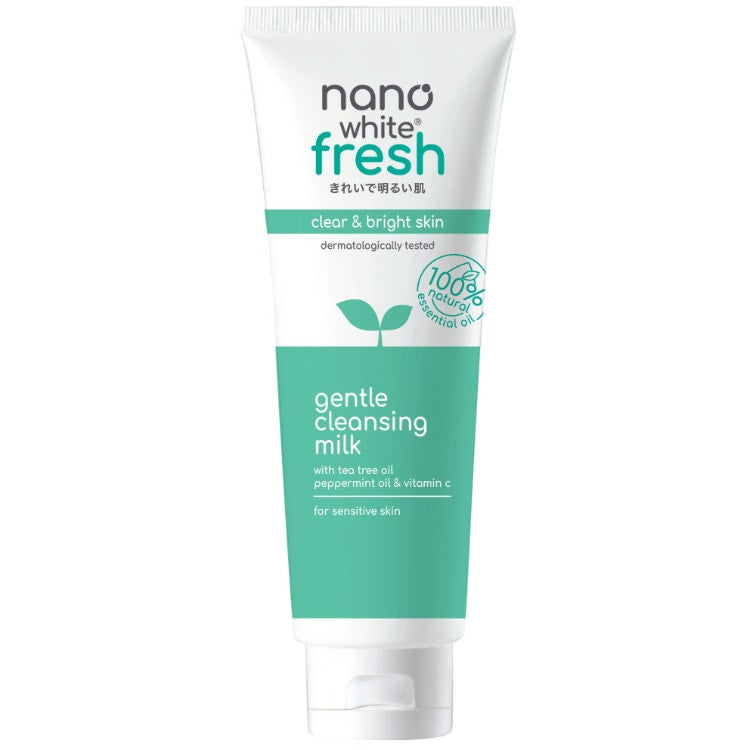
Nanowhite Fresh Gentle Cleansing Milk Cleanser 100G

Nanowhite Fresh Gentle Cleansing Milk Cleanser 100G
NANOWHITE
nanowhite-fresh-gentle-cleansing-milk-cleanser-100g
Cleanse
10084893950245
Morning or Evening?
How often will you use this product?
Notes


Highlights
WHAT IS IT?
Cleansing milk cleanser with natural essential oils (Tea Tree Oil, Peppermint Oil) and Vitamin C
FEATURES
Fights acne-causing bacteria, controls excess sebum and oil, brightens skin, moisturizes and soothes skin, dermatologically mild
BEST FOR
sensitive
CHECKS
Does not contain animal-derived ingredients, not tested on animals, uses eco-friendly packaging
Who Is It For?
What Does It Help With?
Acne Blemishes Excess Oil Control Skin Brightening Soothing Sensitive SkinBudget
Affordable (under $30)How To Use
Which routine should it be used in?
Instructions:
Key Information


What NANOWHITE Says
Product Description:
A total acne and brightening skin care solution with trusted ingredients - Enriched with natural essential oils, Tea Tree Oil and Peppermint Oil work to combat acne and blemishes by controlling the excess secretion of sebum and oil for clearer-looking skin. A dose of Vitamin C works to brighten up the skin, for a more radiant complexion. With the environment and sustainability in mind, Nanowhite Fresh is cruelty-free, using vegan ingredients and eco-friendly packaging
About the Brand:
Ingredients Overview
Ingredients List
Aqua, Glycerin, Myristic Acid, Potassium Hydroxide, Glycol Distearate, Lauric Acid, Hydroxypropyl Methylcellulose, Fragrance, Potassium Cocoyl Glycinate, DMDM Hydantoin, Menthol, Potassium Cocoate, Disodium EDTA, Ascorbyl Glucoside, Melaleuca Alternifolia (Tea Tree) Leaf Oil, Laminaria Digitata Extract, Mentha Arvensis Leaf Oil, Phenoxyethanol
Key Ingredients
Tea Tree Oil,Peppermint Oil,Vitamin C
Ingredients Details
Ascorbyl Glucoside
Common Name(s): Aa2g,2-o-alpha-d-glucopyranosyl-l-ascorbic acid
CAS Number: 129499-78-1
DESCRIPTION
What It Does: Provides stable gradual-release vitamin c activity for brightening and antioxidant protection.
Why It's Used: Most formulation-stable vitamin c derivative — ascorbyl glucoside remains stable in aqueous formulations where pure ascorbic acid oxidises within days, providing sustained vitamin c delivery over weeks of shelf life.
How It Works: Alpha-glucoside bond resists oxidation until cleaved by skin alpha-glucosidase enzymes. releases free l-ascorbic acid in viable epidermis. released ascorbic acid inhibits tyrosinase, stimulates collagen synthesis, and provides antioxidant activity. glucose group provides enhanced water solubility vs ascorbic acid.
Typically Found In: Stable vitamin c serums,brightening products,anti-aging
TECHNICAL DETAILS
Primary Category: Active ingredient – stable vitamin c glucoside
Secondary Functions: Tyrosinase inhibitor,collagen cofactor
Application Areas:

Facial Skincare

Body Care
Hair Care
Beard Care
Color Cosmetics (Makeup)
Dietary/Oral Supplements
Typical Concentration Range: 1%–5%
SOURCING & ETHICS
Vegan Status: Yes – enzymatic synthesis from ascorbic acid and glucose
Halal Status: Yes
Source Notes: Synthetically produced vitamin c derivative.
SKIN COMPATIBILITY
Irritancy Rating: 1/5 – very low
Comedogenicity Rating: 0/5 – non-comedogenic
Sensitivity Concerns: Non-irritating; suitable for all skin types.
Safe for Sensitive Skin: Yes
SAFETY & COMPATIBILITY
Safety Profile: Excellent safety profile. ewg score: 1.
Works Well With: Tocopherol,ferulic acid,niacinamide,spf
Avoid Combining With: No significant incompatibilities
SCIENTIFIC NOTE
Ascorbyl glucoside's stability advantage (18+ months in aqueous formulation vs days for ascorbic acid) arises from the glucose group's steric protection of ascorbic acid's c2 enediol that is the primary oxidation site. glucosidase cleavage in skin removes this protection in situ, releasing active ascorbic acid only where enzymatic activity exists — providing both formulation stability and bioactivation where needed.
Last Verified: Cosing database,yamamoto et al. ascorbyl glucoside stability study
Primary Sources: 2026-03-12
Disodium Edta
Common Name(s): Edathamil disodium,edta disodium,versene 100
CAS Number: 139-33-3
DESCRIPTION
What It Does: Provides metal ion chelation to prevent product degradation and boost preservative and antioxidant efficacy.
Why It's Used: The most essential stability ingredient in cosmetics — disodium edta's metal chelation prevents rancidity, discoloration, and preservative failure caused by trace metal contamination in virtually all aqueous cosmetic formulations.
How It Works: Ethylenediaminetetraacetic acid provides six potential coordination sites for metal ions (aminodiacetate groups). chelates ca²⁺, mg²⁺ (stability), fe³⁺ (fenton radical prevention), cu²⁺ (oxidase inhibition). disrupts gram-negative bacterial outer membrane by chelating membrane calcium, enhancing preservative penetration.
Typically Found In: Virtually all aqueous cosmetics — creams, lotions, shampoos, toners
TECHNICAL DETAILS
Primary Category: Functional ingredient – chelating agent
Secondary Functions: Skin conditioning
Application Areas:
Facial Skincare
Body Care
Hair Care
Beard Care
Color Cosmetics (Makeup)
Dietary/Oral Supplements
Typical Concentration Range: 0.005%–0.1%
SOURCING & ETHICS
Vegan Status: Yes – synthetic
Halal Status: Yes
Source Notes: Commercially produced for cosmetic use. verify vegan/halal status with supplier.
SKIN COMPATIBILITY
Irritancy Rating: 1/5 – very low
Comedogenicity Rating: 0/5 – non-comedogenic
Sensitivity Concerns: Well-tolerated by most skin types.
Safe for Sensitive Skin: Yes
SAFETY & COMPATIBILITY
Safety Profile: Good safety profile at recommended concentrations. ewg score: 1–2.
Works Well With: Standard skincare actives
Avoid Combining With: No known significant incompatibilities
SCIENTIFIC NOTE
Disodium edta's preservative potentiation against gram-negative bacteria is mechanistically elegant: gram-negative outer membranes contain lipopolysaccharide stabilised by calcium and magnesium bridges. edta chelates these metal ions, destabilising the lps layer and creating pores that allow hydrophobic preservatives (phenoxyethanol, parabens) to penetrate — converting gram-negative-resistant preservatives into broad-spectrum ones.
Last Verified: Cosing database,cir safety assessment
Primary Sources: 2026-03-12
Dmdm Hydantoin
Common Name(s): Formaldehyde-releasing preservative,antimicrobial preservation,formaldehyde donor
CAS Number: N/a
DESCRIPTION
What It Does: Provides broad-spectrum preservation against bacteria and fungi through controlled formaldehyde release, maintaining product safety throughout shelf life at eu-permitted concentrations.
Why It's Used: Formaldehyde-releasing preservatives provide reliable broad-spectrum preservation but face increasing consumer and regulatory scrutiny — eu requires label declaration, and many brands adopt 'formaldehyde-free' positioning due to sensitisation concerns.
How It Works: Hydrolysis in aqueous formulation releases formaldehyde (hcho) at controlled rates depending on ph and temperature. free formaldehyde cross-links bacterial proteins and nucleic acids through schiff base formation with amine groups, providing bactericidal activity. sensitisation risk from free formaldehyde's reactivity with skin proteins forming haptens.
Typically Found In: All aqueous formulations
TECHNICAL DETAILS
Primary Category: Active ingredient – cosmetic active
Secondary Functions: Skin conditioning
Application Areas:
Facial Skincare
Body Care
Hair Care
Beard Care
Color Cosmetics (Makeup)
Dietary/Oral Supplements
Typical Concentration Range: Check eu annex v limits
SOURCING & ETHICS
Vegan Status: Yes
Halal Status: Yes
Source Notes: Commercially produced for cosmetic use. verify vegan/halal status with supplier.
SKIN COMPATIBILITY
Irritancy Rating: 1/5 – very low
Comedogenicity Rating: 0/5 – non-comedogenic
Sensitivity Concerns: Well-tolerated by most skin types.
Safe for Sensitive Skin: Yes
SAFETY & COMPATIBILITY
Safety Profile: Good safety profile at recommended concentrations. ewg score: 1–2.
Works Well With: Standard skincare actives
Avoid Combining With: No known significant incompatibilities
SCIENTIFIC NOTE
Eu regulation 1223/2009 requires 'contains formaldehyde' label declaration when free formaldehyde >0.05% in the finished product. many formulators are transitioning away from formaldehyde-releasing preservatives to avoid this label requirement regardless of safety profile.
Last Verified: Cosing database,eu annex v formaldehyde-releasing preservative declaration
Primary Sources: 2026-03-12
Fragrance
Common Name(s): Fragrance ingredient,eu allergen or aromatic component,olfactory/flavour
CAS Number: N/a
DESCRIPTION
What It Does: Provides the complete fragrance profile contributing to product sensory experience and consumer appeal.
Why It's Used: Fragrance is a major consumer purchase driver — up to 70% of consumers make purchasing decisions partially based on product scent.
How It Works: Fragrance blends interact with olfactory receptors providing the sensory profile — complex mixtures activate multiple receptor types for rich, multidimensional scent experiences.
Typically Found In: All fragrance products
TECHNICAL DETAILS
Primary Category: Active ingredient – cosmetic active
Secondary Functions: Skin conditioning
Application Areas:
Facial Skincare
Body Care
Hair Care
Beard Care
Color Cosmetics (Makeup)
Dietary/Oral Supplements
Typical Concentration Range: Standard use levels
SOURCING & ETHICS
Vegan Status: Conditional
Halal Status: Yes
Source Notes: Commercially produced for cosmetic use. verify vegan/halal status with supplier.
SKIN COMPATIBILITY
Irritancy Rating: 1/5 – very low
Comedogenicity Rating: 0/5 – non-comedogenic
Sensitivity Concerns: Well-tolerated by most skin types.
Safe for Sensitive Skin: Yes
SAFETY & COMPATIBILITY
Safety Profile: Good safety profile at recommended concentrations. ewg score: 1–2.
Works Well With: Standard skincare actives
Avoid Combining With: No known significant incompatibilities
SCIENTIFIC NOTE
Ifra guidelines set usage limits for fragrance ingredients based on skin sensitisation and phototoxicity assessment for each application category.
Last Verified: Eu regulation 1223/2009 annex iii,ifra standards,fragrance allergen declaration requirements
Primary Sources: 2026-03-12
