

Nykaa E retail limited
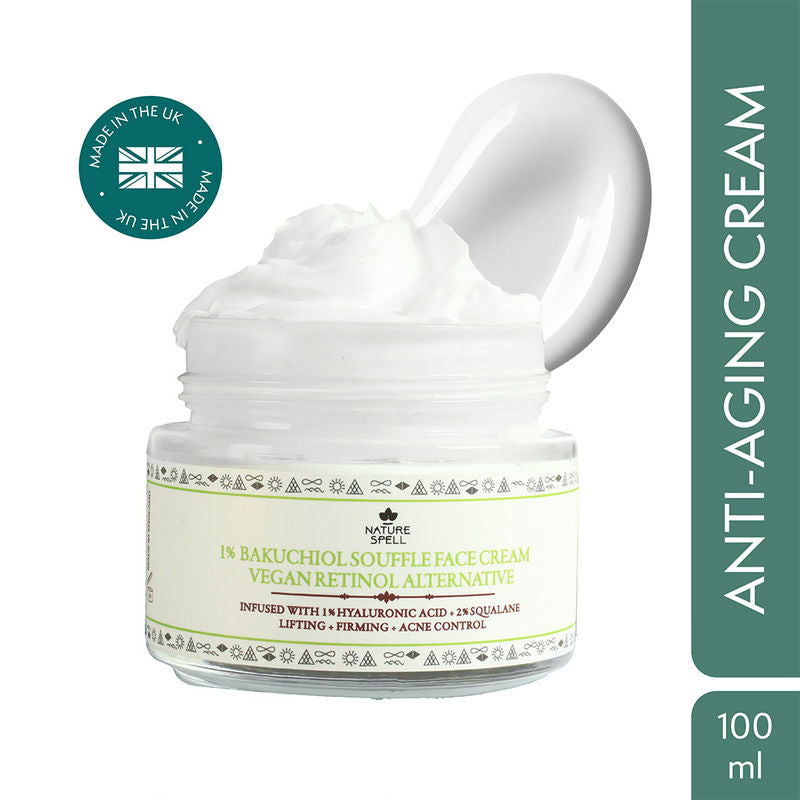
Nature Spell Vegan Retinol Face Moisturiser

Nature Spell Vegan Retinol Face Moisturiser
Nykaa E retail limited
nature-spell-vegan-retinol-face-moisturiser
Moisturize
10084958077221
Morning or Evening?
How often will you use this product?
Notes


Highlights
WHAT IS IT?
Vegan retinol cream with natural plant-based ingredients, 10+ ingredients
FEATURES
Lightweight, easily absorbed, delivers targeted hydration, suitable for all skin types, contains avocado and antioxidant-rich green tea, plant-based alternative to retinol, stimulates collagen, improves elasticity, reduces fine lines and wrinkles, reduces skin discoloration and hyperpigmentation
BEST FOR
sensitive
CHECKS
Paraben
Who Is It For?
What Does It Help With?
Rehydration Skin Renewal Youthful Complexion Reduces Fine Lines Wrinkles Hyperpigmentation And Skin DiscolorationBudget
Affordable (under $30)How To Use
Which routine should it be used in?
Instructions:
Key Information


What Nykaa E retail limited Says
Product Description:
Infused with 1% bakuchiol, 1% hyaluronic acid, 2% squalane, avocado, and matcha green tea. This signature formulation is crafted with natural plant-based retinol and bakuchiol. With a lightweight, easily absorbed, unique formula that will work wonders on all skin types, it offers targeted hydration. Unveil the magic of rejuvenation as the world slumbers with Nature Spell's Nightly Renewal Bakuchiol Cream. A masterful blend that fuses nature's most potent ingredients, the night cream offers the transformative powers of retinol without its associated irritations, making it the perfect vegan retinol cream. Embrace a nightly ritual that hydrates, renews, and revitalizes, ensuring you wake up with a fresher, more youthful complexion. Features: Lightweight and versatile: This unique formula is easily absorbed, delivering targeted hydration suitable for all skin types. Nourishing ingredients: The conditioning power of avocado, combined with antioxidant-rich green tea, leaves your skin feeling soft and supple. The addition of bakuchiol, a plant-based alternative to retinol, adds star quality to this product. Youthful renewal: Stimulate collagen production and improve skin elasticity to reduce fine lines and wrinkles, ensuring a fresher complexion. Gentle yet effective: Enjoy the benefits of retinol without the sensitivity. This product helps reduce skin discoloration and hyperpigmentation, giving you a more even skin tone. This product is vegan, cruelty-free, and paraben-free.
About the Brand:
Ingredients Overview
Ingredients List
Aqua-Water,Glycerin,Cetearyl,Caprylic-Capric-Triglyceride,Propanediol,Sqaulane,Persea-Gratissima-Avocado-Oil,Sodium-Hyaluronate-Crosspolymer,Bakuchiol,Aloe-Barbadensis-Aloe-Vera-Leaf-Juice,Camellia-Sinensis-Green-Tea-Leaf-Extract,Pentylene-Glycol,Polyacrylamide,C13-14-Isoparaffin,Phenoxyethanol,Parfum-Fragrance,Carbomer,Sodium-Hydroxide,Benzophenone-4,Laureth-7,Potassium-Sorbate,Triethylene-Glycol
Key Ingredients
Bakuchiol,Hyaluronic Acid,Matcha Green Tea,Avocado
Ingredients Details
Bakuchiol
Common Name(s): Bakuchiol,(s)-bakuchiol
CAS Number: 10309-37-2
DESCRIPTION
What It Does: Provides retinol-equivalent anti-aging gene expression from a natural plant compound without retinol's limitations.
Why It's Used: The natural retinol alternative — the first plant compound with rct evidence for equivalent anti-aging results to retinol with better safety and photostability.
How It Works: Bakuchiol activates rar beta and retinoid x receptors via allosteric binding mechanism. upregulates type i, iii, and iv collagen synthesis genes. downregulates mmp-1 and mmp-9. antioxidant via phenol radical scavenging. photostable — stable to uv exposure unlike retinol.
Typically Found In: Natural anti-aging serums,pregnancy-safe retinol alternative,photostable anti-aging
TECHNICAL DETAILS
Primary Category: Active ingredient – natural retinol alternative
Secondary Functions: Free radical scavenging,anti-aging
Application Areas:

Facial Skincare
Body Care

Hair Care
Beard Care
Color Cosmetics (Makeup)
Dietary/Oral Supplements
Typical Concentration Range: 0.5%–2%
SOURCING & ETHICS
Vegan Status: Yes – from psoralea corylifolia seeds
Halal Status: Yes
Source Notes: Plant-derived extract or synthetic.
SKIN COMPATIBILITY
Irritancy Rating: 1/5 – very low
Comedogenicity Rating: 0/5 – non-comedogenic
Sensitivity Concerns: Non-irritating; well-tolerated.
Safe for Sensitive Skin: Yes
SAFETY & COMPATIBILITY
Safety Profile: Excellent safety profile. ewg score: 1.
Works Well With: Vitamin c,vitamin e,ferulic acid,spf,other antioxidants
Avoid Combining With: No significant incompatibilities
SCIENTIFIC NOTE
The dhaliwal et al. (2019, british journal of dermatology) split-face rct directly compared 0.5% bakuchiol vs 0.5% retinol twice daily for 12 weeks — both groups showed equivalent reduction in fine lines and wrinkles, but bakuchiol showed significantly less scaling, stinging, and burning. this is the strongest evidence that bakuchiol provides retinol-equivalent anti-aging with better tolerability.
Last Verified: Cosing database,dhaliwal et al. bakuchiol vs retinol rct
Primary Sources: 2026-03-12
Benzophenone-4
Common Name(s): Benzophenone-4
DESCRIPTION
What It Does: Absorbs or reflects uv radiation, preventing uv-induced dna damage, photo-oxidative stress, and premature skin aging.
Why It's Used: Uv filters are the active ingredients in sun protection — without them, formulations cannot make spf claims or prevent solar-induced skin damage.
How It Works: The uv-absorbing chromophore undergoes photoexcitation by uv photons, then dissipates the absorbed energy through thermal relaxation (chemical filters) or photon scattering/reflection (physical filters), preventing photon penetration to skin cells.
Typically Found In: Sunscreens,moisturizers with spf,foundations with spf
TECHNICAL DETAILS
Primary Category: Uv filters
Secondary Functions: Skin-protecting
Application Areas:
Facial Skincare
Body Care
Hair Care
Beard Care
Color Cosmetics (Makeup)
Dietary/Oral Supplements
Typical Concentration Range: 0.5–25% (within regulatory limits)
SOURCING & ETHICS
Vegan Status: Yes
Halal Status: Yes
Source Notes: Synthetic uv filter; no animal components.
SKIN COMPATIBILITY
Irritancy Rating: 1
Comedogenicity Rating: 0
Sensitivity Concerns: Contact allergy to uv filters occurs in approximately 1–3% of the general population; patch testing recommended for those with known photosensitivity.
Safe for Sensitive Skin: Yes
SAFETY & COMPATIBILITY
Safety Profile: Regulatory approval required per market (eu annex vi, fda otc monograph, etc.). generally non-irritating at approved concentrations.
Works Well With: Other uv filters,antioxidants,emollients
Avoid Combining With: Incompatible filter combinations (photodegradation); check regulatory approvals per region
SCIENTIFIC NOTE
Uv filters operate through two mechanisms: organic/chemical filters absorb uv photons through electronic excitation (π→π* transitions in conjugated systems), then dissipate energy via thermal relaxation; inorganic/physical filters (tio2, zno) scatter and reflect photons through mie scattering (particle size 50–300 nm) and band gap absorption. spf is measured in vivo (iso 24444) as the ratio of minimal erythema doses with and without sunscreen.
Last Verified: Cosing eu database; pcpc cosmetic ingredient safety reviews; eu cosmetics regulation annex vi; iso 24444 (in vivo spf testing)
Primary Sources: 2025-01-15
Carbomer
Common Name(s): Carbopol,polyacrylic acid,carboxyvinyl polymer
DESCRIPTION
What It Does: Provides transparent gel textures and thickening at very low concentrations via ph-responsive swelling.
Why It's Used: The most widely used gel thickener – provides crystal-clear, stable gels at concentrations as low as 0.1-0.5% with ph-controlled viscosity.
How It Works: Highly crosslinked polyacrylic acid remains tightly coiled at acidic ph. neutralization with naoh or triethanolamine ionizes carboxylic groups causing electrostatic repulsion that unfolds and swells the polymer coils, dramatically increasing viscosity. concentration-dependent thickening.
Typically Found In: Gels,serums,emulsions,sunscreens
TECHNICAL DETAILS
Primary Category: Functional ingredient – polyacrylic acid thickener
Secondary Functions: Skin conditioning
Application Areas:
Facial Skincare
Body Care
Hair Care
Beard Care
Color Cosmetics (Makeup)
Dietary/Oral Supplements
Typical Concentration Range: 0.1%–2%
SOURCING & ETHICS
Vegan Status: Yes – synthetic
Halal Status: Yes
Source Notes: Commercially produced for cosmetic use. verify vegan/halal status with supplier.
SKIN COMPATIBILITY
Irritancy Rating: 1/5 – very low
Comedogenicity Rating: 0/5 – non-comedogenic
Sensitivity Concerns: Well-tolerated by most skin types.
Safe for Sensitive Skin: Yes
SAFETY & COMPATIBILITY
Safety Profile: Good safety profile at recommended concentrations. ewg score: 1–2.
Works Well With: Standard skincare actives
Avoid Combining With: No known significant incompatibilities
SCIENTIFIC NOTE
Carbomer's ph-responsive swelling mechanism provides an elegant formulation control tool: a neutralized gel can be liquefied by ph reduction (adding acid) and re-thickened by reneutralization. this reversible rheology control allows two-phase products that mix on application without the need for mechanical emulsification.
Last Verified: Cosing database,cir safety assessment
Primary Sources: 2026-03-12
Glycerin
Common Name(s): Glycerol,glycerine,1,2,3-propanetriol
CAS Number: 56-81-5
DESCRIPTION
What It Does: Glycerin pulls water from the environment and deeper skin layers into the outer skin layer (epidermis), boosting moisture levels and keeping skin soft, smooth, and plump.
Why It's Used: It is used in virtually every moisturizer, serum, and cleanser because it is highly effective at hydrating skin, is well-tolerated by all skin types, and enhances the texture and spreadability of formulations.
How It Works: As a humectant, glycerin forms hydrogen bonds with water molecules, trapping them in the skin. it also reinforces the skin barrier by integrating into lipid structures between skin cells.
Typically Found In: Moisturizers,serums,cleansers,toners,sheet masks,sunscreens,body lotions,shampoos,conditioners
TECHNICAL DETAILS
Primary Category: Humectant
Secondary Functions: Skin barrier support,emollient,solvent
Application Areas:
Facial Skincare
Body Care
Hair Care
Beard Care
Color Cosmetics (Makeup)
Dietary/Oral Supplements
Typical Concentration Range: 1%–30% (typical: 3–10%)
SOURCING & ETHICS
Vegan Status: Yes – plant-derived (coconut, soy, palm) or synthetic
Halal Status: Yes – when plant-derived or synthetic; verify source with supplier
Source Notes: Derived from plant oils via hydrolysis or saponification; synthetic versions also available. palm-derived glycerin carries sustainability concerns.
SKIN COMPATIBILITY
Irritancy Rating: 1/5 – very low; non-irritating at all standard concentrations
Comedogenicity Rating: 0/5 – non-comedogenic
Sensitivity Concerns: Extremely rare allergic reactions; generally safe for all skin types including sensitive and baby skin
Safe for Sensitive Skin: Yes
SAFETY & COMPATIBILITY
Safety Profile: Widely recognized as safe. ewg hazard score: 1. no significant concerns for irritation, sensitization, or toxicity at typical concentrations (up to 50%).
Works Well With: Hyaluronic acid,ceramides,niacinamide,panthenol,urea,peptides,retinol,ahas/bhas
Avoid Combining With: No known incompatibilities at standard concentrations
SCIENTIFIC NOTE
Glycerin is an endogenous skin component found naturally in the stratum corneum. aquaporin-3 channels in keratinocytes facilitate glycerin transport, making it integral to natural skin hydration pathways.
Last Verified: Cosing database,cir safety assessment,ewg skin deep,inci decoder
Primary Sources: 2026-03-12
