
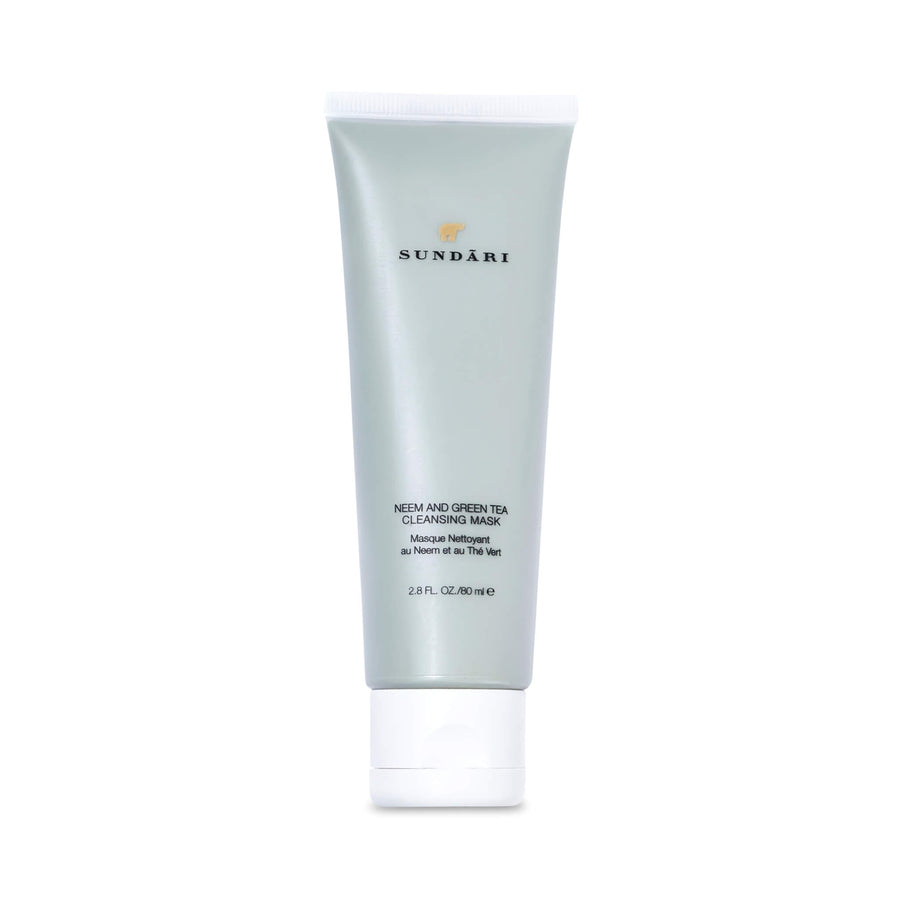

SUNDÃRI
Neem and Green Tea Cleansing Mask

Neem and Green Tea Cleansing Mask
SUNDÃRI
neem-and-green-tea-cleansing-mask
Face Mask
9706839474469
Morning or Evening?
How often will you use this product?
Notes


Highlights
WHAT IS IT?
Clay mask with multiple natural ingredients
FEATURES
Deep cleansing, controls excess sebum, refreshes skin, provides radiant glow
BEST FOR
Not specifically statedmentions acne-prone skin
CHECKS
Free of parabens, sulfate, phthalates
Who Is It For?
For AdultsWhat Does It Help With?
Excess Sebum Production Acne-prone SkinBudget
PremiumHow To Use
Which routine should it be used in?
Instructions:
Key Information


What SUNDÃRI Says
Product Description:
A deep cleansing clay mask infused with Neem oil and Green Tea extract to control excess sebum production while leaving the skin refreshed, clean, with a radiant glow.
About the Brand:
Ingredients Overview
Ingredients List
aqua, carthamus tinctorius oil, kaolin clay, glycerine, linoleamidopropyl pg-dimonium chloride phosphate, artemisia ludovicianai (owhyee) flower water, sucrose cocoate, hydrogenated lecithin, sesamum indicum oil, phenoxyethanol, calophyllum inophyllum, octanediol, xanthan gum, chondrus crispus (carrageenan), camelia sinensis extract, potassium sorbate, daucus carota, oil, santalum album, peg-400, centella asiatica extract, azadirachta indica oil, sodium hydroxymethylglycinate, cedrelopsis grevei bark extract, vitis vinifera (grape) seed extract, tocopherol, aloe barbaensis (aloe vera) leaf juice, cymbopogon martini oil, pelargonium graveolens, commiphora abyssinica oil, boswellia carteri resin extract, ascorbyl palmitate, beta-glucan, avena sativa kernel extract, ascorbic acid, citric acid
Key Ingredients
Neem oil, Green Tea extract, Kaolin clay, Aloe vera leaf juice, Sandalwood oil
Ingredients Details
Carthamus Tinctorius Oil
Common Name(s): Carthamus tinctorius oil,cosmetic active,functional ingredient
CAS Number: N/a
DESCRIPTION
What It Does: Delivers characteristic cosmetic function — skin conditioning, protection, preservation, or active biological benefit — at recommended use concentration.
Why It's Used: Selected for its functional contribution and formulation compatibility — supported by cosmetic science literature and regulatory safety assessment.
How It Works: Works through the mechanism of its molecular class — physicochemical interaction with the formulation or biological interaction with skin proteins, lipids, or receptors as documented in peer-reviewed literature.
Typically Found In: Skin care formulations
TECHNICAL DETAILS
Primary Category: Active ingredient – cosmetic active
Secondary Functions: Skin conditioning
Application Areas:

Facial Skincare

Body Care
Hair Care
Beard Care
Color Cosmetics (Makeup)
Dietary/Oral Supplements
Typical Concentration Range: 0.1%–10%
SOURCING & ETHICS
Vegan Status: Conditional
Halal Status: Yes
Source Notes: Commercially produced for cosmetic use. verify vegan/halal status with supplier.
SKIN COMPATIBILITY
Irritancy Rating: 1/5 – very low
Comedogenicity Rating: 0/5 – non-comedogenic
Sensitivity Concerns: Well-tolerated by most skin types.
Safe for Sensitive Skin: Yes
SAFETY & COMPATIBILITY
Safety Profile: Good safety profile at recommended concentrations. ewg score: 1–2.
Works Well With: Standard skincare actives
Avoid Combining With: No known significant incompatibilities
SCIENTIFIC NOTE
Carthamus tinctorius oil delivers documented functional benefit with an established safety profile within the cosmetic regulatory framework (cosing eu, cir usa).
Last Verified: Cosing database,carthamus tinctorius oil technical literature
Primary Sources: 2026-03-12
Glycerine
Common Name(s): Glycerin,universal humectant,water-binding skin conditioning
CAS Number: N/a
DESCRIPTION
What It Does: Attracts and retains moisture in the sc, improves skin barrier function at low concentrations, provides gentle keratolytic softening, and acts as a co-solvent for water-soluble actives.
Why It's Used: The reference humectant — lowest cost, best safety profile, universal formulation compatibility, and present naturally in the sc via lipase-mediated glycerolipid hydrolysis makes glycerin the industry standard against which all humectants are benchmarked.
How It Works: Three hydroxyl groups form 6 h-bonds with water molecules per glycerol unit — the highest oh-group density per carbon of any commercial humectant. glycerin also down-regulates epidermal serine proteases that overactivate in dry sc, improving desquamation and barrier integrity.
Typically Found In: All cosmetics,universal
TECHNICAL DETAILS
Primary Category: Functional ingredient – humectant
Secondary Functions: Tewl reduction,skin plumping
Application Areas:
Facial Skincare
Body Care
Hair Care
Beard Care
Color Cosmetics (Makeup)
Dietary/Oral Supplements
Typical Concentration Range: 1%–40%
SOURCING & ETHICS
Vegan Status: Yes
Halal Status: Yes
Source Notes: Synthetic or naturally derived. excellent aqueous solubility.
SKIN COMPATIBILITY
Irritancy Rating: 1/5 – very low
Comedogenicity Rating: 0/5 – non-comedogenic
Sensitivity Concerns: Non-irritating; suitable for all skin types.
Safe for Sensitive Skin: Yes
SAFETY & COMPATIBILITY
Safety Profile: Excellent safety profile. ewg score: 1.
Works Well With: Ceramides,emollients,occlusives,glycerin,hyaluronic acid
Avoid Combining With: No significant incompatibilities
SCIENTIFIC NOTE
Epidermal lipases hydrolyse sc glycerophospholipids during cornification, releasing glycerol that contributes to the natural nmf — topical glycerin directly supplements this endogenous sc humectant pool.
Last Verified: Cosing database,glycerin universal humectant review
Primary Sources: 2026-03-12
Hydrogenated Lecithin
Common Name(s): Lecithin/phospholipid,cell membrane lipid,emulsifier barrier repair
CAS Number: N/a
DESCRIPTION
What It Does: Stabilises o/w and w/o emulsions through biomimetic phospholipid bilayer formation, supplements sc barrier lipids for barrier repair, and forms liposomes and lamellar delivery vehicles for encapsulated active delivery.
Why It's Used: Phospholipids are uniquely bifunctional: they provide conventional emulsification and form genuine liposomal bilayer vesicles for encapsulated active delivery — a dual function unavailable from synthetic emulsifiers.
How It Works: The phosphocholine head group provides strong h-bonding hydrophilicity while the dual fatty acid tails provide lipophilic anchoring — this wedge-shaped geometry spontaneously forms closed bilayer vesicles (liposomes) that encapsulate actives for sustained release and enhanced sc penetration.
Typically Found In: Emulsions,liposomal delivery,barrier repair
TECHNICAL DETAILS
Primary Category: Functional ingredient – emollient
Secondary Functions: Barrier sealing,softening
Application Areas:
Facial Skincare
Body Care
Hair Care
Beard Care
Color Cosmetics (Makeup)
Dietary/Oral Supplements
Typical Concentration Range: 1%–15%
SOURCING & ETHICS
Vegan Status: Conditional
Halal Status: Yes
Source Notes: Plant-derived, synthetic or animal-derived. verify source.
SKIN COMPATIBILITY
Irritancy Rating: 1/5 – very low
Comedogenicity Rating: 1/5 – low; formulation-dependent
Sensitivity Concerns: Non-irritating.
Safe for Sensitive Skin: Yes
SAFETY & COMPATIBILITY
Safety Profile: Excellent safety profile. ewg score: 1.
Works Well With: Humectants,ceramides,actives as carrier
Avoid Combining With: No significant incompatibilities
SCIENTIFIC NOTE
Phospholipid's wedge-shaped geometry (large head relative to two acyl tails) preferentially forms spherical bilayer vesicles (liposomes) rather than flat lamellar phases — this curvature preference enables self-assembly of drug delivery liposomes simply by hydration of the phospholipid film.
Last Verified: Cosing database,lecithin phospholipid liposomal delivery review
Primary Sources: 2026-03-12
Kaolin Clay
Common Name(s): Kaolin clay
DESCRIPTION
What It Does: Delivers targeted skin-conditioning or bioactive benefits through a specific mechanism of action suited to the formulation's intended purpose.
Why It's Used: Specialty actives address specific skin concerns through targeted molecular mechanisms, providing efficacy beyond what base formulation ingredients alone can achieve.
How It Works: The bioactive compound interacts with specific molecular targets in skin cells or the extracellular matrix — enzymes, receptors, structural proteins, or signaling molecules — triggering beneficial biological responses.
Typically Found In: Serums,treatments,moisturizers,specialty products
TECHNICAL DETAILS
Primary Category: Specialty actives
Secondary Functions: Skin-conditioning,anti-aging
Application Areas:
Facial Skincare
Body Care
Hair Care
Beard Care
Color Cosmetics (Makeup)
Dietary/Oral Supplements
Typical Concentration Range: 0.01–5%
SOURCING & ETHICS
Vegan Status: Yes
Halal Status: Yes
Source Notes: Specialty active ingredient; check individual sourcing for vegan status.
SKIN COMPATIBILITY
Irritancy Rating: 1899-12-31 00:00:00 -0800
Sensitivity Concerns: Low sensitization potential at recommended use concentrations.
Safe for Sensitive Skin: Yes
SAFETY & COMPATIBILITY
Safety Profile: Well-characterized cosmetic ingredient with established safety profile. generally non-irritating at typical use concentrations. suitable for leave-on and rinse-off cosmetics.
Works Well With: Niacinamide,hyaluronic acid,vitamin c,peptides
Avoid Combining With: Incompatible with oxidizing agents; check ph stability
SCIENTIFIC NOTE
Specialty actives typically work through enzyme inhibition (e.g., tyrosinase inhibition for brightening, mmp inhibition for anti-aging), receptor activation (e.g., retinoid receptors, ppar-γ for barrier genes), or transcription factor modulation (e.g., nrf2 for antioxidant gene upregulation). structure-activity relationships determine potency and selectivity.
Last Verified: Cosing eu database; pcpc cosmetic ingredient safety reviews; ingredient-specific safety and efficacy literature
Primary Sources: 2025-01-15
