
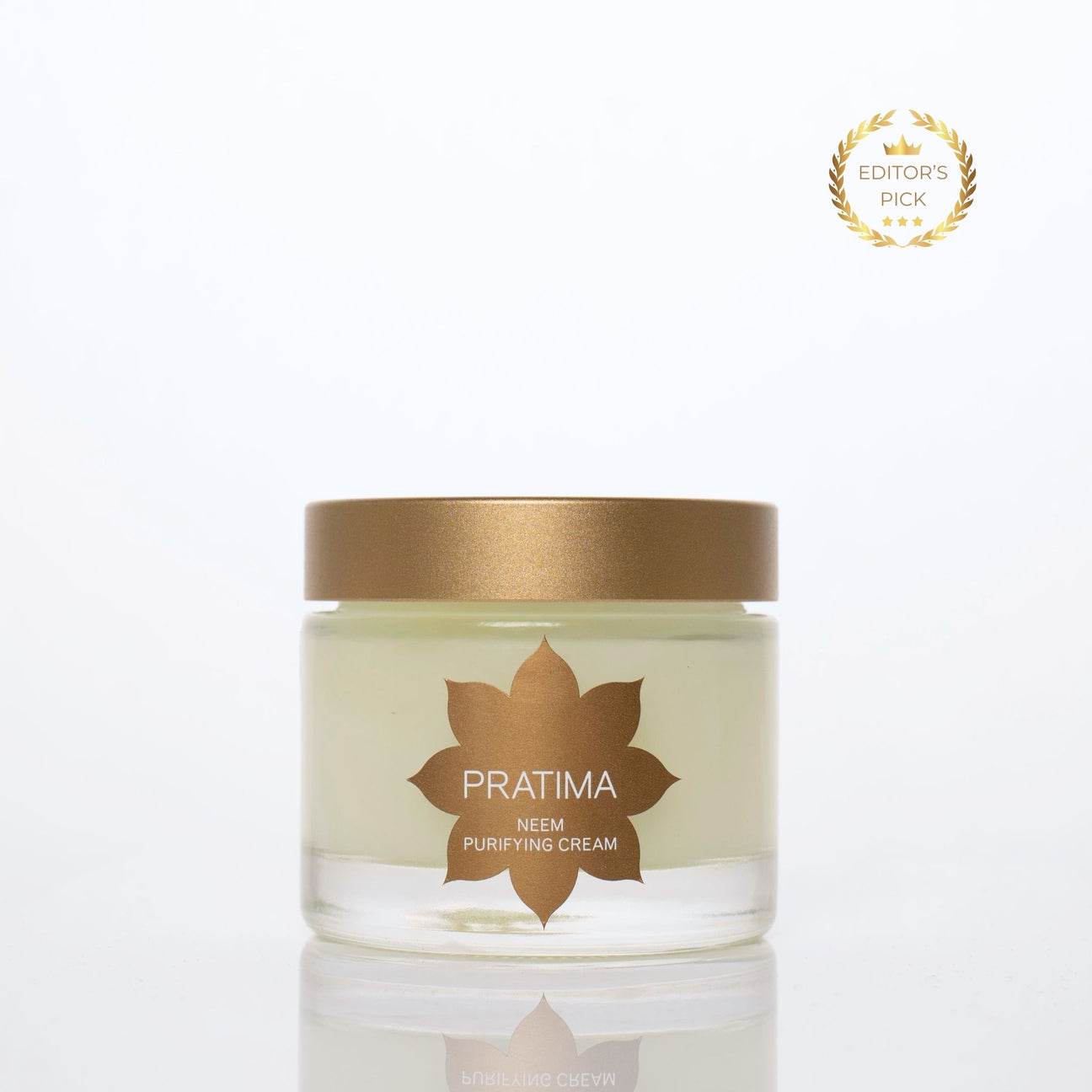

PRATIMA Skincare
Neem Purifying Cream

Neem Purifying Cream
PRATIMA Skincare
neem-purifying-cream
Moisturize
9706843799845
Morning or Evening?
How often will you use this product?
Notes


Highlights
WHAT IS IT?
Moisturizer with 9 ingredients
FEATURES
Lightweight gel consistency, antibacterial, antiseptic
BEST FOR
Oily skin, acne-prone skin
CHECKS
Free of harsh chemicals, parabens, sulfates
Who Is It For?
Above 18 Women And MenWhat Does It Help With?
Blemishes Congested Pores AcneBudget
Mid-rangeHow To Use
Which routine should it be used in?
Instructions:
Key Information


What PRATIMA Skincare Says
Product Description:
An ideal moisturizer for oily skin and congested pores, this formula soothes blemishes and acne-prone complexions. With a lightweight gel consistency, this antibacterial and antiseptic recipe of neem, brahmi, aloe vera, and basil leaves skin hydrated and gently pacified.
About the Brand:
Ingredients Overview
Ingredients List
Aloe Vera, Neem, Brahmi, Basil, Camphor, Sandalwood, Rose, Grape Seed Extract, Lavender. (certified organic)
Key Ingredients
Aloe Vera, Neem, Brahmi, Basil
Ingredients Details
Aloe Vera
Common Name(s): Aloe vera juice,aloe vera gel,aloe barbadensis
CAS Number: 85507-69-3
DESCRIPTION
What It Does: Provides acemannan-based wound healing and comprehensive moisturising skin conditioning from the quintessential healing plant.
Why It's Used: The most universally recognised natural healing plant — aloe vera's acemannan polysaccharides, vitamins, and enzymes provide a comprehensive wound healing and soothing profile with thousands of years of documented use.
How It Works: Acemannan (poly-mannose) activates dectin-1 for wound healing immune stimulation. gibberellin promotes fibroblast growth. salicylic acid derivative provides anti-inflammatory. vitamins c and e provide antioxidant. glucomannan provides humectant.
Typically Found In: After-sun products,wound healing,moisturisers,virtually all skin care categories
TECHNICAL DETAILS
Primary Category: Active ingredient – aloe vera gel
Secondary Functions: Redness reduction,anti-inflammatory,calming
Application Areas:

Facial Skincare
Body Care

Hair Care
Beard Care
Color Cosmetics (Makeup)
Dietary/Oral Supplements
Typical Concentration Range: 0.5%–99%
SOURCING & ETHICS
Vegan Status: Yes – from aloe barbadensis leaf
Halal Status: Yes
Source Notes: Plant-derived extract or synthetic.
SKIN COMPATIBILITY
Irritancy Rating: 1/5 – very low
Comedogenicity Rating: 0/5 – non-comedogenic
Sensitivity Concerns: Non-irritating; ideal for reactive and sensitive skin.
Safe for Sensitive Skin: Yes – particularly recommended for sensitive skin
SAFETY & COMPATIBILITY
Safety Profile: Excellent safety profile. ewg score: 1.
Works Well With: Ceramides,panthenol,allantoin,hyaluronic acid,centella asiatica
Avoid Combining With: No significant incompatibilities
SCIENTIFIC NOTE
Aloe vera's clinical evidence for sunburn relief is among the best for any botanical wound healing ingredient. multiple rcts demonstrate that aloe vera gel reduces healing time of first and second degree burns and sunburns, attributed primarily to acemannan's immunomodulatory wound healing activity and the anti-inflammatory salicylate derivatives providing prostaglandin inhibition.
Last Verified: 2026-03-12
Primary Sources: Cosing database,surjushe et al. aloe vera skin review,cir safety assessment
Camphor
Common Name(s): 2-bornanone,2-camphanone,gum camphor
CAS Number: 76-22-2
DESCRIPTION
What It Does: Provides cooling sensation, analgesic, and anti-itch activity through trpm8 and trpv1 modulation.
Why It's Used: Cooling-sensation active with topical analgesic and anti-itch benefits for soothing formulations requiring temperature-sensation modification.
How It Works: Activates trpm8 (cold thermoreceptor) for cooling sensation. at higher concentrations, desensitizes trpv1 (heat/pain receptor) for analgesic activity. penetration enhancement via stratum corneum lipid fluidization. antimicrobial via membrane disruption.
Typically Found In: Cooling balms,topical pain relief,anti-itch products,sensory skincare
TECHNICAL DETAILS
Primary Category: Active ingredient – monoterpenoid sensory active
Secondary Functions: Redness reduction,anti-inflammatory,calming
Application Areas:
Facial Skincare
Body Care
Hair Care
Beard Care
Color Cosmetics (Makeup)
Dietary/Oral Supplements
Typical Concentration Range: 0.5%–3%
SOURCING & ETHICS
Vegan Status: Conditional - supplier confirmation required
Halal Status: Unverified - supplier confirmation required
Source Notes: Plant-derived extract or synthetic. [audit 2026-07-29 rev2: status downgraded on audit. determination requires shariah-panel sign-off.]
SKIN COMPATIBILITY
Irritancy Rating: 2/5 – low to moderate at high concentrations
Comedogenicity Rating: 0/5 – non-comedogenic
Sensitivity Concerns: Avoid contact with eyes. can cause skin sensitization at concentrations above eu limit. contraindicated in infants and young children.
Safe for Sensitive Skin: Yes – particularly recommended for sensitive skin
SAFETY & COMPATIBILITY
Safety Profile: Eu max 1.5% (leave-on body). avoid near eyes. do not apply to broken skin. not for infant use near face.
Works Well With: Ceramides,panthenol,allantoin,hyaluronic acid,centella asiatica
Avoid Combining With: No significant incompatibilities
SCIENTIFIC NOTE
Camphor's concurrent activation of trpm8 (cooling) and desensitization of trpv1 (heat/pain) provides a unique dual sensory modulation that both masks pain (trpv1 desensitization) and replaces it with a pleasant cooling sensation (trpm8 activation) – explaining the well-documented analgesic efficacy of camphor-containing topical preparations.
Last Verified: 2026-03-12
Primary Sources: Cosing database,cir safety assessment
Grape Seed Extract
Common Name(s): Grape seed extract,opc extract,procyanidin extract
CAS Number: 84929-27-1
DESCRIPTION
What It Does: Provides exceptional opc antioxidant activity and collagen-protecting properties from grape seed proanthocyanidins.
Why It's Used: One of the highest orac value plant extracts – provides comprehensive collagen protection alongside direct antioxidant and vascular-strengthening benefits.
How It Works: Opcs (procyanidins b1-b4) bind collagen fibers preventing free-radical collagen degradation. inhibit collagenase and elastase. cross-link collagen fibers increasing mechanical strength. chelate iron and copper preventing metal-catalyzed fenton radical generation. orac value ~20,000μmol te/g.
Typically Found In: Anti-aging serums,antioxidant complexes,premium skincare
TECHNICAL DETAILS
Primary Category: Active ingredient – antioxidant
Secondary Functions: Collagen fiber binding,elastase inhibition,metal chelation
Application Areas:
Facial Skincare
Body Care
Hair Care
Beard Care
Color Cosmetics (Makeup)
Dietary/Oral Supplements
Typical Concentration Range: 0.1%–5%
SOURCING & ETHICS
Vegan Status: Yes – from vitis vinifera seeds
Halal Status: Yes
Source Notes: Plant-derived extract or synthetic.
SKIN COMPATIBILITY
Irritancy Rating: 1/5 – very low
Comedogenicity Rating: 0/5 – non-comedogenic
Sensitivity Concerns: Non-irritating; well-tolerated.
Safe for Sensitive Skin: Yes
SAFETY & COMPATIBILITY
Safety Profile: Excellent safety profile. ewg score: 1.
Works Well With: Vitamin c,vitamin e,ferulic acid,spf,other antioxidants
Avoid Combining With: No significant incompatibilities
SCIENTIFIC NOTE
Grape seed opcs' direct binding to collagen fibers (via hydroxyl group-collagen hydroxyprolyl hydrogen bonding) is a unique antioxidant mechanism – not simply scavenging free radicals near collagen, but physically binding to collagen fibers creating a protective opc coating that reduces collagen's susceptibility to free radical attack.
Last Verified: 2026-03-12
Primary Sources: Cosing database,fine vitis vinifera opc review
Lavender
Common Name(s): Lavender
DESCRIPTION
What It Does: Delivers targeted skin-conditioning or bioactive benefits through a specific mechanism of action suited to the formulation's intended purpose.
Why It's Used: Specialty actives address specific skin concerns through targeted molecular mechanisms, providing efficacy beyond what base formulation ingredients alone can achieve.
How It Works: The bioactive compound interacts with specific molecular targets in skin cells or the extracellular matrix — enzymes, receptors, structural proteins, or signaling molecules — triggering beneficial biological responses.
Typically Found In: Serums,treatments,moisturizers,specialty products
TECHNICAL DETAILS
Primary Category: Specialty actives
Secondary Functions: Skin-conditioning,anti-aging
Application Areas:
Facial Skincare
Body Care
Hair Care
Beard Care
Color Cosmetics (Makeup)
Dietary/Oral Supplements
Typical Concentration Range: 0.01–5%
SOURCING & ETHICS
Vegan Status: Conditional - supplier confirmation required
Halal Status: Unverified - supplier confirmation required
Source Notes: Specialty active ingredient; check individual sourcing for vegan status. [audit 2026-07-29 rev2: the record's own source_notes does not assert a non-animal origin, or instructs the reader to verify with the supplier; "yes" asserts knowledge the record does not hold. determination requires shariah-panel sign-off.]
SKIN COMPATIBILITY
Irritancy Rating: 1899-12-31 00:00:00 -0800
Sensitivity Concerns: Low sensitization potential at recommended use concentrations.
Safe for Sensitive Skin: Yes
SAFETY & COMPATIBILITY
Safety Profile: Well-characterized cosmetic ingredient with established safety profile. generally non-irritating at typical use concentrations. suitable for leave-on and rinse-off cosmetics.
Works Well With: Niacinamide,hyaluronic acid,vitamin c,peptides
Avoid Combining With: Incompatible with oxidizing agents; check ph stability
SCIENTIFIC NOTE
Specialty actives typically work through enzyme inhibition (e.g., tyrosinase inhibition for brightening, mmp inhibition for anti-aging), receptor activation (e.g., retinoid receptors, ppar-γ for barrier genes), or transcription factor modulation (e.g., nrf2 for antioxidant gene upregulation). structure-activity relationships determine potency and selectivity.
Last Verified: 2025-01-15
Primary Sources: Cosing eu database; pcpc cosmetic ingredient safety reviews; ingredient-specific safety and efficacy literature