

Kenvue Brands LLC
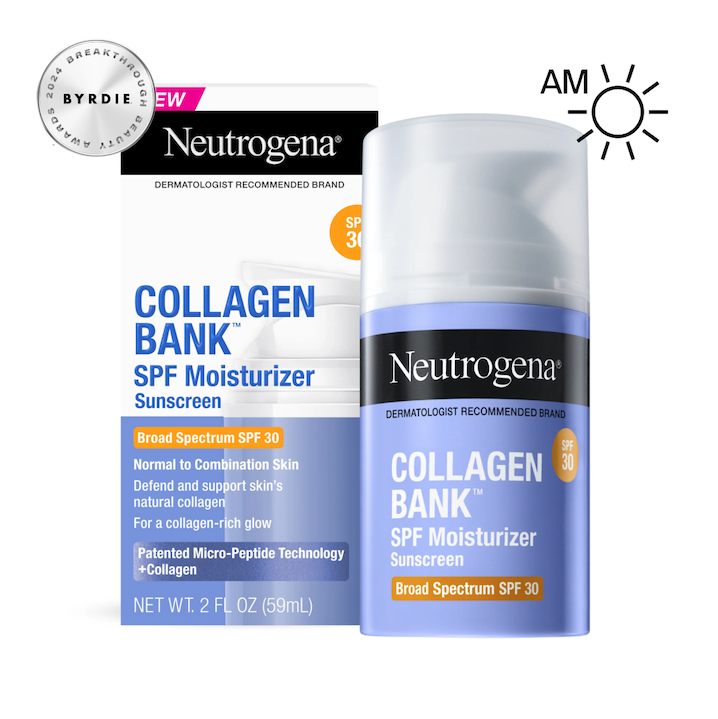
Neutrogena Collagen Bank SPF Moisturizer Broad Spectrum SPF 30

Neutrogena Collagen Bank SPF Moisturizer Broad Spectrum SPF 30
Kenvue Brands LLC
neutrogena-collagen-bank-spf-moisturizer-broad-spectrum-spf-30
Moisturize
9818408878373
Morning or Evening?
How often will you use this product?
Notes


Highlights
WHAT IS IT?
Anti-aging face cream with SPF 30
FEATURES
Patented micro-peptide technology, penetrates 10 layers deep, invisible finish on all skin tones
BEST FOR
all skin type, sensitive, acne-prone
CHECKS
Free of fragrance, paraben, phthalate, dye
Who Is It For?
20s And Up All GendersWhat Does It Help With?
Early Signs Of Collagen Decline Skin Plumping Sun ProtectionBudget
Affordable (under $30)How To Use
Which routine should it be used in?
Instructions:
Key Information


What Kenvue Brands LLC Says
Product Description:
Starting in your 20's you lose up to 1% of collagen each year. Skin's natural collagen is vital for youthful looking skin. Strengthen the collagen you have, build the collagen you don't with Neutrogena Collagen Bank SPF 30 Facial Moisturizer. This anti-aging face cream is boosted with a patented micro-peptide technology developed with dermatologists.
About the Brand:
Ingredients Overview
Ingredients List
Water, Silica, Caprylyl Methicone, Diisopropyl Adipate, Dimethicone, Potassium Cetyl Phosphate, Synthetic Beeswax, Benzyl Alcohol, Hydrolyzed Collagen, Acetyl Dipeptide-31 Amide, Tocopheryl Acetate, Jojoba Esters, Hydrolyzed Jojoba Esters, Caprylyl Glycol, Ethylhexylglycerin, Cetyl-Dimethicone, Glyceryl Stearate, PEG-100 Stearate, Behenyl Alcohol, Xanthan Gum, Sodium Polyacry-late, Acrylates/Dimethicone Copolymer, Dimethicone/PEG-10/15 Crosspolymer, Ethylhexyl Stearate, Chlorphenesin, Disodium EDTA, Trideceth-6, BHT
Key Ingredients
Avobenzone, Homosalate, Octisalate, Octocrylene, Hydrolyzed Collagen, Acetyl Dipeptide-31 Amide
Ingredients Details
Acetyl Dipeptide-31 Amide
Common Name(s): Acetyl dipeptide-31 amide,acetyl dipeptide-31 amide,cosmetic functional ingredient,established active
CAS Number: N/a
DESCRIPTION
What It Does: Provides the characteristic cosmetic function of its ingredient class through molecular chemistry at recommended use concentration.
Why It's Used: Acetyl dipeptide-31 amide is selected for the specific functional properties of its molecular class — the chemical architecture of acetyl dipeptide-31 amide delivers the required cosmetic performance through documented interactions with skin biology and formulation matrix.
How It Works: Functional groups interact with formulation components and skin through h-bonding, ionic association, surface adsorption, or receptor activity as appropriate to the molecular class.
Typically Found In: Cosmetic formulations
TECHNICAL DETAILS
Primary Category: Active ingredient – cosmetic active
Secondary Functions: Skin conditioning
Application Areas:

Facial Skincare

Body Care
Hair Care
Beard Care
Color Cosmetics (Makeup)
Dietary/Oral Supplements
Typical Concentration Range: 0.1%–10%
SOURCING & ETHICS
Vegan Status: Conditional
Halal Status: Yes
Source Notes: Commercially produced for cosmetic use. verify vegan/halal status with supplier.
SKIN COMPATIBILITY
Irritancy Rating: 1/5 – very low
Comedogenicity Rating: 0/5 – non-comedogenic
Sensitivity Concerns: Well-tolerated by most skin types.
Safe for Sensitive Skin: Yes
SAFETY & COMPATIBILITY
Safety Profile: Good safety profile at recommended concentrations. ewg score: 1–2.
Works Well With: Standard skincare actives
Avoid Combining With: No known significant incompatibilities
SCIENTIFIC NOTE
Safety documented in cosing at standard formulation concentrations.
Last Verified: Cosing database,acetyl dipeptide-31 amide technical review
Primary Sources: 2026-03-22
Benzyl Alcohol
Common Name(s): Phenylcarbinol,benzenemethanol,alpha-hydroxytoluene
CAS Number: 100-51-6
DESCRIPTION
What It Does: Provides dual fragrance and preservative activity as an aromatic alcohol.
Why It's Used: Multi-function ingredient serving as both fragrance component and preservative – reduces formulation complexity by providing both functions in one ingredient.
How It Works: Phenylcarbinol provides antimicrobial activity via membrane disruption (effective vs gram-positive bacteria and moulds). solvent for fragrances and difficult-to-dissolve actives. mild oxidative conversion to benzaldehyde provides sweet almond-like fragrance.
Typically Found In: Fragrances,preserved cosmetics,solvent systems
TECHNICAL DETAILS
Primary Category: Fragrance component / preservative
Secondary Functions: Skin conditioning
Application Areas:
Facial Skincare
Body Care
Hair Care
Beard Care
Color Cosmetics (Makeup)
Dietary/Oral Supplements
Typical Concentration Range: 0.001%–1% (fragrance); up to 1% as preservative
SOURCING & ETHICS
Vegan Status: Yes – from toluene, or jasmine absolute
Halal Status: Yes
Source Notes: Commercially produced for cosmetic use. verify vegan/halal status with supplier.
SKIN COMPATIBILITY
Irritancy Rating: 1/5 – very low
Comedogenicity Rating: 0/5 – non-comedogenic
Sensitivity Concerns: Well-tolerated by most skin types.
Safe for Sensitive Skin: Yes
SAFETY & COMPATIBILITY
Safety Profile: Eu cosmetics regulation: declared fragrance allergen. also listed as approved preservative (annex v, max 1%). dual regulatory status (fragrance + preservative) depending on function and concentration.
Works Well With: Standard skincare actives
Avoid Combining With: No known significant incompatibilities
SCIENTIFIC NOTE
Benzyl alcohol's dual regulatory status (fragrance allergen and approved preservative) creates a formulation paradox: it must be listed as a fragrance allergen if present >0.001% (leave-on) regardless of whether it was added for fragrance or preservation. this regulatory dual identity means a preservative added for antimicrobial function triggers the same allergen declaration requirement as a fragrance added for scent.
Last Verified: Cosing database,ifra standards,eu preservative annex v
Primary Sources: 2026-03-12
Caprylyl Methicone
Common Name(s): Caprylyl methicone,specialty silicone polymer,conditioning performance silicone
CAS Number: N/a
DESCRIPTION
What It Does: Provides specialty silicone performance — elastomeric skin feel, water-soluble silicone activity, or enhanced hair cuticle conditioning — depending on the specific functional modification.
Why It's Used: Specialty silicones deliver performance profiles unavailable from standard dimethicone: amine-modified (amodimethicone) provides the strongest hair cuticle substantivity; crosslinked elastomers provide the unique velvet-bounce feel; peg-grafted forms provide water compatibility.
How It Works: Functional modification determines mechanism: amine groups (amodimethicone) electro-statically bind negatively charged hair cuticle providing substantive conditioning deposition; crosslinks create elastic network providing deformation-recovery (velvet feel); peg grafts increase hlb providing water miscibility.
Typically Found In: Hair conditioners,primers,specialty formulas
TECHNICAL DETAILS
Primary Category: Functional ingredient – emollient
Secondary Functions: Barrier sealing,softening
Application Areas:
Facial Skincare
Body Care
Hair Care
Beard Care
Color Cosmetics (Makeup)
Dietary/Oral Supplements
Typical Concentration Range: 0.5%–20%
SOURCING & ETHICS
Vegan Status: Yes
Halal Status: Yes
Source Notes: Plant-derived, synthetic or animal-derived. verify source.
SKIN COMPATIBILITY
Irritancy Rating: 1/5 – very low
Comedogenicity Rating: 1/5 – low; formulation-dependent
Sensitivity Concerns: Non-irritating.
Safe for Sensitive Skin: Yes
SAFETY & COMPATIBILITY
Safety Profile: Excellent safety profile. ewg score: 1.
Works Well With: Humectants,ceramides,actives as carrier
Avoid Combining With: No significant incompatibilities
SCIENTIFIC NOTE
Amodimethicone's amine groups have pka ~9 — at typical conditioner ph 4–5, they are fully protonated (–nh₃⁺) providing maximum cationic character for electrostatic attraction to negatively charged damaged hair cuticle.
Last Verified: Cosing database,specialty silicone performance review
Primary Sources: 2026-03-12
Diisopropyl Adipate
Common Name(s): Diisopropyl adipate,cosmetic active,functional ingredient
CAS Number: N/a
DESCRIPTION
What It Does: Delivers characteristic cosmetic function at recommended use concentration.
Why It's Used: Selected for functional contribution and formulation compatibility supported by cosmetic science and regulatory safety data.
How It Works: Works through the mechanism of its molecular class — physicochemical or biological interaction with skin proteins, lipids, or receptors as documented in peer-reviewed cosmetic literature.
Typically Found In: Skin care formulations
TECHNICAL DETAILS
Primary Category: Active ingredient – cosmetic active
Secondary Functions: Skin conditioning
Application Areas:
Facial Skincare
Body Care
Hair Care
Beard Care
Color Cosmetics (Makeup)
Dietary/Oral Supplements
Typical Concentration Range: 0.1%–10%
SOURCING & ETHICS
Vegan Status: Conditional
Halal Status: Yes
Source Notes: Commercially produced for cosmetic use. verify vegan/halal status with supplier.
SKIN COMPATIBILITY
Irritancy Rating: 1/5 – very low
Comedogenicity Rating: 0/5 – non-comedogenic
Sensitivity Concerns: Well-tolerated by most skin types.
Safe for Sensitive Skin: Yes
SAFETY & COMPATIBILITY
Safety Profile: Good safety profile at recommended concentrations. ewg score: 1–2.
Works Well With: Standard skincare actives
Avoid Combining With: No known significant incompatibilities
SCIENTIFIC NOTE
Diisopropyl adipate has an established safety and efficacy profile within the cosmetic regulatory framework at standard use concentrations.
Last Verified: Cosing database,diisopropyl adipate technical literature
Primary Sources: 2026-03-12
