

NIVEA India Pvt Ltd
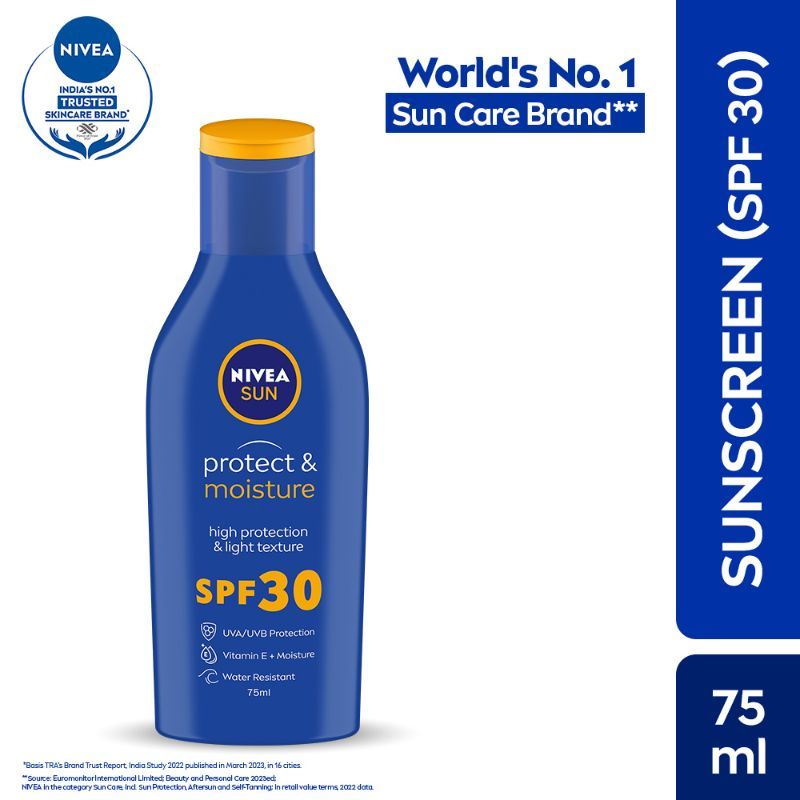
NIVEA Moisturising Sun Lotion SPF 30

NIVEA Moisturising Sun Lotion SPF 30
NIVEA India Pvt Ltd
nivea-moisturising-sun-lotion-spf-30
Suncare
10084799611173
Morning or Evening?
How often will you use this product?
Notes


Highlights
WHAT IS IT?
Sun Lotion SPF 30, 0 ingredients listed
FEATURES
Instant protection from harsh sunrays, fast absorbing formula, advanced collagen protection prevents wrinkles, non-greasy, non-oily, water resistant
BEST FOR
normal
CHECKS
Does not contain greasy/oily ingredients
Who Is It For?
All Genders Age Not SpecifiedWhat Does It Help With?
Sun Protection Wrinkle Prevention HydrationBudget
Affordable (under $30)How To Use
Which routine should it be used in?
Instructions:
Key Information


What NIVEA India Pvt Ltd Says
Product Description:
Get instant protection from harsh sunrays with NIVEA Protect and Moisture Sun Lotion SPF 30. Its fast absorbing formula with advanced collagen protection prevents wrinkles. The non-greasy and non-oily formula is also water resistant. Now no need to wait for 15 mins; just apply and Get Set Go!
About the Brand:
Ingredients Overview
Ingredients List
Aqua, Isopropyl Palmitate, C12-15 Alkyl Benzoate, Glycerin, Alcohol Denat, Bis-Ethylhexyloxyphenol Methoxyphenyl Triazine, Butyl Methoxydibenzoylmethane, Dibutyl Adipate, Ethylhexyl Triazone, Copernicia Cerifera Cera, Glyceryl Stearate SE, Microcrystalline Cellulose, Phenylbenzimidazole Sulfonic Acid, Sodium Ascorbyl Phosphate, Sodium Hyaluronate, Tocopheryl Acetate, Xanthan Gum, Polyglyceryl-3 Methylglucose Distearate, Diisostearoyl Polyglyceryl-3 Dimer Dilinoleate, Hydrogenated Rapeseed Oil, Cetyl Palmitate, Cellulose Gum, Trisodium Ethylenediamine Disuccinate, Hydroxyacetophenone, Ethylhexylglycerin, Phenoxyethanol, Linalool, Benzyl Alcohol, Linalyl Acetate, Alpha-Isomethyl Ionone, Citronellol, Vanillin, Parfum
Key Ingredients
Ingredients Details
Alcohol Denat
Common Name(s): Alcohol denat
DESCRIPTION
What It Does: Delivers targeted skin-conditioning or bioactive benefits through a specific mechanism of action suited to the formulation's intended purpose.
Why It's Used: Specialty actives address specific skin concerns through targeted molecular mechanisms, providing efficacy beyond what base formulation ingredients alone can achieve.
How It Works: The bioactive compound interacts with specific molecular targets in skin cells or the extracellular matrix — enzymes, receptors, structural proteins, or signaling molecules — triggering beneficial biological responses.
Typically Found In: Serums,treatments,moisturizers,specialty products
TECHNICAL DETAILS
Primary Category: Specialty actives
Secondary Functions: Skin-conditioning,anti-aging
Application Areas:

Facial Skincare

Body Care
Hair Care
Beard Care
Color Cosmetics (Makeup)
Dietary/Oral Supplements
Typical Concentration Range: 0.01–5%
SOURCING & ETHICS
Vegan Status: Yes
Halal Status: Conditional
Source Notes: Specialty active ingredient; check individual sourcing for vegan status.
SKIN COMPATIBILITY
Irritancy Rating: 1899-12-31 00:00:00 -0800
Sensitivity Concerns: Low sensitization potential at recommended use concentrations.
Safe for Sensitive Skin: Yes
SAFETY & COMPATIBILITY
Safety Profile: Well-characterized cosmetic ingredient with established safety profile. generally non-irritating at typical use concentrations. suitable for leave-on and rinse-off cosmetics.
Works Well With: Niacinamide,hyaluronic acid,vitamin c,peptides
Avoid Combining With: Incompatible with oxidizing agents; check ph stability
SCIENTIFIC NOTE
Specialty actives typically work through enzyme inhibition (e.g., tyrosinase inhibition for brightening, mmp inhibition for anti-aging), receptor activation (e.g., retinoid receptors, ppar-γ for barrier genes), or transcription factor modulation (e.g., nrf2 for antioxidant gene upregulation). structure-activity relationships determine potency and selectivity.
Last Verified: Cosing eu database; pcpc cosmetic ingredient safety reviews; ingredient-specific safety and efficacy literature
Primary Sources: 2025-01-15
Alpha-isomethyl Ionone
Common Name(s): Alpha-isomethyl ionone
DESCRIPTION
What It Does: Delivers targeted skin-conditioning or bioactive benefits through a specific mechanism of action suited to the formulation's intended purpose.
Why It's Used: Specialty actives address specific skin concerns through targeted molecular mechanisms, providing efficacy beyond what base formulation ingredients alone can achieve.
How It Works: The bioactive compound interacts with specific molecular targets in skin cells or the extracellular matrix — enzymes, receptors, structural proteins, or signaling molecules — triggering beneficial biological responses.
Typically Found In: Serums,treatments,moisturizers,specialty products
TECHNICAL DETAILS
Primary Category: Specialty actives
Secondary Functions: Skin-conditioning,anti-aging
Application Areas:
Facial Skincare
Body Care
Hair Care
Beard Care
Color Cosmetics (Makeup)
Dietary/Oral Supplements
Typical Concentration Range: 0.01–5%
SOURCING & ETHICS
Vegan Status: Yes
Halal Status: Yes
Source Notes: Specialty active ingredient; check individual sourcing for vegan status.
SKIN COMPATIBILITY
Irritancy Rating: 1
Comedogenicity Rating: 0
Sensitivity Concerns: Low sensitization potential at recommended use concentrations.
Safe for Sensitive Skin: Yes
SAFETY & COMPATIBILITY
Safety Profile: Well-characterized cosmetic ingredient with established safety profile. generally non-irritating at typical use concentrations. suitable for leave-on and rinse-off cosmetics.
Works Well With: Niacinamide,hyaluronic acid,vitamin c,peptides
Avoid Combining With: Incompatible with oxidizing agents; check ph stability
SCIENTIFIC NOTE
Specialty actives typically work through enzyme inhibition (e.g., tyrosinase inhibition for brightening, mmp inhibition for anti-aging), receptor activation (e.g., retinoid receptors, ppar-γ for barrier genes), or transcription factor modulation (e.g., nrf2 for antioxidant gene upregulation). structure-activity relationships determine potency and selectivity.
Last Verified: Cosing eu database; pcpc cosmetic ingredient safety reviews; ingredient-specific safety and efficacy literature
Primary Sources: 2025-01-15
Benzyl Alcohol
Common Name(s): Phenylcarbinol,benzenemethanol,alpha-hydroxytoluene
CAS Number: 100-51-6
DESCRIPTION
What It Does: Provides dual fragrance and preservative activity as an aromatic alcohol.
Why It's Used: Multi-function ingredient serving as both fragrance component and preservative – reduces formulation complexity by providing both functions in one ingredient.
How It Works: Phenylcarbinol provides antimicrobial activity via membrane disruption (effective vs gram-positive bacteria and moulds). solvent for fragrances and difficult-to-dissolve actives. mild oxidative conversion to benzaldehyde provides sweet almond-like fragrance.
Typically Found In: Fragrances,preserved cosmetics,solvent systems
TECHNICAL DETAILS
Primary Category: Fragrance component / preservative
Secondary Functions: Skin conditioning
Application Areas:
Facial Skincare
Body Care
Hair Care
Beard Care
Color Cosmetics (Makeup)
Dietary/Oral Supplements
Typical Concentration Range: 0.001%–1% (fragrance); up to 1% as preservative
SOURCING & ETHICS
Vegan Status: Yes – from toluene, or jasmine absolute
Halal Status: Yes
Source Notes: Commercially produced for cosmetic use. verify vegan/halal status with supplier.
SKIN COMPATIBILITY
Irritancy Rating: 1/5 – very low
Comedogenicity Rating: 0/5 – non-comedogenic
Sensitivity Concerns: Well-tolerated by most skin types.
Safe for Sensitive Skin: Yes
SAFETY & COMPATIBILITY
Safety Profile: Eu cosmetics regulation: declared fragrance allergen. also listed as approved preservative (annex v, max 1%). dual regulatory status (fragrance + preservative) depending on function and concentration.
Works Well With: Standard skincare actives
Avoid Combining With: No known significant incompatibilities
SCIENTIFIC NOTE
Benzyl alcohol's dual regulatory status (fragrance allergen and approved preservative) creates a formulation paradox: it must be listed as a fragrance allergen if present >0.001% (leave-on) regardless of whether it was added for fragrance or preservation. this regulatory dual identity means a preservative added for antimicrobial function triggers the same allergen declaration requirement as a fragrance added for scent.
Last Verified: Cosing database,ifra standards,eu preservative annex v
Primary Sources: 2026-03-12
Bis-ethylhexyloxyphenol Methoxyphenyl Triazine
Common Name(s): Bis-ethylhexyloxyphenol methoxyphenyl triazine,antimicrobial biocide,broad-spectrum preservative-grade
CAS Number: N/a
DESCRIPTION
What It Does: Kills bacteria, fungi, and viruses on skin and within formulations through membrane disruption, protein denaturation, or enzyme inhibition — providing antiseptic, preservation, or therapeutic antimicrobial protection.
Why It's Used: Chosen when broad-spectrum antimicrobial coverage including gram-negative bacteria (particularly pseudomonas) is required, where standard cosmetic preservatives provide insufficient protection for challenge tests.
How It Works: Cationic biocides (qacs) adsorb electrostatically to negative microbial surfaces then insert hydrophobic chains into lipid bilayers, collapsing membrane potential. non-ionic biocides (triclosan) inhibit fatty acid synthesis (fabi enoyl reductase). oxidants (h₂o₂, chlorine dioxide) oxidise microbial thiol enzymes non-specifically.
Typically Found In: Antiseptics,therapeutic skin care
TECHNICAL DETAILS
Primary Category: Active ingredient – cosmetic active
Secondary Functions: Skin conditioning
Application Areas:
Facial Skincare
Body Care
Hair Care
Beard Care
Color Cosmetics (Makeup)
Dietary/Oral Supplements
Typical Concentration Range: Check regulatory limits
SOURCING & ETHICS
Vegan Status: Yes
Halal Status: Yes
Source Notes: Commercially produced for cosmetic use. verify vegan/halal status with supplier.
SKIN COMPATIBILITY
Irritancy Rating: 1/5 – very low
Comedogenicity Rating: 0/5 – non-comedogenic
Sensitivity Concerns: Well-tolerated by most skin types.
Safe for Sensitive Skin: Yes
SAFETY & COMPATIBILITY
Safety Profile: Good safety profile at recommended concentrations. ewg score: 1–2.
Works Well With: Standard skincare actives
Avoid Combining With: No known significant incompatibilities
SCIENTIFIC NOTE
Regulatory limits vary significantly by compound and application — formulators must verify permitted concentrations in target market (eu annex v, fda otc monographs) before formulating at functional concentrations.
Last Verified: Cosing database,bis-ethylhexyloxyphenol methoxyphenyl triazine antimicrobial regulatory review
Primary Sources: 2026-03-12
