
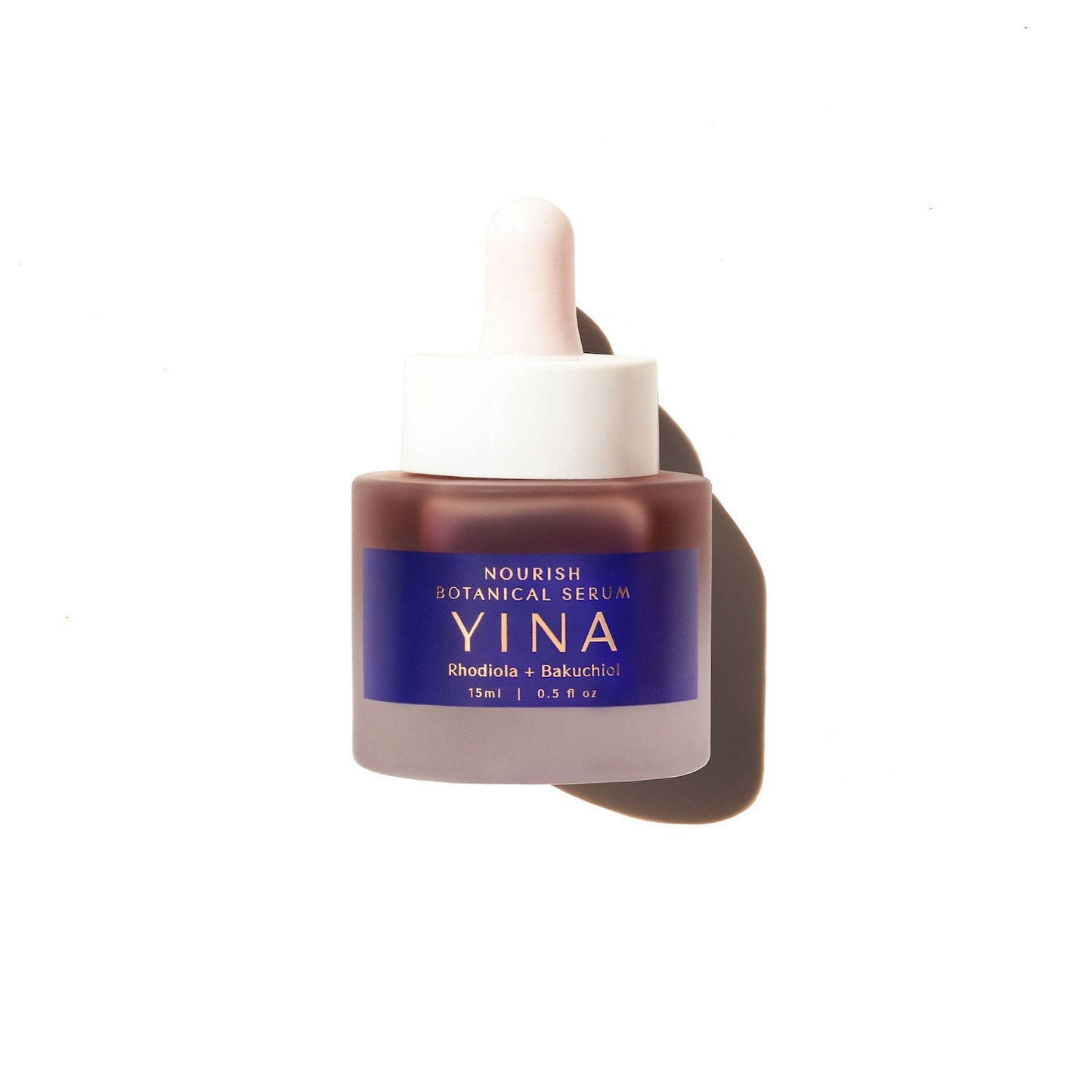

YINA
NOURISH Botanical Serum

NOURISH Botanical Serum
YINA
nourish-botanical-serum
Serum
9706851336485
Morning or Evening?
How often will you use this product?
Notes


Highlights
WHAT IS IT?
A botanical serum with multiple plant-based ingredients
FEATURES
Replenishes and rejuvenates skin, reduces appearance of fine lines, enhances suppleness
BEST FOR
Dry skin
CHECKS
Clean skincare
Who Is It For?
Adults Both Women And MenWhat Does It Help With?
Fine Lines Dryness Dull ComplexionBudget
PremiumHow To Use
Which routine should it be used in?
Instructions:
Key Information


What YINA Says
Product Description:
Your solution for a flawless complexion. NOURISH Botanical serum features a proprietary Chinese medicine plant complex that includes Rhodiola, Bakuchiol, and Asian Knotweed. Powerful and grounding, this serum deeply replenishes and rejuvenates your skin, leaving it glowing with health and radiance.
About the Brand:
Ingredients Overview
Ingredients List
Camellia oleifera (Camellia Seed) Oil, Carthamus tinctorius (Safflower Seed) Oil, Rhodiola rosea (Roseroot) Extract, Psoralea corylifolia (Bakuchiol Seed) Extract, Angelica sinensis (Angelica Root) Extract, Polygonum cuspidatum (Asian Knotweed) Extract, Glycyrrhiza uralensis (Licorice Root) Extract, Arnebia euchroma (Gromwell) Extract, Olive Squalane, Rubus fruticosus (Blackberry Seed) Oil, C12-15 Alkyl Benzoate, Tocopheryl Acetate, Ubiquinone, Vetiveria zizanioides (Vetiver) Oil, Cinnamomum camphora (Ho Wood) Oil, Rosmarinus officinalis (Rosemary Leaf) Extract, Picea mariana (Black Spruce) Oil, Boswellia carteri (Frankincense) Oil, Aquilaria crassna (Agarwood) Oil, Commiphora myrrha (Myrrh) Oil, Limonene, Linalool, Geraniol, Citronellol.
Key Ingredients
Rhodiola, Bakuchiol, Asian Knotweed, Angelica Root, Gromwell Root
Ingredients Details
Camellia Oleifera Camellia Seed Oil
Common Name(s): Camellia oleifera camellia seed oil oil
DESCRIPTION
What It Does: Nourishes and softens skin through its balanced fatty acid profile, while antioxidant compounds protect against oxidative skin damage.
Why It's Used: Plant oils provide physiologically compatible lipid structures that integrate into the skin barrier and deliver fat-soluble antioxidants directly to skin cells.
How It Works: Fatty acids integrate into stratum corneum lipid lamellae, reinforcing the lipid barrier. antioxidants (tocopherols, carotenoids, polyphenols) neutralize ros through electron donation or singlet oxygen quenching.
Typically Found In: Face oils,serums,moisturizers,hair treatments,body oils
TECHNICAL DETAILS
Primary Category: Plant oils
Secondary Functions: Emollient,antioxidant
Application Areas:

Facial Skincare
Body Care
Hair Care

Beard Care
Color Cosmetics (Makeup)
Dietary/Oral Supplements
Typical Concentration Range: 0.5–30%
SOURCING & ETHICS
Vegan Status: Yes
Halal Status: Yes
Source Notes: Cold-pressed or solvent-extracted plant oil; no animal components.
SKIN COMPATIBILITY
Irritancy Rating: 1899-12-31 00:00:00 -0800
Comedogenicity Rating: 2000-01-01 00:00:00 -0800
Sensitivity Concerns: Low sensitization potential at recommended use concentrations.
Safe for Sensitive Skin: Yes
SAFETY & COMPATIBILITY
Safety Profile: Well-characterized cosmetic ingredient with established safety profile. generally non-irritating at typical use concentrations. suitable for leave-on and rinse-off cosmetics.
Works Well With: Vitamin e,ceramides,other plant oils,squalane
Avoid Combining With: Strong oxidizers (accelerate rancidity)
SCIENTIFIC NOTE
Vegetable oils are triglyceride matrices where the fatty acid composition determines skin compatibility, barrier function, and comedogenicity. oleic acid-rich oils (>60%) soften barrier lipids and enhance penetration; linoleic acid-rich oils reinforce ceramide-poor stratum corneum; saturated fatty acid-rich oils provide occlusion without skin penetration.
Last Verified: 2025-01-15
Primary Sources: Cosing eu database; pcpc cosmetic ingredient safety reviews; aocs plant oil composition databases; fatty acid pharmacology reviews
Carthamus Tinctorius Safflower Seed Oil
Common Name(s): Carthamus tinctorius safflower seed oil oil
DESCRIPTION
What It Does: Nourishes and softens skin through its balanced fatty acid profile, while antioxidant compounds protect against oxidative skin damage.
Why It's Used: Plant oils provide physiologically compatible lipid structures that integrate into the skin barrier and deliver fat-soluble antioxidants directly to skin cells.
How It Works: Fatty acids integrate into stratum corneum lipid lamellae, reinforcing the lipid barrier. antioxidants (tocopherols, carotenoids, polyphenols) neutralize ros through electron donation or singlet oxygen quenching.
Typically Found In: Face oils,serums,moisturizers,hair treatments,body oils
TECHNICAL DETAILS
Primary Category: Plant oils
Secondary Functions: Emollient,antioxidant
Application Areas:
Facial Skincare
Body Care
Hair Care
Beard Care
Color Cosmetics (Makeup)
Dietary/Oral Supplements
Typical Concentration Range: 0.5–30%
SOURCING & ETHICS
Vegan Status: Yes
Halal Status: Yes
Source Notes: Cold-pressed or solvent-extracted plant oil; no animal components.
SKIN COMPATIBILITY
Irritancy Rating: 1899-12-31 00:00:00 -0800
Comedogenicity Rating: 2000-01-01 00:00:00 -0800
Sensitivity Concerns: Low sensitization potential at recommended use concentrations.
Safe for Sensitive Skin: Yes
SAFETY & COMPATIBILITY
Safety Profile: Well-characterized cosmetic ingredient with established safety profile. generally non-irritating at typical use concentrations. suitable for leave-on and rinse-off cosmetics.
Works Well With: Vitamin e,ceramides,other plant oils,squalane
Avoid Combining With: Strong oxidizers (accelerate rancidity)
SCIENTIFIC NOTE
Vegetable oils are triglyceride matrices where the fatty acid composition determines skin compatibility, barrier function, and comedogenicity. oleic acid-rich oils (>60%) soften barrier lipids and enhance penetration; linoleic acid-rich oils reinforce ceramide-poor stratum corneum; saturated fatty acid-rich oils provide occlusion without skin penetration.
Last Verified: 2025-01-15
Primary Sources: Cosing eu database; pcpc cosmetic ingredient safety reviews; aocs plant oil composition databases; fatty acid pharmacology reviews
Olive Squalane
Common Name(s): Olive squalane,phytosqualane,certified plant squalane
CAS Number: 0111-01-03
DESCRIPTION
What It Does: Provides certified olive-origin skin-identical hydrocarbon emolliency with highest natural credentials.
Why It's Used: Premium credentialled squalane — olive squalane provides the most prestigious and verifiable squalane provenance from traditional mediterranean olive heritage, essential for brands requiring the highest supply chain transparency and natural origin documentation.
How It Works: Identical molecular formula to other plant squalane (c30h62) — chemically indistinguishable. origin verified via carbon-14 isotope analysis or supply chain documentation. extracted from olive oil deodoriser distillate then hydrogenated. traditional mediterranean sourcing from certified olive mills.
Typically Found In: Premium mediterranean skincare,certified natural products,verified sustainable beauty
TECHNICAL DETAILS
Primary Category: Functional ingredient – emollient
Secondary Functions: Barrier sealing,softening
Application Areas:
Facial Skincare
Body Care
Hair Care
Beard Care
Color Cosmetics (Makeup)
Dietary/Oral Supplements
Typical Concentration Range: 1%–100%
SOURCING & ETHICS
Vegan Status: Conditional - feedstock declaration required
Halal Status: Unverified - feedstock declaration required (plant, animal and petrochemical routes all exist)
Source Notes: Plant-derived, synthetic or animal-derived. verify source. [audit 2026-07-29 rev2: origin-dependent: the same inci exists in plant, animal and petrochemical versions and the name does not discriminate. determination requires shariah-panel sign-off.]
SKIN COMPATIBILITY
Irritancy Rating: 2026-01-05 00:00:00 -0800
Comedogenicity Rating: 0/5
Sensitivity Concerns: Non-irritating.
Safe for Sensitive Skin: Yes
SAFETY & COMPATIBILITY
Safety Profile: Excellent safety profile. ewg score: 1.
Works Well With: Humectants,ceramides,actives as carrier
Avoid Combining With: No significant incompatibilities
SCIENTIFIC NOTE
Olive squalane's origin verification via carbon-14 isotope dating (plant carbon has different ¹⁴c signature than petrochemical carbon which has no ¹⁴c from being geologically old) provides scientific authenticity validation — an absolute verification method distinguishing genuine plant-derived from petroleum-derived squalane that cannot be falsified by adulteration.
Last Verified: 2026-03-12
Primary Sources: Cosing database,cir safety assessment
Rubus Fruticosus Blackberry Seed Oil
Common Name(s): Rubus fruticosus blackberry seed oil oil
DESCRIPTION
What It Does: Nourishes and softens skin through its balanced fatty acid profile, while antioxidant compounds protect against oxidative skin damage.
Why It's Used: Plant oils provide physiologically compatible lipid structures that integrate into the skin barrier and deliver fat-soluble antioxidants directly to skin cells.
How It Works: Fatty acids integrate into stratum corneum lipid lamellae, reinforcing the lipid barrier. antioxidants (tocopherols, carotenoids, polyphenols) neutralize ros through electron donation or singlet oxygen quenching.
Typically Found In: Face oils,serums,moisturizers,hair treatments,body oils
TECHNICAL DETAILS
Primary Category: Plant oils
Secondary Functions: Emollient,antioxidant
Application Areas:
Facial Skincare
Body Care
Hair Care
Beard Care
Color Cosmetics (Makeup)
Dietary/Oral Supplements
Typical Concentration Range: 0.5–30%
SOURCING & ETHICS
Vegan Status: Yes
Halal Status: Yes
Source Notes: Cold-pressed or solvent-extracted plant oil; no animal components.
SKIN COMPATIBILITY
Irritancy Rating: 1899-12-31 00:00:00 -0800
Comedogenicity Rating: 2000-01-01 00:00:00 -0800
Sensitivity Concerns: Low sensitization potential at recommended use concentrations.
Safe for Sensitive Skin: Yes
SAFETY & COMPATIBILITY
Safety Profile: Well-characterized cosmetic ingredient with established safety profile. generally non-irritating at typical use concentrations. suitable for leave-on and rinse-off cosmetics.
Works Well With: Vitamin e,ceramides,other plant oils,squalane
Avoid Combining With: Strong oxidizers (accelerate rancidity)
SCIENTIFIC NOTE
Vegetable oils are triglyceride matrices where the fatty acid composition determines skin compatibility, barrier function, and comedogenicity. oleic acid-rich oils (>60%) soften barrier lipids and enhance penetration; linoleic acid-rich oils reinforce ceramide-poor stratum corneum; saturated fatty acid-rich oils provide occlusion without skin penetration.
Last Verified: 2025-01-15
Primary Sources: Cosing eu database; pcpc cosmetic ingredient safety reviews; aocs plant oil composition databases; fatty acid pharmacology reviews