
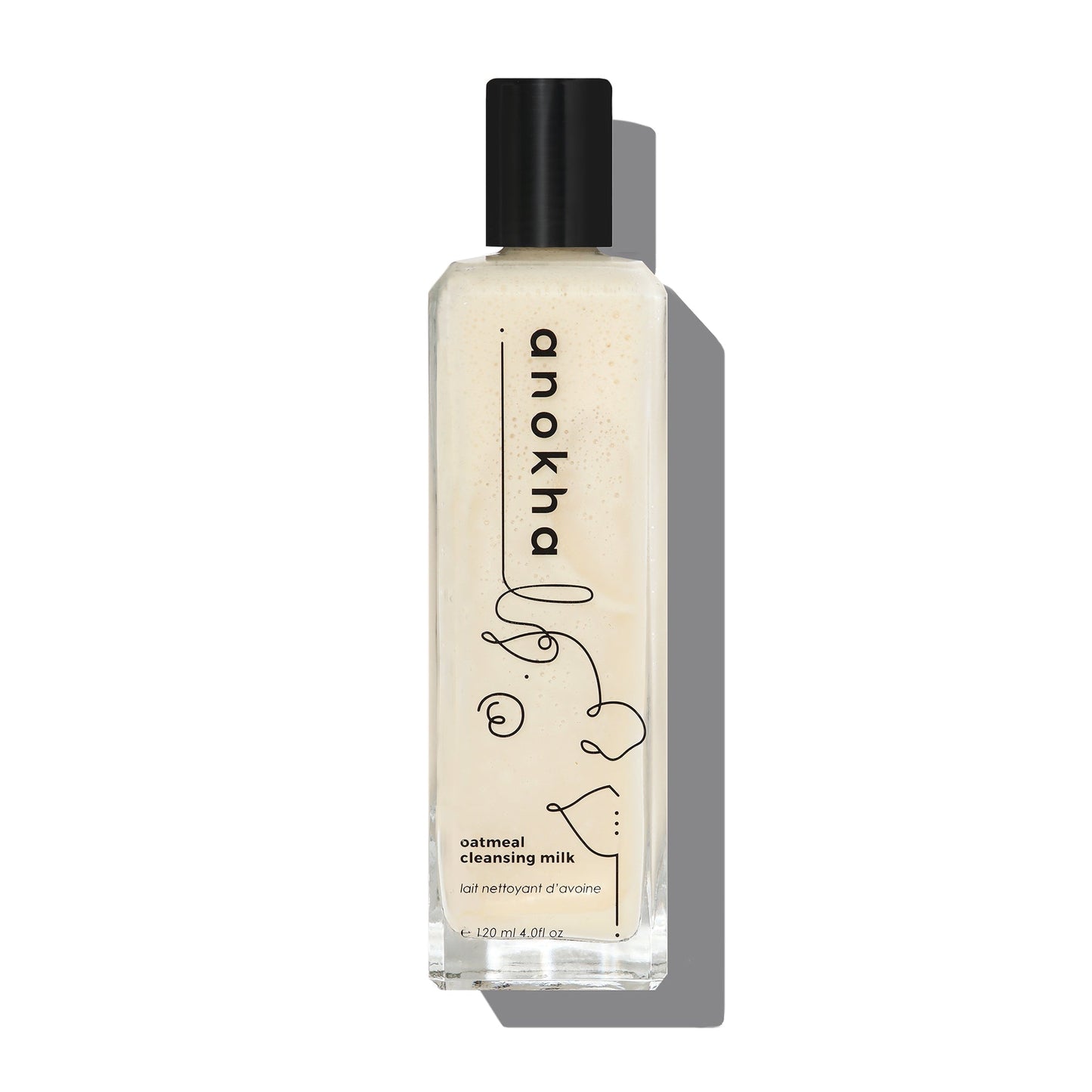

Anokha
Oatmeal Cleansing Milk

Oatmeal Cleansing Milk
Anokha
oatmeal-cleansing-milk
Cleanse
9706845700389
Morning or Evening?
How often will you use this product?
Notes


Highlights
WHAT IS IT?
Oatmeal-based facial cleanser with 11 ingredients
FEATURES
Reduces excess sebum, balances normal skin, clears dead skin buildup, suitable for all skin types
BEST FOR
All skin types
CHECKS
Free of harsh chemicals, artificial fragrances, toxic preservatives, parabens, sulfates
Who Is It For?
Adults Both Women And MenWhat Does It Help With?
Oily Skin Dry Skin Rosacea Atopic Dermatitis Eczema Radiation Injury Xerosis PsoriasisBudget
Mid-rangeHow To Use
Which routine should it be used in?
Instructions:
Key Information


What Anokha Says
Product Description:
A soothing oatmeal face wash to gently wake up and soften skin, minus the morning alarm. Feel soft, look smooth. 100% natural, cruelty-free, physician-formulated; clinically-tested, allergy-tested, and non-irritating. pH balanced at 5.5.
About the Brand:
Ingredients Overview
Ingredients List
Aqua/water/eau, Avena sativa (oat), C14-16 sodium olefin sulfonate, glycerin, glyceryl stearate (and) stearyl alcohol (and) polyglyceryl-2 stearate, decyl glucoside, hydrolyzed milk protein, dehydroacetic acid, benzyl alcohol, xanthan gum, citric acid
Key Ingredients
Colloidal oatmeal, milk protein
Ingredients Details
Decyl Glucoside
Common Name(s): Capryl glucoside,apg surfactant,alkyl polyglucoside
CAS Number: 68515-73-1
DESCRIPTION
What It Does: Provides gentle non-ionic cleansing from natural glucose-derived surfactant chemistry.
Why It's Used: Leading natural-origin surfactant for green/natural formulations requiring gentle, non-ionic cleansing with excellent biodegradability credentials.
How It Works: Non-ionic surfactant with glucoside headgroup and decyl (c10) chain provides mild cleansing via micelle formation. non-ionic character provides lower irritation potential than anionic surfactants. fully biodegradable and from renewable sources.
Typically Found In: Natural cleansers,baby products,green beauty formulas,scalp cleansers
TECHNICAL DETAILS
Primary Category: Functional ingredient – alkyl glucoside surfactant
Secondary Functions: Skin conditioning
Application Areas:

Facial Skincare
Body Care
Hair Care

Beard Care
Color Cosmetics (Makeup)
Dietary/Oral Supplements
Typical Concentration Range: 2%–20%
SOURCING & ETHICS
Vegan Status: Conditional - supplier confirmation required
Halal Status: Unverified - supplier confirmation required
Source Notes: Commercially produced for cosmetic use. verify vegan/halal status with supplier. [audit 2026-07-29 rev2: the record's own source_notes does not assert a non-animal origin, or instructs the reader to verify with the supplier; "yes" asserts knowledge the record does not hold. determination requires shariah-panel sign-off.]
SKIN COMPATIBILITY
Irritancy Rating: 1/5 – very low
Comedogenicity Rating: 0/5 – non-comedogenic
Sensitivity Concerns: Well-tolerated by most skin types.
Safe for Sensitive Skin: Yes
SAFETY & COMPATIBILITY
Safety Profile: Good safety profile at recommended concentrations. ewg score: 1–2.
Works Well With: Standard skincare actives
Avoid Combining With: No known significant incompatibilities
SCIENTIFIC NOTE
Alkyl glucosides' (apgs) non-ionic character means they have no electrical charge that could interact with skin surface proteins and phospholipids – a key reason for their exceptional mildness. ionic surfactants (sulfates, carboxylates) bind to positively charged protein lysine/arginine residues causing denaturation; apgs have no such binding affinity.
Last Verified: 2026-03-12
Primary Sources: Cosing database,cir safety assessment
Dehydroacetic Acid
Common Name(s): Dha preservative,3-acetyl-6-methyl-2h-pyran-2,4(3h)-dione
CAS Number: 520-45-6
DESCRIPTION
What It Does: Provides broad-spectrum preservation effective at higher ph than benzoate or sorbate.
Why It's Used: Ph-flexible preservative for formulations at ph 5-7 where sodium benzoate and potassium sorbate lose efficacy.
How It Works: Cyclic dicarbonyl pyranone structure provides ph-independent antimicrobial activity (active form is the neutral molecule, not ph-dependent ionisation). effective ph 4-8 (much broader than benzoate/sorbate). good antifungal vs aspergillus and candida. often used as sodium salt (sodium dehydroacetate) for water solubility.
Typically Found In: Higher ph cosmetics,anti-fungal preservation systems
TECHNICAL DETAILS
Primary Category: Functional ingredient – pyranone preservative
Secondary Functions: Skin conditioning
Application Areas:
Facial Skincare
Body Care
Hair Care
Beard Care
Color Cosmetics (Makeup)
Dietary/Oral Supplements
Typical Concentration Range: 0.1%–0.6%
SOURCING & ETHICS
Vegan Status: Conditional - supplier confirmation required
Halal Status: Unverified - supplier confirmation required
Source Notes: Commercially produced for cosmetic use. verify vegan/halal status with supplier. [audit 2026-07-29 rev2: the record's own source_notes does not assert a non-animal origin, or instructs the reader to verify with the supplier; "yes" asserts knowledge the record does not hold. determination requires shariah-panel sign-off.]
SKIN COMPATIBILITY
Irritancy Rating: 1/5 – very low
Comedogenicity Rating: 0/5 – non-comedogenic
Sensitivity Concerns: Well-tolerated by most skin types.
Safe for Sensitive Skin: Yes
SAFETY & COMPATIBILITY
Safety Profile: Eu max 0.6% as dehydroacetic acid. less commonly used than benzoate/sorbate due to higher cost.
Works Well With: Standard skincare actives
Avoid Combining With: No known significant incompatibilities
SCIENTIFIC NOTE
Dehydroacetic acid's ph-independent antimicrobial activity arises from a fundamentally different mechanism vs benzoate/sorbate: rather than requiring the acidic free acid form (ph-dependent ionisation), dha's cyclic diketone structure is itself the active antimicrobial form. this means dha provides equivalent antimicrobial activity at ph 5 and ph 7 — completely unlike the ph-sensitive preservatives that lose activity above ph 5.
Last Verified: 2026-03-12
Primary Sources: Cosing database,eu preservative annex v,cir safety assessment
Glycerin
Common Name(s): Glycerol,glycerine,1,2,3-propanetriol
CAS Number: 56-81-5
DESCRIPTION
What It Does: Glycerin pulls water from the environment and deeper skin layers into the outer skin layer (epidermis), boosting moisture levels and keeping skin soft, smooth, and plump.
Why It's Used: It is used in virtually every moisturizer, serum, and cleanser because it is highly effective at hydrating skin, is well-tolerated by all skin types, and enhances the texture and spreadability of formulations.
How It Works: As a humectant, glycerin forms hydrogen bonds with water molecules, trapping them in the skin. it also reinforces the skin barrier by integrating into lipid structures between skin cells.
Typically Found In: Moisturizers,serums,cleansers,toners,sheet masks,sunscreens,body lotions,shampoos,conditioners
TECHNICAL DETAILS
Primary Category: Humectant
Secondary Functions: Skin barrier support,emollient,solvent
Application Areas:
Facial Skincare
Body Care
Hair Care
Beard Care
Color Cosmetics (Makeup)
Dietary/Oral Supplements
Typical Concentration Range: 1%–30% (typical: 3–10%)
SOURCING & ETHICS
Vegan Status: Conditional - feedstock declaration required
Halal Status: Unverified - feedstock declaration required (plant, animal and petrochemical routes all exist)
Source Notes: Derived from plant oils via hydrolysis or saponification; synthetic versions also available. palm-derived glycerin carries sustainability concerns. [audit 2026-07-29 rev2: origin-dependent: the same inci exists in plant, animal and petrochemical versions and the name does not discriminate. determination requires shariah-panel sign-off.]
SKIN COMPATIBILITY
Irritancy Rating: 1/5 – very low; non-irritating at all standard concentrations
Comedogenicity Rating: 0/5 – non-comedogenic
Sensitivity Concerns: Extremely rare allergic reactions; generally safe for all skin types including sensitive and baby skin
Safe for Sensitive Skin: Yes
SAFETY & COMPATIBILITY
Safety Profile: Widely recognized as safe. ewg hazard score: 1. no significant concerns for irritation, sensitization, or toxicity at typical concentrations (up to 50%).
Works Well With: Hyaluronic acid,ceramides,niacinamide,panthenol,urea,peptides,retinol,ahas/bhas
Avoid Combining With: No known incompatibilities at standard concentrations
SCIENTIFIC NOTE
Glycerin is an endogenous skin component found naturally in the stratum corneum. aquaporin-3 channels in keratinocytes facilitate glycerin transport, making it integral to natural skin hydration pathways.
Last Verified: 2026-03-12
Primary Sources: Cosing database,cir safety assessment,ewg skin deep,inci decoder
Glyceryl Stearate
Common Name(s): Glycerol monostearate,gms,glycerin monostearate
CAS Number: 31566-31-1
DESCRIPTION
What It Does: Provides o/w emulsification with emolliency and skin feel improvement from a natural glycerol ester.
Why It's Used: Standard cosmetic monoglyceride emulsifier – widely used for o/w cream formation with clean, natural-origin credentials and good sensory profile.
How It Works: Monoglyceride structure (one fatty acid + glycerol) provides amphiphilic hlb ~3-4 for o/w emulsification when combined with higher hlb co-emulsifiers. forms alpha-gel lamellar structure with water for emulsion stabilization. direct skin conditioning via fatty acid film.
Typically Found In: Creams,lotions,moisturizers – standard in o/w emulsions
TECHNICAL DETAILS
Primary Category: Functional ingredient – monoglyceride emulsifier
Secondary Functions: Barrier sealing,softening
Application Areas:
Facial Skincare
Body Care
Hair Care
Beard Care
Color Cosmetics (Makeup)
Dietary/Oral Supplements
Typical Concentration Range: 1%–10%
SOURCING & ETHICS
Vegan Status: Conditional - feedstock declaration required
Halal Status: Unverified - feedstock declaration required (plant, animal and petrochemical routes all exist)
Source Notes: Plant-derived, synthetic or animal-derived. verify source. [audit 2026-07-29 rev2: origin-dependent: the same inci exists in plant, animal and petrochemical versions and the name does not discriminate. determination requires shariah-panel sign-off.]
SKIN COMPATIBILITY
Irritancy Rating: 1/5 – very low
Comedogenicity Rating: 1/5 – low; formulation-dependent
Sensitivity Concerns: Non-irritating.
Safe for Sensitive Skin: Yes
SAFETY & COMPATIBILITY
Safety Profile: Excellent safety profile. ewg score: 1.
Works Well With: Humectants,ceramides,actives as carrier
Avoid Combining With: No significant incompatibilities
SCIENTIFIC NOTE
Glyceryl stearate's alpha-gel lamellar phase formation (distinguishable by x-ray crystallography from beta crystalline phase) provides superior emulsion stability compared to its beta crystalline form. the alpha-gel phase creates a viscoelastic network that resists droplet coalescence – the fundamental mechanism behind gms's long use as a reliable primary emulsifier.
Last Verified: 2026-03-12
Primary Sources: Cosing database,cir safety assessment