
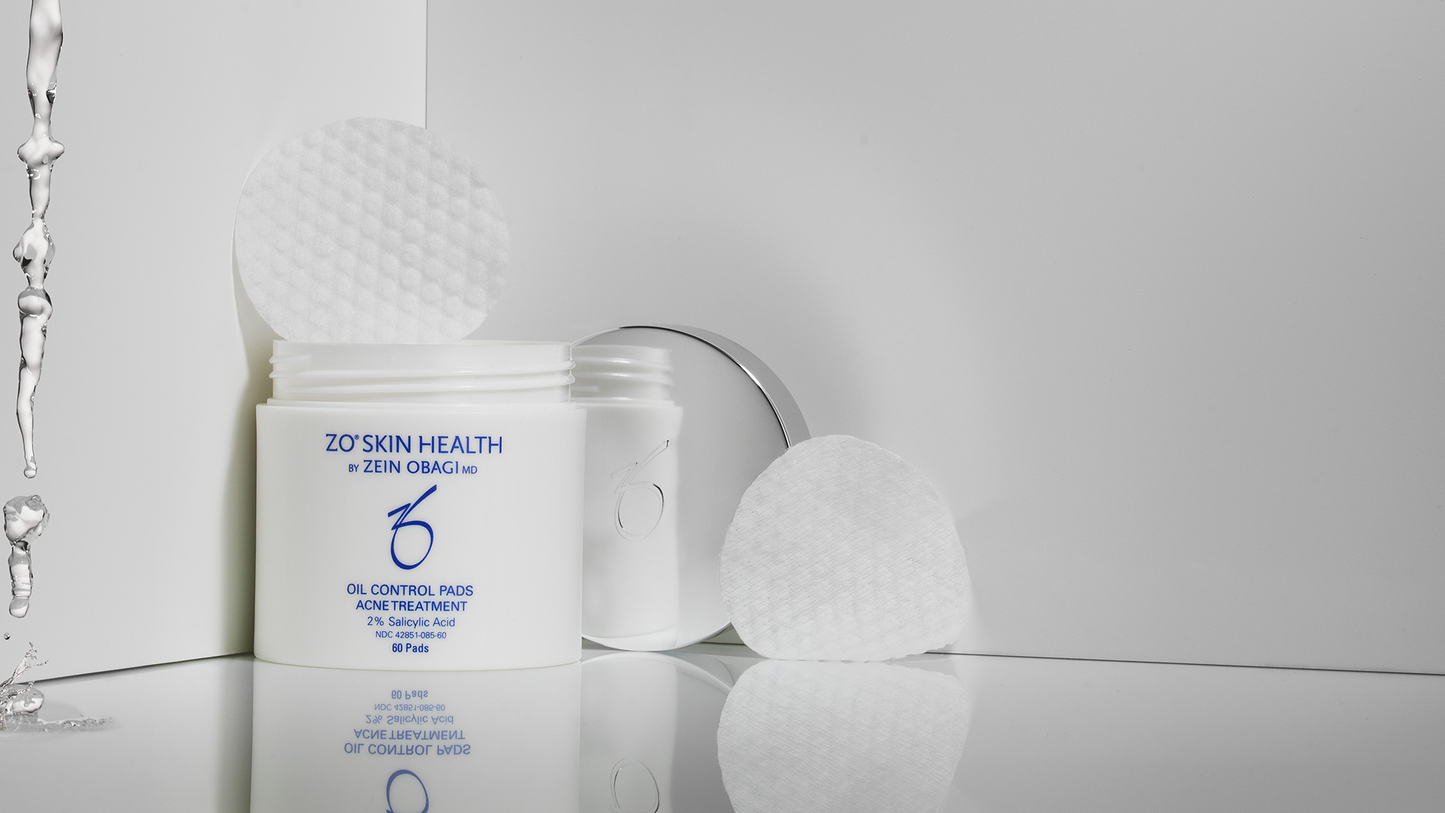

ZO Skin Health
Oil Control Pads Acne Treatment

Oil Control Pads Acne Treatment
ZO Skin Health
oil-control-pads-acne-treatment
Tone
9706803888421
Morning or Evening?
How often will you use this product?
Notes


Highlights
WHAT IS IT?
Toner treatment pads
FEATURES
Reduces acne formation, normalizes oil, reduces appearance of pore size
BEST FOR
Oily and acne-prone skin
CHECKS
Free of parabens, talc, phthalates, synthetic fragrances, fillers, GMO ingredients
Who Is It For?
Adults 18+What Does It Help With?
Acne Oily Skin Enlarged PoresBudget
PremiumHow To Use
Which routine should it be used in?
Instructions:
Key Information

What ZO Skin Health Says
Product Description:
Triple acid treatment toner reduces the formation of acne, normalizes oil and the appearance of pore size
About the Brand:
Ingredients Overview
Ingredients List
Aqua/Water/Eau, Alcohol, Butylene Glycol, Salicylic Acid, Mandelic Acid, Urea, Hamamelis Virginiana (Witch Hazel) Extract, Rosa Canina Fruit Extract, Pterocarpus SoyauxiiWood Extract, Phellondendron Amurense Bark Extract, Hordeum Distichon/Barley Extract/Extrait d'orge à deux rangs, Camellia Sinensis Leaf Extract, Artemisia Vulgaris Extract, Plantago Lanceolata Leaf Extract, Crithmum Maritimum Extract, Spiraea Ulmaria Extract, Menthyl Lactate, Sodium Hydroxide, Glycolic Acid, Sodium Carbonate, Sodium Chloride, Disodium EDTA, t-Butyl Alcohol, Denatonium Benzoate, Phenoxyethanol, Fragrance/Parfum, Citronellol, Hexyl Cinnamal, Limonene, Linalool.
Key Ingredients
Salicylic acid (2%), Mandelic Acid, Glycolic Acid
Ingredients Details
Alcohol
Common Name(s): Alcohol,cosmetic active,functional ingredient
CAS Number: N/a
DESCRIPTION
What It Does: Delivers characteristic cosmetic function at recommended use concentration.
Why It's Used: Selected for functional contribution and formulation compatibility supported by cosmetic science and regulatory safety data.
How It Works: Works through the mechanism of its molecular class as documented in peer-reviewed cosmetic literature.
Typically Found In: Skin care formulations
TECHNICAL DETAILS
Primary Category: Active ingredient – cosmetic active
Secondary Functions: Skin conditioning
Application Areas:

Facial Skincare

Body Care
Hair Care
Beard Care
Color Cosmetics (Makeup)
Dietary/Oral Supplements
Typical Concentration Range: 0.1%–10%
SOURCING & ETHICS
Vegan Status: Conditional
Halal Status: Yes
Source Notes: Commercially produced for cosmetic use. verify vegan/halal status with supplier.
SKIN COMPATIBILITY
Irritancy Rating: 1/5 – very low
Comedogenicity Rating: 0/5 – non-comedogenic
Sensitivity Concerns: Well-tolerated by most skin types.
Safe for Sensitive Skin: Yes
SAFETY & COMPATIBILITY
Safety Profile: Good safety profile at recommended concentrations. ewg score: 1–2.
Works Well With: Standard skincare actives
Avoid Combining With: No known significant incompatibilities
SCIENTIFIC NOTE
Alcohol has an established safety profile within the cosmetic regulatory framework at standard use concentrations.
Last Verified: Cosing database,alcohol technical literature
Primary Sources: 2026-03-12
Butylene Glycol
Common Name(s): 1,3-butanediol,bg,1,3-butylene glycol
CAS Number: 107-88-0
DESCRIPTION
What It Does: Provides humectant hydration and active ingredient solubilization with excellent skin feel.
Why It's Used: Preferred glycol humectant in premium and k-beauty formulations for superior skin feel vs propylene glycol with equivalent functionality.
How It Works: Two hydroxyl groups at 1,3-positions provide water binding and solvent activity. better tolerated than propylene glycol with minimal sensitization risk. 4-carbon backbone provides slightly greater hydrophobic character enabling dissolution of less polar actives vs pg.
Typically Found In: Toners,essences,serums,k-beauty formulas
TECHNICAL DETAILS
Primary Category: Functional ingredient – glycol humectant
Secondary Functions: Tewl reduction,skin plumping
Application Areas:
Facial Skincare
Body Care
Hair Care
Beard Care
Color Cosmetics (Makeup)
Dietary/Oral Supplements
Typical Concentration Range: 1%–10%
SOURCING & ETHICS
Vegan Status: Yes – synthetic
Halal Status: Yes
Source Notes: Synthetic or naturally derived. excellent aqueous solubility.
SKIN COMPATIBILITY
Irritancy Rating: 1/5 – very low
Comedogenicity Rating: 0/5 – non-comedogenic
Sensitivity Concerns: Non-irritating; suitable for all skin types.
Safe for Sensitive Skin: Yes
SAFETY & COMPATIBILITY
Safety Profile: Excellent safety profile. ewg score: 1.
Works Well With: Ceramides,emollients,occlusives,glycerin,hyaluronic acid
Avoid Combining With: No significant incompatibilities
SCIENTIFIC NOTE
K-beauty's preference for butylene glycol over propylene glycol is driven by two factors: bg's superior skin feel (less tacky than pg's higher viscosity) and its lower sensitization potential (1,3-bg has better spatial distribution of hydroxyl groups that reduces protein interaction vs pg's 1,2-position oh groups).
Last Verified: Cosing database,cir safety assessment
Primary Sources: 2026-03-12
Mandelic Acid
Common Name(s): Alpha-hydroxyphenylacetic acid,phenylglycolic acid
CAS Number: 90-64-2
DESCRIPTION
What It Does: Provides gentle aha exfoliation with lipophilic sebosuppressive anti-acne activity suitable for deeper skin tones.
Why It's Used: Skin-of-colour appropriate aha — mandelic acid's large size reduces pih risk making it the preferred aha for fitzpatrick iv–vi skin tones.
How It Works: Larger mw (152 vs glycolic 76) provides slower penetration reducing irritation and post-inflammatory hyperpigmentation risk. benzene ring provides lipophilicity for better follicular penetration and sebum regulation. antibacterial vs p. acnes from phenolic structure.
Typically Found In: Skin-of-colour exfoliants,anti-acne for sensitive skin
TECHNICAL DETAILS
Primary Category: Active ingredient – skin-of-colour appropriate aha
Secondary Functions: Brightening,collagen stimulation
Application Areas:
Facial Skincare
Body Care
Hair Care
Beard Care
Color Cosmetics (Makeup)
Dietary/Oral Supplements
Typical Concentration Range: 1%–15%
SOURCING & ETHICS
Vegan Status: Yes – from bitter almond or synthetic
Halal Status: Yes
Source Notes: Fermentation-derived or synthetic. ph must be ≤4.0 for aha activity.
SKIN COMPATIBILITY
Irritancy Rating: 2/5 – low to moderate
Comedogenicity Rating: 0/5 – non-comedogenic
Sensitivity Concerns: Photosensitizing – mandatory spf use. start at low frequency.
Safe for Sensitive Skin: Use with caution – spf required
SAFETY & COMPATIBILITY
Safety Profile: Safe at otc concentrations. eu: ≤10% leave-on at ph ≥3.5. mandatory spf advisory.
Works Well With: Niacinamide,ceramides,hyaluronic acid,spf
Avoid Combining With: Retinol in same step; multiple exfoliants simultaneously
SCIENTIFIC NOTE
Mandelic acid's safety advantage for darker skin tones arises from its slower penetration rate: the larger lipophilic molecule penetrates 2–4× more slowly than glycolic acid, reducing the risk of post-inflammatory hyperpigmentation from irritant-induced melanocyte stimulation — a critical clinical consideration for fitzpatrick iv–vi skin.
Last Verified: Cosing database,khunger & sacchidanand mandelic acid review
Primary Sources: 2026-03-12
Rosa Canina Fruit Extract
Common Name(s): Rosa canina fruit extract,inci ingredient,cosmetic active
CAS Number: N/a
DESCRIPTION
What It Does: Provides documented cosmetic activity from rosa canina fruit extract.
Why It's Used: Rosa canina fruit extract delivers formulation value through its specific biological activity and established safety and efficacy.
How It Works: Source: rosa canina fruit extract. mechanism: documented in cosmetic literature. safety: cosing-reviewed. standard cosmetic use concentrations.
Typically Found In: Skin care formulations,active products
TECHNICAL DETAILS
Primary Category: Active ingredient – antioxidant
Secondary Functions: Free radical scavenging,anti-aging
Application Areas:
Facial Skincare
Body Care
Hair Care
Beard Care
Color Cosmetics (Makeup)
Dietary/Oral Supplements
Typical Concentration Range: 0.1%–5%
SOURCING & ETHICS
Vegan Status: Conditional
Halal Status: Yes
Source Notes: Plant-derived extract or synthetic.
SKIN COMPATIBILITY
Irritancy Rating: 1/5 – very low
Comedogenicity Rating: 0/5 – non-comedogenic
Sensitivity Concerns: Non-irritating; well-tolerated.
Safe for Sensitive Skin: Yes
SAFETY & COMPATIBILITY
Safety Profile: Excellent safety profile. ewg score: 1.
Works Well With: Vitamin c,vitamin e,ferulic acid,spf,other antioxidants
Avoid Combining With: No significant incompatibilities
SCIENTIFIC NOTE
Rosa canina fruit extract provides cosmetic activity through its characteristic mechanism. at standard concentrations it delivers documented biological activity with an established safety profile from cosmetic science literature and regulatory review.
Last Verified: Cosing database,rosa canina fruit extract technical literature
Primary Sources: 2026-03-12
