

Dermalogica
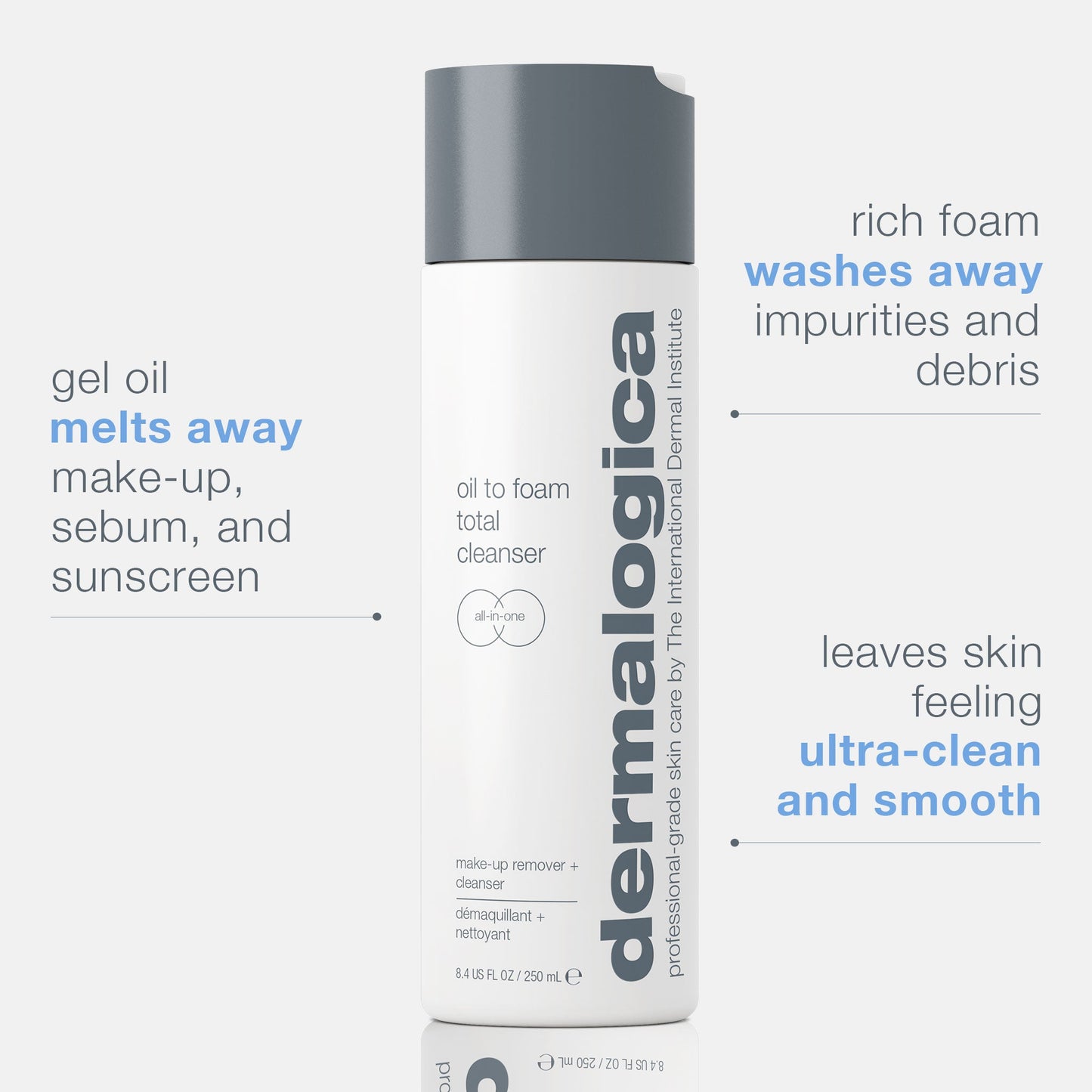
Oil to Foam Total Cleanser

Oil to Foam Total Cleanser
Dermalogica
oil-to-foam-total-cleanser
Cleanse
9784815583525
Morning or Evening?
How often will you use this product?
Notes


Highlights
WHAT IS IT?
Oil to foam cleanser with plant-derived prebiotic
FEATURES
Transforms from gel-oil to cloud-like foam, removes makeup and sunscreen, cleanses in one step
BEST FOR
normal
CHECKS
Paraben-free, artificial colors-free, fragrances-free, gluten-free
Who Is It For?
All Skin TypesWhat Does It Help With?
Makeup Removal Cleansing Maintaining Healthy-looking SkinBudget
Mid-range ($30-$75)How To Use
Which routine should it be used in?
Instructions:
Key Information


What Dermalogica Says
Product Description:
Transformative oil to foam cleanser removes make-up, sunscreen, and debris while cleansing skin in one step for ultra-clean, healthy-looking skin. This dual make-up remover and cleanser starts as a golden gel-oil infused with Sea Buckthorn Oil; massage into skin to melt away layers of make-up, sebum (oil), and sunscreen.
About the Brand:
Ingredients Overview
Ingredients List
Water/Aqua/Eau, Glycerin, Cocamidopropyl Hydroxysultaine, Sodium Cocoyl Glutamate, PEG-60 Almond Glycerides, Hydroxyacetophenone, Camellia Oleifera Seed Extract, Citrus Aurantium Dulcis (Orange) Peel Oil, Lavandula Hybrida Oil, Citrus Paradisi (Grapefruit) Peel Oil, Citrus Nobilis (Mandarin Orange) Peel Oil, Lavandula Angustifolia (Lavender) Oil, Cymbopogon Citratus Leaf Oil, Hippophae Rhamnoides Fruit Oil, Tocopherol, Pentylene Glycol, Hydroxypropyl Guar Hydroxypropyltrimonium Chloride, Caprylyl Glycol, Xanthan Gum, 1,2-Hexanediol, PEG-40 Hydrogenated Castor Oil, PEG-120 Methyl Glucose Dioleate, Saccharide Isomerate, Polysorbate 20, Tetrasodium Glutamate Diacetate, Citric Acid, Sodium Hydroxide, Sodium Citrate, O-Cymen-5-Ol, Limonene, Linalool, Citral
Key Ingredients
Sea Buckthorn Oil, plant-derived prebiotic
Ingredients Details
Camellia Oleifera Seed Extract
Common Name(s): Camellia oleifera seed extract,inci ingredient,cosmetic active
CAS Number: N/a
DESCRIPTION
What It Does: Provides documented cosmetic activity from camellia oleifera seed extract.
Why It's Used: Camellia oleifera seed extract delivers formulation value through its specific biological activity and established safety and efficacy.
How It Works: Source: camellia oleifera seed extract. mechanism: documented in cosmetic literature. safety: cosing-reviewed. standard cosmetic use concentrations.
Typically Found In: Skin care formulations,active products
TECHNICAL DETAILS
Primary Category: Active ingredient – antioxidant
Secondary Functions: Free radical scavenging,anti-aging
Application Areas:

Facial Skincare
Body Care

Hair Care
Beard Care
Color Cosmetics (Makeup)
Dietary/Oral Supplements
Typical Concentration Range: 0.1%–5%
SOURCING & ETHICS
Vegan Status: Conditional - supplier confirmation required
Halal Status: Yes
Source Notes: Plant-derived extract or synthetic. [audit 2026-07-29 rev2: status downgraded on audit. determination requires shariah-panel sign-off.]
SKIN COMPATIBILITY
Irritancy Rating: 1/5 – very low
Comedogenicity Rating: 0/5 – non-comedogenic
Sensitivity Concerns: Non-irritating; well-tolerated.
Safe for Sensitive Skin: Yes
SAFETY & COMPATIBILITY
Safety Profile: Excellent safety profile. ewg score: 1.
Works Well With: Vitamin c,vitamin e,ferulic acid,spf,other antioxidants
Avoid Combining With: No significant incompatibilities
SCIENTIFIC NOTE
Camellia oleifera seed extract provides cosmetic activity through its characteristic mechanism. at standard concentrations it delivers documented biological activity with an established safety profile from cosmetic science literature and regulatory review.
Last Verified: 2026-03-12
Primary Sources: Cosing database,camellia oleifera seed extract technical literature
Citrus Aurantium Dulcis Orange Peel Oil
Common Name(s): Citrus aurantium dulcis orange peel oil oil
DESCRIPTION
What It Does: Nourishes and softens skin through its balanced fatty acid profile, while antioxidant compounds protect against oxidative skin damage.
Why It's Used: Plant oils provide physiologically compatible lipid structures that integrate into the skin barrier and deliver fat-soluble antioxidants directly to skin cells.
How It Works: Fatty acids integrate into stratum corneum lipid lamellae, reinforcing the lipid barrier. antioxidants (tocopherols, carotenoids, polyphenols) neutralize ros through electron donation or singlet oxygen quenching.
Typically Found In: Face oils,serums,moisturizers,hair treatments,body oils
TECHNICAL DETAILS
Primary Category: Plant oils
Secondary Functions: Emollient,antioxidant
Application Areas:
Facial Skincare
Body Care
Hair Care
Beard Care
Color Cosmetics (Makeup)
Dietary/Oral Supplements
Typical Concentration Range: 0.5–30%
SOURCING & ETHICS
Vegan Status: Yes
Halal Status: Yes
Source Notes: Cold-pressed or solvent-extracted plant oil; no animal components.
SKIN COMPATIBILITY
Irritancy Rating: 1899-12-31 00:00:00 -0800
Comedogenicity Rating: 2000-01-01 00:00:00 -0800
Sensitivity Concerns: Low sensitization potential at recommended use concentrations.
Safe for Sensitive Skin: Yes
SAFETY & COMPATIBILITY
Safety Profile: Well-characterized cosmetic ingredient with established safety profile. generally non-irritating at typical use concentrations. suitable for leave-on and rinse-off cosmetics.
Works Well With: Vitamin e,ceramides,other plant oils,squalane
Avoid Combining With: Strong oxidizers (accelerate rancidity)
SCIENTIFIC NOTE
Vegetable oils are triglyceride matrices where the fatty acid composition determines skin compatibility, barrier function, and comedogenicity. oleic acid-rich oils (>60%) soften barrier lipids and enhance penetration; linoleic acid-rich oils reinforce ceramide-poor stratum corneum; saturated fatty acid-rich oils provide occlusion without skin penetration.
Last Verified: 2025-01-15
Primary Sources: Cosing eu database; pcpc cosmetic ingredient safety reviews; aocs plant oil composition databases; fatty acid pharmacology reviews
Citrus Paradisi Grapefruit Peel Oil
Common Name(s): Citrus paradisi grapefruit peel oil oil
DESCRIPTION
What It Does: Nourishes and softens skin through its balanced fatty acid profile, while antioxidant compounds protect against oxidative skin damage.
Why It's Used: Plant oils provide physiologically compatible lipid structures that integrate into the skin barrier and deliver fat-soluble antioxidants directly to skin cells.
How It Works: Fatty acids integrate into stratum corneum lipid lamellae, reinforcing the lipid barrier. antioxidants (tocopherols, carotenoids, polyphenols) neutralize ros through electron donation or singlet oxygen quenching.
Typically Found In: Face oils,serums,moisturizers,hair treatments,body oils
TECHNICAL DETAILS
Primary Category: Plant oils
Secondary Functions: Emollient,antioxidant
Application Areas:
Facial Skincare
Body Care
Hair Care
Beard Care
Color Cosmetics (Makeup)
Dietary/Oral Supplements
Typical Concentration Range: 0.5–30%
SOURCING & ETHICS
Vegan Status: Yes
Halal Status: Yes
Source Notes: Cold-pressed or solvent-extracted plant oil; no animal components.
SKIN COMPATIBILITY
Irritancy Rating: 1899-12-31 00:00:00 -0800
Comedogenicity Rating: 2000-01-01 00:00:00 -0800
Sensitivity Concerns: Low sensitization potential at recommended use concentrations.
Safe for Sensitive Skin: Yes
SAFETY & COMPATIBILITY
Safety Profile: Well-characterized cosmetic ingredient with established safety profile. generally non-irritating at typical use concentrations. suitable for leave-on and rinse-off cosmetics.
Works Well With: Vitamin e,ceramides,other plant oils,squalane
Avoid Combining With: Strong oxidizers (accelerate rancidity)
SCIENTIFIC NOTE
Vegetable oils are triglyceride matrices where the fatty acid composition determines skin compatibility, barrier function, and comedogenicity. oleic acid-rich oils (>60%) soften barrier lipids and enhance penetration; linoleic acid-rich oils reinforce ceramide-poor stratum corneum; saturated fatty acid-rich oils provide occlusion without skin penetration.
Last Verified: 2025-01-15
Primary Sources: Cosing eu database; pcpc cosmetic ingredient safety reviews; aocs plant oil composition databases; fatty acid pharmacology reviews
Cocamidopropyl Hydroxysultaine
Common Name(s): Cahs,hydroxypropyl sultaine
CAS Number: 68139-30-0
DESCRIPTION
What It Does: Provides amphoteric foaming and conditioning with excellent compatibility across surfactant systems.
Why It's Used: Premium amphoteric surfactant for mild foaming shampoos and cleansers requiring broad surfactant compatibility and improved skin and eye tolerance vs capb alternatives.
How It Works: Amphoteric sultaine (internal zwitterion from quaternary ammonium + sulfonate) provides: foam stability and enhancement; antistatic conditioning on hair; mildness enhancement reducing ionic surfactant irritation; viscosity building with salt addition. superior eye tolerance vs capb (betaine).
Typically Found In: Baby shampoos,mild cleansers,eye-safe products
TECHNICAL DETAILS
Primary Category: Functional ingredient – amphoteric surfactant
Secondary Functions: Skin conditioning
Application Areas:
Facial Skincare
Body Care
Hair Care
Beard Care
Color Cosmetics (Makeup)
Dietary/Oral Supplements
Typical Concentration Range: 2%–10%
SOURCING & ETHICS
Vegan Status: Conditional - supplier confirmation required
Halal Status: Unverified - supplier confirmation required
Source Notes: Commercially produced for cosmetic use. verify vegan/halal status with supplier. [audit 2026-07-29 rev2: the record's own source_notes does not assert a non-animal origin, or instructs the reader to verify with the supplier; "yes" asserts knowledge the record does not hold. determination requires shariah-panel sign-off.]
SKIN COMPATIBILITY
Irritancy Rating: 1/5 – very low
Comedogenicity Rating: 0/5 – non-comedogenic
Sensitivity Concerns: Well-tolerated by most skin types.
Safe for Sensitive Skin: Yes
SAFETY & COMPATIBILITY
Safety Profile: Good safety profile at recommended concentrations. ewg score: 1–2.
Works Well With: Standard skincare actives
Avoid Combining With: No known significant incompatibilities
SCIENTIFIC NOTE
Cocamidopropyl hydroxysultaine's superior eye tolerance vs capb arises from its sultaine rather than betaine zwitterionic head group. the sulfonate anion (so3⁻ in sultaine) is a stronger acid group than the carboxylate (coo⁻ in betaine), providing greater charge neutralisation and better interaction with tear film proteins — the molecular basis for its improved eye irritation profile in baby and sensitive-eye formulations.
Last Verified: