

Nykaa E retail limited
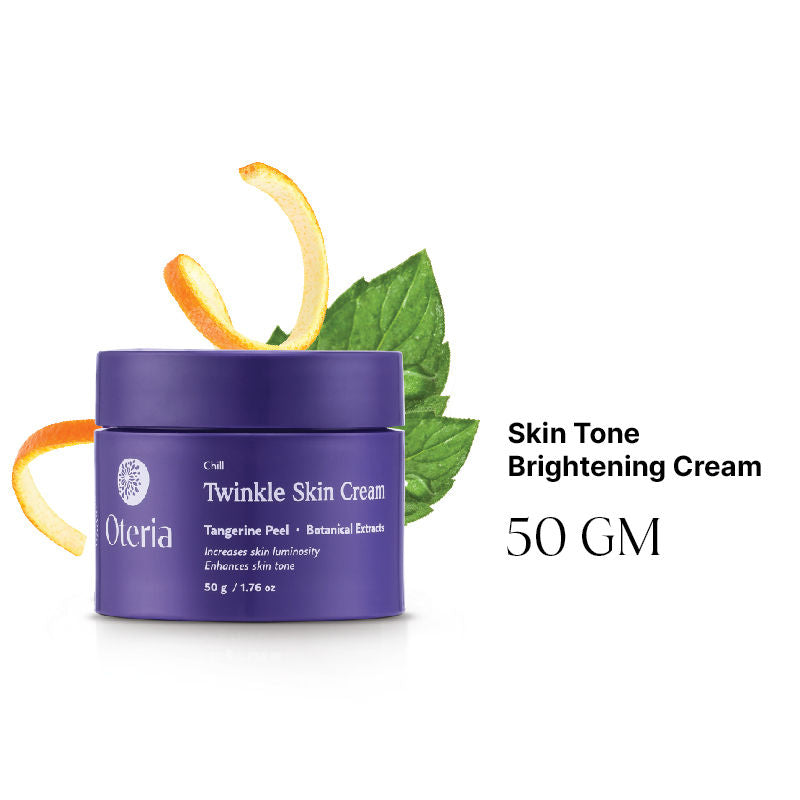
Oteria Twinkle Skin Cream With Tangerine Peel For Pigmentation And Dark Spots PM Routine

Oteria Twinkle Skin Cream With Tangerine Peel For Pigmentation And Dark Spots PM Routine
Nykaa E retail limited
oteria-twinkle-skin-cream-with-tangerine-peel-for-pigmentation-and-dark-spots-pm-routine
Moisturize
10084858757413
Morning or Evening?
How often will you use this product?
Notes


Highlights
WHAT IS IT?
Face Moisturizer with Tangerine Peel and Botanical Extracts
FEATURES
Boosts skin brightness, Anti-aging, Improves skin luminosity, Antioxidant properties
BEST FOR
sensitive
CHECKS
No harsh chemicals, No peeling, Does not clog pores
Who Is It For?
Adults All GendersWhat Does It Help With?
Pigmentation Dark Spots Uneven Skin Tone Dullness Aging SignsBudget
Mid-range ($30-$75)How To Use
Which routine should it be used in?
Instructions:
Key Information


What Nykaa E retail limited Says
Product Description:
Oteria Twinkle Skin Cream with Tangerine Peel is designed for pigmentation and dark spots in the PM skincare routine. It features tangerine peel to boost skin brightness and has anti-aging properties along with botanical extracts that improve skin luminosity and antioxidant protection.
About the Brand:
Ingredients Overview
Ingredients List
Aqua,Butylene-Glycol,Niacinamide,Alpha-Arbutin,Sodium-Metabisulfite,Tranexamic-Acid,Sodium-Citrate,Citric-Acid,Aminopropyl-Ascorbyl-Phosphate,Geranium-Robertianum-Extract,Paeonia-Suffruticosa-Root-Extract,Scutellaria-Baicalensis-Root-Extract,Thymus-Serpyllum-Extract,Alpinia-Katsumadai-Seed-Extract,Glutathione,Stearic-Acid,Isopropyl-Myristate,Titanium-Dioxide,Triethanolamine,Cetyl-Alcohol,Sodium-Hydroxide,Citrus-Reticulata-Tangerine-Peel-Extract,Methylpropanediol,Caprylyl-Glycol,Polyquaternium-80,Didecyldimonium-Chloride,Bisabolol,Dimethyl-Polysiloxane,Disodium-EDTA,Xanthan-Gum,Butylated-Hydroxytoluene,Parfum
Key Ingredients
Tangerine Peel,Botanical Extracts,Niacinamide,Alpha-Arbutin,Tranexamic Acid
Ingredients Details
Alpha-arbutin
Common Name(s): 4-hydroxyphenyl-alpha-d-glucopyranoside
DESCRIPTION
What It Does: Provides potent tyrosinase inhibition with improved stability and tolerability over other arbutin forms.
Why It's Used: Premium arbutin — alpha configuration provides 10× greater tyrosinase inhibition than beta-arbutin at equivalent concentration, making alpha-arbutin the most effective arbutin form.
How It Works: Alpha-glucoside linkage provides enhanced metabolic stability vs beta-arbutin (less enzymatic hydrolysis to free hydroquinone in skin). inhibits tyrosinase via competitive substrate inhibition (ic50 ~24μg/ml vs beta-arbutin ~525μg/ml — 20× more potent). inhibits dopa oxidase step in melanogenesis.
Typically Found In: Brightening serums,anti-spot products,premium lightening
TECHNICAL DETAILS
Primary Category: Active ingredient – arbutin brightening agent
Secondary Functions: Melanin inhibition,hyperpigmentation reduction
Application Areas:

Facial Skincare

Body Care
Hair Care
Beard Care
Color Cosmetics (Makeup)
Dietary/Oral Supplements
Typical Concentration Range: 0.5%–2%
SOURCING & ETHICS
Vegan Status: Yes – synthetic enzymatic synthesis
Halal Status: Yes
Source Notes: Synthetic or plant-derived.
SKIN COMPATIBILITY
Irritancy Rating: 1/5 – very low
Comedogenicity Rating: 0/5 – non-comedogenic
Sensitivity Concerns: Non-irritating; well-tolerated.
Safe for Sensitive Skin: Yes
SAFETY & COMPATIBILITY
Safety Profile: Excellent safety profile. use with spf for maximum efficacy. ewg score: 1.
Works Well With: Niacinamide,vitamin c,alpha-arbutin,tranexamic acid,spf
Avoid Combining With: No significant incompatibilities
SCIENTIFIC NOTE
Alpha-arbutin's 10–20× greater potency vs beta-arbutin at equivalent concentration arises from the alpha-glycosidic bond geometry — the alpha configuration positions the hydroquinone aglycone at a specific orientation relative to the glucose that fits the tyrosinase active site copper more precisely than the beta isomer's different spatial arrangement.
Last Verified: Cosing database,sugimoto et al. arbutin tyrosinase study
Primary Sources: 2026-03-12
Bisabolol
Common Name(s): Alpha-bisabolol,levomenol,(-)-alpha-bisabolol
CAS Number: 515-69-5
DESCRIPTION
What It Does: Reduces skin inflammation, soothes irritation, promotes wound healing, and enhances penetration of co-formulated actives.
Why It's Used: Premium natural soothing active with combined anti-inflammatory, wound healing, and penetration-enhancing activity – clinically validated across sensitive, reactive, and irritated skin types.
How It Works: Inhibits nf-kb pathway reducing pro-inflammatory cytokines il-1β, il-6, tnf-α. enhances stratum corneum lipid fluidity increasing penetration of co-delivered actives. antimicrobial against s. aureus and c. albicans. promotes keratinocyte migration for wound healing.
Typically Found In: Sensitive skin products,post-procedure formulations,anti-irritant formulas,wound healing
TECHNICAL DETAILS
Primary Category: Active ingredient – soothing / anti-inflammatory
Secondary Functions: Anti-inflammatory,penetration enhancement,antimicrobial
Application Areas:
Facial Skincare
Body Care
Hair Care
Beard Care
Color Cosmetics (Makeup)
Dietary/Oral Supplements
Typical Concentration Range: 0.1%–1%
SOURCING & ETHICS
Vegan Status: Yes – from candeia tree (vanillosmopsis erythropappa) or synthetic
Halal Status: Yes
Source Notes: Natural (-)-alpha-bisabolol from brazilian candeia tree is more sustainable and potent than chamomile-derived bisabolol. synthetic (±)-bisabolol is racemic with slightly lower anti-inflammatory potency.
SKIN COMPATIBILITY
Irritancy Rating: 1/5 – very low
Comedogenicity Rating: 0/5 – non-comedogenic
Sensitivity Concerns: Non-irritating; ideal for reactive and sensitive skin.
Safe for Sensitive Skin: Yes – particularly recommended for sensitive skin
SAFETY & COMPATIBILITY
Safety Profile: Excellent safety profile. ewg score: 1.
Works Well With: Ceramides,panthenol,allantoin,hyaluronic acid,centella asiatica
Avoid Combining With: No significant incompatibilities
SCIENTIFIC NOTE
Bisabolol's dual function as both an anti-inflammatory and a penetration enhancer is synergistic – by reducing the inflammatory response that increases barrier tightness while simultaneously fluidizing stratum corneum lipids, it provides enhanced delivery of co-formulated actives in the very conditions where delivery is most needed.
Last Verified: Cosing database,piazza et al. bisabolol anti-inflammatory study,cir safety assessment
Primary Sources: 2026-03-12
Glutathione
Common Name(s): Gsh,gamma-l-glutamyl-l-cysteinyl-glycine,reduced glutathione
CAS Number: 70-18-8
DESCRIPTION
What It Does: Provides the body's primary antioxidant defense while reducing melanin production for brightening.
Why It's Used: Master antioxidant for comprehensive oxidative stress protection alongside unique melanin-shifting brightening action (pheomelanin preference).
How It Works: Three-amino acid tripeptide (gamma-glu-cys-gly). thiol group (-sh) provides electron donation for antioxidant activity and detoxification conjugation. shifts melanin synthesis from eumelanin (dark brown) toward pheomelanin (light yellow-red) for brightening. regenerates vitamins c and e from their oxidized forms.
Typically Found In: Brightening serums,antioxidant serums,anti-aging products
TECHNICAL DETAILS
Primary Category: Active ingredient – master cellular antioxidant
Secondary Functions: Melanin shifting brightening,vitamins c+e regeneration,master antioxidant
Application Areas:
Facial Skincare
Body Care
Hair Care
Beard Care
Color Cosmetics (Makeup)
Dietary/Oral Supplements
Typical Concentration Range: 0.1%–5%
SOURCING & ETHICS
Vegan Status: Yes – fermentation-derived
Halal Status: Yes
Source Notes: Produced by yeast fermentation or chemical synthesis. stability challenge – use encapsulated or stabilized forms.
SKIN COMPATIBILITY
Irritancy Rating: 1/5 – very low
Comedogenicity Rating: 0/5 – non-comedogenic
Sensitivity Concerns: Well-tolerated; some reports of tingling at high concentrations.
Safe for Sensitive Skin: Yes
SAFETY & COMPATIBILITY
Safety Profile: Excellent safety profile. ewg score: 1.
Works Well With: Vitamin c,vitamin e,ferulic acid,spf,other antioxidants
Avoid Combining With: No significant incompatibilities
SCIENTIFIC NOTE
Glutathione's melanin-shifting mechanism (eumelanin→pheomelanin) is entirely different from tyrosinase inhibition. even in the presence of active tyrosinase, glutathione shifts the enzymatic product from dark eumelanin to lighter pheomelanin by chelating copper from the tyrosinase active site and competing for dopa substrate.
Last Verified: Cosing database,villarama & maibach glutathione brightening review,cir safety assessment
Primary Sources: 2026-03-12
Methylpropanediol
Common Name(s): 1,3-butylene glycol alternative,2-methyl-1,3-propanediol,proline-2-propanediol
CAS Number: 2163-42-0
DESCRIPTION
What It Does: Provides humectant and solvent functionality with improved skin feel vs butylene glycol.
Why It's Used: Premium humectant solvent with superior skin feel to conventional diols for elegant premium formulation textures.
How It Works: Branched c4 structure provides good humectant activity. branching reduces viscosity and stickiness vs linear propylene glycol. excellent solvent for challenging actives. antimicrobial boosting from diol structure.
Typically Found In: Premium serums,active delivery systems
TECHNICAL DETAILS
Primary Category: Functional ingredient – humectant
Secondary Functions: Tewl reduction,skin plumping
Application Areas:
Facial Skincare
Body Care
Hair Care
Beard Care
Color Cosmetics (Makeup)
Dietary/Oral Supplements
Typical Concentration Range: 1%–10%
SOURCING & ETHICS
Vegan Status: Yes – synthetic
Halal Status: Yes
Source Notes: Synthetic or naturally derived. excellent aqueous solubility.
SKIN COMPATIBILITY
Irritancy Rating: 1/5 – very low
Comedogenicity Rating: 0/5 – non-comedogenic
Sensitivity Concerns: Non-irritating; suitable for all skin types.
Safe for Sensitive Skin: Yes
SAFETY & COMPATIBILITY
Safety Profile: Excellent safety profile. ewg score: 1.
Works Well With: Ceramides,emollients,occlusives,glycerin,hyaluronic acid
Avoid Combining With: No significant incompatibilities
SCIENTIFIC NOTE
Methylpropanediol's methyl branch provides a 25% reduction in dynamic viscosity vs linear butylene glycol at equivalent concentration — a physically measurable skin feel improvement from the branching's reduction of intermolecular attractive forces. this viscosity reduction translates directly to the 'less sticky, lighter' skin feel that premium formulations require.
Last Verified: Cosing database,cir safety assessment
Primary Sources: 2026-03-12
