
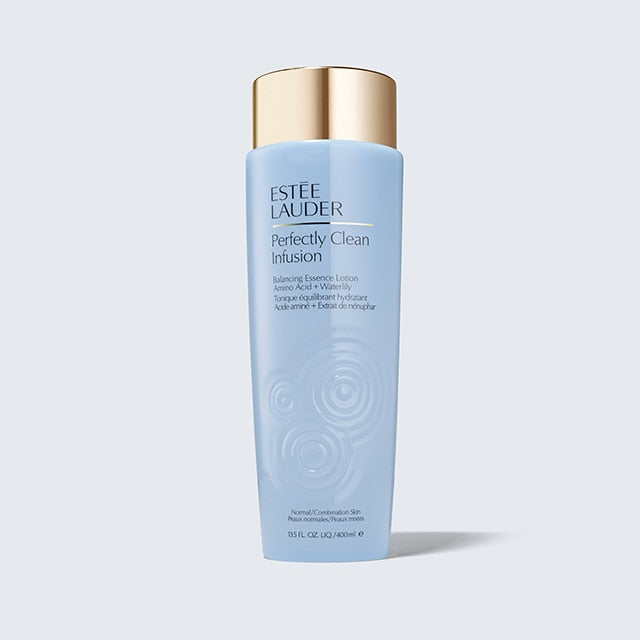

Estee Lauder
Perfectly Clean Infusion Balancing Essence Treatment Lotion

Perfectly Clean Infusion Balancing Essence Treatment Lotion
Estee Lauder
perfectly-clean-infusion-balancing-essence-treatment-lotion
Tone
9784754110757
Morning or Evening?
How often will you use this product?
Notes


Highlights
WHAT IS IT?
Treatment lotion with Amino Acid15 Complex
FEATURES
Refreshing infusion that revitalizes and rebalances skin, amplifies moisturization
BEST FOR
combination
CHECKS
Free of parabens, phthalates, sulfite, sulfates, triclosan, triclocarbon, formaldehyde, silicones, drying alcohol, mineral oil, paraffin, petrolatum
Who Is It For?
Adults With Normal/combination SkinWhat Does It Help With?
Balancing Skin's Oil/water Levels Moisturization SmoothnessBudget
Mid-range ($30-$75)How To Use
Which routine should it be used in?
Instructions:
Key Information


What Estee Lauder Says
Product Description:
Refreshing infusion revitalizes, rebalances. Leaves skin feeling fresh & smooth. Boosted with Amino Acid15 Complex and hydration powerhouse Waterlily Flower Extract to help amplify moisturization within skin's surface.
About the Brand:
Ingredients Overview
Ingredients List
Water\Aqua\Eau, Pentylene Glycol, Polysorbate 20, Nymphaea Alba (Water Lily) Flower Extract, Sodium Hyaluronate, Trehalose, Dipotassium Glycyrrhizate, Caffeine, Phenylalanine, Proline, Glutamic Acid, Aspartic Acid, Arginine, Lysine, Serine, Alanine, Threonine, Histidine, Isoleucine, Tyrosine, Leucine, Valine, Glycine, Nymphaea Alba Root Extract, Berberis Vulgaris Root Extract, Polygala Senega Root Extract, Hypnea Musciformis (Algae) Extract, Sucrose, Sodium Pca, Urea, Glycerin, Caprylyl Glycol, Butylene Glycol, Jojoba Wax Peg-120 Esters, Citric Acid, Dipropylene Glycol, Hexylene Glycol, Sodium Hydroxide, Triacetin, Sodium Palmitoyl Proline, Ppg-5-Ceteth-20, Chlorphenesin, Polyquaternium-51, Fragrance (Parfum), Sodium Citrate, Disodium Edta, Sodium Benzoate, Potassium Sorbate, Phenoxyethanol
Key Ingredients
Amino Acid15 Complex, Waterlily Flower Extract
Ingredients Details
Aspartic Acid
Common Name(s): Aminosuccinic acid,l-aspartate
CAS Number: 56-84-8
DESCRIPTION
What It Does: Provides nmf amino acid conditioning with cell energy metabolic support.
Why It's Used: Nmf acidic amino acid providing skin conditioning from naturally-occurring dicarboxylic amino acid in natural moisturising factor complex.
How It Works: Dicarboxylic amino acid provides dual water-binding ionic sites. aspartate shuttle for cell energy metabolism (nadh transport into mitochondria). mild keratolytic from dicarboxylic acid aha-like activity. nmf component providing moisture retention.
Typically Found In: Nmf-based moisturisers,skin conditioning products
TECHNICAL DETAILS
Primary Category: Active ingredient – acidic nmf amino acid
Secondary Functions: Skin conditioning
Application Areas:

Facial Skincare

Body Care
Hair Care
Beard Care
Color Cosmetics (Makeup)
Dietary/Oral Supplements
Typical Concentration Range: 0.5%–5%
SOURCING & ETHICS
Vegan Status: Conditional - supplier confirmation required
Halal Status: Unverified - supplier confirmation required
Source Notes: Commercially produced for cosmetic use. verify vegan/halal status with supplier. [audit 2026-07-29 rev2: the record's own source_notes does not assert a non-animal origin, or instructs the reader to verify with the supplier; "yes" asserts knowledge the record does not hold. determination requires shariah-panel sign-off.]
SKIN COMPATIBILITY
Irritancy Rating: 1/5 – very low
Comedogenicity Rating: 0/5 – non-comedogenic
Sensitivity Concerns: Well-tolerated by most skin types.
Safe for Sensitive Skin: Yes
SAFETY & COMPATIBILITY
Safety Profile: Good safety profile at recommended concentrations. ewg score: 1–2.
Works Well With: Standard skincare actives
Avoid Combining With: No known significant incompatibilities
SCIENTIFIC NOTE
Aspartic acid's dicarboxylic structure provides dual-site water binding via both alpha and beta carboxylate groups, providing greater molar water retention than monocarboxylic amino acids at equivalent concentration. this dual-site humectancy makes aspartic acid one of the most hydrating single amino acids per mole — a quantitative advantage of its dicarboxylic structure.
Last Verified: 2026-03-12
Primary Sources: Cosing database,cir safety assessment
Caffeine
Common Name(s): Caffeine,methylxanthine anti-cellulite,antioxidant vasoactive
CAS Number: N/a
DESCRIPTION
What It Does: Stimulates lipolysis in adipocytes by inhibiting phosphodiesterase (preventing camp breakdown), reduces eye puffiness through vasoconstriction of periorbital capillaries, and provides antioxidant dna repair stimulation for photoprotective benefit.
Why It's Used: The only cosmetic active with a well-defined mechanism for anti-cellulite claims — phosphodiesterase inhibition elevating adipocyte camp is the documented biochemical pathway, providing mechanism-based efficacy substantiation superior to most slimming actives.
How It Works: Caffeine inhibits phosphodiesterase (pde3, pde4) preventing camp hydrolysis → elevated camp activates protein kinase a → phosphorylates hormone-sensitive lipase → lipolysis of triglycerides in adipocytes. for eye puffiness: caffeine's adenosine receptor antagonism reduces prostaglandin-mediated capillary dilation in periorbital tissue, reducing fluid accumulation.
Typically Found In: Anti-cellulite,eye creams,antioxidant products
TECHNICAL DETAILS
Primary Category: Active ingredient – antioxidant
Secondary Functions: Free radical scavenging,anti-aging
Application Areas:
Facial Skincare
Body Care
Hair Care
Beard Care
Color Cosmetics (Makeup)
Dietary/Oral Supplements
Typical Concentration Range: 0.1%–3%
SOURCING & ETHICS
Vegan Status: Conditional - supplier confirmation required
Halal Status: Unverified - supplier confirmation required
Source Notes: Plant-derived extract or synthetic. [audit 2026-07-29 rev2: status downgraded on audit. determination requires shariah-panel sign-off.]
SKIN COMPATIBILITY
Irritancy Rating: 1/5 – very low
Comedogenicity Rating: 0/5 – non-comedogenic
Sensitivity Concerns: Non-irritating; well-tolerated.
Safe for Sensitive Skin: Yes
SAFETY & COMPATIBILITY
Safety Profile: Excellent safety profile. ewg score: 1.
Works Well With: Vitamin c,vitamin e,ferulic acid,spf,other antioxidants
Avoid Combining With: No significant incompatibilities
SCIENTIFIC NOTE
Caffeine has one of the highest sc penetration rates of any cosmetic active (logp -0.07, mw 194 da) — the combination of small size and moderate logp providing excellent aqueous solubility with sufficient sc lipid partitioning for effective transdermal delivery to adipose tissue.
Last Verified: 2026-03-12
Primary Sources: Cosing database,caffeine pde inhibitor anti-cellulite lipolysis review
Dipotassium Glycyrrhizate
Common Name(s): Dpg,dipotassium glycyrrhizinate,glycyrrhizic acid potassium salt
CAS Number: 68797-35-3
DESCRIPTION
What It Does: Provides glycyrrhizic acid anti-inflammatory and cortisol-potentiating soothing activity.
Why It's Used: The anti-inflammatory licorice active — dipotassium glycyrrhizate provides stronger anti-inflammatory activity than glabridin-containing licorice extract, making it the preferred licorice active for anti-inflammatory formulations.
How It Works: Glycyrrhizic acid inhibits 11-beta-hsd (11-beta-hydroxysteroid dehydrogenase) which inactivates cortisol to cortisone. local cortisol levels increase providing anti-inflammatory activity analogous to mild topical corticosteroid. also inhibits phospholipase a2 and prostaglandin synthesis directly.
Typically Found In: Sensitive skin serums,anti-inflammatory products,anti-itch formulas
TECHNICAL DETAILS
Primary Category: Active ingredient – anti-inflammatory licorice
Secondary Functions: Redness reduction,anti-inflammatory,calming
Application Areas:
Facial Skincare
Body Care
Hair Care
Beard Care
Color Cosmetics (Makeup)
Dietary/Oral Supplements
Typical Concentration Range: 0.1%–1%
SOURCING & ETHICS
Vegan Status: Yes – from glycyrrhiza glabra root
Halal Status: Yes
Source Notes: Plant-derived extract or synthetic.
SKIN COMPATIBILITY
Irritancy Rating: 1/5 – very low
Comedogenicity Rating: 0/5 – non-comedogenic
Sensitivity Concerns: Non-irritating; ideal for reactive and sensitive skin.
Safe for Sensitive Skin: Yes – particularly recommended for sensitive skin
SAFETY & COMPATIBILITY
Safety Profile: Excellent safety profile. ewg score: 1.
Works Well With: Ceramides,panthenol,allantoin,hyaluronic acid,centella asiatica
Avoid Combining With: No significant incompatibilities
SCIENTIFIC NOTE
Dipotassium glycyrrhizate's 11-beta-hsd inhibition provides a corticosteroid-potentiating mechanism: by preventing cortisol deactivation to cortisone, it effectively amplifies the anti-inflammatory activity of the skin's own naturally produced glucocorticoid without introducing exogenous steroids — providing a 'natural steroid potentiation' that explains why licorice preparations have been used as a topical anti-inflammatory for millennia.
Last Verified: 2026-03-12
Primary Sources: Cosing database,armanini et al. glycyrrhizate review
Pentylene Glycol
Common Name(s): 1,2-pentanediol,pentanediol,hydrolite-5
CAS Number: 5765-44-6
DESCRIPTION
What It Does: Provides humectant moisture retention with antimicrobial preservative-boosting activity.
Why It's Used: The balanced multifunctional diol — pentylene glycol provides the ideal balance of humectancy and antimicrobial activity for clean beauty preservation systems with excellent sensory compatibility.
How It Works: C5 diol: longer chain than propylene glycol providing better antimicrobial activity but shorter than 1,2-hexanediol (slightly lower membrane activity). two oh groups provide humectant water binding. solvent for fragrances and some actives. synergistic with phenoxyethanol reducing required phenoxyethanol concentration.
Typically Found In: Clean beauty products,natural preservation systems,moisturisers
TECHNICAL DETAILS
Primary Category: Functional ingredient – multifunctional pentanediol
Secondary Functions: Tewl reduction,skin plumping
Application Areas:
Facial Skincare
Body Care
Hair Care
Beard Care
Color Cosmetics (Makeup)
Dietary/Oral Supplements
Typical Concentration Range: 0.5%–3%
SOURCING & ETHICS
Vegan Status: Yes – synthetic
Halal Status: Yes
Source Notes: Synthetic or naturally derived. excellent aqueous solubility.
SKIN COMPATIBILITY
Irritancy Rating: 1/5 – very low
Comedogenicity Rating: 0/5 – non-comedogenic
Sensitivity Concerns: Non-irritating; suitable for all skin types.
Safe for Sensitive Skin: Yes
SAFETY & COMPATIBILITY
Safety Profile: Excellent safety profile. ewg score: 1.
Works Well With: Ceramides,emollients,occlusives,glycerin,hyaluronic acid
Avoid Combining With: No significant incompatibilities
SCIENTIFIC NOTE
Pentylene glycol's position in clean beauty preservation is due to a regulatory quirk: 1,2-pentanediol is not classified as a preservative in eu cosmetics regulations (unlike phenoxyethanol which requires preservative listing), so it can provide antimicrobial activity while not requiring the 'contains preservative' designation — enabling cleaner labels in natural-positioned formulations.
Last Verified: 2026-03-12
Primary Sources: Cosing database,dsm hydrolite-5 technical data,cir safety assessment