
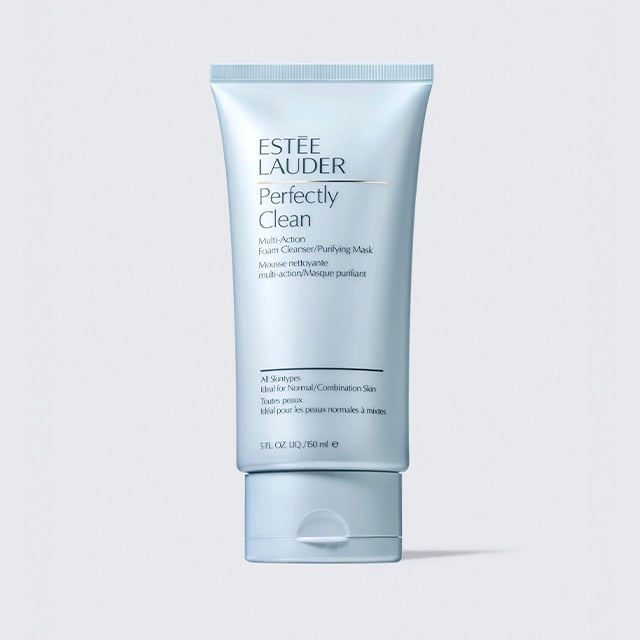

Estee Lauder
Perfectly Clean Multi-Action Foam Cleanser/Purifying Mask

Perfectly Clean Multi-Action Foam Cleanser/Purifying Mask
Estee Lauder
perfectly-clean-multi-action-foam-cleanser-purifying-mask
Cleanse
9784749752613
Morning or Evening?
How often will you use this product?
Notes


Highlights
WHAT IS IT?
Multi-action foam cleanser and purifying mask
FEATURES
Richly lathers to cleanse, 3-minute purifying mask, unclogs pores, leaves skin healthy and fresh
BEST FOR
combination
CHECKS
Dermatologist-tested, Ophthalmologist-tested
Who Is It For?
All Ages All GendersWhat Does It Help With?
Cleansing Purifying Pore UncloggingBudget
Mid-range ($30-$75)How To Use
Which routine should it be used in?
Instructions:
Key Information


What Estee Lauder Says
Product Description:
Treat your skin with this refreshing foam that cleanses gently yet thoroughly. The creamy formula rapidly lathers into a rich foaming cleanser that gently removes makeup and other impurities without drying. Unclogs pores. Leaves skin healthy, fresh and luminous.
About the Brand:
Ingredients Overview
Ingredients List
Water\Aqua\Eau, Myristic Acid, Glycerin, Behenic Acid, Potassium Hydroxide, Palmitic Acid, Sodium Methyl Cocoyl Taurate, Lauric Acid, Stearic Acid, Sucrose, Montmorillonite, Silybum Marianum (Lady'S Thistle) Extract, Gentiana Lutea (Gentian) Root Extract, Algae Extract, Sodium Hyaluronate, Sorbitol, Caffeine, Zinc Pca, Peg-3 Distearate, Kaolin, Fragrance (Parfum), Disodium Edta, Methylchloroisothiazolinone, Methylisothiazolinone
Key Ingredients
Ingredients Details
Behenic Acid
Common Name(s): Docosanoic acid,n-docosanoic acid
CAS Number: 112-85-6
DESCRIPTION
What It Does: Provides c22 saturated fatty acid film for superior hair conditioning and high oxidative stability.
Why It's Used: Long-chain saturated fatty acid for premium hair conditioning with maximum oxidative stability and anti-frizz film formation.
How It Works: C22 saturated chain with highest melting point (80°c) among common cosmetic fatty acids. very dense crystalline packing on hair surface provides superior anti-frizz moisture exclusion. highest oxidative stability (no double bonds) of any cosmetic fatty acid.
Typically Found In: Anti-frizz hair products,stable oils,premium conditioners
TECHNICAL DETAILS
Primary Category: Functional ingredient – c22 saturated fatty acid
Secondary Functions: Barrier sealing,softening
Application Areas:

Facial Skincare

Body Care
Hair Care
Beard Care
Color Cosmetics (Makeup)
Dietary/Oral Supplements
Typical Concentration Range: 0.5%–10%
SOURCING & ETHICS
Vegan Status: Conditional - feedstock declaration required
Halal Status: Unverified - feedstock declaration required (plant, animal and petrochemical routes all exist)
Source Notes: Plant-derived, synthetic or animal-derived. verify source. [audit 2026-07-29 rev2: origin-dependent: the same inci exists in plant, animal and petrochemical versions and the name does not discriminate. determination requires shariah-panel sign-off.]
SKIN COMPATIBILITY
Irritancy Rating: 1/5 – very low
Comedogenicity Rating: 1/5 – low; formulation-dependent
Sensitivity Concerns: Non-irritating.
Safe for Sensitive Skin: Yes
SAFETY & COMPATIBILITY
Safety Profile: Excellent safety profile. ewg score: 1.
Works Well With: Humectants,ceramides,actives as carrier
Avoid Combining With: No significant incompatibilities
SCIENTIFIC NOTE
Behenic acid's 80°c melting point means it remains crystalline at room temperature and below the hair dryer operating temperature (~100-120°c), providing a thermally stable protective film on hair during heat styling. other common fatty acid emollients (oleic, linoleic) melt below 20°c, offering no solid protective film during heat exposure.
Last Verified: 2026-03-12
Primary Sources: Cosing database,cir safety assessment
Glycerin
Common Name(s): Glycerol,glycerine,1,2,3-propanetriol
CAS Number: 56-81-5
DESCRIPTION
What It Does: Glycerin pulls water from the environment and deeper skin layers into the outer skin layer (epidermis), boosting moisture levels and keeping skin soft, smooth, and plump.
Why It's Used: It is used in virtually every moisturizer, serum, and cleanser because it is highly effective at hydrating skin, is well-tolerated by all skin types, and enhances the texture and spreadability of formulations.
How It Works: As a humectant, glycerin forms hydrogen bonds with water molecules, trapping them in the skin. it also reinforces the skin barrier by integrating into lipid structures between skin cells.
Typically Found In: Moisturizers,serums,cleansers,toners,sheet masks,sunscreens,body lotions,shampoos,conditioners
TECHNICAL DETAILS
Primary Category: Humectant
Secondary Functions: Skin barrier support,emollient,solvent
Application Areas:
Facial Skincare
Body Care
Hair Care
Beard Care
Color Cosmetics (Makeup)
Dietary/Oral Supplements
Typical Concentration Range: 1%–30% (typical: 3–10%)
SOURCING & ETHICS
Vegan Status: Conditional - feedstock declaration required
Halal Status: Unverified - feedstock declaration required (plant, animal and petrochemical routes all exist)
Source Notes: Derived from plant oils via hydrolysis or saponification; synthetic versions also available. palm-derived glycerin carries sustainability concerns. [audit 2026-07-29 rev2: origin-dependent: the same inci exists in plant, animal and petrochemical versions and the name does not discriminate. determination requires shariah-panel sign-off.]
SKIN COMPATIBILITY
Irritancy Rating: 1/5 – very low; non-irritating at all standard concentrations
Comedogenicity Rating: 0/5 – non-comedogenic
Sensitivity Concerns: Extremely rare allergic reactions; generally safe for all skin types including sensitive and baby skin
Safe for Sensitive Skin: Yes
SAFETY & COMPATIBILITY
Safety Profile: Widely recognized as safe. ewg hazard score: 1. no significant concerns for irritation, sensitization, or toxicity at typical concentrations (up to 50%).
Works Well With: Hyaluronic acid,ceramides,niacinamide,panthenol,urea,peptides,retinol,ahas/bhas
Avoid Combining With: No known incompatibilities at standard concentrations
SCIENTIFIC NOTE
Glycerin is an endogenous skin component found naturally in the stratum corneum. aquaporin-3 channels in keratinocytes facilitate glycerin transport, making it integral to natural skin hydration pathways.
Last Verified: 2026-03-12
Primary Sources: Cosing database,cir safety assessment,ewg skin deep,inci decoder
Lauric Acid
Common Name(s): Dodecanoic acid,coconut fatty acid,laurostearic acid
CAS Number: 0143-07-07
DESCRIPTION
What It Does: Provides antimicrobial c12 fatty acid activity against p. acnes and skin pathogens alongside emollient conditioning.
Why It's Used: Antimicrobial emollient with documented anti-acne activity through p. acnes membrane disruption – the primary antimicrobial fatty acid in human breast milk and coconut oil.
How It Works: C12 chain length is optimal for antimicrobial fatty acid activity: long enough for membrane insertion but short enough for effective disruption. disrupts p. acnes lipid membrane. converts to monolaurin (antimicrobial monoglyceride) via skin esterases. low melting point (44°c) provides liquid-phase emolliency above skin temperature.
Typically Found In: Anti-acne products,antimicrobial skin care,coconut-based products
TECHNICAL DETAILS
Primary Category: Functional ingredient – c12 medium chain fatty acid
Secondary Functions: Barrier sealing,softening
Application Areas:
Facial Skincare
Body Care
Hair Care
Beard Care
Color Cosmetics (Makeup)
Dietary/Oral Supplements
Typical Concentration Range: 0.5%–10%
SOURCING & ETHICS
Vegan Status: Conditional - feedstock declaration required
Halal Status: Unverified - feedstock declaration required (plant, animal and petrochemical routes all exist)
Source Notes: Plant-derived, synthetic or animal-derived. verify source. [audit 2026-07-29 rev2: origin-dependent: the same inci exists in plant, animal and petrochemical versions and the name does not discriminate. determination requires shariah-panel sign-off.]
SKIN COMPATIBILITY
Irritancy Rating: 1/5 – very low
Comedogenicity Rating: 4/5 – moderate to high comedogenic potential
Sensitivity Concerns: Non-irritating.
Safe for Sensitive Skin: Yes
SAFETY & COMPATIBILITY
Safety Profile: Excellent safety profile. ewg score: 1.
Works Well With: Humectants,ceramides,actives as carrier
Avoid Combining With: No significant incompatibilities
SCIENTIFIC NOTE
Lauric acid's antimicrobial activity against p. acnes (ic50 ~1μg/ml) exceeds benzoyl peroxide's ic50 (~50μg/ml) by approximately 50-fold in in vitro studies, making it one of the most potent naturally occurring anti-p. acnes compounds. its high comedogenicity rating (4/5) presents the paradox of a powerful anti-acne active in a comedogenic vehicle – limiting its practical anti-acne formulation use.
Last Verified: 2026-03-12
Primary Sources: Cosing database,nakatsuji et al. lauric acid anti-acne study,cir safety assessment
Myristic Acid
Common Name(s): Myristic acid,cosmetic active,functional ingredient
CAS Number: N/a
DESCRIPTION
What It Does: Delivers characteristic cosmetic function at recommended use concentration.
Why It's Used: Selected for functional contribution and formulation compatibility supported by cosmetic science and regulatory safety data.
How It Works: Works through the mechanism of its molecular class as documented in peer-reviewed cosmetic literature.
Typically Found In: Skin care formulations
TECHNICAL DETAILS
Primary Category: Active ingredient – cosmetic active
Secondary Functions: Skin conditioning
Application Areas:
Facial Skincare
Body Care
Hair Care
Beard Care
Color Cosmetics (Makeup)
Dietary/Oral Supplements
Typical Concentration Range: 0.1%–10%
SOURCING & ETHICS
Vegan Status: Conditional - feedstock declaration required
Halal Status: Unverified - feedstock declaration required (plant, animal and petrochemical routes all exist)
Source Notes: Commercially produced for cosmetic use. verify vegan/halal status with supplier. [audit 2026-07-29 rev2: origin-dependent: the same inci exists in plant, animal and petrochemical versions and the name does not discriminate. determination requires shariah-panel sign-off.]
SKIN COMPATIBILITY
Irritancy Rating: 1/5 – very low
Comedogenicity Rating: 0/5 – non-comedogenic
Sensitivity Concerns: Well-tolerated by most skin types.
Safe for Sensitive Skin: Yes
SAFETY & COMPATIBILITY
Safety Profile: Good safety profile at recommended concentrations. ewg score: 1–2.
Works Well With: Standard skincare actives
Avoid Combining With: No known significant incompatibilities
SCIENTIFIC NOTE
Myristic acid has an established safety profile within the cosmetic regulatory framework at standard use concentrations.
Last Verified: 2026-03-12
Primary Sources: Cosing database,myristic acid technical literature