

Dermalogica
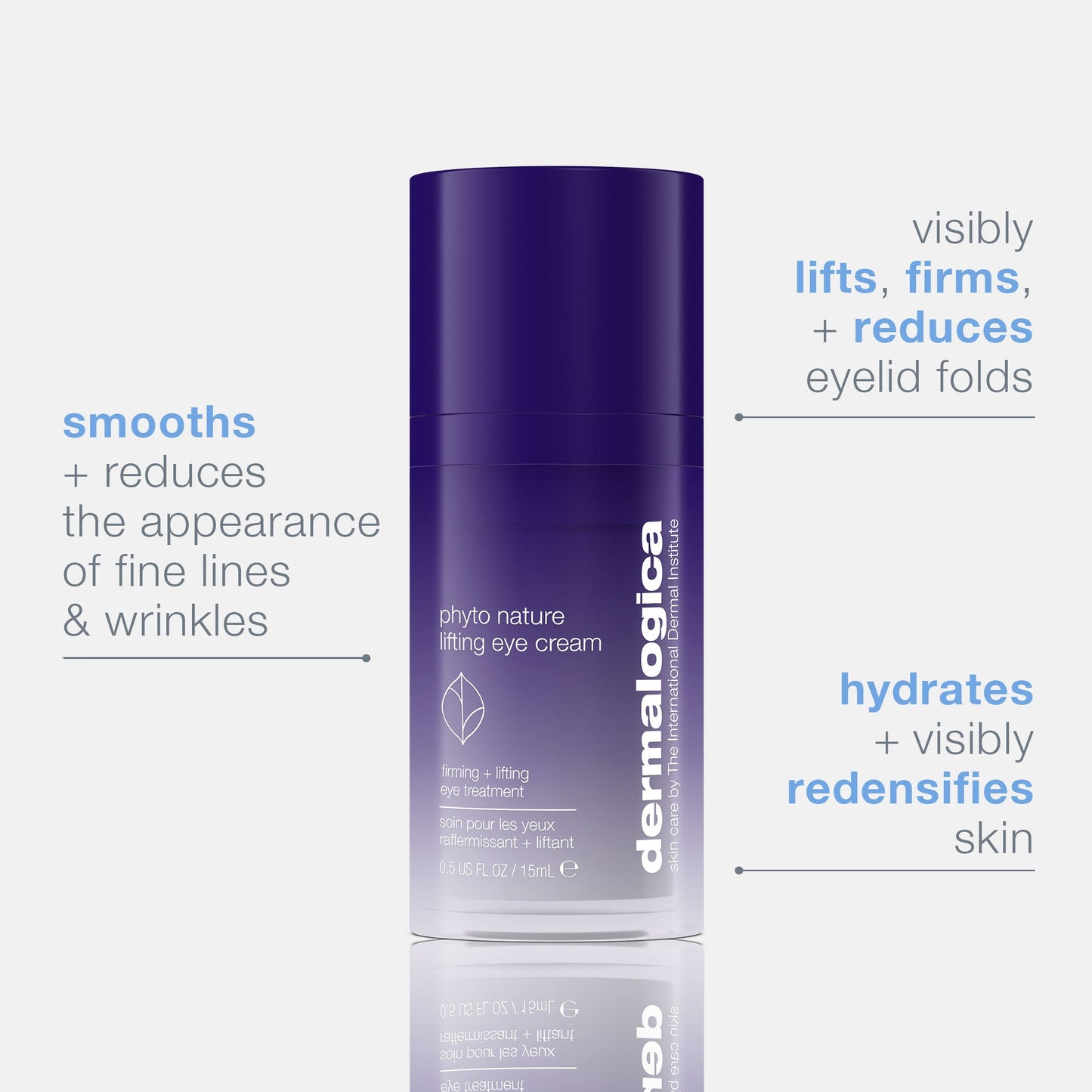
Phyto Nature Lifting Eye Cream

Phyto Nature Lifting Eye Cream
Dermalogica
phyto-nature-lifting-eye-cream
Eyecare
9784814829861
Morning or Evening?
How often will you use this product?
Notes


Highlights
WHAT IS IT?
Eye cream treatment
FEATURES
Immediate lift, reduces visible signs of aging, smooths fine lines and wrinkles, provides hydration
BEST FOR
dry
CHECKS
Paraben-free, artificial colors-free, fragrances-free, gluten-free
Who Is It For?
Adults Experiencing Premature AgingWhat Does It Help With?
Fine Lines Wrinkles Dryness Loss Of Elasticity Premature AgingBudget
Premium ($76-$150)How To Use
Which routine should it be used in?
Instructions:
Key Information

What Dermalogica Says
Product Description:
A nourishing eye cream that visibly addresses aging skin around the entire eye area, including the eyelid. Features powerful peptides, adaptogenic Astragalus, Electric Daisy Flower, and CoQ10 to deliver immediate lift and reduce visible signs of skin aging.
About the Brand:
Ingredients Overview
Ingredients List
Water/Aqua/Eau, Panthenol, Squalane, Glycerin, Pentylene Glycol, Hydrogenated Ethylhexyl Olivate, Propanediol, Triethylhexanoin, Prunus Amygdalus Dulcis (Sweet Almond) Oil, Hydrogenated Vegetable Oil, Glyceryl Stearate SE, Cetearyl Alcohol, Bis-Ethoxydiglycol Cyclohexane 1,4-Dicarboxylate, PEG-100 Stearate, Glyceryl Stearate, Tocopheryl Acetate, Hydroxyacetophenone, Dipotassium Glycyrrhizate, Sodium Hyaluronate, Ubiquinone, Rosmarinus Officinalis (Rosemary) Leaf Extract, Helianthus Annuus (Sunflower) Seed Oil, Citrus Limon (Lemon) Peel Oil, Citrus Aurantium Bergamia (Bergamot) Fruit Oil, Salvia Sclarea (Clary) Oil, Citrus Aurantium Dulcis (Orange) Peel Oil, Avena Sativa (Oat) Kernel Extract, Viola Odorata Leaf Extract, Camellia Sinensis Seed Oil, Carthamus Tinctorius (Safflower) Seed Oil, Oryza Sativa (Rice) Bran Extract, Tapioca Starch, Chenopodium Quinoa Seed Extract, Helianthus Annuus (Sunflower) Extract, Camellia Sinensis Leaf Powder, Sphingomonas Ferment Extract, Spilanthes Acmella Flower/Leaf/Stem Extract, Astragalus Membranaceus Root Extract, Hordeum Vulgare Seed Extract, Candida Bombicola/Glucose/Methyl Rapeseedate Ferment, Rosmarinus Officinalis (Rosemary) Leaf Oil, Lavandula Spica (Lavender) Flower/Leaf/Stem Extract, Litsea Cubeba Fruit Oil, Zingiber Officinale (Ginger) Root Extract, Hydrogenated Olive Oil Unsaponifiables, Mentha Piperita (Peppermint) Oil, Tocopherol, Carnosine, Allantoin, Caprylyl Glycol, Acetyl Tetrapeptide-9, Beta-Glucan, Caffeine, Mannitol, Bisabolol, Trehalose, Lactobacillus Ferment, 1,2-Hexanediol, Steareth-21, Tetrasodium Glutamate Diacetate, Sodium Hydroxide, Aminomethyl Propanol, Carbomer, Microcrystalline Cellulose, Cellulose Gum, Sodium Benzoate, Potassium Sorbate, Limonene, Linalool, Citral
Key Ingredients
Peptides, Astragalus, Electric-Daisy-Flower, CoQ10
Ingredients Details
Glycerin
Common Name(s): Glycerol,glycerine,1,2,3-propanetriol
CAS Number: 56-81-5
DESCRIPTION
What It Does: Glycerin pulls water from the environment and deeper skin layers into the outer skin layer (epidermis), boosting moisture levels and keeping skin soft, smooth, and plump.
Why It's Used: It is used in virtually every moisturizer, serum, and cleanser because it is highly effective at hydrating skin, is well-tolerated by all skin types, and enhances the texture and spreadability of formulations.
How It Works: As a humectant, glycerin forms hydrogen bonds with water molecules, trapping them in the skin. it also reinforces the skin barrier by integrating into lipid structures between skin cells.
Typically Found In: Moisturizers,serums,cleansers,toners,sheet masks,sunscreens,body lotions,shampoos,conditioners
TECHNICAL DETAILS
Primary Category: Humectant
Secondary Functions: Skin barrier support,emollient,solvent
Application Areas:

Facial Skincare
Body Care
Hair Care
Beard Care

Color Cosmetics (Makeup)
Dietary/Oral Supplements
Typical Concentration Range: 1%–30% (typical: 3–10%)
SOURCING & ETHICS
Vegan Status: Yes – plant-derived (coconut, soy, palm) or synthetic
Halal Status: Yes – when plant-derived or synthetic; verify source with supplier
Source Notes: Derived from plant oils via hydrolysis or saponification; synthetic versions also available. palm-derived glycerin carries sustainability concerns.
SKIN COMPATIBILITY
Irritancy Rating: 1/5 – very low; non-irritating at all standard concentrations
Comedogenicity Rating: 0/5 – non-comedogenic
Sensitivity Concerns: Extremely rare allergic reactions; generally safe for all skin types including sensitive and baby skin
Safe for Sensitive Skin: Yes
SAFETY & COMPATIBILITY
Safety Profile: Widely recognized as safe. ewg hazard score: 1. no significant concerns for irritation, sensitization, or toxicity at typical concentrations (up to 50%).
Works Well With: Hyaluronic acid,ceramides,niacinamide,panthenol,urea,peptides,retinol,ahas/bhas
Avoid Combining With: No known incompatibilities at standard concentrations
SCIENTIFIC NOTE
Glycerin is an endogenous skin component found naturally in the stratum corneum. aquaporin-3 channels in keratinocytes facilitate glycerin transport, making it integral to natural skin hydration pathways.
Last Verified: Cosing database,cir safety assessment,ewg skin deep,inci decoder
Primary Sources: 2026-03-12
Glyceryl Stearate Se
Common Name(s): Glyceryl monostearate se,self-emulsifying glyceryl stearate
DESCRIPTION
What It Does: Provides self-emulsifying o/w emulsification with less co-emulsifier requirement.
Why It's Used: Simplified emulsification for formulations where self-emulsification reduces complexity vs standard gms requiring hlb-matched co-emulsifier blends.
How It Works: Small amount of embedded sodium/potassium stearate soap provides in-situ hlb modification enabling self-emulsification without requiring precisely hlb-matched co-emulsifier. forms stable o/w emulsions with water alone under high-shear mixing.
Typically Found In: Simple cream formulations,single-emulsifier systems
TECHNICAL DETAILS
Primary Category: Functional ingredient – self-emulsifying monoglyceride
Secondary Functions: Barrier sealing,softening
Application Areas:
Facial Skincare
Body Care
Hair Care
Beard Care
Color Cosmetics (Makeup)
Dietary/Oral Supplements
Typical Concentration Range: 1%–10%
SOURCING & ETHICS
Vegan Status: Yes – from vegetable glycerol and stearic acid
Halal Status: Yes
Source Notes: Plant-derived, synthetic or animal-derived. verify source.
SKIN COMPATIBILITY
Irritancy Rating: 1/5 – very low
Comedogenicity Rating: 1/5 – low; formulation-dependent
Sensitivity Concerns: Non-irritating.
Safe for Sensitive Skin: Yes
SAFETY & COMPATIBILITY
Safety Profile: Excellent safety profile. ewg score: 1.
Works Well With: Humectants,ceramides,actives as carrier
Avoid Combining With: No significant incompatibilities
SCIENTIFIC NOTE
Glyceryl stearate se's built-in self-emulsification arises from the small percentage (~2-5%) of potassium stearate soap co-crystallized with the monoglyceride. this soap provides the high-hlb co-emulsifier 'partner' needed for stable o/w emulsification without requiring the formulator to select and add a separate high-hlb emulsifier – an elegant simplification of classic emulsifier hlb matching theory.
Last Verified: Cosing database,cir safety assessment
Primary Sources: 2026-03-12
Hydrogenated Ethylhexyl Olivate
Common Name(s): Hydrogenated ethylhexyl olivate,2-ethylhexanol hydrogenated olive oil fatty acids ester
DESCRIPTION
What It Does: Softens and conditions skin with a light, non-greasy feel.
Why It's Used: Used for its stable olive-derived non-greasy emollient; oxidation-resistant vs standard ethylhexyl olivate emollient properties; suitable for lightweight skin care where non-greasy texture is key.
How It Works: Ester of 2-ethylhexanol (branched or specialty alcohol) with hydrogenated olive oil fatty acids; branching reduces crystallinity and greasiness; provides smooth, dry-oil skin feel.
Typically Found In: Lightweight moisturizers,sunscreens,skin serums,body lotions
TECHNICAL DETAILS
Primary Category: Functional ingredient – emollient
Secondary Functions: Skin conditioning,texture modification,spreading agent
Application Areas:
Facial Skincare
Body Care
Hair Care
Beard Care
Color Cosmetics (Makeup)
Dietary/Oral Supplements
Typical Concentration Range: 0.5%–10%
SOURCING & ETHICS
Vegan Status: Yes
Halal Status: Yes
Source Notes: 2-ethylhexanol and hydrogenated olive oil fatty acids; plant or synthetic origin.
SKIN COMPATIBILITY
Irritancy Rating: 1/5 – very low
Comedogenicity Rating: 1/5 – low
Sensitivity Concerns: Generally well tolerated.
Safe for Sensitive Skin: Yes
SAFETY & COMPATIBILITY
Safety Profile: Good safety profile. ewg score: 1.
Works Well With: Other emollients,silicones,natural oils,humectants
Avoid Combining With: No significant incompatibilities
SCIENTIFIC NOTE
Hydrogenated ethylhexyl olivate: 2-ethylhexyl ester of hydrogenated olive oil fatty acids; hydrogenation converts oleic/palmitic to stearic/palmitic; greatly improved oxidative stability vs standard ethylhexyl olivate while maintaining the non-greasy feel.
Last Verified: Cosing database,inci dictionary
Primary Sources: 2026-03-28
Hydrogenated Vegetable Oil
Common Name(s): Hydrogenated vegetable oil,botanical oil/butter,phytochemical active
CAS Number: N/a
DESCRIPTION
What It Does: Provides emollient conditioning, essential fatty acid supplementation, and barrier lipid support.
Why It's Used: Natural carrier oils integrate into sc lipid bilayers for genuine barrier emolliency.
How It Works: Fatty acid triglycerides deliver oleic, linoleic, and linolenic acids for sc integration and essential fatty acid barrier repair.
Typically Found In: Botanical skin care,natural products
TECHNICAL DETAILS
Primary Category: Active ingredient – antioxidant
Secondary Functions: Free radical scavenging,anti-aging
Application Areas:
Facial Skincare
Body Care
Hair Care
Beard Care
Color Cosmetics (Makeup)
Dietary/Oral Supplements
Typical Concentration Range: 0.1%–30%
SOURCING & ETHICS
Vegan Status: Conditional
Halal Status: Conditional
Source Notes: Plant-derived extract or synthetic.
SKIN COMPATIBILITY
Irritancy Rating: 1/5 – very low
Comedogenicity Rating: 0/5 – non-comedogenic
Sensitivity Concerns: Non-irritating; well-tolerated.
Safe for Sensitive Skin: Yes
SAFETY & COMPATIBILITY
Safety Profile: Excellent safety profile. ewg score: 1.
Works Well With: Vitamin c,vitamin e,ferulic acid,spf,other antioxidants
Avoid Combining With: No significant incompatibilities
SCIENTIFIC NOTE
Plant secondary metabolites evolved for uv photoprotection and pathogen defence — mechanisms directly translatable to cosmetic antioxidant and anti-inflammatory activity in human skin.
Last Verified: Cosing database,hydrogenated vegetable oil botanical review
Primary Sources: 2026-03-12
