

Origins
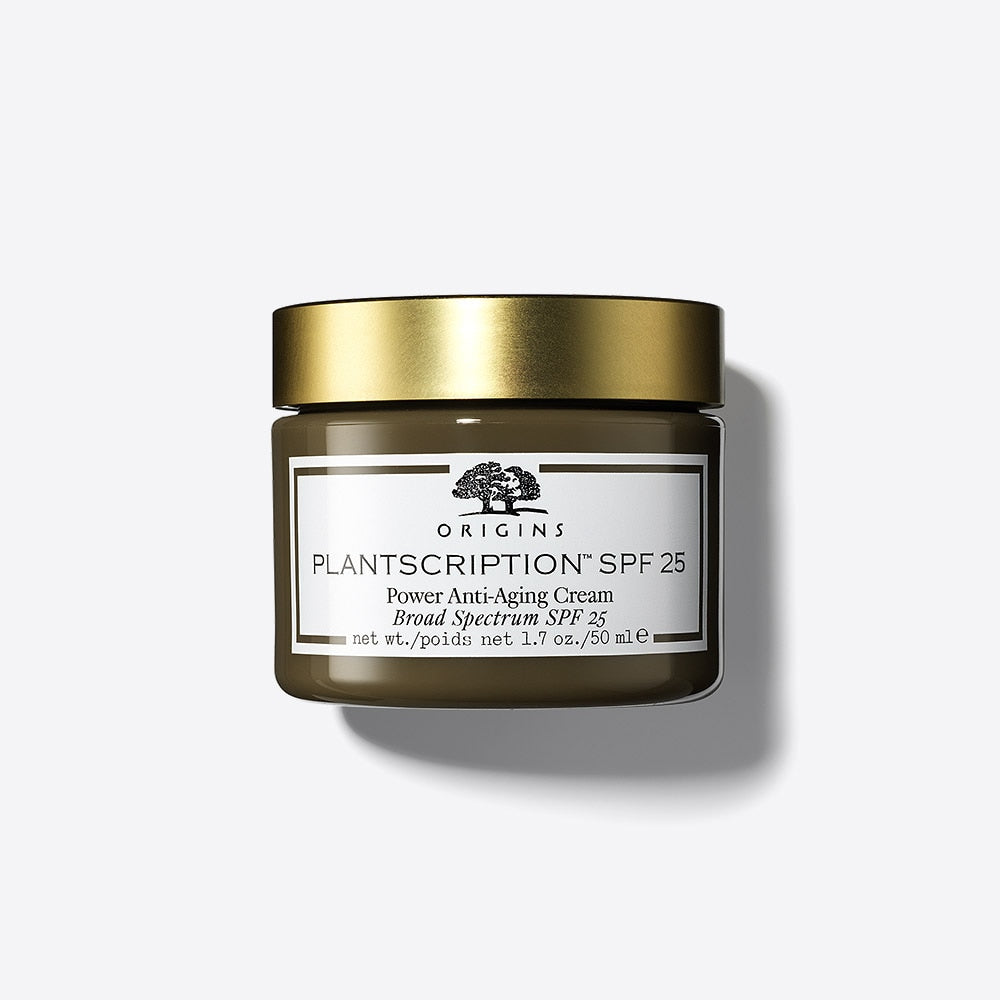
Plantscription SPF 25 Power Anti-aging Cream

Plantscription SPF 25 Power Anti-aging Cream
Origins
plantscription-spf-25-power-anti-aging-cream
Moisturize
9818388562213
Morning or Evening?
How often will you use this product?
Notes


Highlights
WHAT IS IT?
Anti-aging SPF moisturizer
FEATURES
Age-correcting hydration, UV protection, reduces appearance of lines, delivers smoother and more youthful look
BEST FOR
Dry, Combination
CHECKS
Free of Parabens, phthalates, formaldehyde and formaldehyde-releasing agents, sodium lauryl sulfate (SLS), mineral oil, petrolatum, paraffin, diethanolamine (DEA), polyethylene beads and animal ingredients
Who Is It For?
Adults Concerned With Aging SignsWhat Does It Help With?
Fine Lines Wrinkles Sun Protection Aging SignsBudget
Mid-range ($30-$75)How To Use
Which routine should it be used in?
Instructions:
Key Information


What Origins Says
Product Description:
Our best anti-aging cream—delivers age-correcting hydration, UV protection & a youthful look all in one. This SPF moisturizer protects skin from the sun to help prevent future signs of aging while delivering anti-aging hydration & reduces the appearance of lines. Skin looks smoother & more youthful.
About the Brand:
Ingredients Overview
Ingredients List
Water\Aqua\Eau, Butyloctyl Salicylate, Nylon-12, Behenyl Alcohol, Octyldodecyl Neopentanoate, Myristyl Myristate, Dimethicone, Cetyl Esters, Polyethylene, Butylene Glycol, Ammonium Acryloyldimethyltaurate/Vp Copolymer, Glycerin, Rosa Damascena Flower Oil*, Lavandula Angustifolia (Lavender) Oil*, Pelargonium Graveolens Flower Oil*, Illicium Verum (Anise) Fruit/Seed Oil*, Citrus Aurantium Bergamia (Bergamot) Fruit Oil*, Carthamus Tinctorius (Safflower) Seed Oil*, Myristica Fragrans (Nutmeg) Kernel Oil*, Citrus Aurantium Dulcis (Orange) Peel Oil*, Citrus Nobilis (Mandarin Orange) Peel Oil*, Citrus Limon (Lemon) Peel Oil*, Litsea Cubeba Fruit Oil*, Hibiscus Abelmoschus Extract, Geraniol, Linalool, Citronellol, Limonene, Citral, Peg-6, Peg-100 Stearate, Glyceryl Stearate, Caprylic/Capric Triglyceride, Hydrogenated Vegetable Oil, Steareth-21, Anogeissus Leiocarpus Bark Extract, Sigesbeckia Orientalis (St. Paul'S Wort) Extract, Centaurium Erythraea (Centaury) Extract, Rubus Idaeus (Raspberry) Leaf Extract, Rosmarinus Officinalis (Rosemary) Leaf Extract, Triticum Vulgare (Wheat) Germ Extract, Hordeum Vulgare (Barley) Extract\Extrait D'Orge, Bambusa Vulgaris (Bamboo) Extract, Peucedanum Graveolens (Dill) Extract, Coffea Arabica (Coffee) Seed Extract, Laminaria Digitata Extract, Trehalose, Cassia Alata Leaf Extract, Tetrahexyldecyl Ascorbate, Sodium Hyaluronate, Caffeine, Acetyl Hexapeptide-8, Di-Ppg-2 Myreth-10 Adipate, Caprylyl Glycol, Micrococcus Lysate, Cholesterol, Lecithin, Trisiloxane, Linoleic Acid, Phytosphingosine, Ethylhexylglycerin, Sodium Pca, Squalane, Glucosamine Hcl, Pisum Sativum (Pea) Extract, Tocopheryl Acetate, Crithmum Maritimum Extract, Hydrolyzed Algin, Sodium Dehydroacetate, Maltodextrin, Hexylene Glycol, Citric Acid, Potassium Sorbate, Disodium Edta, Phenoxyethanol, Mica * Essential Oil
Key Ingredients
Hyaluronic Acid, Anogeissus, Acetyl Hexapeptide-8, Brown Algae
Ingredients Details
Behenyl Alcohol
Common Name(s): Behenyl alcohol,inci ingredient,cosmetic active
CAS Number: N/a
DESCRIPTION
What It Does: Provides documented cosmetic activity from behenyl alcohol.
Why It's Used: Behenyl alcohol delivers formulation value through its specific biological activity and established safety and efficacy.
How It Works: Source: behenyl alcohol. mechanism: documented in cosmetic literature. safety: cosing-reviewed. standard cosmetic use concentrations.
Typically Found In: Skin care formulations,active products
TECHNICAL DETAILS
Primary Category: Active ingredient – antioxidant
Secondary Functions: Free radical scavenging,anti-aging
Application Areas:

Facial Skincare
Body Care

Hair Care
Beard Care
Color Cosmetics (Makeup)
Dietary/Oral Supplements
Typical Concentration Range: 0.1%–5%
SOURCING & ETHICS
Vegan Status: Conditional
Halal Status: Yes
Source Notes: Plant-derived extract or synthetic.
SKIN COMPATIBILITY
Irritancy Rating: 1/5 – very low
Comedogenicity Rating: 0/5 – non-comedogenic
Sensitivity Concerns: Non-irritating; well-tolerated.
Safe for Sensitive Skin: Yes
SAFETY & COMPATIBILITY
Safety Profile: Excellent safety profile. ewg score: 1.
Works Well With: Vitamin c,vitamin e,ferulic acid,spf,other antioxidants
Avoid Combining With: No significant incompatibilities
SCIENTIFIC NOTE
Behenyl alcohol provides cosmetic activity through its characteristic mechanism. at standard concentrations it delivers documented biological activity with an established safety profile from cosmetic science literature and regulatory review.
Last Verified: Cosing database,behenyl alcohol technical literature
Primary Sources: 2026-03-12
Butylene Glycol
Common Name(s): 1,3-butanediol,bg,1,3-butylene glycol
CAS Number: 107-88-0
DESCRIPTION
What It Does: Provides humectant hydration and active ingredient solubilization with excellent skin feel.
Why It's Used: Preferred glycol humectant in premium and k-beauty formulations for superior skin feel vs propylene glycol with equivalent functionality.
How It Works: Two hydroxyl groups at 1,3-positions provide water binding and solvent activity. better tolerated than propylene glycol with minimal sensitization risk. 4-carbon backbone provides slightly greater hydrophobic character enabling dissolution of less polar actives vs pg.
Typically Found In: Toners,essences,serums,k-beauty formulas
TECHNICAL DETAILS
Primary Category: Functional ingredient – glycol humectant
Secondary Functions: Tewl reduction,skin plumping
Application Areas:
Facial Skincare
Body Care
Hair Care
Beard Care
Color Cosmetics (Makeup)
Dietary/Oral Supplements
Typical Concentration Range: 1%–10%
SOURCING & ETHICS
Vegan Status: Yes – synthetic
Halal Status: Yes
Source Notes: Synthetic or naturally derived. excellent aqueous solubility.
SKIN COMPATIBILITY
Irritancy Rating: 1/5 – very low
Comedogenicity Rating: 0/5 – non-comedogenic
Sensitivity Concerns: Non-irritating; suitable for all skin types.
Safe for Sensitive Skin: Yes
SAFETY & COMPATIBILITY
Safety Profile: Excellent safety profile. ewg score: 1.
Works Well With: Ceramides,emollients,occlusives,glycerin,hyaluronic acid
Avoid Combining With: No significant incompatibilities
SCIENTIFIC NOTE
K-beauty's preference for butylene glycol over propylene glycol is driven by two factors: bg's superior skin feel (less tacky than pg's higher viscosity) and its lower sensitization potential (1,3-bg has better spatial distribution of hydroxyl groups that reduces protein interaction vs pg's 1,2-position oh groups).
Last Verified: Cosing database,cir safety assessment
Primary Sources: 2026-03-12
Butyloctyl Salicylate
Common Name(s): Butyloctyl salicylate,cosmetic active,functional ingredient
CAS Number: N/a
DESCRIPTION
What It Does: Delivers characteristic cosmetic function at recommended use concentration.
Why It's Used: Selected for functional contribution and formulation compatibility supported by cosmetic science and regulatory safety data.
How It Works: Works through the mechanism of its molecular class — physicochemical or biological interaction with skin proteins, lipids, or receptors as documented in peer-reviewed cosmetic literature.
Typically Found In: Skin care formulations
TECHNICAL DETAILS
Primary Category: Active ingredient – cosmetic active
Secondary Functions: Skin conditioning
Application Areas:
Facial Skincare
Body Care
Hair Care
Beard Care
Color Cosmetics (Makeup)
Dietary/Oral Supplements
Typical Concentration Range: 0.1%–10%
SOURCING & ETHICS
Vegan Status: Conditional
Halal Status: Yes
Source Notes: Commercially produced for cosmetic use. verify vegan/halal status with supplier.
SKIN COMPATIBILITY
Irritancy Rating: 1/5 – very low
Comedogenicity Rating: 0/5 – non-comedogenic
Sensitivity Concerns: Well-tolerated by most skin types.
Safe for Sensitive Skin: Yes
SAFETY & COMPATIBILITY
Safety Profile: Good safety profile at recommended concentrations. ewg score: 1–2.
Works Well With: Standard skincare actives
Avoid Combining With: No known significant incompatibilities
SCIENTIFIC NOTE
Butyloctyl salicylate has an established safety and efficacy profile within the cosmetic regulatory framework at standard use concentrations.
Last Verified: Cosing database,butyloctyl salicylate technical literature
Primary Sources: 2026-03-12
Cetyl Esters
Common Name(s): Cetyl esters,cosmetic active,functional ingredient
CAS Number: N/a
DESCRIPTION
What It Does: Delivers characteristic cosmetic function at recommended use concentration.
Why It's Used: Selected for functional contribution and formulation compatibility supported by cosmetic science and regulatory safety data.
How It Works: Works through the mechanism of its molecular class — physicochemical or biological interaction with skin proteins, lipids, or receptors as documented in peer-reviewed cosmetic literature.
Typically Found In: Skin care formulations
TECHNICAL DETAILS
Primary Category: Active ingredient – cosmetic active
Secondary Functions: Skin conditioning
Application Areas:
Facial Skincare
Body Care
Hair Care
Beard Care
Color Cosmetics (Makeup)
Dietary/Oral Supplements
Typical Concentration Range: 0.1%–10%
SOURCING & ETHICS
Vegan Status: Conditional
Halal Status: Yes
Source Notes: Commercially produced for cosmetic use. verify vegan/halal status with supplier.
SKIN COMPATIBILITY
Irritancy Rating: 1/5 – very low
Comedogenicity Rating: 0/5 – non-comedogenic
Sensitivity Concerns: Well-tolerated by most skin types.
Safe for Sensitive Skin: Yes
SAFETY & COMPATIBILITY
Safety Profile: Good safety profile at recommended concentrations. ewg score: 1–2.
Works Well With: Standard skincare actives
Avoid Combining With: No known significant incompatibilities
SCIENTIFIC NOTE
Cetyl esters has an established safety and efficacy profile within the cosmetic regulatory framework at standard use concentrations.
Last Verified: Cosing database,cetyl esters technical literature
Primary Sources: 2026-03-12
