

Plum
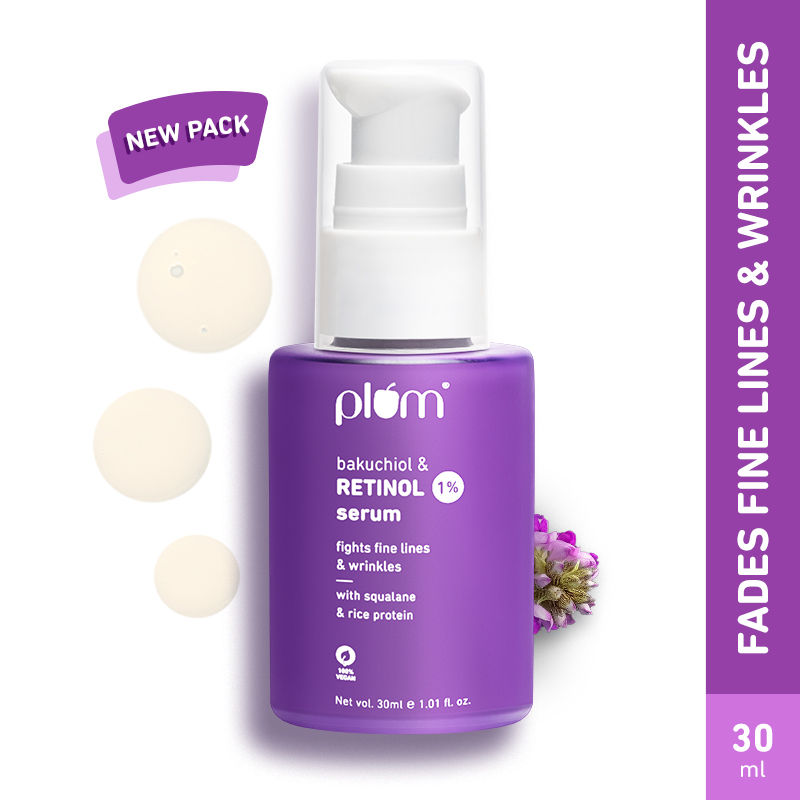
Plum 1% Retinol Anti-Aging Face Serum With Bakuchiol- Boosts Collagen, Reduces Fine Lines & Wrinkles

Plum 1% Retinol Anti-Aging Face Serum With Bakuchiol- Boosts Collagen, Reduces Fine Lines & Wrinkles
Plum
plum-1-retinol-anti-aging-face-serum-with-bakuchiol-boosts-collagen-reduces-fine-lines-wrinkles
Serum
10084921737509
Morning or Evening?
How often will you use this product?
Notes


Highlights
WHAT IS IT?
Face Serum with Retinyl palmitate and Bakuchiol, 30+ ingredients
FEATURES
Boosts collagen, reduces fine lines and wrinkles, speeds up skin cell turnover, hydrates, reduces age spots
BEST FOR
sensitive
CHECKS
Parabens, Fragrance
Who Is It For?
Over 25 Years All GendersWhat Does It Help With?
Anti-aging Fine Lines Wrinkles Hydration Age SpotsBudget
Affordable (under $30)How To Use
Which routine should it be used in?
Instructions:
Key Information


What Plum Says
Product Description:
Boosts collagen production making skin look supple, firm and youthful. Speeds up skin cell turnover rate reducing the appearance of fine lines and wrinkles. Boosts natural production of hyaluronic acid that keeps skin plump and reduces age spots.
About the Brand:
Ingredients Overview
Ingredients List
Aqua,Aloe-Barbadensis-Leaf-Juice,Sucrose,Propanediol,Squalane,Isodecyl-Neopentanoate,Retinyl-Palmitate,Malus-Domestica-Fruit-Cell-Culture-Extract,Hydrolyzed-Rice-Protein,Hydrolyzed-Pea-Protein,Glycine,Proline,Hydrolyzed-Sodium-Hyaluronate,Psoralea-Corylifolia-Bakuchi-Oil,Benzyl-Alcohol,Hydroxyacetophenone,Caprylyl-Glycol,Xanthan-Gum,Glycerin,Lecithin,Phenoxyethanol,Sorbitol,Cyclodextrin,Hydroxyethyl-Acrylate-Sodium-Acryloyldimethyl-Taurate-Copolymer,Isohexadecane,Polysorbate-60,Sodium-Gluconate,Sodium-Polyacryloyldimethyl-Taurate,Ammonium-Acryloyldimethyltaurate-VP-Copolymer
Key Ingredients
Retinyl palmitate, Bakuchiol, Plant polypeptides, Amino acids
Ingredients Details
Cyclodextrin
Common Name(s): Bcd,cycloheptaamylose,betadex
CAS Number: 7585-39-9
DESCRIPTION
What It Does: Provides molecular encapsulation for improved solubility, stability, and controlled release of challenging cosmetic actives.
Why It's Used: Molecular encapsulation technology — beta-cyclodextrin's toroidal cavity provides a hydrophobic microenvironment for solubilising and stabilising oil-soluble actives in aqueous formulations.
How It Works: 7 glucose units in cyclic toroidal structure provide 6.0-6.5å inner cavity. hydrophobic interior complexes lipophilic guest molecules. complexation improves water solubility (guest molecule becomes water-dispersible), stability (protection from oxidation and hydrolysis), and controlled release (guest releases gradually by diffusion). outer hydrophilic face provides water compatibility.
Typically Found In: Active delivery systems,fragrance encapsulation,stability-challenged actives
TECHNICAL DETAILS
Primary Category: Functional ingredient – inclusion complex host
Secondary Functions: Skin conditioning
Application Areas:

Facial Skincare

Body Care
Hair Care
Beard Care
Color Cosmetics (Makeup)
Dietary/Oral Supplements
Typical Concentration Range: 0.1%–10%
SOURCING & ETHICS
Vegan Status: Conditional - supplier confirmation required
Halal Status: Unverified - supplier confirmation required
Source Notes: Commercially produced for cosmetic use. verify vegan/halal status with supplier. [audit 2026-07-29 rev2: the record's own source_notes does not assert a non-animal origin, or instructs the reader to verify with the supplier; "yes" asserts knowledge the record does not hold. determination requires shariah-panel sign-off.]
SKIN COMPATIBILITY
Irritancy Rating: 1/5 – very low
Comedogenicity Rating: 0/5 – non-comedogenic
Sensitivity Concerns: Well-tolerated by most skin types.
Safe for Sensitive Skin: Yes
SAFETY & COMPATIBILITY
Safety Profile: Good safety profile at recommended concentrations. ewg score: 1–2.
Works Well With: Standard skincare actives
Avoid Combining With: No known significant incompatibilities
SCIENTIFIC NOTE
Beta-cyclodextrin's pharmaceutical drug delivery applications (dozens of fda-approved cd-drug complexes) provide unparalleled safety and efficacy documentation for a cosmetic excipient. the same cd technology that delivers cholesterol-lowering drugs and antifungals in pharmaceutical formulations enables cosmetic actives to be delivered more effectively — a pharmaceutical innovation directly adapted to cosmetic performance enhancement.
Last Verified: 2026-03-12
Primary Sources: Cosing database,loftsson & brewster cyclodextrin review
Glycerin
Common Name(s): Glycerol,glycerine,1,2,3-propanetriol
CAS Number: 56-81-5
DESCRIPTION
What It Does: Glycerin pulls water from the environment and deeper skin layers into the outer skin layer (epidermis), boosting moisture levels and keeping skin soft, smooth, and plump.
Why It's Used: It is used in virtually every moisturizer, serum, and cleanser because it is highly effective at hydrating skin, is well-tolerated by all skin types, and enhances the texture and spreadability of formulations.
How It Works: As a humectant, glycerin forms hydrogen bonds with water molecules, trapping them in the skin. it also reinforces the skin barrier by integrating into lipid structures between skin cells.
Typically Found In: Moisturizers,serums,cleansers,toners,sheet masks,sunscreens,body lotions,shampoos,conditioners
TECHNICAL DETAILS
Primary Category: Humectant
Secondary Functions: Skin barrier support,emollient,solvent
Application Areas:
Facial Skincare
Body Care
Hair Care
Beard Care
Color Cosmetics (Makeup)
Dietary/Oral Supplements
Typical Concentration Range: 1%–30% (typical: 3–10%)
SOURCING & ETHICS
Vegan Status: Conditional - feedstock declaration required
Halal Status: Unverified - feedstock declaration required (plant, animal and petrochemical routes all exist)
Source Notes: Derived from plant oils via hydrolysis or saponification; synthetic versions also available. palm-derived glycerin carries sustainability concerns. [audit 2026-07-29 rev2: origin-dependent: the same inci exists in plant, animal and petrochemical versions and the name does not discriminate. determination requires shariah-panel sign-off.]
SKIN COMPATIBILITY
Irritancy Rating: 1/5 – very low; non-irritating at all standard concentrations
Comedogenicity Rating: 0/5 – non-comedogenic
Sensitivity Concerns: Extremely rare allergic reactions; generally safe for all skin types including sensitive and baby skin
Safe for Sensitive Skin: Yes
SAFETY & COMPATIBILITY
Safety Profile: Widely recognized as safe. ewg hazard score: 1. no significant concerns for irritation, sensitization, or toxicity at typical concentrations (up to 50%).
Works Well With: Hyaluronic acid,ceramides,niacinamide,panthenol,urea,peptides,retinol,ahas/bhas
Avoid Combining With: No known incompatibilities at standard concentrations
SCIENTIFIC NOTE
Glycerin is an endogenous skin component found naturally in the stratum corneum. aquaporin-3 channels in keratinocytes facilitate glycerin transport, making it integral to natural skin hydration pathways.
Last Verified: 2026-03-12
Primary Sources: Cosing database,cir safety assessment,ewg skin deep,inci decoder
Glycine
Common Name(s): Aminoacetic acid,aminoethanoic acid,h-gly-oh
CAS Number: 56-40-6
DESCRIPTION
What It Does: Provides nmf amino acid skin conditioning and collagen-constituent support.
Why It's Used: The collagen amino acid — glycine is the most abundant amino acid in collagen (every third residue in the triple helix is glycine) making topical glycine the most physiologically relevant collagen-support amino acid.
How It Works: Nmf component via zwitterionic water retention. collagen triple helix requires gly-x-y repeat where glycine's small size allows close packing. wound healing via fibroblast glutathione synthesis support. anti-inflammatory via glycine-gated chloride channel activation (inhibitory neuromodulator).
Typically Found In: Skin conditioning products,wound healing,nmf moisturisers
TECHNICAL DETAILS
Primary Category: Active ingredient – simplest amino acid
Secondary Functions: Skin conditioning
Application Areas:
Facial Skincare
Body Care
Hair Care
Beard Care
Color Cosmetics (Makeup)
Dietary/Oral Supplements
Typical Concentration Range: 0.5%–5%
SOURCING & ETHICS
Vegan Status: Conditional - feedstock declaration required
Halal Status: Unverified - feedstock declaration required (plant, animal and petrochemical routes all exist)
Source Notes: Commercially produced for cosmetic use. verify vegan/halal status with supplier. [audit 2026-07-29 rev2: origin-dependent: the same inci exists in plant, animal and petrochemical versions and the name does not discriminate. determination requires shariah-panel sign-off.]
SKIN COMPATIBILITY
Irritancy Rating: 1/5 – very low
Comedogenicity Rating: 0/5 – non-comedogenic
Sensitivity Concerns: Well-tolerated by most skin types.
Safe for Sensitive Skin: Yes
SAFETY & COMPATIBILITY
Safety Profile: Good safety profile at recommended concentrations. ewg score: 1–2.
Works Well With: Standard skincare actives
Avoid Combining With: No known significant incompatibilities
SCIENTIFIC NOTE
Glycine's mandatory presence at every third position in collagen's triple helix (gly-x-y repeat) arises from its unique zero side-chain structure — only glycine is small enough to fit at the sterically restricted centre of the triple helix where the three polypeptide chains cross. no other amino acid can substitute for glycine in the collagen triple helix without disrupting the structure, making glycine irreplaceable in collagen biology.
Last Verified:
Hydroxyacetophenone
Common Name(s): Para-hydroxyacetophenone,piceol,4-acetylphenol
CAS Number: 99-93-4
DESCRIPTION
What It Does: Provides antioxidant and preservative-boosting activity in a naturally-occurring clean-label phenolic.
Why It's Used: Clean-label preservation support — hydroxyacetophenone provides antioxidant and antimicrobial-boosting properties from a naturally-occurring compound accepted in natural cosmetic certifications.
How It Works: Para-hydroxyl group provides antioxidant radical scavenging. disrupts bacterial cell membrane penetration for preservative system boosting. anti-inflammatory via nf-kb inhibition. occurs naturally in plants including pear and raspberry as a secondary metabolite.
Typically Found In: Natural preservation systems,antioxidant serums,clean beauty
TECHNICAL DETAILS
Primary Category: Functional ingredient – antioxidant preservative booster
Secondary Functions: Free radical scavenging,anti-aging
Application Areas:
Facial Skincare
Body Care
Hair Care
Beard Care
Color Cosmetics (Makeup)
Dietary/Oral Supplements
Typical Concentration Range: 0.1%–1%
SOURCING & ETHICS
Vegan Status: Conditional - supplier confirmation required
Halal Status: Unverified - supplier confirmation required
Source Notes: Plant-derived extract or synthetic. [audit 2026-07-29 rev2: status downgraded on audit. determination requires shariah-panel sign-off.]
SKIN COMPATIBILITY
Irritancy Rating: 1/5 – very low
Comedogenicity Rating: 0/5 – non-comedogenic
Sensitivity Concerns: Non-irritating; well-tolerated.
Safe for Sensitive Skin: Yes
SAFETY & COMPATIBILITY
Safety Profile: Excellent safety profile. ewg score: 1.
Works Well With: Vitamin c,vitamin e,ferulic acid,spf,other antioxidants
Avoid Combining With: No significant incompatibilities
SCIENTIFIC NOTE
Hydroxyacetophenone's natural occurrence in fruits (pear, raspberry, passion fruit) at detectable concentrations provides clean-label justification for use in natural cosmetics. its cosmos certification acceptance reflects the growing demand for functional preservation ingredients that meet natural certification criteria — an ingredient with genuine plant-origin credentials that provides meaningful antimicrobial and antioxidant functions simultaneously.
Last Verified: