

Ponds
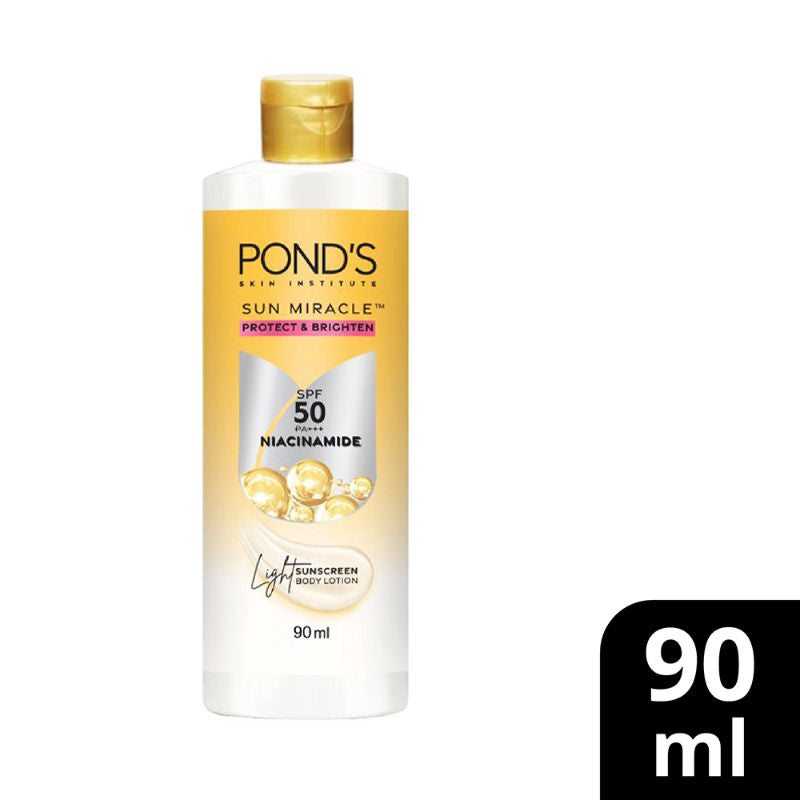
Ponds Sun Miracle SPF 50 PA+++ Niacinamide Light Sunscreen Body Lotion

Ponds Sun Miracle SPF 50 PA+++ Niacinamide Light Sunscreen Body Lotion
Ponds
ponds-sun-miracle-spf-50-pa-niacinamide-light-sunscreen-body-lotion
Suncare
10084980850981
Morning or Evening?
How often will you use this product?
Notes


Highlights
WHAT IS IT?
Body Sunscreen, 52 ingredients
FEATURES
Light sunscreen body lotion with SPF 50 PA+++, contains Niacinamide, provides protection and moisturization, non-sticky and fast absorbing
BEST FOR
sensitive
CHECKS
It does not contain parabens explicitly stated, but does contain fragrance and preservatives like Phenoxyethanol
Who Is It For?
Adults All GendersWhat Does It Help With?
Sun Protection Moisturizing Brightening With NiacinamideBudget
Mid-range ($30-$75)How To Use
Which routine should it be used in?
Instructions:
Key Information


What Ponds Says
Product Description:
Explore the entire range of Body Sunscreen available on Nykaa. Shop more Ponds products here. You can browse through the complete world of Ponds Body Sunscreen.
About the Brand:
Ingredients Overview
Ingredients List
Water,Ethylhexyl-Methoxycinnamate,Ethylhexyl-Salicylate,Silica,Phenylbenzimidazole-Sulfonic-Acid,Diethylamino-hydroxybenzoyl-hexyl-benzoate,Dimethicone,Cyclopentasiloxane,Stearic-Acid,Octocrylene,Glycerin,Glycol-Stearate-&-Stearamide-AMP,PEG-100-Stearate,Aluminum-Starch-Octenylsuccinate,Niacinamide,Methylene-Bis-Benzotriazolyl-Tetramethylbutylphenol,Glyceryl-Stearate,Caprylyl-Glycol,Phenoxyethanol,Sodium-Hydroxide,Cetyl-Alcohol,Talc,Potassium-Hydroxide,Carbomer,Xanthan-Gum,Cyclopentasiloxane-&-Dimethicone-Crosspolymer,BHT,Sodium-Ascorbyl-Phosphate,Petrolatum,Disodium-EDTA,Sodium-Hyaluronate-Crosspolymer,Sodium-Hyaluronate,Sodium-Acetylated-Hyaluronate,Hydrolyzed-Hyaluronic-Acid,Pentylene-Glycol,Ethylhexylglycerin,Fragrance,Alpha-Isomethyl-Ionone,Benzyl-Alcohol,Benzyl-Benzoate,Citronellol,Geraniol,Hexyl-Cinnamal,Hydroxycitronellal,Limonene,Linalool
Key Ingredients
Niacinamide,Ethylhexyl Methoxycinnamate,Ethylhexyl Salicylate,Methylene Bis-Benzotriazolyl Tetramethylbutylphenol,Sodium Hyaluronate
Ingredients Details
Bht
Common Name(s): Bht
DESCRIPTION
What It Does: Delivers targeted skin-conditioning or bioactive benefits through a specific mechanism of action suited to the formulation's intended purpose.
Why It's Used: Specialty actives address specific skin concerns through targeted molecular mechanisms, providing efficacy beyond what base formulation ingredients alone can achieve.
How It Works: The bioactive compound interacts with specific molecular targets in skin cells or the extracellular matrix — enzymes, receptors, structural proteins, or signaling molecules — triggering beneficial biological responses.
Typically Found In: Serums,treatments,moisturizers,specialty products
TECHNICAL DETAILS
Primary Category: Specialty actives
Secondary Functions: Skin-conditioning,anti-aging
Application Areas:

Facial Skincare

Body Care
Hair Care
Beard Care
Color Cosmetics (Makeup)
Dietary/Oral Supplements
Typical Concentration Range: 0.01–5%
SOURCING & ETHICS
Vegan Status: Yes
Halal Status: Yes
Source Notes: Specialty active ingredient; check individual sourcing for vegan status.
SKIN COMPATIBILITY
Irritancy Rating: 1
Comedogenicity Rating: 0
Sensitivity Concerns: Low sensitization potential at recommended use concentrations.
Safe for Sensitive Skin: Yes
SAFETY & COMPATIBILITY
Safety Profile: Well-characterized cosmetic ingredient with established safety profile. generally non-irritating at typical use concentrations. suitable for leave-on and rinse-off cosmetics.
Works Well With: Niacinamide,hyaluronic acid,vitamin c,peptides
Avoid Combining With: Incompatible with oxidizing agents; check ph stability
SCIENTIFIC NOTE
Specialty actives typically work through enzyme inhibition (e.g., tyrosinase inhibition for brightening, mmp inhibition for anti-aging), receptor activation (e.g., retinoid receptors, ppar-γ for barrier genes), or transcription factor modulation (e.g., nrf2 for antioxidant gene upregulation). structure-activity relationships determine potency and selectivity.
Last Verified: Cosing eu database; pcpc cosmetic ingredient safety reviews; ingredient-specific safety and efficacy literature
Primary Sources: 2025-01-15
Carbomer
Common Name(s): Carbopol,polyacrylic acid,carboxyvinyl polymer
DESCRIPTION
What It Does: Provides transparent gel textures and thickening at very low concentrations via ph-responsive swelling.
Why It's Used: The most widely used gel thickener – provides crystal-clear, stable gels at concentrations as low as 0.1-0.5% with ph-controlled viscosity.
How It Works: Highly crosslinked polyacrylic acid remains tightly coiled at acidic ph. neutralization with naoh or triethanolamine ionizes carboxylic groups causing electrostatic repulsion that unfolds and swells the polymer coils, dramatically increasing viscosity. concentration-dependent thickening.
Typically Found In: Gels,serums,emulsions,sunscreens
TECHNICAL DETAILS
Primary Category: Functional ingredient – polyacrylic acid thickener
Secondary Functions: Skin conditioning
Application Areas:
Facial Skincare
Body Care
Hair Care
Beard Care
Color Cosmetics (Makeup)
Dietary/Oral Supplements
Typical Concentration Range: 0.1%–2%
SOURCING & ETHICS
Vegan Status: Yes – synthetic
Halal Status: Yes
Source Notes: Commercially produced for cosmetic use. verify vegan/halal status with supplier.
SKIN COMPATIBILITY
Irritancy Rating: 1/5 – very low
Comedogenicity Rating: 0/5 – non-comedogenic
Sensitivity Concerns: Well-tolerated by most skin types.
Safe for Sensitive Skin: Yes
SAFETY & COMPATIBILITY
Safety Profile: Good safety profile at recommended concentrations. ewg score: 1–2.
Works Well With: Standard skincare actives
Avoid Combining With: No known significant incompatibilities
SCIENTIFIC NOTE
Carbomer's ph-responsive swelling mechanism provides an elegant formulation control tool: a neutralized gel can be liquefied by ph reduction (adding acid) and re-thickened by reneutralization. this reversible rheology control allows two-phase products that mix on application without the need for mechanical emulsification.
Last Verified: Cosing database,cir safety assessment
Primary Sources: 2026-03-12
Citronellol
Common Name(s): (r)-3,7-dimethyl-6-octen-1-ol,rhodinol
CAS Number: 106-22-9
DESCRIPTION
What It Does: Provides soft, lasting rose-floral fragrance note.
Why It's Used: Essential rose fragrance monoterpene for lasting smooth floral notes in high-quality perfumery and cosmetic fragrances.
How It Works: Allylic alcohol monoterpene provides fixative property in fragrance blends. good skin substantivity for lasting scent. softer, rounder rose note vs geraniol's fresher character. natural in rose otto at 18-34%.
Typically Found In: Rose perfumes,floral fragrances,luxury skincare
TECHNICAL DETAILS
Primary Category: Fragrance component – monoterpene alcohol
Secondary Functions: Skin conditioning
Application Areas:
Facial Skincare
Body Care
Hair Care
Beard Care
Color Cosmetics (Makeup)
Dietary/Oral Supplements
Typical Concentration Range: 0.001%–1%
SOURCING & ETHICS
Vegan Status: Yes – from rose, geranium, citronella oils
Halal Status: Yes
Source Notes: Commercially produced for cosmetic use. verify vegan/halal status with supplier.
SKIN COMPATIBILITY
Irritancy Rating: 1/5 – very low
Comedogenicity Rating: 0/5 – non-comedogenic
Sensitivity Concerns: Well-tolerated by most skin types.
Safe for Sensitive Skin: Yes
SAFETY & COMPATIBILITY
Safety Profile: Eu cosmetics regulation: declared fragrance allergen. ifra guidelines apply.
Works Well With: Standard skincare actives
Avoid Combining With: No known significant incompatibilities
SCIENTIFIC NOTE
Citronellol's r-enantiomer (natural) vs s-enantiomer (synthetic) provide meaningfully different scent character – a remarkable demonstration of chiral scent discrimination by olfactory receptors. the (r) form provides the characteristic rose note while the (s) form has a distinctly different, less pleasant character. this enantiomeric scent difference means that the biological handedness of naturally-sourced vs racemic synthetic citronellol produces perceptibly different fragrance quality.
Last Verified: Cosing database,ifra standards
Primary Sources: 2026-03-12
Cyclopentasiloxane
Common Name(s): Cyclopentasiloxane,cyclic volatile silicone,dry-touch carrier solvent
CAS Number: N/a
DESCRIPTION
What It Does: Provides a dry, weightless application vehicle that evaporates cleanly leaving actives and non-volatile silicones deposited on skin — eliminating the residual heaviness of conventional liquid carrier solvents.
Why It's Used: Cyclosiloxanes are the unique volatile silicone solvents that dissolve non-volatile silicones (dimethicone, cyclomethicone), organic uv filters, and lipophilic actives, providing the sensory-superior dry-touch application experience in premium formulations.
How It Works: Cyclosiloxane vapour pressure (d5 cyclopentasiloxane ~0.3 mmhg at 25°c) provides clean evaporation at body temperature. the cyclic ring structure provides lower boiling point than equivalent linear dimethicone, enabling faster evaporation while the ring conformation maintains the silicone's low surface energy for smooth application.
Typically Found In: Primers,antiperspirants,sunscreens
TECHNICAL DETAILS
Primary Category: Functional ingredient – emollient
Secondary Functions: Barrier sealing,softening
Application Areas:
Facial Skincare
Body Care
Hair Care
Beard Care
Color Cosmetics (Makeup)
Dietary/Oral Supplements
Typical Concentration Range: 1%–50%
SOURCING & ETHICS
Vegan Status: Yes
Halal Status: Yes
Source Notes: Plant-derived, synthetic or animal-derived. verify source.
SKIN COMPATIBILITY
Irritancy Rating: 1/5 – very low
Comedogenicity Rating: 1/5 – low; formulation-dependent
Sensitivity Concerns: Non-irritating.
Safe for Sensitive Skin: Yes
SAFETY & COMPATIBILITY
Safety Profile: Excellent safety profile. ewg score: 1.
Works Well With: Humectants,ceramides,actives as carrier
Avoid Combining With: No significant incompatibilities
SCIENTIFIC NOTE
Cyclopentasiloxane (d5) and cyclohexasiloxane (d6) are under eu regulatory review for potential environmental persistence (pbt assessment) — formulators should monitor eu regulation 2018/35 implementation for restrictions in wash-off products.
Last Verified: Cosing database,eu cyclosiloxane regulatory review
Primary Sources: 2026-03-12
