
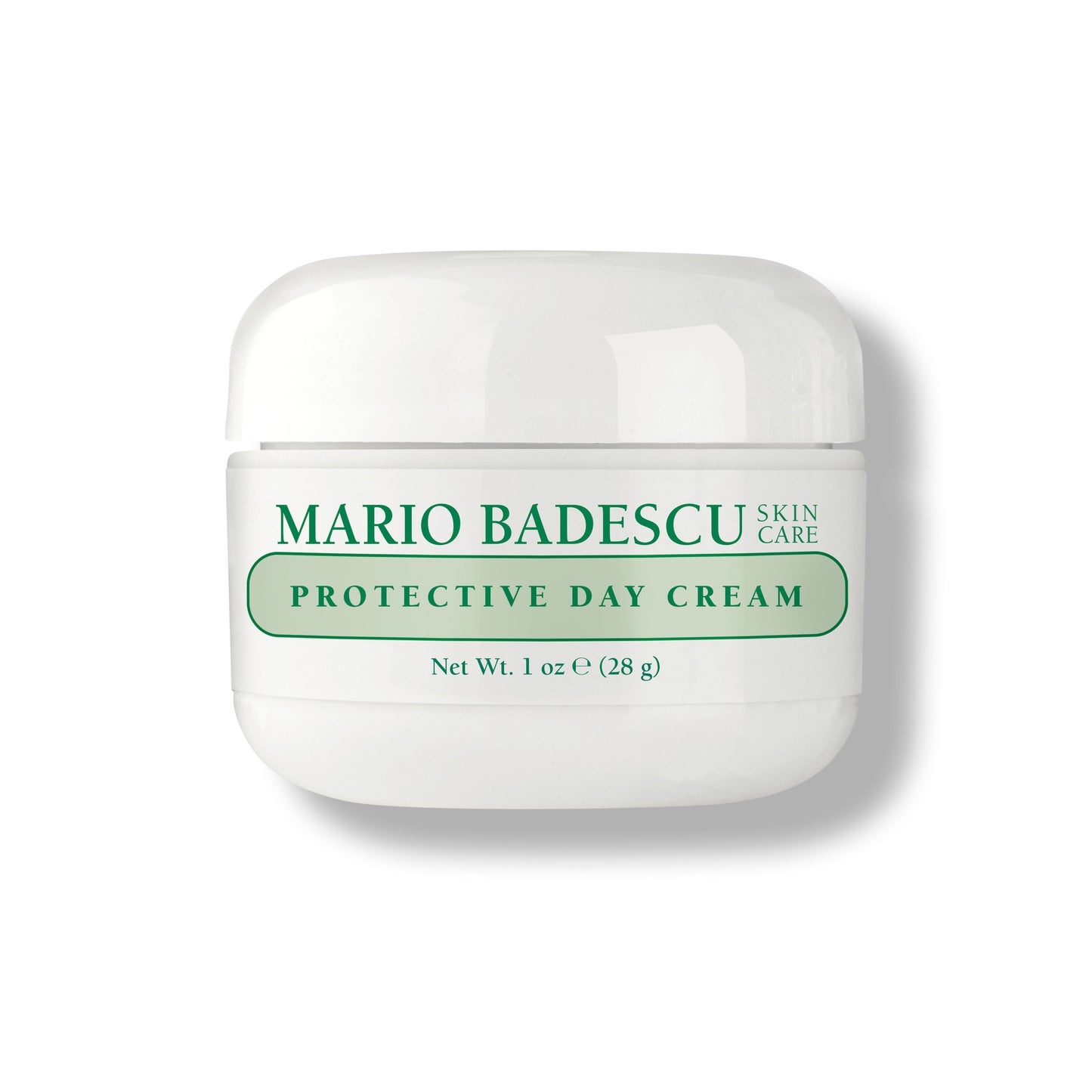

Mario Badescu
Protective Day Cream

Protective Day Cream
Mario Badescu
protective-day-cream
Moisturize
9818372342053
Morning or Evening?
How often will you use this product?
Notes


Highlights
WHAT IS IT?
Protective day cream with antioxidant-rich ingredients
FEATURES
Lightweight, non-greasy, fast-absorbing formula, forms protective barrier, shields against cold weather
BEST FOR
dry, combination, sensitive
CHECKS
Free of sulfate, phthalate
Who Is It For?
All Ages All GendersWhat Does It Help With?
Hydration Protection Against Dehydration And Cold Climate ConditionsBudget
Affordable (under $30)How To Use
Which routine should it be used in?
Instructions:
Key Information


What Mario Badescu Says
Product Description:
Hydrates and nourishes skin. Antioxidant-rich with Vitamins B5 and Vitamin E and a range of skin conditioning oils including Evening Primrose, Olive Leaf Extract and Soybean Oil.
About the Brand:
Ingredients Overview
Ingredients List
AQUA (WATER, EAU), PARAFFINUM LIQUIDUM (MINERAL OIL, HULLE MINÉRALE), STEARIC ACID, DIMETHICONE, CERA MICROCRISTALLINA (MICROCRYSTALLINE WAX, CIRE MICROCRISTALLINE), CETEARYL ALCOHOL, GLYCERIN, CETYL ALCOHOL, ZINC OXIDE, CERA ALBA (BEESWAX, CIRE D'ABEILLE), PROPYLENE GLYCOL, CETEARETH-20, GLYCINE SOJA (SOYBEAN) OIL, OENOTHERA BIENNIS (EVENING PRIMROSE) SEED EXTRACT, OLEA EUROPAEA (OLIVE) LEAF EXTRACT, CARRAGEENAN, TOCOPHEROL, GLYCERYL ISOSTEARATE, PARFUM (FRAGRANCE), TRIETHANOLAMINE, DIAZOLIDINYL UREA, PROPYLPARABEN, METHYLPARABEN, SODIUM BENZOATE, MAGNESIUM ASPARTATE, SORBITAN SESQUIOLEATE, BENZOIC ACID, PANTHENOL, POTASSIUM ASPARTATE, POTASSIUM HYDROXIDE, SARCOSINE, GLYCERYL ACRYLATE/ACRYLIC ACID COPOLYMER, BENZYL BENZOATE, LIMONENE
Key Ingredients
Beeswax, Vitamin B5, Vitamin E, Olive Leaf Extract
Ingredients Details
Beeswax
Common Name(s): Cera alba (white),cera flava (yellow),apis mellifera wax
CAS Number: 8012-89-3
DESCRIPTION
What It Does: Provides natural wax structure and emolliency for cosmetic texture and lip balm applications.
Why It's Used: The original cosmetic wax – provides natural, hard-texture structure for lip balms, sticks, and creams with emollient skin conditioning.
How It Works: Complex mixture of esters (wax esters), hydrocarbons (hentriacontane), and fatty acids provides semi-crystalline structure. melting point 62-65°c enables stable solid products. emulsifying capacity from free cerotic acid content.
Typically Found In: Lip balms,cosmetic sticks,creams,natural cosmetics
TECHNICAL DETAILS
Primary Category: Functional ingredient – natural wax
Secondary Functions: Natural wax structure,occlusive conditioning
Application Areas:

Facial Skincare

Body Care
Hair Care
Beard Care
Color Cosmetics (Makeup)
Dietary/Oral Supplements
Typical Concentration Range: 2%–30%
SOURCING & ETHICS
Vegan Status: No - animal-derived
Halal Status: Conditional - bee-derived; widely held permissible, confirm certifier stance
Source Notes: Plant-derived, synthetic or animal-derived. verify source. [audit 2026-07-29 rev2: bee-derived; permissibility widely accepted but fatwa varies by jurisdiction. determination requires shariah-panel sign-off.]
SKIN COMPATIBILITY
Irritancy Rating: 1/5 – very low
Comedogenicity Rating: 1/5 – low; formulation-dependent
Sensitivity Concerns: Non-irritating.
Safe for Sensitive Skin: Yes
SAFETY & COMPATIBILITY
Safety Profile: Excellent safety profile. ewg score: 1.
Works Well With: Humectants,ceramides,actives as carrier
Avoid Combining With: No significant incompatibilities
SCIENTIFIC NOTE
Beeswax's multi-component wax ester composition (myricyl palmitate as primary component) provides a unique crystalline structure that gives lip balms and cosmetic sticks their characteristic 'dragée' glide – different from synthetic wax esters that lack this crystalline lattice diversity.
Last Verified: 2026-03-12
Primary Sources: Cosing database,cir safety assessment
Evening Primrose Oil
Common Name(s): Evening primrose oil,epo
CAS Number: 90028-66-3
DESCRIPTION
What It Does: Provides gla anti-inflammatory activity for eczema and inflammatory skin conditions.
Why It's Used: The most clinically studied gla oil for eczema – clinical evidence for improved skin barrier function, reduced itch, and inflammation in atopic dermatitis patients.
How It Works: Gla (8-10%) provides anti-inflammatory pge1 precursors. high linoleic acid (72-74%) repairs barrier ceramide synthesis. combined anti-inflammatory + barrier repair addresses the dual pathophysiology (barrier dysfunction + immune dysregulation) of atopic dermatitis.
Typically Found In: Eczema products,barrier repair formulations,anti-inflammatory skin care
TECHNICAL DETAILS
Primary Category: Functional ingredient – emollient
Secondary Functions: Gla anti-inflammatory,eczema support,barrier repair
Application Areas:
Facial Skincare
Body Care
Hair Care
Beard Care
Color Cosmetics (Makeup)
Dietary/Oral Supplements
Typical Concentration Range: 1%–20%
SOURCING & ETHICS
Vegan Status: Conditional - supplier confirmation required
Halal Status: Unverified - supplier confirmation required
Source Notes: Plant-derived, synthetic or animal-derived. verify source. [audit 2026-07-29 rev2: the record's own source_notes does not assert a non-animal origin, or instructs the reader to verify with the supplier; "yes" asserts knowledge the record does not hold. determination requires shariah-panel sign-off.]
SKIN COMPATIBILITY
Irritancy Rating: 1/5 – very low
Comedogenicity Rating: 1/5 – very low
Sensitivity Concerns: Non-irritating.
Safe for Sensitive Skin: Yes
SAFETY & COMPATIBILITY
Safety Profile: Excellent safety profile. ewg score: 1.
Works Well With: Humectants,ceramides,actives as carrier
Avoid Combining With: No significant incompatibilities
SCIENTIFIC NOTE
Multiple clinical trials demonstrate evening primrose oil supplementation (topical and oral) significantly reduces tewl and eczema severity scores in atopic dermatitis. the dual mechanism (gla anti-inflammatory + linoleic acid barrier repair) addresses both the immune and barrier aspects of eczema simultaneously.
Last Verified: 2026-03-12
Primary Sources: Cosing database,bamford et al. epo atopic dermatitis meta-analysis
Olive Leaf Extract
Common Name(s): Olive leaf extract extract
DESCRIPTION
What It Does: Provides antioxidant protection, soothing anti-inflammatory effects, and skin-conditioning benefits through plant-derived polyphenols and phytochemicals.
Why It's Used: Plant extracts concentrate bioactive phytochemicals evolved for environmental protection — uv, microbial, and oxidative stressors — that translate to skin benefits.
How It Works: Polyphenols (flavonoids, phenolic acids) inhibit nf-κb-mediated inflammatory signaling, scavenge reactive oxygen species through electron donation, and chelate pro-oxidant metal ions to reduce oxidative skin damage.
Typically Found In: Serums,toners,moisturizers,masks,essences
TECHNICAL DETAILS
Primary Category: Botanical extracts
Secondary Functions: Antioxidant,anti-inflammatory
Application Areas:
Facial Skincare
Body Care
Hair Care
Beard Care
Color Cosmetics (Makeup)
Dietary/Oral Supplements
Typical Concentration Range: 0.1–10%
SOURCING & ETHICS
Vegan Status: Yes
Halal Status: Yes
Source Notes: Plant-derived extract; no animal components.
SKIN COMPATIBILITY
Irritancy Rating: 1899-12-31 00:00:00 -0800
Sensitivity Concerns: Low sensitization potential at recommended use concentrations.
Safe for Sensitive Skin: Yes
SAFETY & COMPATIBILITY
Safety Profile: Well-characterized cosmetic ingredient with established safety profile. generally non-irritating at typical use concentrations. suitable for leave-on and rinse-off cosmetics.
Works Well With: Niacinamide,hyaluronic acid,vitamin c,ceramides
Avoid Combining With: Strong oxidizing agents
SCIENTIFIC NOTE
Plant secondary metabolites (flavonoids, terpenes, phenolic acids) are biosynthesized as defense compounds against uv, herbivores, and pathogens. their anti-inflammatory activity typically derives from competitive inhibition of cox-2 and 5-lox enzymes (ic50 1–50 µm), while antioxidant activity involves single electron transfer (set) and hydrogen atom transfer (hat) mechanisms with structure-dependent rate constants.
Last Verified: 2025-01-15
Primary Sources: Cosing eu database; pcpc cosmetic ingredient safety reviews; phytochemical and ethnobotanical literature
Vitamin B5
Common Name(s): Panthenol / vitamin b5,pro-vitamin humectant conditioner,wound healing active
CAS Number: N/a
DESCRIPTION
What It Does: Deeply hydrates by binding water in the viable epidermis (not just the sc surface), stimulates keratinocyte proliferation for wound healing and barrier repair, and coats hair strands for conditioning and shine.
Why It's Used: Panthenol penetrates far deeper than glycerin due to its smaller size — reaching the viable epidermis where it converts to pantothenic acid (coa precursor) for direct metabolic support of skin cell function.
How It Works: D-panthenol is oxidised to pantothenic acid by skin alcoholic dehydrogenase after sc penetration → incorporated into coenzyme a (coa) → acetyl-coa for fatty acid synthesis supporting ceramide production. the polyol oh groups provide direct humectant water binding during transit.
Typically Found In: Healing skin care,conditioning,hair products
TECHNICAL DETAILS
Primary Category: Functional ingredient – humectant
Secondary Functions: Tewl reduction,skin plumping
Application Areas:
Facial Skincare
Body Care
Hair Care
Beard Care
Color Cosmetics (Makeup)
Dietary/Oral Supplements
Typical Concentration Range: 0.5%–5%
SOURCING & ETHICS
Vegan Status: Yes
Halal Status: Yes
Source Notes: Synthetic or naturally derived. excellent aqueous solubility.
SKIN COMPATIBILITY
Irritancy Rating: 1/5 – very low
Comedogenicity Rating: 0/5 – non-comedogenic
Sensitivity Concerns: Non-irritating; suitable for all skin types.
Safe for Sensitive Skin: Yes
SAFETY & COMPATIBILITY
Safety Profile: Excellent safety profile. ewg score: 1.
Works Well With: Ceramides,emollients,occlusives,glycerin,hyaluronic acid
Avoid Combining With: No significant incompatibilities
SCIENTIFIC NOTE
Panthenol's unique dual mechanism — provitamin metabolic activity (via coa) and direct humectant function (via oh groups) — provides both immediate surface moisture and deeper metabolic skin support from a single vitamin ingredient.
Last Verified: 2026-03-12
Primary Sources: Cosing database,d-panthenol vitamin b5 humectant wound healing review