

Nykaa E retail limited
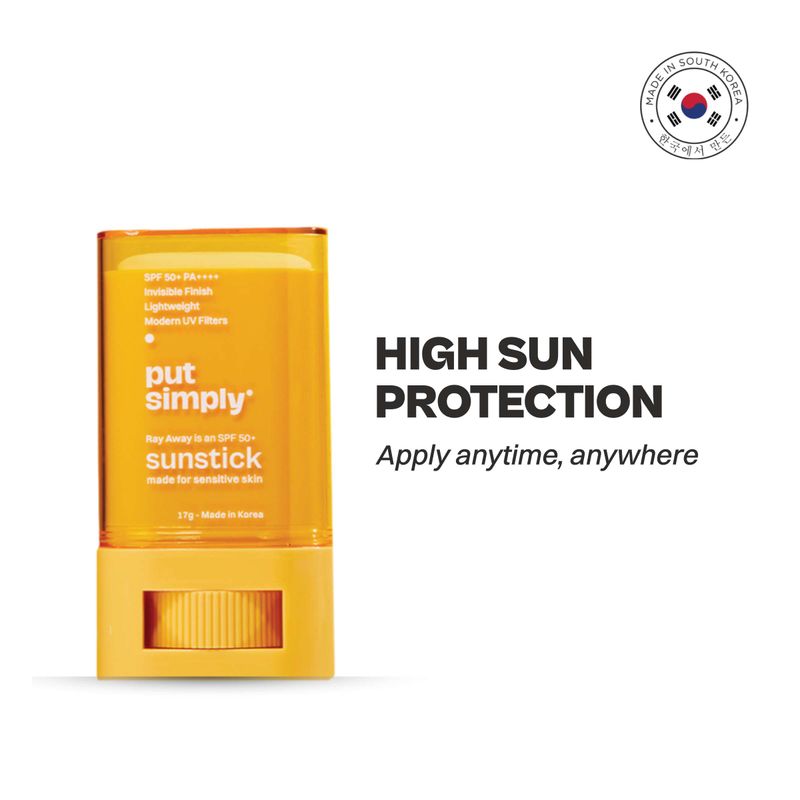
Put Simply Ray Away Korean Sunscreen Stick / Sunstick SPF 50, Invisible Skin-Like Finish,No White Cast

Put Simply Ray Away Korean Sunscreen Stick / Sunstick SPF 50, Invisible Skin-Like Finish,No White Cast
Nykaa E retail limited
put-simply-ray-away-korean-sunscreen-stick-sunstick-spf-50-invisible-skin-like-finish-no-white-cast
Suncare
10085015421221
Morning or Evening?
How often will you use this product?
Notes


Highlights
WHAT IS IT?
Sunscreen stick with 17g pack size
FEATURES
Broad spectrum protection without white cast, Hydrates and reinforces skin barrier, Soothes irritation and reduces redness, Protects barrier, locks in moisture and treats acne
BEST FOR
sensitive
CHECKS
No white cast, No irritation
Who Is It For?
Unspecified Age Range And GenderWhat Does It Help With?
Sun Protection Hydration Irritation Acne RednessBudget
Mid-range ($30-$75)How To Use
Which routine should it be used in?
Instructions:
Key Information


What Nykaa E retail limited Says
Product Description:
Explore the entire range of Face Sunscreen available on Nykaa. Shop more Put Simply products here. You can browse through the complete world of Put Simply Face Sunscreen.
About the Brand:
Ingredients Overview
Ingredients List
Methyl-Methacrylate-Crosspolymer, Caprylyl-Methicone, Synthetic-Wax, Dibutyl-Adipate, Isopropyl-Palmitate, Coco-Caprylate/Caprate, Butyloctyl-Salicylate, Silica, Diethylamino-Hydroxybenzoyl-Hexyl-Benzoate, Bis-Ethylhexyloxyphenol-Methoxyphenyl-Triazine, Caprylyl-Trimethicone, Ethylhexyl-Palmitate, Ethylhexyl-Triazone, Microcrystalline-Wax, Polysilicone-15, Synthetic-Fluorphlogopite, Vinyl-Dimethicone, Vinyl-Dimethicone/Methicone-Silsesquioxane-Crosspolymer, Hydrogenated-Lecithin, Ceramide-EOP, Cetearyl-Alcohol, Stearic-Acid, Ceramide-NP, Ceramide-NS, Cholesterol, Phytosphingosine, Ceramide-AP, Ceramide-AS, Bis-Behenyl/Isostearyl/Phytosteryl-Dimer-Dilinoleyl-Dimer-Dilinoleate, Camellia-Japonica-Seed-Oil, Polyglyceryl-4, Diisostearate/Polyhydroxystearate/Sebacate, Tocopherol
Key Ingredients
Modern Korean UV Filters, 5 Ceramide Complex, Cica, Phytosphingosine
Ingredients Details
Cholesterol
Common Name(s): 5-cholesten-3-ol,cholesterin
CAS Number: 57-88-5
DESCRIPTION
What It Does: Provides essential barrier sterol function as one of three critical stratum corneum lipid components.
Why It's Used: Essential component of complete barrier repair formulations – the stratum corneum barrier requires ceramides:cholesterol:fatty acids in approximately 1:1:1 molar ratio for complete barrier restoration.
How It Works: Integrates between ceramide headgroups in lamellar body structures, providing fluidity and flexibility to the otherwise rigid ceramide-dominated lipid matrix. controls lamellar body phase behavior for functional barrier.
Typically Found In: Barrier repair moisturizers,eczema treatments,dry skin formulations
TECHNICAL DETAILS
Primary Category: Active ingredient – barrier sterol
Secondary Functions: Lamellar body structure,barrier sterol
Application Areas:

Facial Skincare
Body Care

Hair Care
Beard Care
Color Cosmetics (Makeup)
Dietary/Oral Supplements
Typical Concentration Range: 0.01%–1%
SOURCING & ETHICS
Vegan Status: Conditional - feedstock declaration required
Halal Status: Unverified - feedstock declaration required (plant, animal and petrochemical routes all exist)
Source Notes: Traditionally from lanolin (wool grease). plant-derived cholesterol alternatives include phytosterols, though these show slightly different barrier integration. verify for vegan/halal. [audit 2026-07-29 rev2: origin-dependent: the same inci exists in plant, animal and petrochemical versions and the name does not discriminate. determination requires shariah-panel sign-off.]
SKIN COMPATIBILITY
Irritancy Rating: 1/5 – very low
Comedogenicity Rating: 0/5 – non-comedogenic
Sensitivity Concerns: Endogenous molecule; excellent tolerability.
Safe for Sensitive Skin: Yes
SAFETY & COMPATIBILITY
Safety Profile: Exceptional safety profile. natural skin component. ewg score: 1.
Works Well With: Other ceramides,cholesterol,free fatty acids,hyaluronic acid,niacinamide
Avoid Combining With: No significant incompatibilities
SCIENTIFIC NOTE
Elias demonstrated that barrier repair requires all three lipid classes (ceramides, cholesterol, fatty acids) in approximately equimolar ratios. formulations providing only ceramides without cholesterol and fatty acids show significantly inferior barrier restoration vs complete triple-lipid combinations.
Last Verified: 2026-03-12
Primary Sources: Cosing database,elias et al. barrier lipid ratio study,loden barrier repair review
Coco-caprylate/caprate
Common Name(s): Coco-caprylate/caprate
DESCRIPTION
What It Does: Smooths and softens skin by filling intercorneocyte spaces, reducing friction, and providing a pleasant aesthetic skin feel in formulations.
Why It's Used: Synthetic esters provide tailored aesthetic properties — spreadability, skin feel, volatility, refractive index — that natural oils alone cannot consistently deliver.
How It Works: The ester molecule fills microscopic surface irregularities between corneocytes, reducing coefficient of friction, reflecting light uniformly, and providing a lubrication layer that protects the skin surface.
Typically Found In: Moisturizers,sunscreens,color cosmetics,body lotions,lip products
TECHNICAL DETAILS
Primary Category: Synthetic emollients
Secondary Functions: Emollient
Application Areas:
Facial Skincare
Body Care
Hair Care
Beard Care
Color Cosmetics (Makeup)
Dietary/Oral Supplements
Typical Concentration Range: 1–20%
SOURCING & ETHICS
Vegan Status: Conditional - feedstock declaration required
Halal Status: Unverified - feedstock declaration required (plant, animal and petrochemical routes all exist)
Source Notes: Synthetically produced ester emollient; no animal components. [audit 2026-07-29 rev2: origin-dependent: the same inci exists in plant, animal and petrochemical versions and the name does not discriminate. determination requires shariah-panel sign-off.]
SKIN COMPATIBILITY
Irritancy Rating: 1
Comedogenicity Rating: 1
Sensitivity Concerns: Low sensitization potential at recommended use concentrations.
Safe for Sensitive Skin: Yes
SAFETY & COMPATIBILITY
Safety Profile: Well-characterized cosmetic ingredient with established safety profile. generally non-irritating at typical use concentrations. suitable for leave-on and rinse-off cosmetics.
Works Well With: Silicones,uv filters,other emollients
Avoid Combining With: Strongly alkaline conditions (risk of saponification of ester-type emollients)
SCIENTIFIC NOTE
The spreading coefficient of an emollient is governed by its surface tension, viscosity, and polarity. esters with branched alkyl chains (e.g., isopropyl, isostearyl) spread rapidly and leave a non-tacky film; linear long-chain esters provide more substantive moisturization. hlb value determines the preferred formulation system (w/o vs o/w emulsions).
Last Verified: 2025-01-15
Primary Sources: Cosing eu database; pcpc cosmetic ingredient safety reviews; ingredient-specific safety and efficacy literature
Phytosphingosine
Common Name(s): 4-hydroxysphinganine,tetrahydroxysphinganine
CAS Number: 554-62-1
DESCRIPTION
What It Does: Provides antimicrobial activity against p. acnes and s. aureus while supporting ceramide synthesis and reducing inflammation.
Why It's Used: Used in acne and sensitive skin formulations for combined antimicrobial, anti-inflammatory, and barrier repair activity from a single plant-derived sphingoid base.
How It Works: Trihydroxy structure provides stronger antimicrobial activity vs sphingosine. substrate for ceramide synthase to form phytoceramides. reduces pro-inflammatory cytokine production in keratinocytes.
Typically Found In: Anti-acne products,sensitive skin treatments,barrier repair formulations
TECHNICAL DETAILS
Primary Category: Active ingredient – plant sphingoid base
Secondary Functions: Anti-acne,ceramide synthesis,anti-inflammatory
Application Areas:
Facial Skincare
Body Care
Hair Care
Beard Care
Color Cosmetics (Makeup)
Dietary/Oral Supplements
Typical Concentration Range: 0.01%–0.5%
SOURCING & ETHICS
Vegan Status: Conditional - feedstock declaration required
Halal Status: Unverified - feedstock declaration required (plant, animal and petrochemical routes all exist)
Source Notes: Derived from yeast (pichia) fermentation or plant sphingolipid hydrolysis. fully plant-derived. [audit 2026-07-29 rev2: origin-dependent: the same inci exists in plant, animal and petrochemical versions and the name does not discriminate. determination requires shariah-panel sign-off.]
SKIN COMPATIBILITY
Irritancy Rating: 1/5 – very low
Comedogenicity Rating: 0/5 – non-comedogenic
Sensitivity Concerns: Endogenous molecule; excellent tolerability.
Safe for Sensitive Skin: Yes
SAFETY & COMPATIBILITY
Safety Profile: Exceptional safety profile. natural skin component. ewg score: 1.
Works Well With: Other ceramides,cholesterol,free fatty acids,hyaluronic acid,niacinamide
Avoid Combining With: No significant incompatibilities
SCIENTIFIC NOTE
Phytosphingosine's additional 4-hydroxy group (vs sphingosine) significantly enhances antimicrobial activity while maintaining ceramide precursor function. clinically demonstrated to reduce p. acnes counts and inflammatory lesions in acne studies.
Last Verified: 2026-03-12
Primary Sources: Cosing database,lintner phytosphingosine review,kawano et al. ceramide precursor study
Polysilicone-15
Common Name(s): Parsol slx,dimethicodiethylbenzalmalonate
CAS Number: 207732-84-1
DESCRIPTION
What It Does: Provides photostable uvb protection with silicone skin feel and formulation versatility.
Why It's Used: Premium silicone uvb filter combining photostable uv protection with silicone emollient skin conditioning properties.
How It Works: Malonate chromophore on polydimethylsiloxane backbone absorbs uvb (λmax 312nm). photostable from silicone backbone's photochemical inertness preventing chromophore degradation. silicone backbone provides skin conditioning alongside uv protection.
Typically Found In: Premium european sunscreens,silicone-based uv formulations
TECHNICAL DETAILS
Primary Category: Active ingredient – silicone uv filter
Secondary Functions: Skin conditioning
Application Areas:
Facial Skincare
Body Care
Hair Care
Beard Care
Color Cosmetics (Makeup)
Dietary/Oral Supplements
Typical Concentration Range: Up to 10% (eu)
SOURCING & ETHICS
Vegan Status: Conditional - supplier confirmation required
Halal Status: Unverified - supplier confirmation required
Source Notes: Commercially produced for cosmetic use. verify vegan/halal status with supplier. [audit 2026-07-29 rev2: the record's own source_notes does not assert a non-animal origin, or instructs the reader to verify with the supplier; "yes" asserts knowledge the record does not hold. determination requires shariah-panel sign-off.]
SKIN COMPATIBILITY
Irritancy Rating: 1/5 – very low
Comedogenicity Rating: 0/5 – non-comedogenic
Sensitivity Concerns: Well-tolerated by most skin types.
Safe for Sensitive Skin: Yes
SAFETY & COMPATIBILITY
Safety Profile: Eu approved. not fda approved. ewg score: 2.
Works Well With: Standard skincare actives
Avoid Combining With: No known significant incompatibilities
SCIENTIFIC NOTE
Polysilicone-15's photostability from its silicone backbone exemplifies the photochemical principle of chromophore isolation: the si-o backbone absorbs minimal uv and undergoes no photoinduced bond rearrangements, providing an inert molecular scaffold that prevents photodegradation of the attached malonate chromophore — unlike freestanding organic chromophores that can degrade via radical chain reactions.
Last Verified: 2026-03-12
Primary Sources: Cosing database,dsm parsol slx technical data