

Nykaa E retail limited
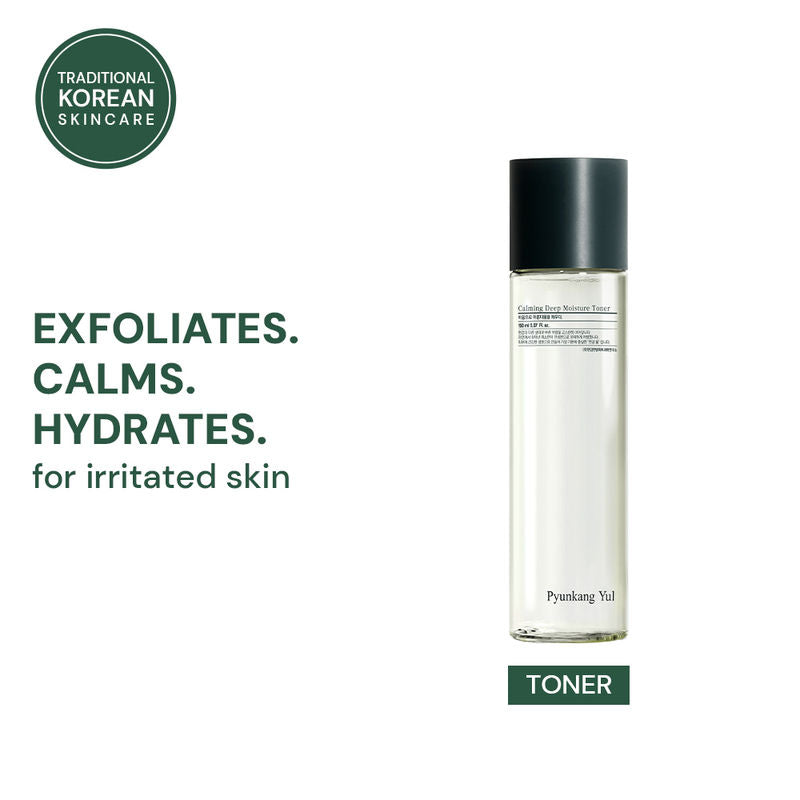
Pyunkang Yul Calming Deep Moisture Toner

Pyunkang Yul Calming Deep Moisture Toner
Nykaa E retail limited
pyunkang-yul-calming-deep-moisture-toner
Tone
10084741873957
Morning or Evening?
How often will you use this product?
Notes


Highlights
WHAT IS IT?
Toner, multiple soothing extracts
FEATURES
Clinically tested, soothes acne-prone skin, reduces sebum, improves skin texture, low pH formulation, zero-irritation certified, EWG-safe vegan ingredients
BEST FOR
sensitive
CHECKS
Paraben-Free,Preservative-Free,Fragrance-free
Who Is It For?
All Genders Not Specified Age RangeWhat Does It Help With?
Acne-prone Skin Sebum Control Improving Skin Texture Sensitive And Reddened SkinBudget
Affordable (under $30)How To Use
Which routine should it be used in?
Instructions:
Key Information


What Nykaa E retail limited Says
Product Description:
The Calming Deep Moisture Toner is a clinically tested toner designed to soothe acne-prone skin, reduce sebum, and improve skin texture. Human application tests have verified its effectiveness in reducing pore size, oil, sebum, and blackheads, while gently smoothing the skin's texture. This toner has a healthy low pH formulation, is certified zero-irritation, and contains only EWG-safe vegan ingredients. It is recommended for acne-prone, sensitive, and reddened skin types, and works best when used with Pyunkang Yul Calming Serum and Calming Cream for enhanced calming effects and deeper moisture. Key ingredients include five soothing extracts from Centella Asiatica, which provide quick relief to the skin and control excessive sebum for a smooth texture. The watery and fresh formula effectively provides deep moisture without stickiness.
About the Brand:
Ingredients Overview
Ingredients List
Water,Propanediol,Glycerin,Dipropylene Glycol,Betaine,Butylene Glycol,Caprylyl Glycol,Pentylene Glycol,Hydroxyacetophenone,Panthenol,C12-14 Pareth-12,Sodium Citrate,Citric Acid,Disodium EDTA,Gluconolactone,Salix Alba (Willow) Bark Extract,1,2-Hexanediol,Lonicera Japonica (Honeysuckle) Flower Extract,Sodium Hyaluronate,Centella Asiatica Extract,Melaleuca Alternifolia (Tea Tree) Leaf Extract,Salvia Officinalis (Sage) Leaf Extract,Camellia Japonica Flower Extract,Hydrolyzed Hyaluronic Acid,Hydroxypropyltrimonium Hyaluronate,Sodium Hyaluronate Crosspolymer,Asiatic Acid,Asiaticoside,Sodium Acetylated Hyaluronate,Madecassic Acid,Madecassoside
Key Ingredients
Centella Asiatica Extract,Salix Alba (Willow) Bark Extract,Melaleuca Alternifolia (Tea Tree) Leaf Extract,Panthenol,Sodium Hyaluronate
Ingredients Details
1-2-hexanediol
Common Name(s): 1-2-hexanediol,cosmetic active,functional ingredient
CAS Number: N/a
DESCRIPTION
What It Does: Delivers characteristic cosmetic function at recommended use concentration.
Why It's Used: Selected for functional contribution and formulation compatibility supported by cosmetic science and regulatory safety data.
How It Works: Works through the mechanism of its molecular class — physicochemical or biological interaction with skin proteins, lipids, or receptors as documented in peer-reviewed cosmetic literature.
Typically Found In: Skin care formulations
TECHNICAL DETAILS
Primary Category: Active ingredient – cosmetic active
Secondary Functions: Skin conditioning
Application Areas:

Facial Skincare

Body Care
Hair Care
Beard Care
Color Cosmetics (Makeup)
Dietary/Oral Supplements
Typical Concentration Range: 0.1%–10%
SOURCING & ETHICS
Vegan Status: Conditional
Halal Status: Yes
Source Notes: Commercially produced for cosmetic use. verify vegan/halal status with supplier.
SKIN COMPATIBILITY
Irritancy Rating: 1/5 – very low
Comedogenicity Rating: 0/5 – non-comedogenic
Sensitivity Concerns: Well-tolerated by most skin types.
Safe for Sensitive Skin: Yes
SAFETY & COMPATIBILITY
Safety Profile: Good safety profile at recommended concentrations. ewg score: 1–2.
Works Well With: Standard skincare actives
Avoid Combining With: No known significant incompatibilities
SCIENTIFIC NOTE
1-2-hexanediol has an established safety and efficacy profile within the cosmetic regulatory framework at standard use concentrations.
Last Verified: Cosing database,1-2-hexanediol technical literature
Primary Sources: 2026-03-12
Asiatic Acid
Common Name(s): Brahmic acid,centella active
CAS Number: 464-92-6
DESCRIPTION
What It Does: Stimulates normal wound healing collagen synthesis while preventing excessive fibrosis and hypertrophic scar formation.
Why It's Used: Unique anti-fibrotic wound healing ingredient – stimulates collagen i and iii while reducing excessive tgf-β-driven fibrosis, making it ideal for preventing hypertrophic scars.
How It Works: Stimulates col1a1/col3a1 transcription in normal fibroblasts while inhibiting tgf-β-induced myofibroblast differentiation that drives hypertrophic scar formation. also inhibits nf-kb for anti-inflammatory activity.
Typically Found In: Scar prevention products,post-procedure recovery,wound healing
TECHNICAL DETAILS
Primary Category: Active ingredient – soothing / anti-inflammatory
Secondary Functions: Anti-fibrotic,scar prevention,collagen regulation
Application Areas:
Facial Skincare
Body Care
Hair Care
Beard Care
Color Cosmetics (Makeup)
Dietary/Oral Supplements
Typical Concentration Range: 0.01%–1%
SOURCING & ETHICS
Vegan Status: Yes – from centella asiatica
Halal Status: Yes
Source Notes: Plant-derived extract or synthetic.
SKIN COMPATIBILITY
Irritancy Rating: 1/5 – very low
Comedogenicity Rating: 0/5 – non-comedogenic
Sensitivity Concerns: Non-irritating; ideal for reactive and sensitive skin.
Safe for Sensitive Skin: Yes – particularly recommended for sensitive skin
SAFETY & COMPATIBILITY
Safety Profile: Excellent safety profile. ewg score: 1.
Works Well With: Ceramides,panthenol,allantoin,hyaluronic acid,centella asiatica
Avoid Combining With: No significant incompatibilities
SCIENTIFIC NOTE
The paradox of asiatic acid is its ability to both stimulate collagen synthesis (anti-aging) and prevent fibrosis (anti-scarring) from the same compound. this selective effect occurs because asiatic acid stimulates normal fibroblast collagen synthesis while specifically inhibiting tgf-β1-driven myofibroblast transformation – the cell type responsible for excessive scar tissue.
Last Verified: Cosing database,maquart et al. asiatic acid study
Primary Sources: 2026-03-12
Asiaticoside
Common Name(s): Centella asiatica glycoside,asiaticoside b
CAS Number: 16830-15-2
DESCRIPTION
What It Does: Accelerates wound healing and reduces scar formation through fibroblast activation and collagen synthesis stimulation.
Why It's Used: Clinically proven scar reduction and wound healing active – the compound behind centella's legendary wound healing reputation.
How It Works: Promotes fibroblast proliferation and collagen synthesis via tgf-β independent mechanism (distinct from madecassoside). also inhibits hyaluronidase protecting extracellular matrix. antimicrobial activity supports wound healing environment.
Typically Found In: Post-surgical products,scar treatments,wound healing formulations
TECHNICAL DETAILS
Primary Category: Active ingredient – soothing / anti-inflammatory
Secondary Functions: Scar reduction,wound healing,collagen stimulation
Application Areas:
Facial Skincare
Body Care
Hair Care
Beard Care
Color Cosmetics (Makeup)
Dietary/Oral Supplements
Typical Concentration Range: 0.01%–2%
SOURCING & ETHICS
Vegan Status: Yes – centella asiatica derived
Halal Status: Yes
Source Notes: Extracted from centella asiatica aerial parts alongside madecassoside, asiatic acid, and madecassic acid.
SKIN COMPATIBILITY
Irritancy Rating: 1/5 – very low
Comedogenicity Rating: 0/5 – non-comedogenic
Sensitivity Concerns: Non-irritating; ideal for reactive and sensitive skin.
Safe for Sensitive Skin: Yes – particularly recommended for sensitive skin
SAFETY & COMPATIBILITY
Safety Profile: Excellent safety profile. ewg score: 1.
Works Well With: Ceramides,panthenol,allantoin,hyaluronic acid,centella asiatica
Avoid Combining With: No significant incompatibilities
SCIENTIFIC NOTE
Asiaticoside's mechanism of wound healing involves release of aglycone asiatic acid after hydrolysis by skin beta-glucosidases. the glycoside form provides better stratum corneum penetration than the hydrophobic aglycone, acting as a prodrug for the active asiatic acid at the wound healing site.
Last Verified: Cosing database,bylka et al. centella asiatica review
Primary Sources: 2026-03-12
Betaine
Common Name(s): Trimethylglycine,tmg,natural betaine
CAS Number: 107-43-7
DESCRIPTION
What It Does: Provides osmoprotective humectant conditioning with anti-irritant and mild foam-boosting activity.
Why It's Used: Natural-origin multifunctional osmolyte from sugar beet providing hydration, anti-irritancy, and conditioning in virtually every cosmetic category.
How It Works: Quaternary ammonium betaine provides zwitterionic character for water binding via ionic hydration. osmoprotective function at 100–500mm as compatible solute protecting cells from osmotic stress. reduces surfactant irritation by competing with sls for protein binding sites. mild foam enhancement.
Typically Found In: Virtually all categories — moisturisers, shampoos, cleansers
TECHNICAL DETAILS
Primary Category: Functional ingredient – humectant
Secondary Functions: Tewl reduction,skin plumping
Application Areas:
Facial Skincare
Body Care
Hair Care
Beard Care
Color Cosmetics (Makeup)
Dietary/Oral Supplements
Typical Concentration Range: 0.5%–10%
SOURCING & ETHICS
Vegan Status: Yes – from beta vulgaris (sugar beet) molasses
Halal Status: Yes
Source Notes: Synthetic or naturally derived. excellent aqueous solubility.
SKIN COMPATIBILITY
Irritancy Rating: 1/5 – very low
Comedogenicity Rating: 0/5 – non-comedogenic
Sensitivity Concerns: Non-irritating; suitable for all skin types.
Safe for Sensitive Skin: Yes
SAFETY & COMPATIBILITY
Safety Profile: Excellent safety profile. ewg score: 1.
Works Well With: Ceramides,emollients,occlusives,glycerin,hyaluronic acid
Avoid Combining With: No significant incompatibilities
SCIENTIFIC NOTE
Betaine's anti-irritant mechanism for surfactant systems involves competitive protein protection: betaine at high concentrations preferentially interacts with skin proteins, occupying binding sites that would otherwise be occupied by surfactant molecules causing protein denaturation. this competition reduces available protein binding for irritating surfactants, explaining betaine's well-documented ability to reduce sls irritation when co-formulated.
Last Verified: Cosing database,craig betaine osmoprotective review,cir safety assessment
Primary Sources: 2026-03-12
