

Raaga Professional
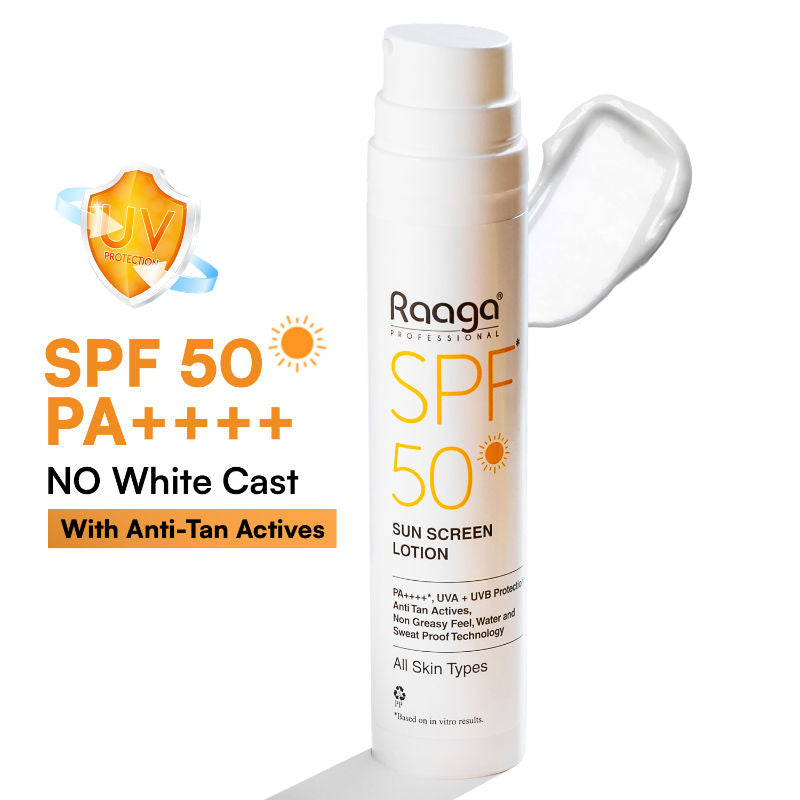
Raaga Professional Spf 50 Pa++++ Sunscreen Lotion With Uva + Uvb Protection, All Skin Types, 55 Ml

Raaga Professional Spf 50 Pa++++ Sunscreen Lotion With Uva + Uvb Protection, All Skin Types, 55 Ml
Raaga Professional
raaga-professional-spf-50-pa-sunscreen-lotion-with-uva-uvb-protection-all-skin-types-55-ml
Suncare
10084966072613
Morning or Evening?
How often will you use this product?
Notes


Highlights
WHAT IS IT?
Sunscreen lotion with SPF 50 and PA +4 protection
FEATURES
Protects against UVA and UVB rays, waterproof and sweat proof, prevents skin darkening, prevents sun tanning, photo aging prevention, blends easily without white cast
BEST FOR
all skin types
CHECKS
Does not leave white cast
Who Is It For?
All Genders No Specific Age MentionedWhat Does It Help With?
Sun Damage Skin Darkening Sun Tanning Sunburn Uv Spots Photo Aging Protection From Uv Generated Free RadicalsBudget
Affordable (under $30)How To Use
Which routine should it be used in?
Instructions:
Key Information

What Raaga Professional Says
Product Description:
Raaga Professional Sunscreen lotion with SPF 50 is a complete solution to all sun damage problems like skin darkening due to UV rays, sun tanning, sunburn, UV spots, photo aging etc. It easily blends into the skin without leaving behind any white cast. For best results use Raaga professionals face wash, toner, moisturizer and follow it up with SPF 50. This sunscreen lotion permeates easily thereby helping protect skin from UV generated free radicals. Protects skin against harmful UVA and UVB rays. Provides PA +4 level protection which is one of the best among all the SPF available. Special waterproof and sweat proof technology for Indian weather. Great for everyday wear.
About the Brand:
Ingredients Overview
Ingredients List
Aqua/Water, Dicaprylyl Carbonate, Octyl methoxycinnamate, Octyldodecanol & Octydodecyl Xyloside & PEG-30 Dipolyhydroxystearate, Glycerin, Benzophenone-3, Butyl methoxydibenzoylmethane, Octocrylene, Ethylhexyl triazone, Titanium Dioxide (and) Aluminum Hydroxide (and) isostearic Acid, Sorbitan stearate, Magnisum sulphate, Perfume, Phenoxyethanol (and) Methylparaben (and) Ethylparaben (and) Propylparaben (and) Butylparaben (and) Isobutylparaben, Phenoxyethanol & Methylisothiazolinone, Glycyrrhiza Glabra( Licorice) extract, Triclosan, Pentaerythrityl tetra-di-t butyl hydroxycinnamate
Key Ingredients
Ingredients Details
Benzophenone-3
Common Name(s): Oxybenzone,2-hydroxy-4-methoxybenzophenone,uva+uvb filter
CAS Number: 131-57-7
DESCRIPTION
What It Does: Provides combined uva and uvb filtration in a single chemical uv filter molecule.
Why It's Used: Combined uva+uvb filter historically used for broad-spectrum coverage in a single ingredient, now increasingly restricted.
How It Works: Benzophenone chromophore absorbs uvb (305nm) and uva-ii (326nm) via two separate n→π* transitions. water-soluble allows aqueous phase formulation. single filter providing partial broad-spectrum coverage.
Typically Found In: Sunscreens (being phased out in many markets)
TECHNICAL DETAILS
Primary Category: Active ingredient – chemical uva/uvb filter
Secondary Functions: Skin conditioning
Application Areas:

Facial Skincare

Body Care
Hair Care
Beard Care
Color Cosmetics (Makeup)
Dietary/Oral Supplements
Typical Concentration Range: Up to 6% (eu), 6% (us fda)
SOURCING & ETHICS
Vegan Status: Yes – synthetic
Halal Status: Yes
Source Notes: Commercially produced for cosmetic use. verify vegan/halal status with supplier.
SKIN COMPATIBILITY
Irritancy Rating: 1/5 – very low
Comedogenicity Rating: 0/5 – non-comedogenic
Sensitivity Concerns: Well-tolerated by most skin types.
Safe for Sensitive Skin: Yes
SAFETY & COMPATIBILITY
Safety Profile: Eu max 6%. coral reef/aquatic toxicity — banned hawaii, palau, some us states. potential endocrine activity at high systemic exposure. ewg score: 7. use declining due to regulatory pressure.
Works Well With: Standard skincare actives
Avoid Combining With: No known significant incompatibilities
SCIENTIFIC NOTE
Benzophenone-3's declining use reflects evolving understanding of environmental and endocrine impacts: discovered in coral bleaching studies, its restriction in hawaii (2018) sparked a global trend in marine-safe sunscreen formulations that is reshaping the industry away from bp-3 toward mineral filters and marine-safer organic alternatives.
Last Verified: Cosing database,fda uv filter otc monograph,hawaii bp-3 restriction law
Primary Sources: 2026-03-12
Butyl Methoxydibenzoylmethane
Common Name(s): Butyl methoxydibenzoylmethane,organic uv filter,photostabilising sunscreen active
CAS Number: N/a
DESCRIPTION
What It Does: Absorbs uv radiation at specific wavelengths (uva 320–400 nm, uvb 290–320 nm) and dissipates photon energy as heat rather than skin-damaging photochemical reactions.
Why It's Used: Organic uv filters are chosen for their high molar extinction coefficient, specific spectral coverage, and formulation compatibility — individual filters are combined to provide broad-spectrum coverage across uva+uvb.
How It Works: Uv photon absorption by the aromatic chromophore π-system excites the molecule from s₀ ground state to s₁ excited state. rapid internal conversion or photoisomerisation dissipates energy as vibrational heat before it can initiate skin photodamage.
Typically Found In: Sunscreens,photoprotective products
TECHNICAL DETAILS
Primary Category: Active ingredient – cosmetic active
Secondary Functions: Skin conditioning
Application Areas:
Facial Skincare
Body Care
Hair Care
Beard Care
Color Cosmetics (Makeup)
Dietary/Oral Supplements
Typical Concentration Range: Check local sunscreen regulations
SOURCING & ETHICS
Vegan Status: Yes
Halal Status: Yes
Source Notes: Commercially produced for cosmetic use. verify vegan/halal status with supplier.
SKIN COMPATIBILITY
Irritancy Rating: 1/5 – very low
Comedogenicity Rating: 0/5 – non-comedogenic
Sensitivity Concerns: Well-tolerated by most skin types.
Safe for Sensitive Skin: Yes
SAFETY & COMPATIBILITY
Safety Profile: Good safety profile at recommended concentrations. ewg score: 1–2.
Works Well With: Standard skincare actives
Avoid Combining With: No known significant incompatibilities
SCIENTIFIC NOTE
Organic uv filters require photostabilisation (by avobenzone-octocrylene pairing, or triazine stabilisers) as some absorbers degrade on uv exposure — formulator must verify photostability of the chosen filter combination.
Last Verified: Cosing database,butyl methoxydibenzoylmethane organic uv filter review
Primary Sources: 2026-03-12
Dicaprylyl Carbonate
Common Name(s): Dicaprylyl carbonate,cosmetic active,functional ingredient
CAS Number: N/a
DESCRIPTION
What It Does: Delivers characteristic cosmetic function at recommended use concentration.
Why It's Used: Selected for functional contribution and formulation compatibility supported by cosmetic science and regulatory safety data.
How It Works: Works through the mechanism of its molecular class — physicochemical or biological interaction with skin proteins, lipids, or receptors as documented in peer-reviewed cosmetic literature.
Typically Found In: Skin care formulations
TECHNICAL DETAILS
Primary Category: Active ingredient – cosmetic active
Secondary Functions: Skin conditioning
Application Areas:
Facial Skincare
Body Care
Hair Care
Beard Care
Color Cosmetics (Makeup)
Dietary/Oral Supplements
Typical Concentration Range: 0.1%–10%
SOURCING & ETHICS
Vegan Status: Conditional
Halal Status: Yes
Source Notes: Commercially produced for cosmetic use. verify vegan/halal status with supplier.
SKIN COMPATIBILITY
Irritancy Rating: 1/5 – very low
Comedogenicity Rating: 0/5 – non-comedogenic
Sensitivity Concerns: Well-tolerated by most skin types.
Safe for Sensitive Skin: Yes
SAFETY & COMPATIBILITY
Safety Profile: Good safety profile at recommended concentrations. ewg score: 1–2.
Works Well With: Standard skincare actives
Avoid Combining With: No known significant incompatibilities
SCIENTIFIC NOTE
Dicaprylyl carbonate has an established safety and efficacy profile within the cosmetic regulatory framework at standard use concentrations.
Last Verified: Cosing database,dicaprylyl carbonate technical literature
Primary Sources: 2026-03-12
Ethylhexyl Triazone
Common Name(s): Uvinul t 150,octyl triazone,eht
CAS Number: 88122-99-0
DESCRIPTION
What It Does: Provides maximum spf contribution per unit concentration from the highest-extinction-coefficient uvb filter.
Why It's Used: Most spf-efficient uvb filter — eht provides 6× more spf contribution per gram than omc, enabling high-spf formulations with minimal uv filter load.
How It Works: Three benzotriazole chromophores on triazine core provide εmax ~155,000 (vs omc ~24,000 — 6× more potent). photostable from triazine scaffold preventing chromophore photodegradation. oil-soluble for lipid phase.
Typically Found In: High-spf european sunscreens
TECHNICAL DETAILS
Primary Category: Active ingredient – efficient uvb filter
Secondary Functions: Skin conditioning
Application Areas:
Facial Skincare
Body Care
Hair Care
Beard Care
Color Cosmetics (Makeup)
Dietary/Oral Supplements
Typical Concentration Range: Up to 5% (eu)
SOURCING & ETHICS
Vegan Status: Yes – synthetic
Halal Status: Yes
Source Notes: Commercially produced for cosmetic use. verify vegan/halal status with supplier.
SKIN COMPATIBILITY
Irritancy Rating: 1/5 – very low
Comedogenicity Rating: 0/5 – non-comedogenic
Sensitivity Concerns: Well-tolerated by most skin types.
Safe for Sensitive Skin: Yes
SAFETY & COMPATIBILITY
Safety Profile: Eu approved. not fda approved. ewg score: 1.
Works Well With: Standard skincare actives
Avoid Combining With: No known significant incompatibilities
SCIENTIFIC NOTE
Ethylhexyl triazone's εmax of ~155,000 l/mol·cm is 6× greater than omc (~24,000), 48× greater than homosalate (~3,200), and represents the practical upper limit of organic uvb filter molar absorptivity. this extraordinary absorption coefficient arises from three benzotriazole chromophores geometrically arranged on the triazine core to simultaneously absorb uvb photons — a triplex chromophore design providing additive absorptivity.
Last Verified: Cosing database,basf uvinul t 150 technical data
Primary Sources: 2026-03-12
