

REN Clean Skincare
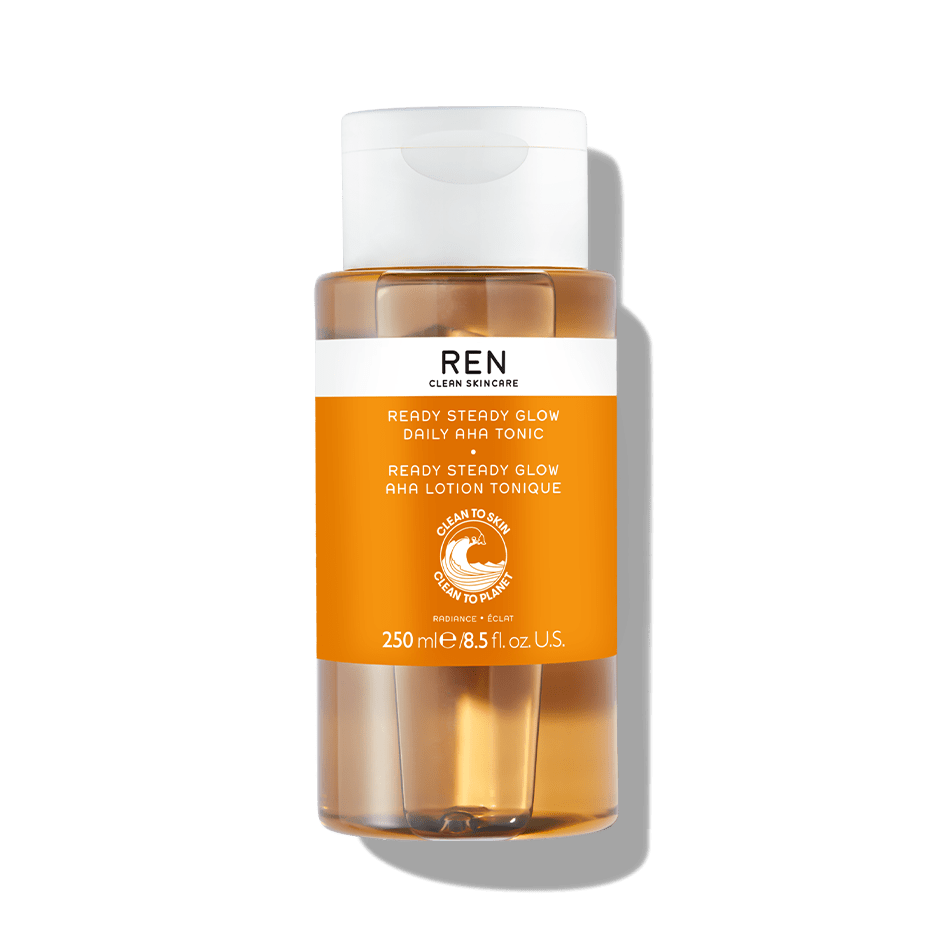
Radiance Ready Steady Glow Daily AHA Tonic

Radiance Ready Steady Glow Daily AHA Tonic
REN Clean Skincare
radiance-ready-steady-glow-daily-aha-tonic
Tone, Exfoliation
9706853794085
Morning or Evening?
How often will you use this product?
Notes


Highlights
WHAT IS IT?
Exfoliating toner
FEATURES
Exfoliates, brightens, smooths skin texture, evens skin tone, minimizes pores and fine lines
BEST FOR
All skin types
CHECKS
Clean beauty, free of synthetic fragrances or colors, silicones, sulfates, PEGs, parabens, urea, TEA/DEA
Who Is It For?
Adults Women And MenWhat Does It Help With?
Dullness Uneven Skin Tone Fine Lines Enlarged PoresBudget
Mid-rangeHow To Use
Which routine should it be used in?
Instructions:
Key Information


What REN Clean Skincare Says
Product Description:
Delivering multiple benefits in just one step, this leave on skin-refining toner helps to eliminate dulling dead skin cells and exfoliates away excess sebum to reveal a brighter, clarified, hydrated, smoother and more even-looking complexion.
About the Brand:
Ingredients Overview
Ingredients List
Aqua (Water), Sodium Lactate, Lactic Acid, Heptyl Glucoside, Potassium Azeloyl Diglycinate, Triethyl Citrate, Glyceryl Caprylate, Salix Nigra (Willow) Bark Extract, Benzoic Acid, Citrus Nobilis (Mandarin) Peel Oil, Citrus Aurantium Dulcis (Orange) Flower Oil, Citrus Grandis (Grapefruit) Peel Oil, Citrus Tangerina (Tangerine) Peel Oil, Heptanol, Parfum (Fragrance), Limonene
Key Ingredients
Lactic Acid, Salicin, Azelaic Acid Precursors
Ingredients Details
Benzoic Acid
Common Name(s): Cosmetic preservative,microbial growth inhibitor,product stability agent
CAS Number: N/a
DESCRIPTION
What It Does: Prevents microbial contamination that would otherwise render water-containing cosmetics unsafe — inhibiting bacterial, fungal, and yeast growth through membrane disruption, enzyme inhibition, or metabolic interference at permitted regulatory concentrations.
Why It's Used: Preservatives are safety-critical — un-preserved water-containing cosmetics can develop dangerous microbial contamination (pseudomonas aeruginosa eye infections, s. aureus skin infections) within days. preservation is a regulatory requirement, not an optional enhancement.
How It Works: Mechanism varies by class: organic acids (benzoic, dehydroacetic) disrupt intracellular ph in bacteria and fungi by proton flux across membranes; parabens inhibit membrane-associated enzyme function; chlorhexidine disrupts bacterial and fungal membrane integrity through divalent ion chelation of membrane phospholipids.
Typically Found In: All aqueous formulations
TECHNICAL DETAILS
Primary Category: Active ingredient – cosmetic active
Secondary Functions: Skin conditioning
Application Areas:

Facial Skincare

Body Care
Hair Care
Beard Care
Color Cosmetics (Makeup)
Dietary/Oral Supplements
Typical Concentration Range: Check annex v eu limits
SOURCING & ETHICS
Vegan Status: Yes
Halal Status: Yes
Source Notes: Commercially produced for cosmetic use. verify vegan/halal status with supplier.
SKIN COMPATIBILITY
Irritancy Rating: 1/5 – very low
Comedogenicity Rating: 0/5 – non-comedogenic
Sensitivity Concerns: Well-tolerated by most skin types.
Safe for Sensitive Skin: Yes
SAFETY & COMPATIBILITY
Safety Profile: Good safety profile at recommended concentrations. ewg score: 1–2.
Works Well With: Standard skincare actives
Avoid Combining With: No known significant incompatibilities
SCIENTIFIC NOTE
Eu regulation 1223/2009 annex v lists all permitted preservatives with maximum concentrations — preservatives not listed are prohibited. formulators must verify both permitted status and maximum concentration for each market before finalising preservation systems.
Last Verified: Eu regulation 1223/2009 annex v,cosmetic preservative regulatory review
Primary Sources: 2026-03-12
Glyceryl Caprylate
Common Name(s): Glycerol monocaprylate,mono caprylate of glycerol,schercemol gmc
CAS Number: 26402-26-6
DESCRIPTION
What It Does: Provides natural origin antimicrobial preservation alongside skin conditioning in clean beauty formulations.
Why It's Used: Natural-origin preservative for truly natural formulations seeking effective preservation without synthetic preservatives.
How It Works: Monoglyceride structure inserts into microbial cell membranes via the caprylic acid chain, disrupting membrane integrity. glycerol moiety contributes skin conditioning. effective against gram-positive bacteria and some yeasts at formulation concentrations.
Typically Found In: Natural and organic cosmetics,clean beauty,cosmos-certified products
TECHNICAL DETAILS
Primary Category: Functional ingredient – natural monoglyceride preservative
Secondary Functions: Skin conditioning
Application Areas:
Facial Skincare
Body Care
Hair Care
Beard Care
Color Cosmetics (Makeup)
Dietary/Oral Supplements
Typical Concentration Range: 0.3%–1.5%
SOURCING & ETHICS
Vegan Status: Yes – from glycerol and caprylic acid (plant sources)
Halal Status: Yes
Source Notes: From vegetable glycerol and plant-derived caprylic acid (coconut/palm kernel). cosmos-approved for certified natural cosmetics.
SKIN COMPATIBILITY
Irritancy Rating: 1/5 – very low
Comedogenicity Rating: 0/5 – non-comedogenic
Sensitivity Concerns: Well-tolerated by most skin types.
Safe for Sensitive Skin: Yes
SAFETY & COMPATIBILITY
Safety Profile: Good safety profile at recommended concentrations. ewg score: 1–2.
Works Well With: Standard skincare actives
Avoid Combining With: No known significant incompatibilities
SCIENTIFIC NOTE
Glyceryl caprylate's preservation mechanism (membrane disruption via monoglyceride structure) is distinct from synthetic preservatives (protein enzyme inhibition). this mechanistic difference is why it is approved in cosmos natural certification where synthetic enzyme inhibitors are not permitted.
Last Verified: Cosing database,cosmos standard,basf technical data
Primary Sources: 2026-03-12
Heptyl Glucoside
Common Name(s): Heptyl glucoside,cosmetic active,functional ingredient
CAS Number: N/a
DESCRIPTION
What It Does: Delivers characteristic cosmetic function at recommended use concentration.
Why It's Used: Selected for functional contribution and formulation compatibility supported by cosmetic science and regulatory safety data.
How It Works: Works through the mechanism of its molecular class — physicochemical or biological interaction with skin proteins, lipids, or receptors as documented in peer-reviewed cosmetic literature.
Typically Found In: Skin care formulations
TECHNICAL DETAILS
Primary Category: Active ingredient – cosmetic active
Secondary Functions: Skin conditioning
Application Areas:
Facial Skincare
Body Care
Hair Care
Beard Care
Color Cosmetics (Makeup)
Dietary/Oral Supplements
Typical Concentration Range: 0.1%–10%
SOURCING & ETHICS
Vegan Status: Conditional
Halal Status: Yes
Source Notes: Commercially produced for cosmetic use. verify vegan/halal status with supplier.
SKIN COMPATIBILITY
Irritancy Rating: 1/5 – very low
Comedogenicity Rating: 0/5 – non-comedogenic
Sensitivity Concerns: Well-tolerated by most skin types.
Safe for Sensitive Skin: Yes
SAFETY & COMPATIBILITY
Safety Profile: Good safety profile at recommended concentrations. ewg score: 1–2.
Works Well With: Standard skincare actives
Avoid Combining With: No known significant incompatibilities
SCIENTIFIC NOTE
Heptyl glucoside has an established safety and efficacy profile within the cosmetic regulatory framework at standard use concentrations.
Last Verified: Cosing database,heptyl glucoside technical literature
Primary Sources: 2026-03-12
Lactic Acid
Common Name(s): L-lactic acid,2-hydroxypropionic acid,milk acid
CAS Number: 50-21-5
DESCRIPTION
What It Does: Exfoliates dead skin cells, attracts and retains moisture, brightens skin tone, and improves texture.
Why It's Used: Dual exfoliant and humectant – uniquely hydrating vs other ahas. gentler and suitable for normal-to-sensitive skin.
How It Works: Disrupts desmosomes to promote exfoliation at low ph. acts as humectant. also stimulates ceramide synthesis at lower concentrations for barrier support.
Typically Found In: Chemical exfoliants,toners,serums,professional peels
TECHNICAL DETAILS
Primary Category: Active ingredient – alpha hydroxy acid (aha)
Secondary Functions: Humectant,brightening,barrier support,ceramide synthesis
Application Areas:
Facial Skincare
Body Care
Hair Care
Beard Care
Color Cosmetics (Makeup)
Dietary/Oral Supplements
Typical Concentration Range: 2%–10% (daily); 20%–90% (professional); active at ph ≤3.9
SOURCING & ETHICS
Vegan Status: Yes – synthetic or fermentation-derived
Halal Status: Yes
Source Notes: Fermentation-derived from carbohydrates or synthetically produced. both l-form and dl-form used.
SKIN COMPATIBILITY
Irritancy Rating: 2/5 – low to moderate
Comedogenicity Rating: 0/5 – non-comedogenic
Sensitivity Concerns: Photosensitizing – spf required. better tolerated than glycolic acid for most skin types.
Safe for Sensitive Skin: Use with caution – spf required
SAFETY & COMPATIBILITY
Safety Profile: Safe at otc concentrations. eu: ≤10% leave-on at ph ≥3.5. mandatory spf advisory.
Works Well With: Niacinamide,ceramides,hyaluronic acid,spf
Avoid Combining With: Retinol in same step; multiple exfoliants simultaneously
SCIENTIFIC NOTE
Lactic acid's role as a natural moisturizing factor (nmf) component makes it uniquely hydrating among ahas. ceramide synthesis stimulation at 2% provides barrier benefits complementing exfoliating activity.
Last Verified: Cosing database,stiller et al. lactic acid review,sccs aha opinion
Primary Sources: 2026-03-12
