
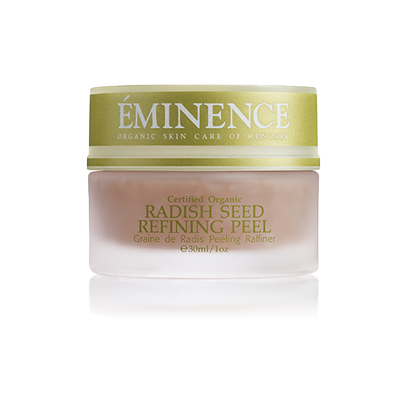

Eminence Organic Skin Care
Radish Seed Refining Peel

Radish Seed Refining Peel
Eminence Organic Skin Care
radish-seed-refining-peel
Exfoliation
9628202664229
Morning or Evening?
How often will you use this product?
Notes


Highlights
WHAT IS IT?
Exfoliating peel with herbal extracts
FEATURES
Hypoallergenic, detoxifying, stimulates skin renewal, smooths appearance of lines
BEST FOR
Normal skin
CHECKS
Does not contain soy, nuts, gluten, sodium lauryl sulfate
Who Is It For?
Adults Both Women And MenWhat Does It Help With?
Breakouts Signs Of AgingBudget
Mid-rangeHow To Use
Which routine should it be used in?
Instructions:
Key Information


What Eminence Organic Skin Care Says
Product Description:
This hypoallergenic peel helps prevent the appearance of breakouts with its detoxifying herbal extracts. Nettle, whole grain oat and willow bark stimulate skin renewal and smooth the appearance of lines. Made with Biodynamic® ingredients from Demeter International Certified Biodynamic® farms.
About the Brand:
Ingredients Overview
Ingredients List
Aqua, Linseed Acid, Raphanus Sativus Seed Extract, Mespilus Germanica, Solanum Tuberosum, Avena Sativa, Salix Alba Bark Extract, Urtica Dioica Extract, Melissa Officinalis, Mel, Hydroxyethyl Cellulose, Lactic Acid, C8-C16 Alkyl Glucoside, Coco Glucoside, Glycerin, Xanthan Gum, Salicilic Acid, Melaleuca Alternifolia Oil, Salviaofficinalis Oil, Zinc Sulfate, Sodium Benzoate, Ascorbic Acid,Potassium Sorbate, Tocopherol, Sesamum Indicum.
Key Ingredients
Nettle, Radish Seed Extract, Whole Grain Oat, Willow Bark, Lemon Balm, Naseberry
Ingredients Details
Linseed Acid
Common Name(s): Fatty acid or acid blend,soap formulation precursor,emollient conditioner
CAS Number: N/a
DESCRIPTION
What It Does: Provides fatty acid emolliency and soap precursor activity.
Why It's Used: Fatty acid emollient/soap precursor — fatty acids provide skin conditioning in free form and form classical soaps on neutralisation with alkali, providing the oldest cleansing chemistry known.
How It Works: Mixed fatty acid blend. free acid: emollient, barrier. naoh/koh neutralisation → soap. saponification: classic soap-making chemistry. emollient: free acid sc integration. conditioning. traditional ingredient.
Typically Found In: Soap formulation,emollient products
TECHNICAL DETAILS
Primary Category: Active ingredient – cosmetic active
Secondary Functions: Skin conditioning
Application Areas:

Facial Skincare

Body Care
Hair Care
Beard Care
Color Cosmetics (Makeup)
Dietary/Oral Supplements
Typical Concentration Range: 0.5%–20%
SOURCING & ETHICS
Vegan Status: Conditional - supplier confirmation required
Halal Status: Unverified - supplier confirmation required
Source Notes: Commercially produced for cosmetic use. verify vegan/halal status with supplier. [audit 2026-07-29 rev2: the record's own source_notes does not assert a non-animal origin, or instructs the reader to verify with the supplier; "yes" asserts knowledge the record does not hold. determination requires shariah-panel sign-off.]
SKIN COMPATIBILITY
Irritancy Rating: 1/5 – very low
Comedogenicity Rating: 0/5 – non-comedogenic
Sensitivity Concerns: Well-tolerated by most skin types.
Safe for Sensitive Skin: Yes
SAFETY & COMPATIBILITY
Safety Profile: Good safety profile at recommended concentrations. ewg score: 1–2.
Works Well With: Standard skincare actives
Avoid Combining With: No known significant incompatibilities
SCIENTIFIC NOTE
Fatty acid soap ionisation ph sensitivity: free fatty acids (rcooh) form soaps (rcoo-) above their pka (~4.5-5.0). at skin ph 5.5, fatty acid soaps partially ionise providing a natural buffering that moderates soap harshness. in the soap transition zone (ph 5-7), the equilibrium between rcooh (non-irritating) and rcoo- (cleansing) provides simultaneous mild cleansing and skin compatibility — the natural soap buffering explaining why fatty acid-based cleansers at slightly acidic ph are gentler than fully alkaline formulations.
Last Verified: 2026-03-12
Primary Sources: Cosing database,fatty acid soap ionisation ph review
Mel
Common Name(s): Mel,mel (honey),natural bee honey,multi-active humectant antimicrobial
CAS Number: N/a
DESCRIPTION
What It Does: Provides hygroscopic moisture retention from the supersaturated sugar content, broad-spectrum antimicrobial protection from glucose oxidase-generated h2o2 and bee defensin-1, wound healing activity from hydrogen peroxide oxidative signalling, and antioxidant protection from honey's polyphenol content.
Why It's Used: Honey's antimicrobial mechanism (h2o2 + defensin-1 peptide) provides broad-spectrum activity against both gram-positive and gram-negative bacteria including mrsa — with the unique property that no documented antimicrobial resistance exists against honey after thousands of years of use.
How It Works: Glucose oxidase in honey catalyses glucose + o2 → gluconolactone + h2o2 (0.5-1 mm) providing sustained low-level h2o2 antimicrobial activity. bee defensin-1 (royalisin) provides direct membrane-disrupting antimicrobial peptide activity. the 70-80% sugar content provides 0.5-0.6 water activity insufficient for microbial growth — the combined mechanisms explaining honey's extraordinary preservation properties.
Typically Found In: Anti-aging,wound care,antimicrobial skin care
TECHNICAL DETAILS
Primary Category: Active ingredient – humectant
Secondary Functions: Moisture retention,hydration
Application Areas:
Facial Skincare
Body Care
Hair Care
Beard Care
Color Cosmetics (Makeup)
Dietary/Oral Supplements
Typical Concentration Range: 1%–20%
SOURCING & ETHICS
Vegan Status: No - animal-derived
Halal Status: Conditional - bee-derived; widely held permissible, confirm certifier stance
Source Notes: Plant-derived or fermentation-produced. [audit 2026-07-29 rev2: bee-derived; permissibility widely accepted but fatwa varies by jurisdiction. determination requires shariah-panel sign-off.]
SKIN COMPATIBILITY
Irritancy Rating: 1/5 – very low
Comedogenicity Rating: 0/5 – non-comedogenic
Sensitivity Concerns: Non-irritating; suitable for sensitive skin.
Safe for Sensitive Skin: Yes
SAFETY & COMPATIBILITY
Safety Profile: Excellent safety profile. ewg score: 1.
Works Well With: Ceramides,emollients,occlusives,barrier actives
Avoid Combining With: No significant incompatibilities
SCIENTIFIC NOTE
Manuka honey (from leptospermum scoparium) provides the highest medical-grade antimicrobial activity from methylglyoxal (mgo) content supplementing the h2o2 mechanism — umf/mgo certification ensures standardised antimicrobial potency for clinical wound care applications.
Last Verified: 2026-03-22
Primary Sources: Cosing database,mel honey multi-active humectant antimicrobial review
Melissa Officinalis
Common Name(s): Melissa officinalis,cosmetic active,functional ingredient
CAS Number: N/a
DESCRIPTION
What It Does: Delivers characteristic cosmetic function at recommended use concentration.
Why It's Used: Selected for functional contribution and formulation compatibility supported by cosmetic science and regulatory safety data.
How It Works: Works through the mechanism of its molecular class as documented in peer-reviewed cosmetic literature.
Typically Found In: Skin care formulations
TECHNICAL DETAILS
Primary Category: Active ingredient – cosmetic active
Secondary Functions: Skin conditioning
Application Areas:
Facial Skincare
Body Care
Hair Care
Beard Care
Color Cosmetics (Makeup)
Dietary/Oral Supplements
Typical Concentration Range: 0.1%–10%
SOURCING & ETHICS
Vegan Status: Conditional - supplier confirmation required
Halal Status: Unverified - supplier confirmation required
Source Notes: Commercially produced for cosmetic use. verify vegan/halal status with supplier. [audit 2026-07-29 rev2: the record's own source_notes does not assert a non-animal origin, or instructs the reader to verify with the supplier; "yes" asserts knowledge the record does not hold. determination requires shariah-panel sign-off.]
SKIN COMPATIBILITY
Irritancy Rating: 1/5 – very low
Comedogenicity Rating: 0/5 – non-comedogenic
Sensitivity Concerns: Well-tolerated by most skin types.
Safe for Sensitive Skin: Yes
SAFETY & COMPATIBILITY
Safety Profile: Good safety profile at recommended concentrations. ewg score: 1–2.
Works Well With: Standard skincare actives
Avoid Combining With: No known significant incompatibilities
SCIENTIFIC NOTE
Melissa officinalis has an established safety profile within the cosmetic regulatory framework at standard use concentrations.
Last Verified: 2026-03-12
Primary Sources: Cosing database,melissa officinalis technical literature
Raphanus Sativus Seed Extract
Common Name(s): Raphanus sativus seed extract,raphanus sativus seed extract,botanical extract,phytochemical active
CAS Number: N/a
DESCRIPTION
What It Does: Provides antioxidant protection from polyphenol radical scavenging, anti-inflammatory activity from terpenoid nf-kb/cox pathway inhibition, and skin conditioning from the secondary metabolite complex.
Why It's Used: Raphanus sativus seed extract is selected for the characteristic secondary metabolite signature of raphanus sativus — whether polyphenols, terpenoids, alkaloids, or polysaccharides, the phytochemical profile provides antioxidant, anti-inflammatory, or skin conditioning benefits specific to this botanical species.
How It Works: Polyphenol catechol h-atom donation for ros scavenging (10⁶-10⁹ m⁻¹s⁻¹); terpenoids inhibit iκb kinase; flavonoids compete at cox-1/2; alkaloids modulate specific receptor targets.
Typically Found In: Botanical skin care
TECHNICAL DETAILS
Primary Category: Active ingredient – antioxidant
Secondary Functions: Free radical scavenging,anti-aging
Application Areas:
Facial Skincare
Body Care
Hair Care
Beard Care
Color Cosmetics (Makeup)
Dietary/Oral Supplements
Typical Concentration Range: 0.1%–10%
SOURCING & ETHICS
Vegan Status: Conditional - supplier confirmation required
Halal Status: Conditional - basis not stated in source record; supplier origin confirmation required to determine what evidence applies
Source Notes: Plant-derived extract or synthetic. [audit 2026-07-29 rev2: status downgraded on audit. determination requires shariah-panel sign-off.]
SKIN COMPATIBILITY
Irritancy Rating: 1/5 – very low
Comedogenicity Rating: 0/5 – non-comedogenic
Sensitivity Concerns: Non-irritating; well-tolerated.
Safe for Sensitive Skin: Yes
SAFETY & COMPATIBILITY
Safety Profile: Excellent safety profile. ewg score: 1.
Works Well With: Vitamin c,vitamin e,ferulic acid,spf,other antioxidants
Avoid Combining With: No significant incompatibilities
SCIENTIFIC NOTE
Standardise to marker compounds for consistent bioactivity — field-grown material varies 3-10× in secondary metabolite content.
Last Verified: 2026-03-22
Primary Sources: Cosing database,raphanus sativus seed extract botanical extract review