
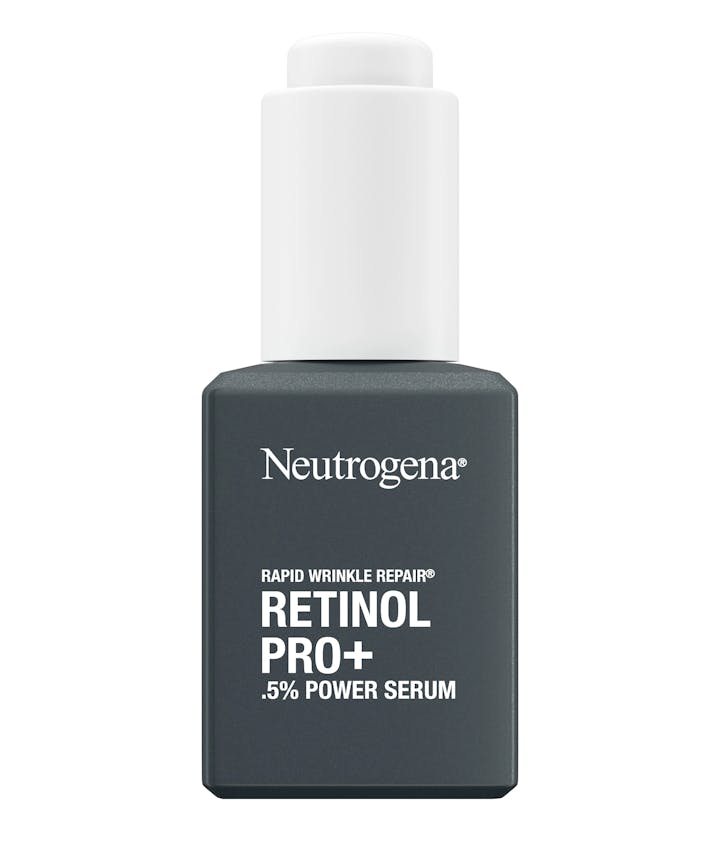

Neutrogena
Rapid Wrinkle Repair Retinol Pro+ .5% Power Serum

Rapid Wrinkle Repair Retinol Pro+ .5% Power Serum
Neutrogena
rapid-wrinkle-repair-retinol-pro-5-power-serum
Serum
9818407829797
Morning or Evening?
How often will you use this product?
Notes


Highlights
WHAT IS IT?
Retinol face serum with 0.5% pure retinol
FEATURES
Fast-absorbing, lightweight serum, improves skin firmness and elasticity, shows results in 1 week
BEST FOR
All skin type
CHECKS
Free of alcohol, sulfate, silicon, oil, paraben
Who Is It For?
Adults With Aging Skin ConcernsWhat Does It Help With?
Deep Wrinkles Stubborn Dark Spots Skin Firmness And ElasticityBudget
Mid-range ($30-$75)How To Use
Which routine should it be used in?
Instructions:
Key Information


What Neutrogena Says
Product Description:
Reduce the look of stubborn dark spots and deep wrinkles with Neutrogena Rapid Wrinkle Repair® Retinol Face Serum. This powerful anti-aging facial serum contains 0.5% pure retinol, a dermatologist-proven form of vitamin A, balanced with nourishing emollients to deliver potent retinol without irritation.
About the Brand:
Ingredients Overview
Ingredients List
Isohexadecane, Dicaprylyl-Carbonate, Pentaerythrityl-Tetraethylhexanoate, Ppg-15-Stearyl-Ether, Triethyl-Citrate, Polysorbate-20, Retinol, Fragrance, Tocopheryl-Acetate, Bisabolol, Bht, Pentaerythrityl-Tetra-Di-T-Butyl-Hydroxyhydrocinnamate
Key Ingredients
Retinol, Tocopheryl Acetate, Bisabolol
Ingredients Details
Bisabolol
Common Name(s): Alpha-bisabolol,levomenol,(-)-alpha-bisabolol
CAS Number: 515-69-5
DESCRIPTION
What It Does: Reduces skin inflammation, soothes irritation, promotes wound healing, and enhances penetration of co-formulated actives.
Why It's Used: Premium natural soothing active with combined anti-inflammatory, wound healing, and penetration-enhancing activity – clinically validated across sensitive, reactive, and irritated skin types.
How It Works: Inhibits nf-kb pathway reducing pro-inflammatory cytokines il-1β, il-6, tnf-α. enhances stratum corneum lipid fluidity increasing penetration of co-delivered actives. antimicrobial against s. aureus and c. albicans. promotes keratinocyte migration for wound healing.
Typically Found In: Sensitive skin products,post-procedure formulations,anti-irritant formulas,wound healing
TECHNICAL DETAILS
Primary Category: Active ingredient – soothing / anti-inflammatory
Secondary Functions: Anti-inflammatory,penetration enhancement,antimicrobial
Application Areas:

Facial Skincare
Body Care

Hair Care
Beard Care
Color Cosmetics (Makeup)
Dietary/Oral Supplements
Typical Concentration Range: 0.1%–1%
SOURCING & ETHICS
Vegan Status: Conditional - supplier confirmation required
Halal Status: Unverified - supplier confirmation required
Source Notes: Natural (-)-alpha-bisabolol from brazilian candeia tree is more sustainable and potent than chamomile-derived bisabolol. synthetic (±)-bisabolol is racemic with slightly lower anti-inflammatory potency. [audit 2026-07-29 rev2: status downgraded on audit. determination requires shariah-panel sign-off.]
SKIN COMPATIBILITY
Irritancy Rating: 1/5 – very low
Comedogenicity Rating: 0/5 – non-comedogenic
Sensitivity Concerns: Non-irritating; ideal for reactive and sensitive skin.
Safe for Sensitive Skin: Yes – particularly recommended for sensitive skin
SAFETY & COMPATIBILITY
Safety Profile: Excellent safety profile. ewg score: 1.
Works Well With: Ceramides,panthenol,allantoin,hyaluronic acid,centella asiatica
Avoid Combining With: No significant incompatibilities
SCIENTIFIC NOTE
Bisabolol's dual function as both an anti-inflammatory and a penetration enhancer is synergistic – by reducing the inflammatory response that increases barrier tightness while simultaneously fluidizing stratum corneum lipids, it provides enhanced delivery of co-formulated actives in the very conditions where delivery is most needed.
Last Verified: 2026-03-12
Primary Sources: Cosing database,piazza et al. bisabolol anti-inflammatory study,cir safety assessment
Dicaprylyl Carbonate
Common Name(s): Dicaprylyl carbonate,cosmetic active,functional ingredient
CAS Number: N/a
DESCRIPTION
What It Does: Delivers characteristic cosmetic function at recommended use concentration.
Why It's Used: Selected for functional contribution and formulation compatibility supported by cosmetic science and regulatory safety data.
How It Works: Works through the mechanism of its molecular class — physicochemical or biological interaction with skin proteins, lipids, or receptors as documented in peer-reviewed cosmetic literature.
Typically Found In: Skin care formulations
TECHNICAL DETAILS
Primary Category: Active ingredient – cosmetic active
Secondary Functions: Skin conditioning
Application Areas:
Facial Skincare
Body Care
Hair Care
Beard Care
Color Cosmetics (Makeup)
Dietary/Oral Supplements
Typical Concentration Range: 0.1%–10%
SOURCING & ETHICS
Vegan Status: Conditional - supplier confirmation required
Halal Status: Unverified - supplier confirmation required
Source Notes: Commercially produced for cosmetic use. verify vegan/halal status with supplier. [audit 2026-07-29 rev2: the record's own source_notes does not assert a non-animal origin, or instructs the reader to verify with the supplier; "yes" asserts knowledge the record does not hold. determination requires shariah-panel sign-off.]
SKIN COMPATIBILITY
Irritancy Rating: 1/5 – very low
Comedogenicity Rating: 0/5 – non-comedogenic
Sensitivity Concerns: Well-tolerated by most skin types.
Safe for Sensitive Skin: Yes
SAFETY & COMPATIBILITY
Safety Profile: Good safety profile at recommended concentrations. ewg score: 1–2.
Works Well With: Standard skincare actives
Avoid Combining With: No known significant incompatibilities
SCIENTIFIC NOTE
Dicaprylyl carbonate has an established safety and efficacy profile within the cosmetic regulatory framework at standard use concentrations.
Last Verified: 2026-03-12
Primary Sources: Cosing database,dicaprylyl carbonate technical literature
Fragrance
Common Name(s): Fragrance ingredient,eu allergen or aromatic component,olfactory/flavour
CAS Number: N/a
DESCRIPTION
What It Does: Provides the complete fragrance profile contributing to product sensory experience and consumer appeal.
Why It's Used: Fragrance is a major consumer purchase driver — up to 70% of consumers make purchasing decisions partially based on product scent.
How It Works: Fragrance blends interact with olfactory receptors providing the sensory profile — complex mixtures activate multiple receptor types for rich, multidimensional scent experiences.
Typically Found In: All fragrance products
TECHNICAL DETAILS
Primary Category: Active ingredient – cosmetic active
Secondary Functions: Skin conditioning
Application Areas:
Facial Skincare
Body Care
Hair Care
Beard Care
Color Cosmetics (Makeup)
Dietary/Oral Supplements
Typical Concentration Range: Standard use levels
SOURCING & ETHICS
Vegan Status: Conditional - supplier confirmation required
Halal Status: Unverified - supplier confirmation required
Source Notes: Commercially produced for cosmetic use. verify vegan/halal status with supplier. [audit 2026-07-29 rev2: the record's own source_notes does not assert a non-animal origin, or instructs the reader to verify with the supplier; "yes" asserts knowledge the record does not hold. determination requires shariah-panel sign-off.]
SKIN COMPATIBILITY
Irritancy Rating: 1/5 – very low
Comedogenicity Rating: 0/5 – non-comedogenic
Sensitivity Concerns: Well-tolerated by most skin types.
Safe for Sensitive Skin: Yes
SAFETY & COMPATIBILITY
Safety Profile: Good safety profile at recommended concentrations. ewg score: 1–2.
Works Well With: Standard skincare actives
Avoid Combining With: No known significant incompatibilities
SCIENTIFIC NOTE
Ifra guidelines set usage limits for fragrance ingredients based on skin sensitisation and phototoxicity assessment for each application category.
Last Verified: 2026-03-12
Primary Sources: Eu regulation 1223/2009 annex iii,ifra standards,fragrance allergen declaration requirements
Isohexadecane
Common Name(s): Permethyl 101a,c16 isoparaffin
DESCRIPTION
What It Does: Provides ultra-lightweight dry-touch emolliency with excellent pigment dispersion for lightweight formulations.
Why It's Used: Premium lightweight emollient for dry-touch formulations — isohexadecane's highly branched structure provides the lightest, driest application feel of common cosmetic hydrocarbons.
How It Works: Highly branched c16 isoparaffin provides very low surface tension for fast spreading. completely non-polar structure provides no water retention (dry feel). excellent pigment wetting for colour cosmetics. very low viscosity (2.5 cst) for fluid application.
Typically Found In: Lightweight foundations,sunscreens,colour cosmetics,dry-touch products
TECHNICAL DETAILS
Primary Category: Functional ingredient – branched hydrocarbon emollient
Secondary Functions: Barrier sealing,softening
Application Areas:
Facial Skincare
Body Care
Hair Care
Beard Care
Color Cosmetics (Makeup)
Dietary/Oral Supplements
Typical Concentration Range: 1%–30%
SOURCING & ETHICS
Vegan Status: Conditional - supplier confirmation required
Halal Status: Unverified - supplier confirmation required
Source Notes: Plant-derived, synthetic or animal-derived. verify source. [audit 2026-07-29 rev2: the record's own source_notes does not assert a non-animal origin, or instructs the reader to verify with the supplier; "yes" asserts knowledge the record does not hold. determination requires shariah-panel sign-off.]
SKIN COMPATIBILITY
Irritancy Rating: 1/5 – very low
Comedogenicity Rating: 0/5 – non-comedogenic
Sensitivity Concerns: Non-irritating.
Safe for Sensitive Skin: Yes
SAFETY & COMPATIBILITY
Safety Profile: Excellent safety profile. ewg score: 1.
Works Well With: Humectants,ceramides,actives as carrier
Avoid Combining With: No significant incompatibilities
SCIENTIFIC NOTE
Isohexadecane's highly branched structure (methyl-substituted hexadecane) prevents the close molecular packing that creates liquid crystalline phases in linear hydrocarbons, resulting in a permanently disordered liquid state with very low viscosity and surface tension. this structural disorder from branching is the molecular basis for the lighter, faster-spreading application feel vs equivalent linear hydrocarbons.
Last Verified: 2026-03-12
Primary Sources: Cosing database,cir safety assessment