

RAS Luxury Oils
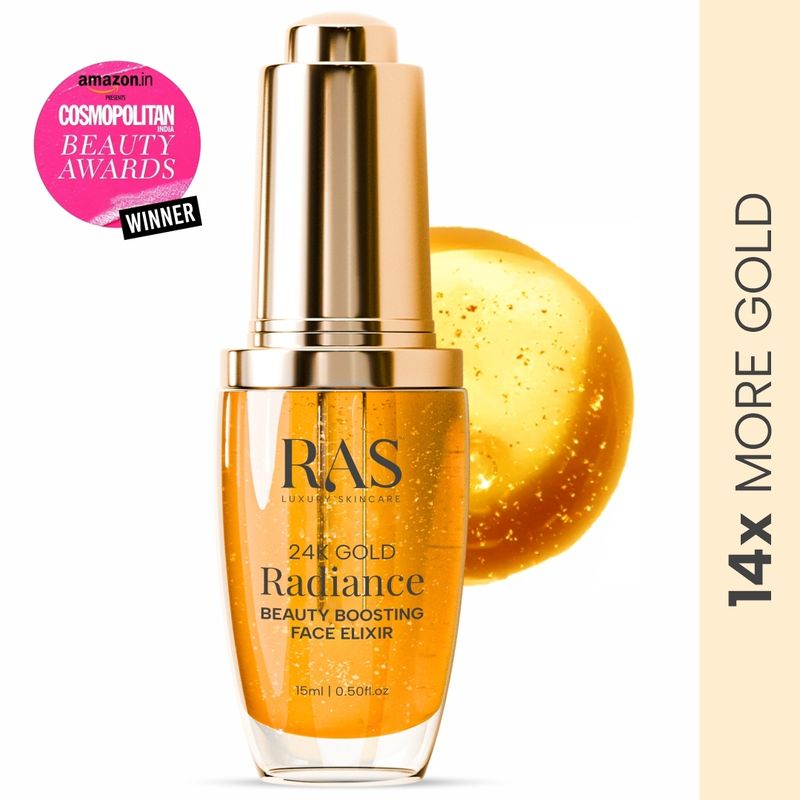
RAS Luxury Oils 24K Gold Radiance Beauty Boosting Face Elixir Serum For Glowing Skin

RAS Luxury Oils 24K Gold Radiance Beauty Boosting Face Elixir Serum For Glowing Skin
RAS Luxury Oils
ras-luxury-oils-24k-gold-radiance-beauty-boosting-face-elixir-serum-for-glowing-skin
Serum
10084952342821
Morning or Evening?
How often will you use this product?
Notes


Highlights
WHAT IS IT?
Face Elixir with 14 key ingredients
FEATURES
Contains 24k gold flakes, lightweight non-greasy texture, deeply hydrating, suitable for use under makeup, clinical grade pure essential oils, natural botanical oils and extracts.
BEST FOR
dry
CHECKS
No parabens, no sulfates, no silicones (implied by product claims and tags)
Who Is It For?
Adults All GendersWhat Does It Help With?
Hydration Radiance Glowing Skin Skin Nourishment Anti-aging BenefitsBudget
Premium ($76-$150)How To Use
Which routine should it be used in?
Instructions:
Key Information


What RAS Luxury Oils Says
Product Description:
Silky, lightweight face elixir with 24k gold flakes that dissolve into the skin for a subtle natural glow. Deeply hydrates and works great under makeup. Contains Rosa Canina (Rosehip) Fruit Oil, Corylus Avellana (Hazelnut) Seed Oil, Simmondsia Chinensis (Jojoba) Seed Oil, Squalane (Olive), Punica Granatum (Pomegranate) Seed Oil, Calendula Officinalis (Calendula) Flower Extract, Crocus Sativus (Saffron) Extract, Rosa Damascena (Rose) Flower Oil, Boswellia Carterii (Frankincense) Oil, Santalum Album (Sandalwood) Oil, Lavandula Angustifolia (Lavender) Flower Oil, clinical grade pure essential oil blend and 24k gold.
About the Brand:
Ingredients Overview
Ingredients List
Rosa-Canina-(Rosehip)-Fruit-Oil,Corylus-Avellana-(Hazelnut)-Seed-Oil,Simmondsia-Chinensis-(Jojoba)-Seed-Oil,Squalane-(Olive),Punica-Granatum-(Pomegranate)-Seed-Oil,Calendula-Officinalis-(Calendula)-Flower-Extract,Crocus-Sativus-(Saffron)-Extract,Rosa-Damascena-(Rose)-Flower-Oil,Boswellia-Carterii-(Frankincense)-Oil,Santalum-Album-(Sandalwood)-Oil,Lavandula-Angustifolia-(Lavender)-Flower-Oil,Aroma,24k-Gold,Citronellol,Citral,Eugenol,Geraniol,Linalool,Limonene,Farnesol
Key Ingredients
Rosa Canina (Rosehip) Fruit Oil, Corylus Avellana (Hazelnut) Seed Oil, Simmondsia Chinensis (Jojoba) Seed Oil, Squalane(Olive), 24k Gold
Ingredients Details
Aroma
Common Name(s): Aroma
DESCRIPTION
What It Does: Delivers targeted skin-conditioning or bioactive benefits through a specific mechanism of action suited to the formulation's intended purpose.
Why It's Used: Specialty actives address specific skin concerns through targeted molecular mechanisms, providing efficacy beyond what base formulation ingredients alone can achieve.
How It Works: The bioactive compound interacts with specific molecular targets in skin cells or the extracellular matrix — enzymes, receptors, structural proteins, or signaling molecules — triggering beneficial biological responses.
Typically Found In: Serums,treatments,moisturizers,specialty products
TECHNICAL DETAILS
Primary Category: Specialty actives
Secondary Functions: Skin-conditioning,anti-aging
Application Areas:

Facial Skincare

Body Care
Hair Care
Beard Care
Color Cosmetics (Makeup)
Dietary/Oral Supplements
Typical Concentration Range: 0.01–5%
SOURCING & ETHICS
Vegan Status: Conditional - supplier confirmation required
Halal Status: Unverified - supplier confirmation required
Source Notes: Specialty active ingredient; check individual sourcing for vegan status. [audit 2026-07-29 rev2: the record's own source_notes does not assert a non-animal origin, or instructs the reader to verify with the supplier; "yes" asserts knowledge the record does not hold. determination requires shariah-panel sign-off.]
SKIN COMPATIBILITY
Irritancy Rating: 1
Comedogenicity Rating: 0
Sensitivity Concerns: Low sensitization potential at recommended use concentrations.
Safe for Sensitive Skin: Yes
SAFETY & COMPATIBILITY
Safety Profile: Well-characterized cosmetic ingredient with established safety profile. generally non-irritating at typical use concentrations. suitable for leave-on and rinse-off cosmetics.
Works Well With: Niacinamide,hyaluronic acid,vitamin c,peptides
Avoid Combining With: Incompatible with oxidizing agents; check ph stability
SCIENTIFIC NOTE
Specialty actives typically work through enzyme inhibition (e.g., tyrosinase inhibition for brightening, mmp inhibition for anti-aging), receptor activation (e.g., retinoid receptors, ppar-γ for barrier genes), or transcription factor modulation (e.g., nrf2 for antioxidant gene upregulation). structure-activity relationships determine potency and selectivity.
Last Verified: 2025-01-15
Primary Sources: Cosing eu database; pcpc cosmetic ingredient safety reviews; ingredient-specific safety and efficacy literature
Citral
Common Name(s): 3,7-dimethyl-2,6-octadienal,geranial+neral mix
CAS Number: 5392-40-5
DESCRIPTION
What It Does: Provides the defining intense lemon-citrus fragrance note.
Why It's Used: The lemon scent compound – citral defines the fresh lemon scent in lemon essential oil and lemongrass with potent antimicrobial activity.
How It Works: Mixture of e-isomer (geranial) and z-isomer (neral). antimicrobial via michael addition to thiol enzymes. inhibits nf-kb for anti-inflammatory activity. antioxidant via allylic aldehyde.
Typically Found In: Citrus fragrances,antibacterial products,lemon-scented cosmetics
TECHNICAL DETAILS
Primary Category: Fragrance component – lemon aldehyde
Secondary Functions: Skin conditioning
Application Areas:
Facial Skincare
Body Care
Hair Care
Beard Care
Color Cosmetics (Makeup)
Dietary/Oral Supplements
Typical Concentration Range: 0.001%–0.5%
SOURCING & ETHICS
Vegan Status: Conditional - supplier confirmation required
Halal Status: Unverified - supplier confirmation required
Source Notes: Commercially produced for cosmetic use. verify vegan/halal status with supplier. [audit 2026-07-29 rev2: the record's own source_notes does not assert a non-animal origin, or instructs the reader to verify with the supplier; "yes" asserts knowledge the record does not hold. determination requires shariah-panel sign-off.]
SKIN COMPATIBILITY
Irritancy Rating: 1/5 – very low
Comedogenicity Rating: 0/5 – non-comedogenic
Sensitivity Concerns: Well-tolerated by most skin types.
Safe for Sensitive Skin: Yes
SAFETY & COMPATIBILITY
Safety Profile: Eu cosmetics regulation: declared fragrance allergen. high sensitisation potential from alpha,beta-unsaturated aldehyde structure. ifra strict limits.
Works Well With: Standard skincare actives
Avoid Combining With: No known significant incompatibilities
SCIENTIFIC NOTE
Citral's high sensitisation potential (llna ec3 ~0.11%) is a consequence of its alpha,beta-unsaturated aldehyde structure providing a highly reactive michael acceptor for skin protein covalent binding. the e/z mixture (geranial/neral) in natural citral means both isomers contribute to the sensitisation burden – explaining why lemongrass oil (very high citral content, ~60-80%) is one of the more common essential oil allergens.
Last Verified: 2026-03-12
Primary Sources: Cosing database,ifra standards
Citronellol
Common Name(s): (r)-3,7-dimethyl-6-octen-1-ol,rhodinol
CAS Number: 106-22-9
DESCRIPTION
What It Does: Provides soft, lasting rose-floral fragrance note.
Why It's Used: Essential rose fragrance monoterpene for lasting smooth floral notes in high-quality perfumery and cosmetic fragrances.
How It Works: Allylic alcohol monoterpene provides fixative property in fragrance blends. good skin substantivity for lasting scent. softer, rounder rose note vs geraniol's fresher character. natural in rose otto at 18-34%.
Typically Found In: Rose perfumes,floral fragrances,luxury skincare
TECHNICAL DETAILS
Primary Category: Fragrance component – monoterpene alcohol
Secondary Functions: Skin conditioning
Application Areas:
Facial Skincare
Body Care
Hair Care
Beard Care
Color Cosmetics (Makeup)
Dietary/Oral Supplements
Typical Concentration Range: 0.001%–1%
SOURCING & ETHICS
Vegan Status: Conditional - supplier confirmation required
Halal Status: Unverified - supplier confirmation required
Source Notes: Commercially produced for cosmetic use. verify vegan/halal status with supplier. [audit 2026-07-29 rev2: the record's own source_notes does not assert a non-animal origin, or instructs the reader to verify with the supplier; "yes" asserts knowledge the record does not hold. determination requires shariah-panel sign-off.]
SKIN COMPATIBILITY
Irritancy Rating: 1/5 – very low
Comedogenicity Rating: 0/5 – non-comedogenic
Sensitivity Concerns: Well-tolerated by most skin types.
Safe for Sensitive Skin: Yes
SAFETY & COMPATIBILITY
Safety Profile: Eu cosmetics regulation: declared fragrance allergen. ifra guidelines apply.
Works Well With: Standard skincare actives
Avoid Combining With: No known significant incompatibilities
SCIENTIFIC NOTE
Citronellol's r-enantiomer (natural) vs s-enantiomer (synthetic) provide meaningfully different scent character – a remarkable demonstration of chiral scent discrimination by olfactory receptors. the (r) form provides the characteristic rose note while the (s) form has a distinctly different, less pleasant character. this enantiomeric scent difference means that the biological handedness of naturally-sourced vs racemic synthetic citronellol produces perceptibly different fragrance quality.
Last Verified: 2026-03-12
Primary Sources: Cosing database,ifra standards
Eugenol
Common Name(s): 4-allyl-2-methoxyphenol,clove oil component,caryophyllene companion
CAS Number: 97-53-0
DESCRIPTION
What It Does: Provides warm clove fragrance note with local anaesthetic and antimicrobial properties.
Why It's Used: Natural local anaesthetic fragrance – eugenol provides clove's dual function as both a fragrance compound and a topical anaesthetic used in dentistry for pain relief.
How It Works: Activates trpv1 for local anaesthetic desensitisation (same mechanism as capsaicin but much weaker). inhibits cox and lox for anti-inflammatory activity. membrane disruption for antimicrobial activity. antioxidant via phenolic radical scavenging.
Typically Found In: Spice fragrances,dental products,clove-scented cosmetics
TECHNICAL DETAILS
Primary Category: Fragrance component – phenylpropanoid
Secondary Functions: Skin conditioning
Application Areas:
Facial Skincare
Body Care
Hair Care
Beard Care
Color Cosmetics (Makeup)
Dietary/Oral Supplements
Typical Concentration Range: 0.001%–0.5%
SOURCING & ETHICS
Vegan Status: Conditional - supplier confirmation required
Halal Status: Unverified - supplier confirmation required
Source Notes: Commercially produced for cosmetic use. verify vegan/halal status with supplier. [audit 2026-07-29 rev2: the record's own source_notes does not assert a non-animal origin, or instructs the reader to verify with the supplier; "yes" asserts knowledge the record does not hold. determination requires shariah-panel sign-off.]
SKIN COMPATIBILITY
Irritancy Rating: 1/5 – very low
Comedogenicity Rating: 0/5 – non-comedogenic
Sensitivity Concerns: Well-tolerated by most skin types.
Safe for Sensitive Skin: Yes
SAFETY & COMPATIBILITY
Safety Profile: Eu cosmetics regulation: declared fragrance allergen. ifra guidelines apply. sensitiser at high concentrations.
Works Well With: Standard skincare actives
Avoid Combining With: No known significant incompatibilities
SCIENTIFIC NOTE
Eugenol's dental anaesthetic use predates modern pharmaceutical dentistry – oil of cloves (primarily eugenol) has been used for toothache relief for centuries. modern dentistry still uses eugenol in zinc oxide-eugenol cement for temporary cavity filling, where eugenol's trpv1 desensitisation provides pain relief while zinc oxide provides structural material – a pharmaceutical application of a fragrance compound still standard in clinical dentistry.
Last Verified: 2026-03-12
Primary Sources: Cosing database,ifra standards,eugenol dental review