

Recode
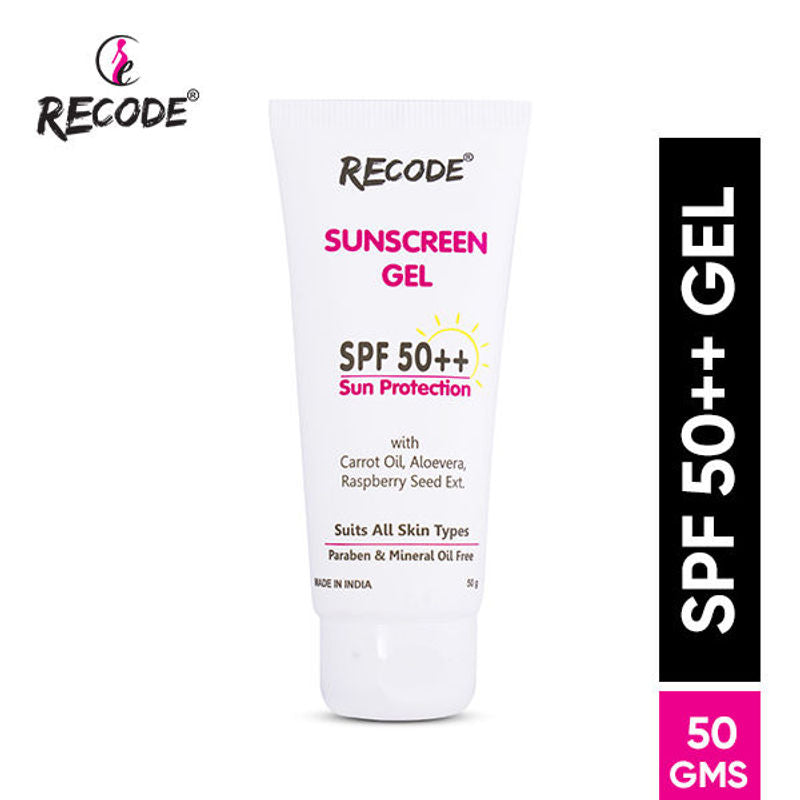
Recode SPF 50++ Gel In Tube

Recode SPF 50++ Gel In Tube
Recode
recode-spf-50-gel-in-tube
Suncare
10084925145381
Morning or Evening?
How often will you use this product?
Notes


Highlights
WHAT IS IT?
Sun protection gel with multiple active ingredients including Aloe vera and oils
FEATURES
Provides SPF 50 UVA and UVB protection, suitable for face and body, includes natural extracts like Aloe vera, Raspberry Seed Oil, and Carrot Oil, 100% authentic
BEST FOR
sensitive
CHECKS
Paraben-Free,Alcohol-free,Fragrance-free
Who Is It For?
Adults UnisexWhat Does It Help With?
Protection From Uva And Uvb Rays Prevention From SunburnBudget
Affordable (under $30)How To Use
Which routine should it be used in?
Instructions:
Key Information


What Recode Says
Product Description:
Recode Daily use SPF 50 Sun protection Gel is for face and body. It provides protection and prevention from burning effect of UVA and UVB rays. We are team Recode -A group of seasoned cosmetic experts passionate and committed to drive excellence in the beauty and personal care industry. We have been instrumental in combining quality with creativity in each product we offer to bring about a Universal Studio Arte in the Industry. Our association with the leading manufacturers from across the globe, majorly Germany and Taiwan, boosts our confidence further to promise a product quality which is beyond excellence. With 100% authentic products, we offer a well curated comprehensive selection of makeup, skincare, hair care, bath and body categories.
About the Brand:
Ingredients Overview
Ingredients List
Aqua,Benzophenone-4,Octocrylene,Octyl-Salicylate,Carbomer,Tinosorb-M, Titanium-Dioxide,Disodium-EDTA,Aloe-vera-Extract,Raspberry-Seed-Oil,Carrot-Oil,Octyl-Methoxy-Cinnamate,Phenoxy-Ethanol,Fragrance
Key Ingredients
Aloe vera Extract,Raspberry Seed Oil,Carrot Oil,Benzophenone-4,Octocrylene,Octyl Salicylate,Tinosorb M, Titanium Dioxide
Ingredients Details
Benzophenone-4
Common Name(s): Benzophenone-4
DESCRIPTION
What It Does: Absorbs or reflects uv radiation, preventing uv-induced dna damage, photo-oxidative stress, and premature skin aging.
Why It's Used: Uv filters are the active ingredients in sun protection — without them, formulations cannot make spf claims or prevent solar-induced skin damage.
How It Works: The uv-absorbing chromophore undergoes photoexcitation by uv photons, then dissipates the absorbed energy through thermal relaxation (chemical filters) or photon scattering/reflection (physical filters), preventing photon penetration to skin cells.
Typically Found In: Sunscreens,moisturizers with spf,foundations with spf
TECHNICAL DETAILS
Primary Category: Uv filters
Secondary Functions: Skin-protecting
Application Areas:

Facial Skincare

Body Care
Hair Care
Beard Care
Color Cosmetics (Makeup)
Dietary/Oral Supplements
Typical Concentration Range: 0.5–25% (within regulatory limits)
SOURCING & ETHICS
Vegan Status: Yes
Halal Status: Yes
Source Notes: Synthetic uv filter; no animal components.
SKIN COMPATIBILITY
Irritancy Rating: 1
Comedogenicity Rating: 0
Sensitivity Concerns: Contact allergy to uv filters occurs in approximately 1–3% of the general population; patch testing recommended for those with known photosensitivity.
Safe for Sensitive Skin: Yes
SAFETY & COMPATIBILITY
Safety Profile: Regulatory approval required per market (eu annex vi, fda otc monograph, etc.). generally non-irritating at approved concentrations.
Works Well With: Other uv filters,antioxidants,emollients
Avoid Combining With: Incompatible filter combinations (photodegradation); check regulatory approvals per region
SCIENTIFIC NOTE
Uv filters operate through two mechanisms: organic/chemical filters absorb uv photons through electronic excitation (π→π* transitions in conjugated systems), then dissipate energy via thermal relaxation; inorganic/physical filters (tio2, zno) scatter and reflect photons through mie scattering (particle size 50–300 nm) and band gap absorption. spf is measured in vivo (iso 24444) as the ratio of minimal erythema doses with and without sunscreen.
Last Verified: Cosing eu database; pcpc cosmetic ingredient safety reviews; eu cosmetics regulation annex vi; iso 24444 (in vivo spf testing)
Primary Sources: 2025-01-15
Carbomer
Common Name(s): Carbopol,polyacrylic acid,carboxyvinyl polymer
DESCRIPTION
What It Does: Provides transparent gel textures and thickening at very low concentrations via ph-responsive swelling.
Why It's Used: The most widely used gel thickener – provides crystal-clear, stable gels at concentrations as low as 0.1-0.5% with ph-controlled viscosity.
How It Works: Highly crosslinked polyacrylic acid remains tightly coiled at acidic ph. neutralization with naoh or triethanolamine ionizes carboxylic groups causing electrostatic repulsion that unfolds and swells the polymer coils, dramatically increasing viscosity. concentration-dependent thickening.
Typically Found In: Gels,serums,emulsions,sunscreens
TECHNICAL DETAILS
Primary Category: Functional ingredient – polyacrylic acid thickener
Secondary Functions: Skin conditioning
Application Areas:
Facial Skincare
Body Care
Hair Care
Beard Care
Color Cosmetics (Makeup)
Dietary/Oral Supplements
Typical Concentration Range: 0.1%–2%
SOURCING & ETHICS
Vegan Status: Yes – synthetic
Halal Status: Yes
Source Notes: Commercially produced for cosmetic use. verify vegan/halal status with supplier.
SKIN COMPATIBILITY
Irritancy Rating: 1/5 – very low
Comedogenicity Rating: 0/5 – non-comedogenic
Sensitivity Concerns: Well-tolerated by most skin types.
Safe for Sensitive Skin: Yes
SAFETY & COMPATIBILITY
Safety Profile: Good safety profile at recommended concentrations. ewg score: 1–2.
Works Well With: Standard skincare actives
Avoid Combining With: No known significant incompatibilities
SCIENTIFIC NOTE
Carbomer's ph-responsive swelling mechanism provides an elegant formulation control tool: a neutralized gel can be liquefied by ph reduction (adding acid) and re-thickened by reneutralization. this reversible rheology control allows two-phase products that mix on application without the need for mechanical emulsification.
Last Verified: Cosing database,cir safety assessment
Primary Sources: 2026-03-12
Fragrance
Common Name(s): Fragrance ingredient,eu allergen or aromatic component,olfactory/flavour
CAS Number: N/a
DESCRIPTION
What It Does: Provides the complete fragrance profile contributing to product sensory experience and consumer appeal.
Why It's Used: Fragrance is a major consumer purchase driver — up to 70% of consumers make purchasing decisions partially based on product scent.
How It Works: Fragrance blends interact with olfactory receptors providing the sensory profile — complex mixtures activate multiple receptor types for rich, multidimensional scent experiences.
Typically Found In: All fragrance products
TECHNICAL DETAILS
Primary Category: Active ingredient – cosmetic active
Secondary Functions: Skin conditioning
Application Areas:
Facial Skincare
Body Care
Hair Care
Beard Care
Color Cosmetics (Makeup)
Dietary/Oral Supplements
Typical Concentration Range: Standard use levels
SOURCING & ETHICS
Vegan Status: Conditional
Halal Status: Yes
Source Notes: Commercially produced for cosmetic use. verify vegan/halal status with supplier.
SKIN COMPATIBILITY
Irritancy Rating: 1/5 – very low
Comedogenicity Rating: 0/5 – non-comedogenic
Sensitivity Concerns: Well-tolerated by most skin types.
Safe for Sensitive Skin: Yes
SAFETY & COMPATIBILITY
Safety Profile: Good safety profile at recommended concentrations. ewg score: 1–2.
Works Well With: Standard skincare actives
Avoid Combining With: No known significant incompatibilities
SCIENTIFIC NOTE
Ifra guidelines set usage limits for fragrance ingredients based on skin sensitisation and phototoxicity assessment for each application category.
Last Verified: Eu regulation 1223/2009 annex iii,ifra standards,fragrance allergen declaration requirements
Primary Sources: 2026-03-12
Octocrylene
Common Name(s): 2-ethylhexyl 2-cyano-3,3-diphenylacrylate
CAS Number: 6197-30-4
DESCRIPTION
What It Does: Provides uvb-uva-ii uv protection and essential avobenzone photostabilisation.
Why It's Used: The essential combination partner — octocrylene's dual uv filter + avobenzone photostabilisation function makes it virtually irreplaceable for durable broad-spectrum chemical sunscreens requiring uva-i coverage.
How It Works: Cyanocinnamate chromophore absorbs uvb-uva-ii (λmax 303nm). triplet energy transfer from excited avobenzone to octocrylene photostabilises avobenzone (>90% efficiency at 3:1 avobenzone:octocrylene ratio). hydrophobic character enhances water resistance.
Typically Found In: Broad-spectrum sunscreens,avobenzone-containing formulas
TECHNICAL DETAILS
Primary Category: Active ingredient – uv filter and photostabiliser
Secondary Functions: Skin conditioning
Application Areas:
Facial Skincare
Body Care
Hair Care
Beard Care
Color Cosmetics (Makeup)
Dietary/Oral Supplements
Typical Concentration Range: Up to 10% (eu), 10% (us fda)
SOURCING & ETHICS
Vegan Status: Yes – synthetic
Halal Status: Yes
Source Notes: Commercially produced for cosmetic use. verify vegan/halal status with supplier.
SKIN COMPATIBILITY
Irritancy Rating: 1/5 – very low
Comedogenicity Rating: 0/5 – non-comedogenic
Sensitivity Concerns: Well-tolerated by most skin types.
Safe for Sensitive Skin: Yes
SAFETY & COMPATIBILITY
Safety Profile: Eu max 10%. fda: 10%. ewg score: 3. recent benzophenone impurity concerns from aged product hydrolysis under study.
Works Well With: Standard skincare actives
Avoid Combining With: No known significant incompatibilities
SCIENTIFIC NOTE
Octocrylene's triplet energy transfer photostabilisation of avobenzone operates via a dexter electron exchange mechanism: excited-state avobenzone (triplet) transfers excitation energy to octocrylene via orbital overlap, allowing avobenzone to return to its ground state uv-absorbing form without photodegradation. this energy transfer is only efficient at close molecular proximity — requiring intimate mixing of the two compounds in the formulation oil phase.
Last Verified: Cosing database,fda uv filter otc monograph,sccs octocrylene opinion
Primary Sources: 2026-03-12
